Window cleaning quote calculator
Build a window cleaning quote pane by pane: counts by type, your price for each type, a surcharge for extra storeys, and your minimum fee. Every price is your own, so the total matches how you price.
- Four pane types
- Storey surcharge
- Minimum fee floor
Before you run the numbers
One total, every pane type visible
A window cleaning quote is not one price. It is a count of panes, a price for each kind of pane, and the extra work that height and inside cleaning add. When those parts are bundled into a single figure, it is hard for the customer to see what they are paying for, and hard for you to check the quote later.
This calculator keeps the parts separate. Enter your counts and your own prices, and see the total build up line by line, with your minimum fee applied at the end if the job is small.
Your numbers
1. Count the panes and enter your price for each type
2. Storeys and your surcharge
The first storey is priced at your base pane prices. Your surcharge is applied once for each storey above the first.
3. Inside and out (optional)
4. Minimum call-out fee
If the pane total works out lower than this fee, the fee becomes the total and the result says so.
Result
Quote total
Enter your own prices on the left to see the total.
Short answer
A window cleaning quote calculator adds up your panes by type, standard, large, skylight, and conservatory, each at your own price per pane. It then applies your per storey surcharge, your inside and out multiplier if you clean both sides, and floors the total at your minimum call-out fee.
What the quote covers
What goes into a window cleaning quote?
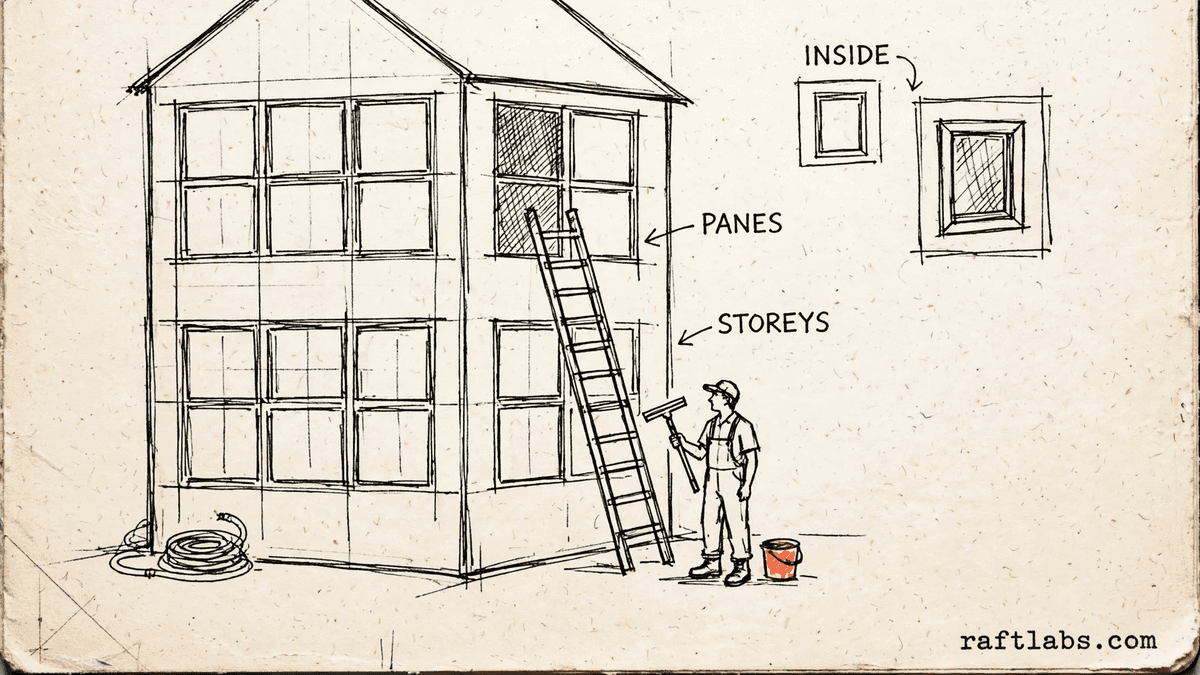
A window cleaning quote starts with the glass itself. Panes come in different sizes and positions, and each kind takes a different amount of time. This calculator groups them into four types: standard panes, large panes, skylights, and conservatory panes. You count each type and enter your own price per pane for it.
Height comes next. Panes on the first storey are reached quickly. Panes higher up take longer and may need longer poles or ladders, so the calculator adds your own surcharge percentage once for each storey above the first.
The last two parts are choices you set. If the customer wants both faces of the glass cleaned, the inside and out option applies your own multiplier. And if the whole job works out very small, your minimum call-out fee becomes the total, so a short visit is still priced as a visit.
| Quote part | What it covers | Who sets the price |
|---|---|---|
| Standard panes | Regular windows counted one by one, at your price per pane | You, from your own price list |
| Large panes | Bigger windows and glass panels that take longer per pane, at your price per pane | You, from your own price list |
| Skylight panes | Roof windows that need roof access or longer poles, at your price per pane | You, from your own price list |
| Conservatory panes | Conservatory glass panels, walls and roof sections, at your price per pane | You, from your own price list |
| Storey surcharge | Extra for each storey above the first, as your own percentage of the pane subtotal | You |
| Inside and out | Cleaning both faces of the glass, charged with your own multiplier when selected | You |
| Minimum call-out fee | The lowest total you will visit for, used when the pane total works out lower | You |
The math
How the total is worked out
First, each pane count is multiplied by your price for that type, and the four results are added into a subtotal. Then the storey factor is applied: one plus your surcharge percentage times the number of storeys above the first. If inside and out cleaning is selected, your multiplier is applied next. At the end, the total is compared with your minimum call-out fee, and the higher of the two is the quote.
Subtotal = (Standard x Price) + (Large x Price) + (Skylight x Price) + (Conservatory x Price)
Storey factor = 1 + (Surcharge % x (Storeys - 1))
Total = max(Subtotal x Storey factor x Inside/out multiplier, Minimum fee)
Example: 20 standard panes at an example price of $12 per pane comes to $240. Six large panes at an example price of $18 comes to $108. Two skylights at an example price of $25 comes to $50. Four conservatory panes at an example price of $15 comes to $60. The example subtotal is $458.
$240 + $108 + $50 + $60 = $458
The example building has 2 storeys and an example surcharge of 10% for each extra storey, so the storey factor is 1.10 and the subtotal becomes $503.80. Inside and out cleaning is selected with an example multiplier of 1.5, which brings the total to $755.70. An example minimum fee of $80 is below that total, so the quote stays at $755.70.
$458 x 1.10 = $503.80, then $503.80 x 1.5 = $755.70
Every figure in this example is a made-up input chosen to show the math. Your total will use the counts and prices you enter.
Getting it right
How to quote a window cleaning job accurately
The total is only as good as the count and the prices behind it. Four steps keep a quote accurate and free of surprises on the day.
- 01
Count every pane before you price
Walk the whole building and count the panes by type as you go: standard, large, skylight, and conservatory. Note the panes you cannot reach from the ground. A quote built on a guessed count will be wrong, however careful the pricing is.
- 02
Note the storeys and the access
Write down how many storeys the building has and how you will reach the top panes. Set your surcharge percentage for the extra storeys before you quote, so the same rule applies to every job and no quote depends on who priced it.
- 03
Decide what inside cleaning includes
Inside work means moving furniture, protecting floors and sills, and working room by room. Agree with the customer which rooms are included before you set your multiplier, and say plainly if tracks, frames, or screens are part of the job or not.
- 04
Set your minimum before you travel
A small job still takes travel and setup time. Fix the lowest fee you will visit for, enter it in the calculator, and let the tool apply it. That way a small quote never goes out below the amount the visit costs you to make.
Frequently asked questions
Straight answers to what buyers ask before they scope. Still stuck? .
- A window cleaning quote usually lists the panes by type, with a count and a price for each type. It then adds any charge for working at height, any extra for cleaning inside as well as outside, and a minimum call-out fee if the job is small. This calculator follows the same layout, and every price in it is one you enter yourself.
- Higher panes take longer to reach and may need longer poles or ladders, so many cleaners add a surcharge for each storey above the first. In this calculator the first storey is priced at your base pane prices. You enter your own surcharge percentage, and the tool applies it once for each extra storey.
- Outside only cleaning covers the outer face of the glass. Inside and out cleaning covers both faces, which means moving furniture, protecting floors, and working through the building room by room. Cleaners often charge for it with a multiplier on the outside price. Enter your own multiplier and turn the inside and out option on to apply it.
- A minimum call-out fee is the lowest amount a cleaner will charge for a visit, however small the job is. It covers the travel, the setup, and the time the visit takes out of the day. Enter your own minimum fee and the calculator will use it as the total whenever the pane total works out lower.
- Walk the building and count each pane of glass once, grouping them as you go: standard panes, large panes, skylights, and conservatory panes. Count a door panel with glass as a pane if you clean it as one. Write the counts down by type, because the quote is only as accurate as the count behind it.
- Yes. A company can enter its own price for each pane type, its own surcharge for extra storeys, its own inside and out multiplier, and its own minimum call-out fee. The result is an itemised quote the customer can read line by line, which makes the conversation about price much easier.
Stay on topic
More for window cleaning teams
The tools give you a range. A call gives you a number.
30-minute scoping call. We will walk through how your company handles quotes, rounds, and repeat visits today, and you leave with a clear plan for the software that runs it.