Snow removal contract cost calculator
Compare pay per push with one seasonal contract price, side by side: your properties, your prices, and your own push estimate for the season.
- Per push vs seasonal
- Your push estimate
- Extras priced separately
Before you run the numbers
Two ways to charge, shown side by side
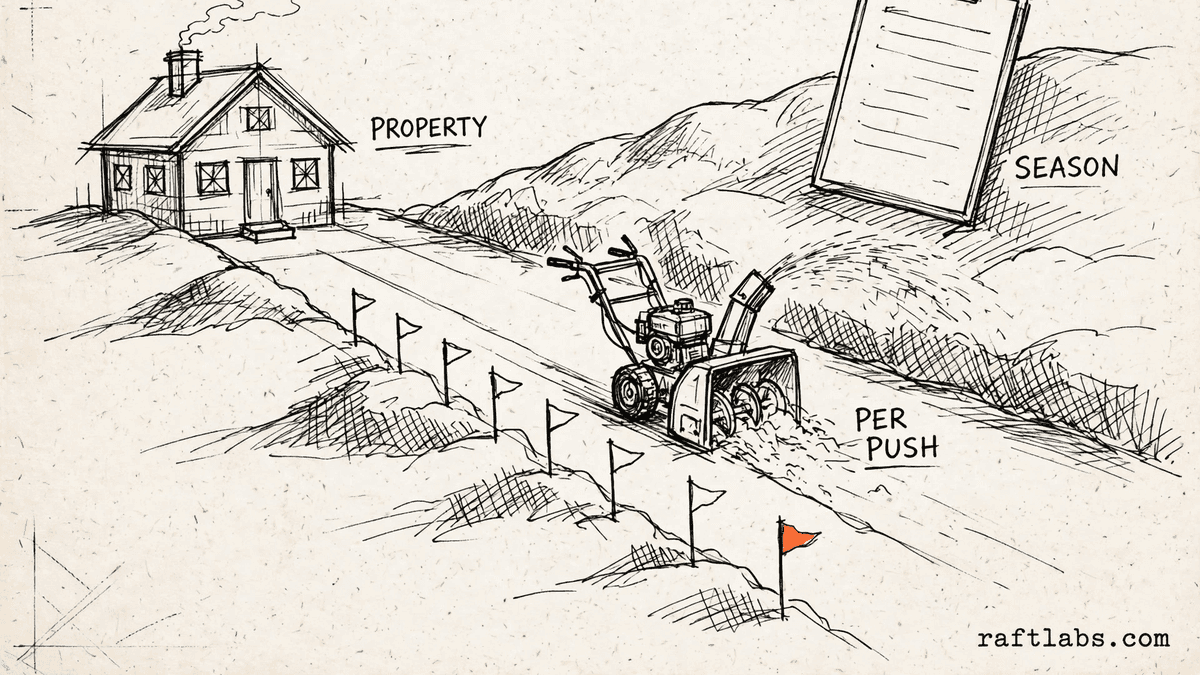
A snow removal season can be charged two ways. Under pay per push, every visit is charged on its own, so the season total depends on how many pushes the season needs. Under a seasonal contract, the client pays one fixed price for the season, whatever the push count turns out to be.
This calculator puts both figures in front of you at once. Enter your own prices and your own estimate of pushes for the season, and compare the two totals property by property.
Your numbers
1. Properties and per push price
The push count is your own estimate for the season ahead. Enter the figure from your own records and route terms.
2. Seasonal contract discount
3. Per visit extras
Result
Seasonal contract price
Enter your own prices on the left to see the total.
Short answer
A snow removal contract cost calculator compares two ways to charge for a season: paying per push at your price per property, and one seasonal contract price after your discount. It uses your property count, your push estimate, and your prices for extras such as salting and walkway clearing.
What the calculator covers
What goes into the cost of a snow removal contract?
The comparison rests on three figures you enter. The first is the property count: how many properties are cleared on each push. The second is your price per property per push. The third is your estimate of how many pushes the season will need. That estimate is yours alone, and the calculator does not replace it with any figure of its own.
From those three figures the calculator builds the pay per push season total. It then builds the seasonal contract price by applying your discount to that total. The gap between the two figures is the amount given up in return for one fixed season payment.
Extras sit outside that comparison. Salting and walkway clearing are each priced per property per visit, and each one is shown per visit and per season. Keeping extras on their own lines makes it clear what the base clearing costs and what each extra adds.
| Cost line | What it covers | Who sets the price |
|---|---|---|
| Pay per push | Each visit charged at your price per property, added up over the pushes you enter | You, through your price per property and push estimate |
| Seasonal contract | One season price, worked out from the pay per push total with your discount applied | You, through your seasonal contract discount |
| Salting | An extra charged per property per visit, when you include it | You, through your salting price per property per visit |
| Walkway clearing | An extra charged per property per visit, when you include it | You, through your walkway price per property per visit |
The math
How the two prices are worked out
The pay per push season total is properties multiplied by your price per property, multiplied by the pushes you enter. The seasonal contract price is that total multiplied by one minus your discount percentage. Each extra is properties multiplied by your price for that extra per visit, and the season figure for an extra is its per visit figure multiplied by the pushes.
Season total = Properties x Price per property x Pushes, and Contract price = Season total x (1 - Discount)
Example: an example of 20 properties, an example price of $50 per property per push, and an example estimate of 10 pushes for the season. The pay per push season total is 20 x $50 x 10 = $10,000. Per property, that is $50 per push and $500 for the season.
Example discount: an example discount of 10 percent gives a seasonal contract price of $10,000 x 0.90 = $9,000, which is $450 per property for the season. Example extras: salting at an example price of $15 per property per visit is $300 per visit and $3,000 per season, and walkway clearing at an example price of $10 per property per visit is $200 per visit and $2,000 per season.
$10,000 pay per push vs $9,000 seasonal contract, a difference of $1,000
Every figure in this example is a made-up input chosen to show the math. Your figures will use the prices and the push estimate you enter.
Getting it right
How to get an accurate contract comparison
The comparison is only as good as the estimate and the prices behind it. Four steps keep it honest.
- 01
Use your own push estimate
The push count drives every season figure in the result. Base it on your own route records and the terms you work to, such as the depth at which you go out. Run the calculator with a low and a high estimate as well, so you can see the range before you quote a fixed season price.
- 02
Price per property first
Set your price per property per push before you touch the discount. The seasonal contract price is built from the pay per push total, so a weak per push price carries straight into the contract figure, only lower.
- 03
Set the discount with care
The discount is the share you give up in return for one season payment. Check the per property season price after the discount, not just the headline total, so you can see what each property on the route is paying for the season.
- 04
Price extras as their own lines
Salting and walkway clearing take time and materials on every visit. Price each extra per property per visit and keep it on its own line, so a client can see what the extra costs and you are not absorbing it inside the main price.
Frequently asked questions
Straight answers to what buyers ask before they scope. Still stuck? .
- It compares the two common ways to charge for a season of snow clearing. One is pay per push, where each visit is charged at your price per property. The other is one seasonal contract price, worked out from the pay per push total with your discount applied. Both figures sit side by side so you can read them together.
- The season total is the number of properties multiplied by your price per property per push, multiplied by the number of pushes you enter for the season. Each push charges every property once, so the property count and the push count both matter. Every figure in that chain is one you enter.
- Start with the pay per push season total. Then apply your seasonal contract discount: the contract price is the season total multiplied by one minus the discount percentage. A discount of zero leaves the contract price equal to the pay per push total. The discount is your own figure, entered by you.
- Each extra is priced per property per visit. The per visit figure is the number of properties multiplied by your price for that extra. The per season figure is the per visit figure multiplied by the pushes you entered. Extras are shown on their own lines, separate from the main contract comparison, so you can include or leave out each one.
- You do. The push count is your own estimate for the season ahead, based on your route, your contracts, and your own records. The calculator does not supply a push count and does not base the figure on any place or weather pattern. Change the estimate and run it again to see how the season total moves.
- Yes. Enter your property count, your price per property per push, and your push estimate, then set your seasonal discount to see the contract price beside the pay per push total. Add your prices for salting or walkway clearing if you offer them. The result gives you per property figures you can put in front of a client.
Stay on topic
More for snow removal teams
The tools give you a range. A call gives you a number.
30-minute scoping call. We will walk through how your team handles routes, contracts, and per push billing today, and you leave with a clear plan for the software that runs it.