Refrigeration maintenance cost calculator
Compare a planned-visit contract against pay-as-you-go callouts for the same units, from your own rates. Both yearly totals, the difference, and the cost per unit per year, side by side.
- Contract vs pay-as-you-go
- Per unit per year
- Your rates only
Before you run the numbers
Two ways to pay for the same units
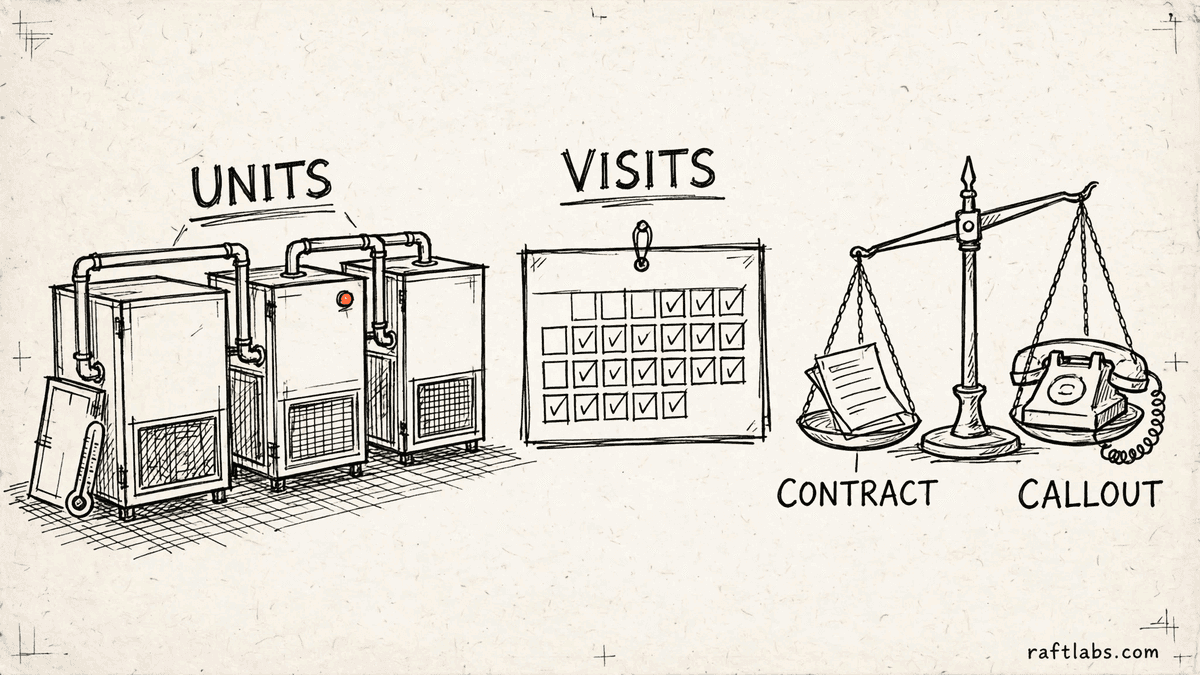
Refrigeration upkeep is usually bought one of two ways. A contract spreads the cost into planned visits at a set rate. Pay-as-you-go skips the visits and pays for each breakdown as it happens, at a callout fee plus the repair itself.
Which one costs less over a year depends on your rates and on how often your units actually break down. This calculator builds both sides from your own figures and puts them side by side, so the comparison is about your units and your prices, not a general rule.
Your numbers
1. Your units
Count every unit the comparison covers: cold rooms, cabinets, display cases, and cellar cooling, as your own list defines them.
2. The contract side: planned visits
Enter the per-visit rate from the contract you hold or the quote you were given. The calculator multiplies units by visits by that rate.
3. The pay-as-you-go side: breakdown callouts
Use your own service history for the callout count and the average repair bill. A year of invoices gives a better figure than a guess.
Result
Lower annual cost
Enter your own per-visit rate and callout figures on the left to see the comparison.
Short answer
A refrigeration maintenance cost calculator compares two ways of paying for the same units over a year. The contract side is units times planned visits per unit times your per-visit rate. The pay-as-you-go side is units times expected callouts times your callout fee plus average repair cost. It shows both totals and which is lower.
What the cost covers
What goes into a refrigeration maintenance cost?
On the contract side, the cost is planned work: a set number of visits to each unit each year, each visit charged at the per-visit rate. The yearly total is fixed once the rate and the visit count are set, which is why contracts are easy to budget.
On the pay-as-you-go side, the cost is unplanned work: each breakdown brings a callout fee, plus the labour and parts the repair needs. The yearly total depends on how many callouts the units raise, so it can swing from one year to the next.
This calculator holds the unit count the same on both sides and shows the two yearly totals, the difference between them, and each side as a cost per unit per year. Every figure is your own input.
| Cost part | What it covers | Who sets the price |
|---|---|---|
| Planned visits | Scheduled maintenance visits, priced as units times visits per unit per year times your per-visit rate | You, from your contract or quote |
| Callout fee | Your flat fee for attending a breakdown, charged once per callout before any repair work | You |
| Labour and parts per callout | Your average repair bill on top of the callout fee: the time on site plus the parts fitted | You, from your service history |
The math
How the comparison is worked out
Each side is one multiplication chain. The contract side multiplies units by visits by the per-visit rate. The pay-as-you-go side multiplies units by expected callouts by the full cost of one callout, which is the callout fee plus the average labour and parts. The difference is the gap between the two totals.
Contract cost per year = Units x Visits per unit per year x Per-visit rate
Pay-as-you-go cost per year = Units x Callouts per unit per year x (Callout fee + Average labour and parts)
Cost per unit per year = Annual cost / Units
Example, using example inputs only: an example 10 units. The contract side has an example 4 planned visits per unit per year at an example per-visit rate of $180. The pay-as-you-go side has an example 2 callouts per unit per year, an example callout fee of $95, and an example average labour and parts figure of $260 per callout.
Contract: 10 x 4 x $180 = $7,200 per year, which is $720 per unit per year. Pay-as-you-go: one callout costs $95 + $260 = $355, so 10 x 2 x $355 = $7,100 per year, which is $710 per unit per year. The difference is $100 per year, and on these example figures pay-as-you-go is the lower side by that $100.
Every figure in this example is a made-up input chosen to show the math. Your verdict will use the rates and callout history you enter.
Quoting well
Tips for a fair maintenance comparison
The comparison is only as honest as the figures behind it. Four habits keep it fair.
- 01
Build the callout side from real history
Count last year callouts per unit and average what they cost from your invoices. A guessed callout count can flip the verdict, because the pay-as-you-go total moves in direct proportion to it.
- 02
Compare per unit when the estate changes
Totals built on different unit counts cannot be compared fairly. When a site adds a cold room or drops a cabinet, rerun the comparison and read the per-unit lines, which stay comparable across counts.
- 03
State what a planned visit covers
A per-visit rate means little without the visit scope. Write down what each visit checks, cleans, and tests, so the contract side of the comparison is priced against a known amount of work.
- 04
Weigh the bad year, not just the average year
Pay-as-you-go is priced here on expected callouts. One compressor failure can cost more than a year of visits. Before choosing on cost alone, check what a single bad breakdown would do to the pay-as-you-go side.
Frequently asked questions
Straight answers to what buyers ask before they scope. Still stuck? .
- It compares the two common ways of paying for refrigeration upkeep over one year. One side is a maintenance contract: planned visits at a per-visit rate. The other side is pay-as-you-go: no planned visits, and each breakdown is paid as a callout fee plus the labour and parts for that repair. Both sides are built only from figures you enter.
- The contract side is the number of units times the planned visits per unit per year times your per-visit rate. If a contract quotes one yearly figure instead of a per-visit rate, divide that figure by the units and the visits to get the per-visit rate to enter. The calculator also shows the contract cost per unit per year.
- The pay-as-you-go side is the number of units times the callouts you expect per unit per year times the full cost of one callout. The full cost of one callout is your callout fee plus your average labour and parts for a repair. Your own service history is the best source for the callout count and the average repair figure.
- It puts both sides on the same footing when the unit count changes. A site that adds or removes units can compare the new quote against the old one per unit, instead of comparing two totals built on different counts. It also makes it easy to compare one site against another in the same estate.
- Not always. The calculator compares money only, on the figures you enter. A contract also buys planned checks, which can catch a failing part before it spoils stock, and it smooths spending across the year. Pay-as-you-go can leave a quiet year cheap and a bad year expensive. Use the cost verdict as the starting point, then weigh the risk each side leaves with you.
- Yes. Enter the customer unit count, the visits your contract would make, and your per-visit rate on one side. On the other side, enter the callouts those units actually raised last year and what those callouts cost. The two yearly totals and the per-unit figures give both sides a shared set of numbers to talk through.
Stay on topic
More for refrigeration service teams
The tools give you a range. A call gives you a number.
30-minute scoping call. We will walk through how your company handles contracts, planned visits, and callouts today, and you leave with a clear plan for the software that runs it.