Jet ski rental price calculator
Work out a jet ski rental price from your own rates: by the hour or by the half-day block, plus extras and fuel per craft. The damage deposit is shown on its own line, never added to the price.
- Hourly or half-day, cheaper wins
- Extras and fuel per craft
- Deposit kept separate
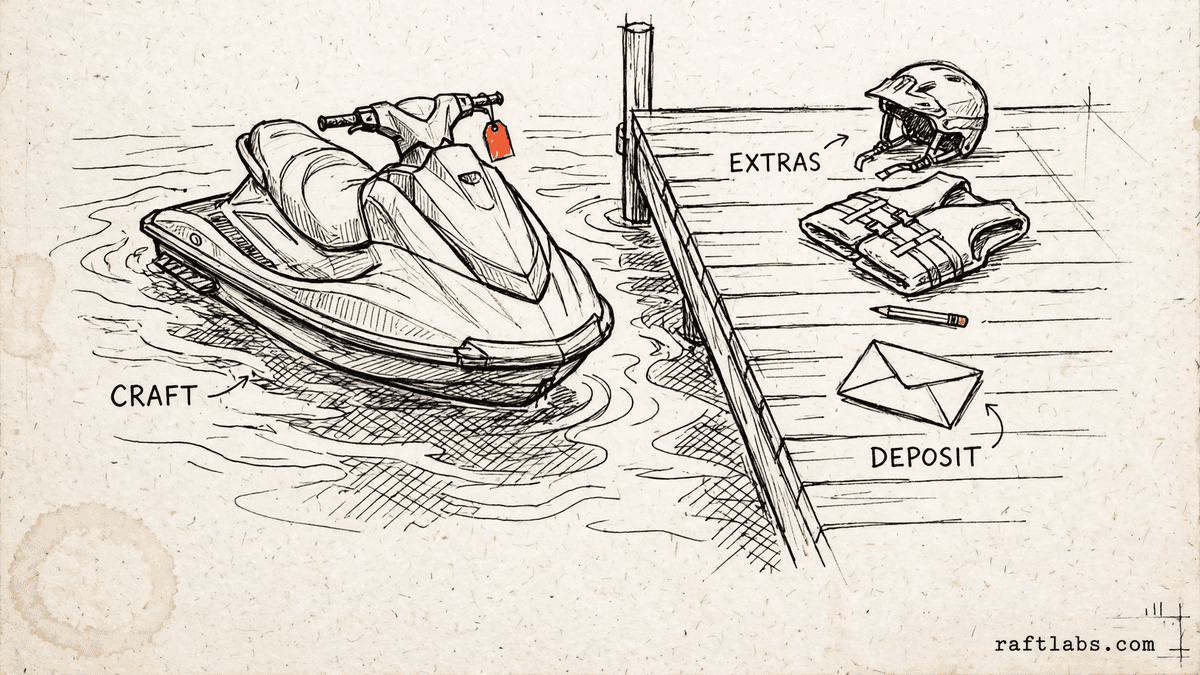
Before you run the numbers
One rental total, deposit kept separate
A jet ski rental price has two ways of counting the time: by the hour, or by the half-day block. Which one costs less depends on your rates and how long the rental lasts. On top of the time, a booking can add extras and a fuel amount for each craft.
This calculator works out both ways of counting the time with your own rates and uses the cheaper one. The damage deposit is shown on its own line, because it is money held, not money spent.
Your numbers
1. Your rates
How many hours your half-day block covers.
2. The booking
3. Extras per craft
4. Fuel and deposit
The deposit is money held while the craft is out. It is shown on its own line and never added to the rental total.
Result
Estimated rental total
Enter your own rates on the left to see the total.
Short answer
A jet ski rental price calculator compares paying by the hour against paying by the half-day block, using your own rates, then adds extras and fuel for each craft. It shows the rental total, the cost per craft, and the damage deposit held separately.
What the price covers
What goes into the price of a jet ski rental?
The price of a jet ski rental covers four kinds of cost. The first and largest is the time on the water. You pay either by the hour or by the half-day block, and the cheaper of the two for your rental length is the fair way to count it.
The second is extras: add-ons the renter chooses, such as a wetsuit, a tow tube, or extra rider gear. Each extra is priced per craft, so a booking with two craft pays for the extra twice. The third is a fuel surcharge, a flat amount per craft that some operators charge and others do not.
The fourth figure is the damage deposit. It is not part of the price at all. It is money held per craft while the craft is out and returned when the craft comes back undamaged. This calculator shows it on its own line and never adds it to the rental total.
| Cost part | What it covers | Who sets the price |
|---|---|---|
| The rate block | The cheaper of paying by the hour or paying by the half-day block, using your own rates | The rental operator |
| Extras | Optional add-ons per craft, such as a wetsuit, a tow tube, or extra rider gear | The rental operator |
| Fuel surcharge | A flat fuel amount per craft, if the operator charges one | The rental operator |
| Damage deposit | Money held per craft while the craft is out, shown separately and never added to the rental total | The rental operator |
The math
How the total is worked out
The calculator works out the time cost two ways for each craft. The hourly way is the rental hours times your hourly rate. The block way is the number of half-day blocks needed to cover the rental, rounded up, times your half-day rate. The cheaper of the two becomes the rate block.
Rental total = Cheaper rate block x Craft + Included extras x Craft + Fuel surcharge x Craft
Example, using example inputs only: an hourly rate of $80 and a half-day rate of $250 for a 4-hour block, a rental of 5 hours, and 2 craft. By the hour, 5 x $80 = $400 per craft. By the block, the rental needs 2 blocks to cover 5 hours, so 2 x $250 = $500 per craft. The hourly way wins at $400 per craft.
Add an example wetsuit at $15 per craft for 2 craft, which is $30, and an example fuel surcharge of $25 per craft for 2 craft, which is $50.
$400 x 2 + $30 + $50 = $880
The rental total is $880, and the cost per craft is $440. An example damage deposit of $500 per craft means $1,000 is held for the 2 craft. That $1,000 is not part of the $880. Every figure in this example is a made-up input chosen to show the math. Your total will use the rates you enter.
Getting it right
How to get an accurate jet ski rental quote
The total is only as good as the figures behind it. Four steps keep a quote accurate and clear for the renter.
- 01
Set your own rates first
Enter the hourly rate and half-day rate you actually charge, and set how many hours your half-day block covers. The calculator uses only your figures, so the comparison between the two ways of paying reflects your own price list.
- 02
Count the craft and the hours
Enter how many craft are going out and how many hours the rental lasts. The rate block is worked out per craft, then multiplied by the number of craft, so a group booking is priced the same way as a single craft booking.
- 03
Add only the extras the renter chose
Turn on an extra only when the renter asked for it, and enter your price per craft for it. Extras that stay off add nothing to the total, which keeps the quote honest about what is included and what is not.
- 04
Keep the deposit on its own line
Tell the renter the deposit amount before the booking is confirmed, and show it apart from the rental price. The calculator holds it on a separate line so nobody mistakes money held for money spent.
Frequently asked questions
Straight answers to what buyers ask before they scope. Still stuck? .
- The price starts with the time on the water. You either pay by the hour for the hours you rent, or you pay for half-day blocks that cover the rental length. The calculator works out both ways with your own rates and uses the cheaper one, then adds any extras and fuel for each craft.
- No. The damage deposit is money held while the craft is out, not money spent on the rental. The calculator shows the deposit on its own line and never adds it to the rental total, so you can see what the rental costs and what is only being held apart.
- A half-day block wins when the block price for the time you need is lower than the hourly rate times the same hours. For short rentals the hourly rate is often cheaper. For longer rentals that fill most of a block, the block can cost less. The calculator compares both and names the cheaper one.
- Extras are the add-ons a renter can choose, such as a wetsuit, a tow tube, or extra rider gear. Each extra has its own price per craft in this calculator. Turn on only the extras the renter wants, enter your price for each one, and the cost is added for every craft in the booking.
- Some operators charge a flat fuel amount per craft on top of the rental rate. Enter your own fuel surcharge per craft and the calculator adds it once for each craft in the booking. If you do not charge one, leave it at zero and no fuel line appears in the total.
- Yes. An operator can enter its own hourly rate, half-day rate, and half-day length, then add the craft count, extras, fuel, and deposit for a booking. The result is an itemised quote that shows the renter each line, with the deposit kept separate from the price.
Stay on topic
More for jet ski rental teams
The tools give you a range. A call gives you a number.
30-minute scoping call. We will walk through how your rental operation handles bookings, pricing, and deposits today, and you leave with a clear plan for the software that runs it.