Home inspection fee calculator
Build an inspection fee line by line: your base fee, a size charge above the limit you set, add-on tests, and travel. Every price is your own, so the total matches the quote in front of you.
- Base fee plus size charge
- Add-on tests priced apart
- Surcharge shown as a line
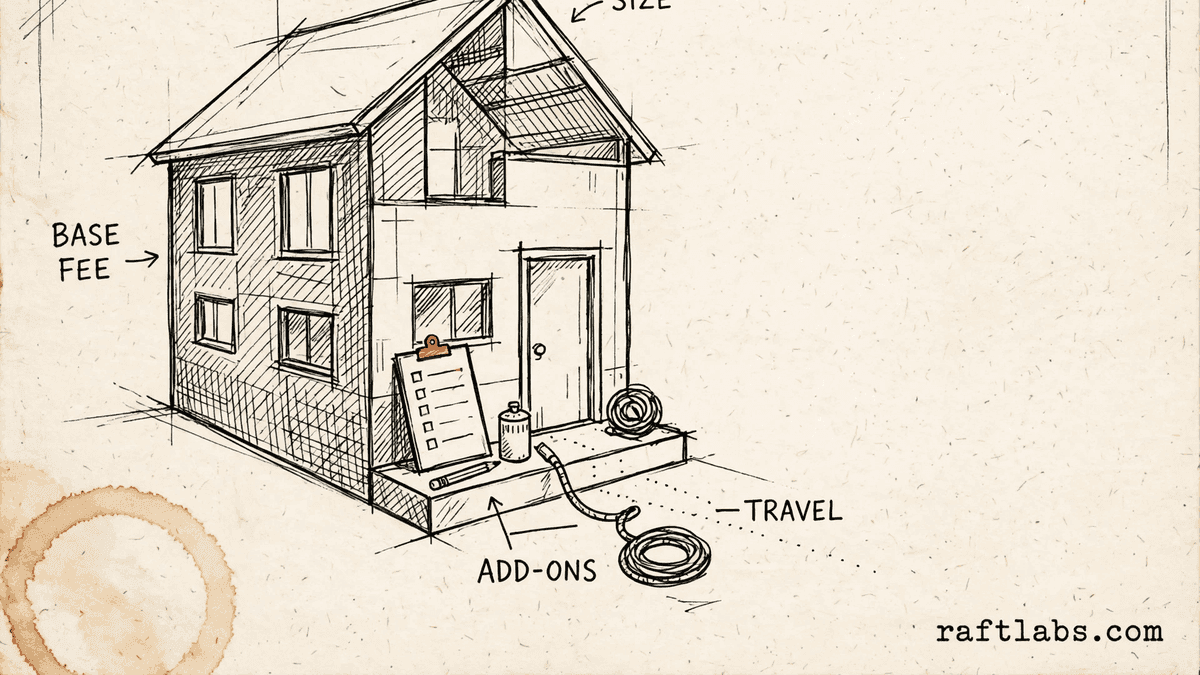
Before you run the numbers
One total, every line visible
An inspection fee is not one price. It is a short list of separate charges: a base fee, a charge for the size of the home, any extra tests the buyer asks for, and travel. When those lines are bundled into a single figure, it is hard to tell what you are paying for.
This calculator keeps the lines separate. Enter the prices your firm charges, add the size of the home, and see the total build up line by line.
Your numbers
1. Home size and base fee
2. Size charge above your limit
Only the floor area above your limit is charged at this rate. A home at or below the limit has no size charge.
3. Add-on tests
4. Older-home surcharge
5. Travel
Leave at zero if the home is inside the area your base fee already covers.
Result
Estimated total
Enter your own prices on the left to see the total.
Short answer
A home inspection fee calculator adds up the parts of an inspection quote: your base fee, a size charge for floor area above the limit you set, any add-on tests you include such as radon or a sewer scope, an older-home surcharge if you apply one, and travel.
What the price covers
What goes into the price of a home inspection?
The price of a home inspection covers five kinds of cost. The first is the base fee, which covers the inspection itself for a home up to the size limit the firm sets. The second is the size charge: floor area above that limit, charged at a price per square foot.
The third is add-on tests the buyer chooses, such as a radon test, a sewer scope, or a pool inspection. Each test takes extra time and equipment, so each one is priced on its own and only added when the buyer asks for it.
The fourth is an older-home surcharge. Older homes can take longer to check and write up, so some firms add a percentage on top of the base fee and size charge. The last cost is travel, for homes outside the area the firm normally covers. Every figure here is one you enter, because each firm sets its own prices.
| Cost part | What it covers | Who sets the price |
|---|---|---|
| Base fee | The inspection itself, up to the home size limit you set | The inspection firm |
| Size charge | Floor area above your size limit, charged at your price per square foot | The inspection firm |
| Add-on tests | Optional tests such as radon, a sewer scope, or a pool inspection | The inspection firm |
| Older-home surcharge | A percentage you add on the base fee and size charge for older homes | The inspection firm |
| Travel fee | Travel to a home outside the area you normally cover | The inspection firm |
The math
How the total is worked out
The size charge comes first. Take the home size, subtract the size limit you set, and charge only the part above the limit at your price per square foot. Add that to your base fee. If you apply an older-home surcharge, add that percentage on top of the two together. Then add each add-on test you included and the travel fee.
Size charge = max(0, Home size - Size limit) x Rate. Total = (Base fee + Size charge) with surcharge if applied + Add-ons + Travel
Example: a base fee with an example price of $350, for a home of 2,400 square feet. The example size limit is 1,500 square feet, so 900 square feet sit above the limit. At an example rate of $0.15 per square foot, the size charge is $135. The base fee and size charge together come to $485.
900 x $0.15 = $135. $350 + $135 = $485
An older-home surcharge with an example rate of 10% adds $48.50, taking the running total to $533.50. Add a radon test at an example price of $150 and a travel fee with an example price of $40, and the total fee is $723.50. Every figure in this example is a made-up input chosen to show the math. Your total will use the prices you enter.
$485 + $48.50 + $150 + $40 = $723.50
Getting it right
How to get an accurate inspection fee
The total is only as good as the figures behind it. Four steps keep a fee accurate and free of surprises later.
- 01
Confirm the home size first
The size charge depends on the floor area, so confirm the square feet before you quote. Use the listing figure or the county record, and check it with the seller if the two do not match. A wrong size gives a wrong fee.
- 02
Set your size limit and rate once
Decide the home size your base fee covers and the price per square foot above it. Use the same limit and rate on every quote, so two homes of the same size get the same fee and you can explain the charge the same way each time.
- 03
Price each add-on on its own
A radon test, a sewer scope, and a pool inspection each take different time and equipment. Price each one separately and only add the ones the buyer asks for, so nobody pays for a test they did not want.
- 04
Show the fee in writing, line by line
Send the quote with the base fee, the size charge, each add-on, any surcharge, and travel as separate lines. If a buyer asks why the fee is what it is, each line answers one part of that question.
Frequently asked questions
Straight answers to what buyers ask before they scope. Still stuck? .
- A home inspection fee covers the inspection itself, priced from the base fee and the size of the home. Add-on tests such as a radon test, a sewer scope, or a pool inspection are priced on top of that when you ask for them. Travel can be a separate line when the home is outside the area you normally cover. This calculator follows the same layout, and every price in it is one you enter yourself.
- Many inspectors charge a base fee up to a set home size, then add a small amount for each square foot above that size. You set both parts in this calculator: the size limit and your price per square foot above it. Only the area above your limit is charged at that rate, so a home at or below the limit has no size charge at all.
- Common add-ons are a radon test, a sewer scope, and a pool inspection. Each one takes extra time and extra equipment, so each one is priced on its own. Tick only the add-ons the buyer has asked for, enter your price for each one, and the calculator adds them as separate lines so the buyer can see what each test costs.
- Older homes often take longer to inspect. The systems are older, access can be harder, and there is more to check and write up. Some inspectors add a percentage on top of the base fee and size charge to cover that extra time. If you do, set the percentage yourself in the calculator and turn the surcharge on. The amount then shows as its own line.
- The inspection firm sets its own price for each add-on test. There is no single price that applies to every firm or every area. Enter the price your firm charges for each test you include, and leave out any test the buyer has not asked for.
- Yes. Enter your base fee, your size limit and rate, and your prices for the add-ons you offer. Then add the home size for the job in front of you, any older-home surcharge you apply, and your travel fee. The result is an itemised fee the buyer can read line by line before they book.
Stay on topic
More for inspection teams
The tools give you a range. A call gives you a number.
30-minute scoping call. We will walk through how your firm handles bookings, reports, and fee quotes today, and you leave with a clear plan for the software that runs it.