Fireworks display cost calculator
Add up a fireworks display from your own figures: product, crew, licensing, insurance, transport, site preparation, and cleanup, plus a contingency you set. See the total and the cost per minute of show.
- Itemised display lines
- Contingency shown separately
- Cost per minute
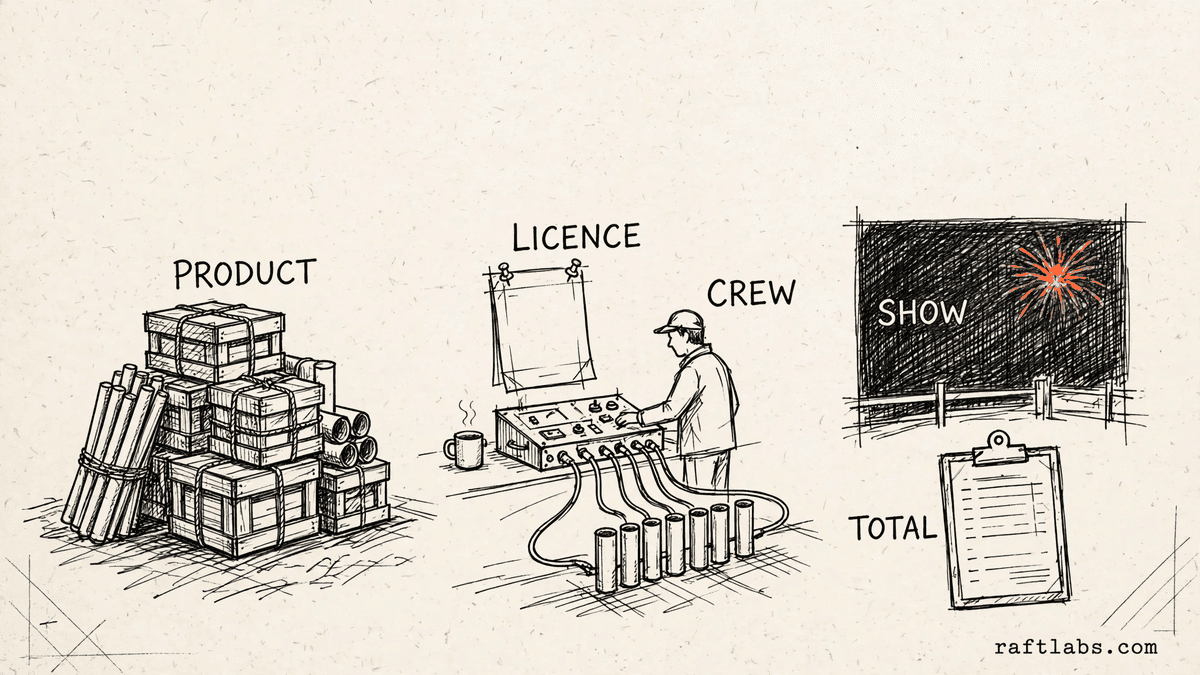
Before you run the numbers
Every line priced from your own figures
A display total is made of the product, the crew, and a set of fees and site costs that change from one event to the next. A single lump sum hides which part moved when a quote changes.
This calculator keeps those parts separate. You enter your own cost or fee for each one, set your own contingency percentage, and the result shows the itemised total plus the cost per minute of show.
Your numbers
1. Product and crew
2. Fees, transport, and site work
3. Contingency and show length
Every cost and fee here starts at zero, and the contingency percent starts at zero too. Enter the figures from your own quotes and rate cards. The calculator supplies no prices of its own.
Result
Total display cost
Enter your own costs and fees on the left to see the total.
Short answer
A fireworks display cost calculator adds up the full cost of a display from your own figures. It totals the product cost, crew cost from your crew count, day rate, and days, licensing and permit fees, insurance, transport, site preparation, and cleanup, then adds your contingency percentage and shows the cost per minute of show.
What the cost covers
What goes into a fireworks display cost?
The starting point is the product: the fireworks fired in the display, priced as one cost for this show. Around it sits the crew, paid per person per day for setup and show days.
Then come the event costs: licensing and permit fees, insurance, transport, site preparation, and cleanup. Each one is set per event, and each one is a figure you enter from your own quotes and rate cards.
Last is contingency. It is not a cost that has happened. It is a share of the subtotal, at a percentage you choose, held for costs that move. The calculator shows it as its own line so it never hides inside the other figures.
| Cost part | What it covers | Who sets the price |
|---|---|---|
| Product | The fireworks used in the display, priced as one cost for this show | You, from your own product costs |
| Crew | The crew who set up and fire the show, priced per person per day at your day rate | You |
| Licensing and permits | The licence and permit fees for this display at this site, entered as one fee line | You, from your own quotes |
| Insurance | The insurance cover for the display, entered as its own fee | You |
| Transport | Moving product, crew, and firing gear to and from the site | You |
| Site preparation and cleanup | Preparing the firing site before the show and clearing it after, each priced as its own cost | You |
| Contingency | A share of the subtotal, at the percentage you set, held for costs that move | You |
The math
How the display total is worked out
The calculator works out the crew line from your inputs, adds every line into a subtotal, applies your contingency percentage to that subtotal, and divides the final total by the show length.
Crew = Crew count x Your crew day rate x Days
Subtotal = Product + Crew + Licensing + Insurance + Transport + Site preparation + Cleanup
Contingency = Subtotal x Your contingency percent / 100. Total = Subtotal + Contingency
Cost per minute = Total / Show length in minutes
Example, using example inputs only: an example product cost of $8,000, a crew of 5 at an example day rate of $300 for 2 days, an example licensing fee of $750, an example insurance fee of $950, an example transport cost of $600, an example site preparation cost of $400, and an example cleanup cost of $350. The example contingency is 10 percent, and the example show length is 20 minutes.
Crew: 5 x $300 x 2 = $3,000. Subtotal: $8,000 + $3,000 + $750 + $950 + $600 + $400 + $350 = $14,050. Contingency: $14,050 x 10 / 100 = $1,405. Total: $14,050 + $1,405 = $15,455.
The cost per minute is $15,455 / 20 = $772.75, shown rounded in the calculator. Every figure in this example is a made-up input chosen to show the math. Your total will use the rates and fees you enter.
Quoting well
Tips for a clear fireworks display quote
A clear quote names the product, the crew, and each fee as separate lines. Four habits keep the quote easy to read and easy to compare.
- 01
Quote each fee as its own line
Licensing, insurance, and transport change from one event to the next. When each one is a separate line, a client can see what moved when a total changes, and you can update one fee without rebuilding the whole quote.
- 02
Count setup days in the crew line
A display crew usually works at the site before the show day. Include those days in the days figure so the crew line covers the full job, not only the night of the show.
- 03
Show the contingency as its own line
A contingency hidden inside a total looks like padding. A contingency shown as its own line, at a percentage the client can see, reads as what it is: money held for costs that move, returned or explained if it is not used.
- 04
Use cost per minute to compare designs
Two designs with different lengths are hard to compare on total alone. The cost per minute gives you a steady measure to set side by side before you pick a design or change the show length.
Frequently asked questions
Straight answers to what buyers ask before they scope. Still stuck? .
- A full display cost covers the fireworks product itself, the crew who set up and fire the show, licensing and permit fees, insurance, transport, site preparation, and cleanup after the show. This calculator prices each part as its own line, and every figure in it is one you enter yourself.
- Crew cost is your crew count multiplied by your day rate per person, multiplied again by the number of days the crew works. Setup days count the same as show days here, so include every day the crew is on site in the days figure.
- Contingency is a share of the subtotal you set aside for costs that move: extra product, a longer setup, or a change at the site. You choose the percentage. The calculator works out that share of the subtotal, shows it as its own line, and adds it to the total. Leave it at zero if you do not hold a contingency.
- Cost per minute spreads the whole display total across the show length you enter. It is a quick way to compare two designs: a longer show at the same total costs less per minute, and a design that adds product mostly raises this figure. It is a comparison figure, not a price you charge per minute.
- No. Licensing and permit fees depend on the site, the local rules, and the type of display, and they change from one event to the next. That is why this calculator leaves them as a plain fee field for you to fill in from your own quotes, instead of guessing a figure for you.
- Yes. Enter the product cost for this show, your crew count and day rate, and the licensing, insurance, transport, site preparation, and cleanup figures for the event. Set your contingency percentage and the show length. The result is an itemised total with the contingency amount and the cost per minute, which you can read back to the client line by line.
Stay on topic
More for fireworks display teams
The tools give you a range. A call gives you a number.
30-minute scoping call. We will walk through how your team handles bookings, inventory, and permits today, and you leave with a clear plan for the software that runs it.