Deposition cost calculator
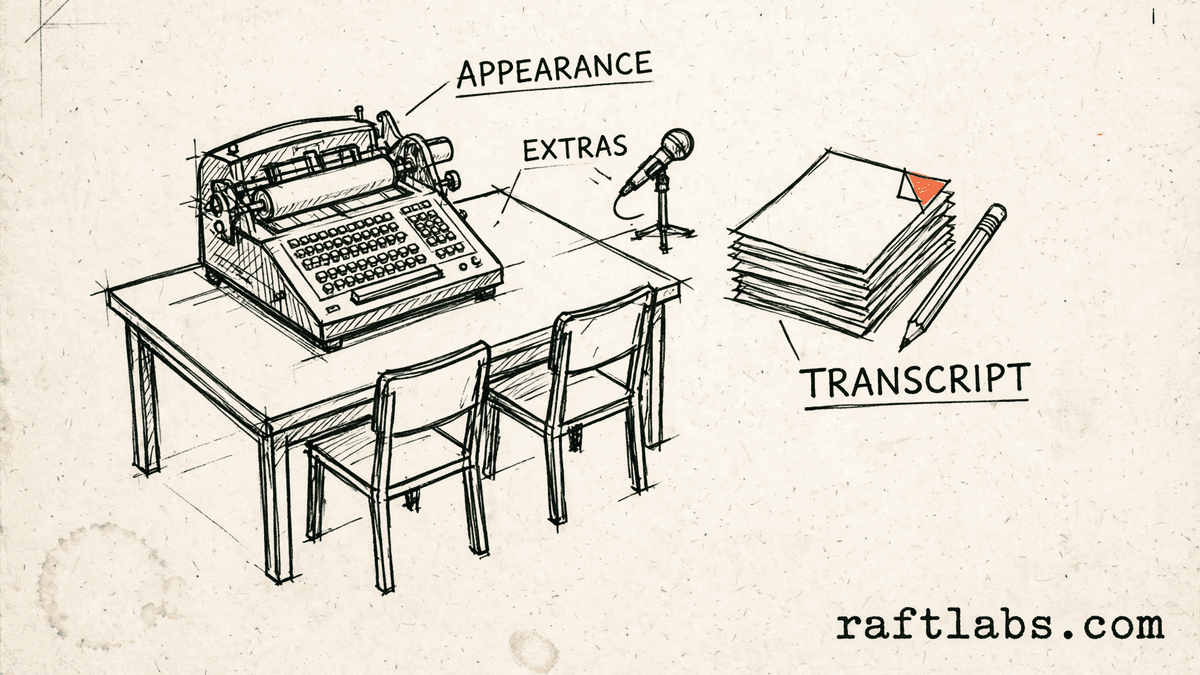
Build a deposition estimate line by line: the appearance fee, the transcript, copies, and extras. Every rate is your own, so the estimate matches your agency.
- Hourly or day fee
- Original and copy rates
- Rush shown as its own line
Before you run the numbers
One estimate, every line visible
A deposition estimate is not one price. It is the reporter time, the transcript pages, the copies, and the extras the job needs. When those lines are bundled into a single figure, the client cannot tell what drives the total, and the agency cannot show where the money goes.
This calculator keeps the lines separate. Enter your own fees and rates, set the hours and the page estimate, and see the itemised total and what it comes to per hour of testimony.
Your numbers
1. Length and appearance fee
2. Transcript pages, rates, and sets
The first set is priced at the original rate. Each set after the first is priced at the copy rate. One set means the original only.
3. Extras
4. Rush turnaround (optional)
Result
Estimated total
Enter your own rates on the left to see the estimate.
Short answer
A deposition cost calculator adds the reporter appearance fee to the transcript cost, worked out from your page estimate and your per-page rates, plus any extras you include such as video, an interpreter, realtime, or rush handling. Every rate is one you enter, so the estimate uses your agency figures.
What the cost covers
What goes into the cost of a deposition?
The cost of a deposition covers two main parts and a set of extras. The first part is the reporter appearance fee: the charge for the reporter who attends and takes the testimony down. Agencies charge it per hour or as one fee for the day.
The second part is the transcript. It is priced from the number of pages the deposition produces. The first set of pages is priced at the original per-page rate, and each added copy set is priced at the copy per-page rate. In this calculator, the number of copies you enter is the total number of sets ordered, so one set means the original only.
The extras depend on the job. A videographer and an interpreter are charged per hour. Realtime, a live text feed during the deposition, and exhibit handling are charged as set fees. A rush turnaround adds a percentage when the transcript is needed faster than the normal schedule. Every rate here is one you enter, because agencies set their own.
| Cost part | What it covers | Who sets the price |
|---|---|---|
| Appearance fee | The reporter time taking the testimony down, charged per hour or per day | The court reporting agency |
| Transcript | The page estimate priced at the original rate for the first set and the copy rate for added sets | The court reporting agency |
| Video and interpreter | A videographer and an interpreter, each charged per hour when used | The court reporting agency |
| Realtime and exhibits | A realtime fee and an exhibit handling charge, when the job needs them | The court reporting agency |
| Rush turnaround | A percentage added to the subtotal when the transcript is needed faster than normal | The court reporting agency |
The math
How the estimate is worked out
The appearance fee is the hours times the hourly rate, or the day rate when the fee is charged per day for one day. The transcript is the page estimate times the original rate for the first set, plus the page estimate times the copy rate for each added set. Extras are added next, and a rush percentage, when used, is applied to that subtotal.
Total = Appearance + Transcript + Extras, plus the rush share when rush is on
Example: a deposition of 4 hours, with an example appearance rate of $75 per hour, comes to $300. A page estimate of 200 pages at an example original rate of $4 per page comes to $800. With 3 sets ordered in total, the 2 added sets at an example copy rate of $1.50 per page come to $600, so the transcript is $1,400. A videographer at an example rate of $60 per hour for 4 hours comes to $240. Realtime at an example fee of $150 and exhibit handling at an example fee of $50 bring the subtotal to $2,140.
$300 + $1,400 + $240 + $150 + $50 = $2,140
With an example rush charge of 25%, the rush line is $535 and the total is $2,675. That total over 4 hours of testimony is $668.75 per hour of testimony. Every figure in this example is a made-up input chosen to show the math. Your estimate will use the rates you enter.
Getting it right
How to build an accurate deposition estimate
The estimate is only as good as the figures behind it. Four steps keep it accurate and free of surprises later.
- 01
Agree the length and the page estimate first
The hours drive the appearance fee and the hourly extras, and the page estimate drives the transcript line. Agree both before the deposition where you can, and say plainly that the final page count is only known once the transcript is finished.
- 02
Settle the number of sets and the rates
Ask how many transcript sets are being ordered in total, and confirm the original rate for the first set and the copy rate for each added set. A set ordered later is still priced, so counting sets at the start keeps the estimate honest.
- 03
List the extras before the day
Video, an interpreter, realtime, and exhibit handling each change the total. Confirm which ones the job needs before the deposition starts, so no line appears on the bill that the client first hears about afterwards.
- 04
Put the rush terms in writing
If the transcript is needed fast, agree the deadline and the rush percentage before work starts. A rush line that was agreed in writing is a simple line on the bill. A rush line that was not agreed is an argument.
Frequently asked questions
Straight answers to what buyers ask before they scope. Still stuck? .
- A deposition cost usually has two main parts. The first is the reporter appearance fee for the time spent taking the testimony down. The second is the transcript, priced from the number of pages and the per-page rate. Extras such as a videographer, an interpreter, realtime, or exhibit handling are added on their own lines when they are used.
- Agencies charge the appearance fee in one of two ways. Some charge by the hour, so the fee grows with the length of the deposition. Others charge one fee for the day. The calculator supports both: pick per hour and enter the hours with your hourly rate, or pick per day and enter your day rate for one day.
- The transcript cost starts with an estimate of how many pages the deposition will produce. The first set of pages is priced at the original rate. Each added copy set is priced at the copy rate. Add the two together and you have the transcript line. The page count is an estimate until the transcript is finished, so the final page count can move this line.
- The original is the first finished transcript, and it carries the work of turning spoken testimony into a checked, formatted record. Copies are added sets of that same transcript for other parties, and they are usually priced lower per page. Enter both of your own rates, and set how many sets in total are being ordered.
- Common extras are a videographer, charged by the hour, an interpreter, also charged by the hour, a realtime fee for a live text feed during the deposition, and an exhibit handling charge for managing the documents shown. Each extra is priced on its own line, and only the extras you turn on are counted in the total.
- A rush turnaround means the transcript is produced faster than the normal schedule, and agencies charge for that speed as a percentage added to the bill. Enter your own rush percentage and turn the rush line on, and the calculator adds that share of the subtotal and shows it as its own line before the final total.
- Yes. An agency can enter its own appearance fee, its original and copy per-page rates, and its prices for extras, then set the hours, the page estimate, and the number of sets for the job in question. The result is an itemised estimate the client can read line by line, with the per-hour-of-testimony view shown as well.
Stay on topic
More for court reporting teams
The tools give you a range. A call gives you a number.
30-minute scoping call. We will walk through how your agency handles scheduling, transcript delivery, and billing today, and you leave with a clear plan for the software that runs it.