Bike repair cost calculator
Build a repair quote from your own shop rate: tick the jobs on the bike, add the hours and parts cost for each one, and set your parts markup. The quote comes back itemised, job by job.
- Six job rows
- Your rate, your markup
- Itemised quote
Before you run the numbers
One bike, priced job by job
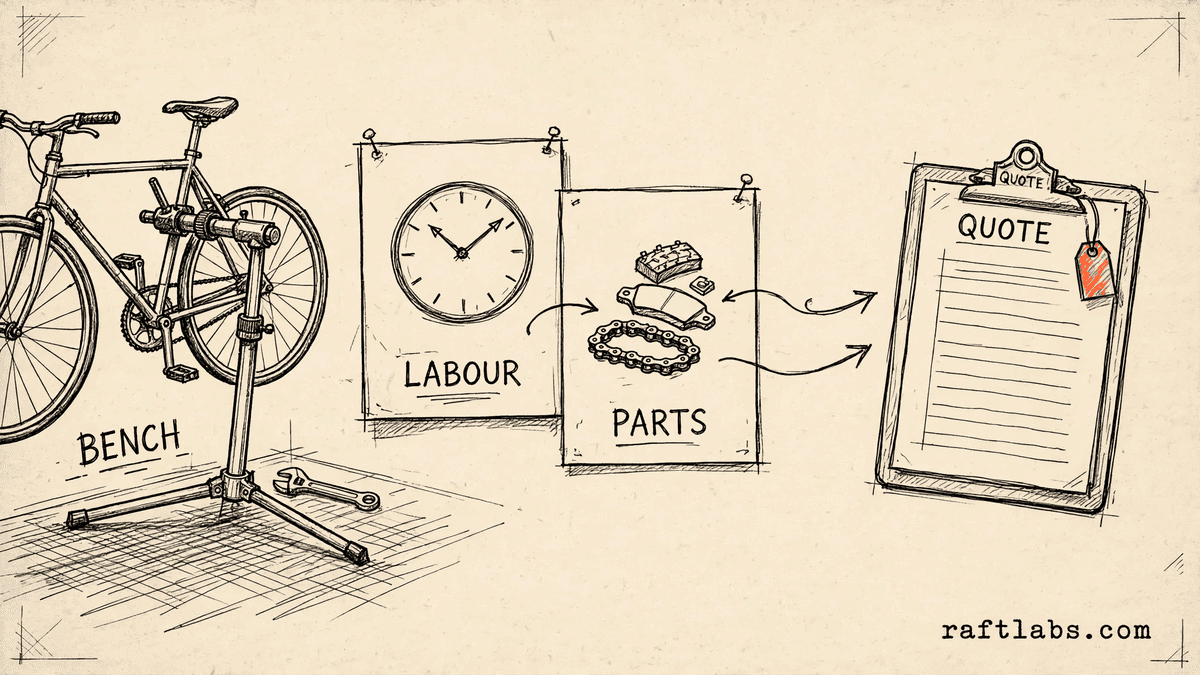
A repair bill is rarely one job. A bike on the stand might need a tune-up, new brake pads, and a wheel true at the same time. Each job takes its own time and its own parts, so each one should be priced on its own line.
This calculator prices every job you tick from your own shop rate and your own parts costs, adds your markup to the parts, and adds the jobs up into one quote total you can read back line by line.
Your numbers
1. Your shop rate and parts markup
The markup is added to the parts cost on every job in the quote. Leave it at zero if you quote parts at cost.
2. Jobs on this bike
Tick each job the bike needs, then enter the hours you expect it to take and what its parts cost you. Jobs left unticked stay out of the quote.
Result
Quote total
Enter your own shop rate and parts costs on the left to see the quote.
Short answer
A bike repair cost calculator builds a repair quote job by job from your own numbers. Each job is priced as its labour hours times your shop rate per hour, plus its parts at your cost with your markup added. The quote total is the labour total plus the parts quoted across every job you include.
What the cost covers
What goes into a bike repair cost?
A bike repair cost has two parts. The first is labour: the time the work takes, charged at the shop rate per hour. Labour is priced per job, because a brake service and a drivetrain service do not take the same time.
The second part is parts. Parts enter the quote at what they cost the shop, and most shops add a markup on top to cover ordering, holding stock, and fitting risk. This calculator shows parts at cost and parts quoted as two separate lines, so the markup is visible rather than buried in the total.
The quote total is the labour total plus the parts quoted. Nothing else is added. Every rate and price in the calculator is your own input, so the total reflects your shop and your prices.
| Cost part | What it covers | Who sets the price |
|---|---|---|
| Labour | The time each job takes, priced as its hours times your shop rate per hour | You, from your own shop rate |
| Parts at cost | What the parts for each job cost you, before any markup is added | You |
| Parts markup | Your percentage added on top of the parts cost. The marked-up figure is the parts line in the quote | You |
The math
How the repair quote is worked out
Each job is priced the same way. Its labour is its hours times your shop rate. Its parts are its parts cost with your markup percentage added. The job line is those two figures added together, and the quote total is every job line added up.
Job line = (Job hours x Your shop rate) + (Job parts cost x (1 + Your markup / 100))
Quote total = Labour total + Parts quoted
Example, using example inputs only: an example shop rate of $60 per hour and an example parts markup of 25 percent. The bike needs a tune-up at an example 1.5 hours with example parts of $20, and a brake service at an example 0.5 hours with example parts of $15.
Tune-up: labour 1.5 x $60 = $90, parts $20 x 1.25 = $25, job line $115. Brake service: labour 0.5 x $60 = $30, parts $15 x 1.25 = $18.75, job line $48.75. The labour total is $90 + $30 = $120. Parts at cost are $20 + $15 = $35, and parts quoted are $25 + $18.75 = $43.75.
Quote total: $120 + $43.75 = $163.75.
Every figure in this example is a made-up input chosen to show the math. Your total will use the rate, hours, parts costs, and markup you enter.
Quoting well
Tips for a clear bike repair quote
A clear quote names each job, its hours, and its parts as separate lines. Four habits keep the quote easy to read and easy to approve.
- 01
Price each job on its own line
A single lump sum hides where the money goes. One line per job, with its own hours and parts, lets the customer approve the work job by job and makes it easy to drop a job if they want a smaller bill.
- 02
Use your real hours, not the hours you wish for
Enter the hours the job actually takes in your shop, including setup and testing. Hours that are too low make the quote look good and the job unprofitable. Hours that are honest keep the quote and the workshop in step.
- 03
Keep one markup across the quote
One markup figure for every job keeps the parts lines consistent and easy to explain. Changing the markup job by job makes the quote harder to check and harder to defend if the customer asks how a line was built.
- 04
Quote before you start the work
Run the numbers and agree the quote before the bike goes on the stand. A quote agreed up front turns a surprise bill into a settled price, and it gives the customer a clear point to say yes or no.
Frequently asked questions
Straight answers to what buyers ask before they scope. Still stuck? .
- A bike repair quote lists each job on the bike with its labour and its parts. Labour is the hours for that job times the shop rate per hour. Parts are what the parts cost the shop, with the shop markup added. Each job sits on its own line, so the customer can see what the total is made of. Every figure in this calculator is one you enter yourself.
- Labour is the hours a job takes times the shop rate per hour. Each job carries its own hours, so a short brake job and a longer drivetrain job are priced apart rather than blended into one figure. Enter your own rate per hour and the hours for each job, and the calculator works out the labour line for every row.
- You enter what the parts for a job cost you, and the calculator adds your markup percentage on top. Parts that cost 100 with a markup of 25 percent are quoted at 125. One markup figure applies to the parts on every job in the quote, which keeps the parts lines consistent from job to job. Set the markup to zero if you quote parts at cost.
- The calculator has rows for a tune-up, a brake service, a drivetrain service, wheel true and spoke work, and an e-bike diagnostic, plus a custom job row for anything else. Tick the jobs the bike needs and leave the rest unticked. Each ticked job takes its own labour hours and parts cost.
- The two lines show the markup openly. Parts at cost is what the parts cost the shop across the whole quote. Parts quoted is that same figure with your markup added, and it is the parts figure that goes into the quote total. Showing both lines makes it easy to check the markup and to explain it if a customer asks.
- Yes. Enter your shop rate once, tick each job on the bike, and add the hours and parts cost for each one, then set your markup. The result is an itemised quote with a line per job, a labour total, and a parts total, which the customer can read line by line before they approve the work.
Stay on topic
More for bike repair teams
The tools give you a range. A call gives you a number.
30-minute scoping call. We will walk through how your shop handles repair tickets, parts, and customer updates today, and you leave with a clear plan for the software that runs it.