
"I genuinely feel they care about where we're trying to take it."
Aaron McGoona
Founder, TicketStop
Marketing Attribution Software Development Services
Ad spend spreads across Google, Meta, TikTok, and a handful of other platforms, plus content, email, and outbound, and each platform reports its own version of what drove the sale. Off-the-shelf attribution tools apply the same multi-touch model to every business, whether or not it matches how your customers actually buy. We build attribution models around your actual customer journey, so you own the data and the logic instead of renting a black-box algorithm.
Multi-touch attribution modeled around your actual customer journey, not a generic template
Unified tracking across ad platforms, content, email, and offline touchpoints in one data model
First-party data you own, not a black-box algorithm you rent by the seat
Fixed-cost delivery, scoped up front, with source code ownership
Bring the problem, the current workflow, or the existing code. We reply with a practical next step within one business day.
Trusted by






















The brief
Good software decisions begin with the constraint, not a list of features or a preferred technology.
Every ad platform showing you a different number for what actually drove the sale, so no one agrees where next quarter's budget should go?
Outgrown your attribution tool once your channel mix, sales cycle, or offline touchpoints got more complex than a per-pixel model can track?
Plain answer
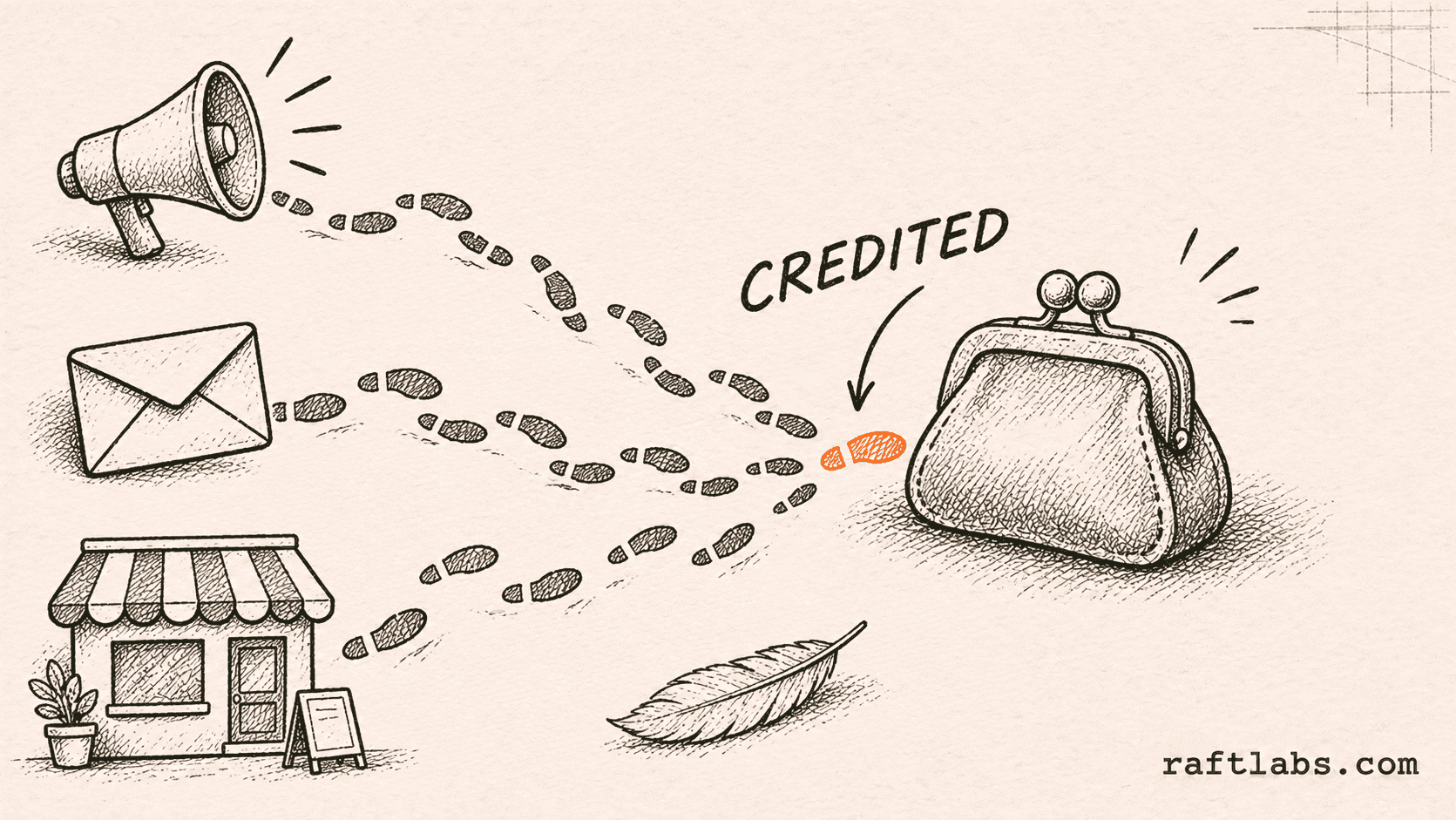
Marketing attribution software tracks which channels and touchpoints actually drive revenue, connecting ad spend, content, and sales activity to closed deals instead of a last-click guess. DTC and B2B brands with a channel mix turn to custom attribution once off-the-shelf tools stop matching how customers convert. Every RaftLabs project starts at $10000, with a fixed price agreed before development begins.
What to remember
Proof
Every ad platform reports its own version of what drove the sale, so the numbers rarely match, and someone still has to decide which one to trust before the next budget meeting. That gets harder, not easier, once you're running multiple platforms, publishing content, sending email, and closing deals over a sales cycle that lasts weeks or months. We build the attribution layer that gives you one model instead of five conflicting reports.
It is whether software is the right answer at all. We use four possible recommendations before discussing a development scope.
Choose a maintained product when it handles the core workflow and the remaining gaps can be solved with configuration, a connector, or a small process change. Paying for software you do not have to maintain is often the better trade.
Keep the existing product when users still get value from it and the code can be understood safely. Start with evidence: where the code lives, how the data is organized, what is tested, which outside services it depends on, who can access what, and how updates go live.
Own the system when the workflow shapes margin, customer experience, speed, or a product customers pay for. Start with one complete path and the system connections that path cannot work without.
Do not turn a changing policy into permanent software. Stabilise the rules, name the workflow owner, and measure the cost of the current process before paying for a product.
Not sure which path is yours? Bring it to a 30-minute call. Leave with the answer in writing.
Capabilities
An attribution model built around your actual customer journey, not a generic first-click or last-click default, scoped to how your customers really convert.
Spend and conversion data pulled from Google, Meta, TikTok, and other ad platforms into one data model, so channel performance is compared on the same terms.
Calls, events, in-store visits, and long B2B sales cycles tracked alongside digital touchpoints, so offline activity isn't left out of the attribution picture.
Your customer and conversion data lives in infrastructure you own, not inside a vendor's black-box algorithm you're renting by the month.
Dashboards built around the decisions your team actually makes, budget reallocation, channel investment, campaign cuts, not a generic report template.
Data pulled automatically from your CRM, ad accounts, and analytics tools, so attribution updates without anyone exporting a spreadsheet.
How we work
We map your ad platforms, sales cycle, offline touchpoints, and the decisions your attribution model needs to support. You leave with a written scope and a fixed-price quote.
We design the attribution data model, the integration layer for each channel, and the reporting structure your team will actually use.
You review working software at each increment. Tracking, modeling, and dashboards are built and tested as the work progresses.
The model runs against real campaign data so your team can validate attribution accuracy before budget decisions depend on it.
Proof
The engineers who map your channels also build the attribution layer. No offshore handoff after the contract is signed.
We scope the work, calculate the cost, and lock it in writing before any development starts.
A track record building data pipelines and reporting dashboards that process real campaign and CRM data at scale.
No vendor lock-in after delivery, and no algorithm you have to keep renting. The codebase, and the data model inside it, is yours.
What it costs
The first phase covers one attribution path across your channels, with unified tracking and revenue reporting wired in.
Starting investment
Starts at $10000
Start with the spend where you least know what is working. After a 30-minute call, you get a written build, buy, repair, or wait recommendation plus first-phase direction. Free, whether or not you build with us.
Custom attribution for DTC and B2B brands once off-the-shelf tools stop matching how customers convert.
Tracking of which channels and touchpoints actually drive revenue, connecting ad spend, content, and sales activity to closed deals instead of a last-click guess.
Channel mixes where off-the-shelf tools stop matching how customers convert, at a fixed price agreed before development begins.
A maintained product already handles the core workflow and the remaining gaps can be solved with configuration, a connector, or a small process change.
Keep the existing product when users still get value from it and the code can be understood safely.
| Triple Whale or Northbeam | Custom | |
|---|---|---|
| Best fit | DTC brands whose channel mix fits their model | A channel mix, sales cycle, or offline touchpoints complex enough that a per-pixel model stops tracking what actually happened |
| Tracking | A per-pixel model | Tracking of what actually happened across a complex channel mix |
Proof
Three-year average engagement. Founders and operators describing the work in their own words. No marketing varnish.
Their ability to translate my vision into a fully functional MVP in just 8 weeks was outstanding. Highly recommend!
Eric M.
Founder at Intrinsic Sales
"I genuinely feel they care about where we're trying to take it."
Aaron McGoona
Founder, TicketStop
Work with us
Tell us how your channel mix and sales cycle actually work today, and where the reporting breaks down. We'll scope a fixed-cost build.
Marketing attribution software tracks which marketing touchpoints, ad platforms, content, email, and sales activity actually contribute to a closed deal or purchase, instead of crediting the last click or first click by default.
Yes. We build the attribution model around your actual customer journey, whether that's a short DTC purchase path or a long B2B sales cycle with multiple stakeholders, during discovery.
Yes. Pulling spend and conversion data from Google, Meta, TikTok, and other ad platforms, plus offline touchpoints like calls, events, and in-store visits, into one data model is the core of most requests in this space.
Every RaftLabs project starts at $10000. A focused attribution MVP covers core multi-touch modeling and unified tracking; a full platform adds dashboards and CRM integrations. We scope a fixed cost after discovery, before any development starts.
Ask whether attributed revenue reconciles with actual orders or closed deals. A tool built only on platform-reported data inherits the same self-grading numbers with a nicer dashboard. Multi-touch, MMM, and incrementality each solve a different problem: ask which models you can run and whether you can see the weights.
Incrementality testing should sit beside attribution, not after it. Where models agree, act with confidence; where they disagree, run an incrementality test. Ask for a pilot on your own traffic, not an industry average, and run finalists against a quarter of historical data plus a product launch or channel change, so outputs compare against something the business already understands.
Safari, Firefox, and Brave block third-party cookies by default, so attribution needs a first-party data strategy, server-side ingestion, and model-based measurement that does not collapse when pixel data thins. The most common failure mode is not the wrong vendor, it is the right vendor at the wrong maturity stage: analyst capacity to interpret findings and run experiments matters as much as the tooling.
Established platforms like Triple Whale and Northbeam are strong tools for DTC brands whose channel mix fits their model. Custom software makes sense once your channel mix, sales cycle, or offline touchpoints get complex enough that a per-pixel model stops tracking what actually happened. We help assess the right fit during discovery.
DTC and B2B brands that have outgrown per-pixel SaaS attribution tools like Triple Whale, Rockerbox, or Northbeam, usually because they run multiple ad platforms, have offline touchpoints, or have a sales cycle too long for a standard multi-touch template to model accurately.