



















Equine management software

The work happens in a barn aisle at six in the morning, and any system that requires someone to remember it later has already lost. Most stables track a horse's record across paper files, a spreadsheet, and whatever the last barn software vendor built. We build software around the unit of work that matters: the horse.

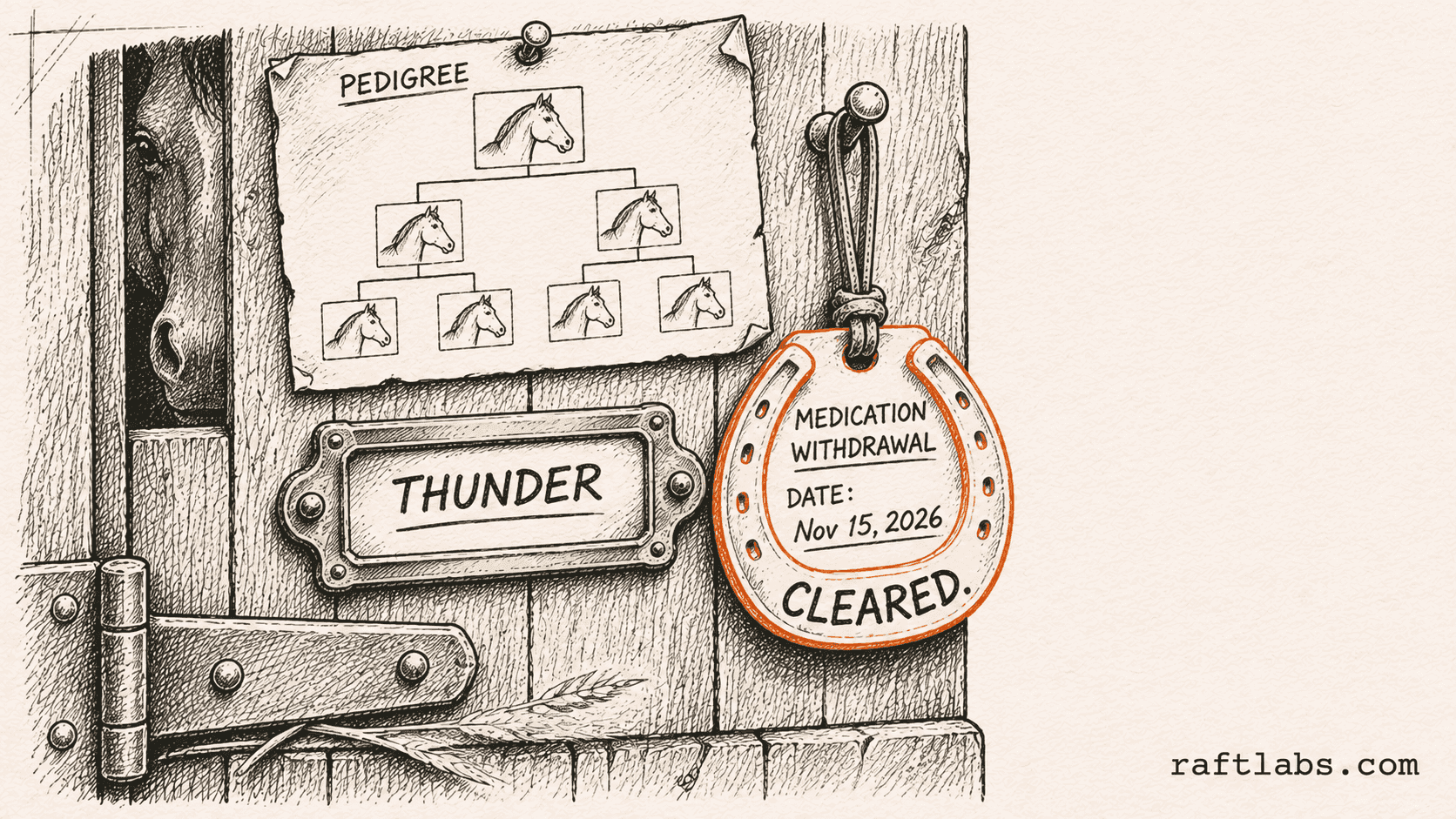
  • Pedigree and breeding records with multi-generation tracking and registry-compliant documentation

  • Vet and medication tracking with race-day withdrawal-time compliance built in

  • Care logged at the point of care: the care record and the billing record are the same record

  • Fixed-cost delivery, scoped up front

3+ years RetentionWeek 1 First milestoneFixed price Pricing

The problem

Sound familiar?

  • Add-on care logged on a dry-erase board wiped every Sunday, so extra feedings, blanket swaps, and farrier visits never make it onto the invoice?

  • A horse's full history (pedigree, vet records, race record) scattered across three systems when it moves to a new trainer?

Short answer

RaftLabs builds equine management software: pedigree and breeding, vet and medication tracking with race-day withdrawal compliance, race entry and eligibility, barn and stable operations, and multi-stable portability across trainers and facilities. It fits stables, breeding operations, and racing yards with records split across paper, spreadsheets, and unconnected software. A tool runs $30K to $60K over 10 to 16 weeks, fixed.

Who this is for

Equine operations we build for

Boarding stables

Care-to-cash as one record, so add-on services stop leaking between the whiteboard and the invoice.

Breeding operations

Pedigree and registry-compliant records that hold up year after year.

Racing and training yards

Medication and withdrawal-time tracking that keeps race day compliant.

Multi-stable operations

Records that travel with the horse between breeding, training, and racing facilities.

Trusted by

Perceptional logoMusgrave GroupUrShipper logoBrux Dental SolutionsBella Skin Institute LogoEnergia RewardsDraftly logoTuneClub LogoSekou LMS logoLogo of food order management app gulaSnelwegDealsGrubly logoPSi logoInstantor Rewards logologo of Mobile app for events, membership clubs, and communitiesAldiFest retail campaign logoVidmattic logoEMS Connect logoWorx Squad logologo of Online Web App For Making Intrologo of Referral and Viral Marketing PlatformConcurrences logoGE logoTicketstop logo

01 Diagnosis

Where equine operations actually leak

  1. 01
    Problem

    Add-on care never makes it onto the invoice

    Solution

    The moment between when a service happens and when it gets recorded somewhere durable enough to survive until invoice day depends entirely on human memory and whoever happens to be on shift. A stall-rest horse's extra feedings get tracked on a dry-erase board wiped every Sunday. A blanket swap during a weekend shift change never makes it onto either manager's radar. Compounded across a full boarding roster and repeated month after month, that is a structural leak, not a series of isolated mistakes.We build care capture at the point of care: the groom logs the service where the horse is, and the care record and the billing record are the same record. Care recorded at the stall becomes the invoice line, with nothing re-keyed on billing day.

  2. 02
    Problem

    The barn aisle is where software goes to die

    Solution

    Equine work happens in barn aisles, farm roads, and properties with no signal. Software that needs an internet connection to function is a real problem. And the demo that runs on sample data proves nothing about a mid-month diet change, a lapsed autopay, and a farrier bill landed on the wrong horse in the same week.Our barn tools work offline-first: care logged with no signal syncs when it returns. We test against the real messy month, not the clean demo. Gloves, dust, and dead zones are the test conditions, so capture works at the stall door.

  3. 03
    Problem

    A horse's history doesn't travel with the horse

    Solution

    When a horse moves from a breeding operation to a training stable to a new owner, its pedigree, vet history, and performance record often stay behind in whatever system the previous facility used, if they were digitized at all. The new team starts from partial information, and gaps in vet history or medication records create real risk. Software built around the horse, not the facility, keeps the record portable as ownership and location change.We build multi-stable data portability so the full record travels with the horse, with access control scoped to who should see and edit what. Every horse opens with its full history on screen, wherever it was last stabled.

  4. 04
    Problem

    Medication records aren't audit-ready

    Solution

    Racing jurisdictions enforce strict medication rules and required withdrawal times before competition, and the consequences of a compliance failure (disqualification, suspension, fines) fall on the trainer and owner. Tracking medication administration and withdrawal windows well enough to remember them isn't the same as tracking them well enough to produce a defensible record on demand. Structured medication logging with automatic withdrawal-time alerts turns compliance from a memory exercise into a system.

02 What we ship

What we build for stables and breeding operations

  1. Pedigree and breeding records

    Multi-generation pedigree tracking and breeding records with documentation formatted for registry submission, scoped to the specific breed registry your operation works with.

  2. Vet and medication tracking

    Veterinary history and medication logging with race-day withdrawal-time tracking and alerting, built around your racing jurisdiction's compliance requirements.

  3. Race entry and eligibility management

    Entry and eligibility tracking, nomination deadlines, and condition-book monitoring scoped to the tracks and racing circuits your operation runs in.

  4. Barn and stable operations

    Day-to-day operational tools for feeding schedules, turnout, and farrier and vet visit scheduling, connected to the same record as breeding and race data, not a separate whiteboard.

  5. Multi-stable data portability

    Records built to travel with a horse as it moves between breeding, training, and racing facilities, with access control scoped to who should see and edit what.

  6. Sales and auction documentation

    Structured pedigree, vet history, and performance documentation formatted for bloodstock sales and auction catalog requirements.

Integrations

Records that connect across the horse's life

Pedigree, vet history, and performance records move with the horse instead of staying locked in one facility's software.

Registry and records
Breed registry documentation · Vet and medication records
Racing
Race entry and eligibility data
The access-control model, who can see and edit what, is scoped alongside the portability requirement.

03 Buy, build, or wait

Stay on the template while the operation is small and standard.

The equine software question is really about where the work happens.

Buy or rent

  • Stable Secretary, while it fits

    Standard boarding operations on a proven template, before the mobile and customization gaps bite.

  • Excel + QuickBooks, as a pilot

    For 20 or fewer horses, generic tools with an equine template can be adequate before the leak matters.

Build custom

  • When the work is in the barn aisle

    Offline-first, glove-friendly capture at six in the morning. Generic software assumes a desk.

  • When the leak is structural

    Add-on care lost between the dry-erase board and invoice day. Care-to-cash as one record.

  • When the record must travel

    Horses move between breeding, training, and racing. The record follows the horse, not the facility.

Bottom line

Stay on the template while the operation is small and standard. Build when the capture point, the leak, or the record's journey stop fitting.

04 How we work

How we build equine management software

Every equine software build needs your record-keeping, registry, and jurisdiction requirements mapped before any code exists, and a data model built around pedigree, vet, and medication tracking from day one. Our equine management software development service walks through how we approach discovery, data modeling, build, and field testing.

05 Track record

What stables get when they work with us

Cost agreed before development starts
Fixed
First module: a tool your team actually uses
10-16 wk
Shipping production software for niche, operational industries
Since 2015

08 Why us

Why choose us?

  • 01

    Built for the barn aisle, not the desk

    Offline-first, glove-friendly capture at six in the morning, because generic software assumes someone sitting down to type.
  • 02

    The record follows the horse

    Multi-stable portability is designed in, so pedigree, vet history, and performance travel between facilities with the animal.
  • 03

    Fixed cost, scoped after discovery

    Scope and price are agreed before work starts, with post-launch support included.

09 Questions

Common questions

Yes. Multi-generation pedigree tracking, breeding records, and documentation formatted for registry submission (Jockey Club and equivalent breed registries) are a core part of what we build. We scope the specific registry and documentation requirements your operation needs during discovery.

Yes. Racing jurisdictions have strict medication rules and required withdrawal times before a horse can compete, and getting this wrong has real regulatory consequences. We build medication logging with the tracking and alerting your compliance process requires. The specific rules come from your racing jurisdiction and veterinarian, which we build the software around during discovery.

Yes, if that's how your operation works. Multi-stable data portability means a horse's pedigree, vet history, and performance record travel with it rather than staying locked in the software of the facility it's leaving. That is a common requirement for operations that regularly move horses between breeding, training, and racing facilities. We scope the access-control model (who can see and edit what) alongside the portability requirement.

A single-purpose tool covering pedigree and vet records typically takes 10-16 weeks and runs $30K to $60K. A full platform with race entry management, multi-stable support, and barn operations runs 16-24 weeks and $90K to $160K. We scope every project before pricing. Fixed cost, agreed before work starts.

Yes. Race entry involves eligibility rules, nomination deadlines, and condition-book tracking that vary by track and jurisdiction. We build entry and eligibility tracking scoped to the tracks and racing circuits your operation runs in.

Yes. Migrating records off software you've outgrown, or off a vendor that's no longer supported, is a common reason stables come to us. We scope the migration as its own phase, validating what transfers cleanly before cutover.

That is the most honest question in this industry. The system is designed for the barn aisle: one-tap care logging that works where there's no signal and syncs later, large targets that work with gloves on, and no proprietary messaging app anyone has to log into. A charge logged when it happens does not depend on anyone remembering it three weeks later. And a leak caused by process design will not be solved by asking staff to be more careful. We fix the capture point instead.

Get a build-vs-off-the-shelf plan for your operation

Tell us how your operation tracks breeding, vet, and race records today, and where the gaps are. We'll tell you what we'd build, what it costs, and what we'd leave on paper.

  • Scope and cost agreed before work starts. No surprises. No obligation.
  • Working prototype within 3 weeks of kickoff.
  • Pay by milestone. You see progress before each invoice.
  • 60-day post-launch warranty. Bug fixes, UI tweaks, and deployment support. No retainer.
  • All conversations are NDA-protected.