Agricultural Equipment Dealer Software Development
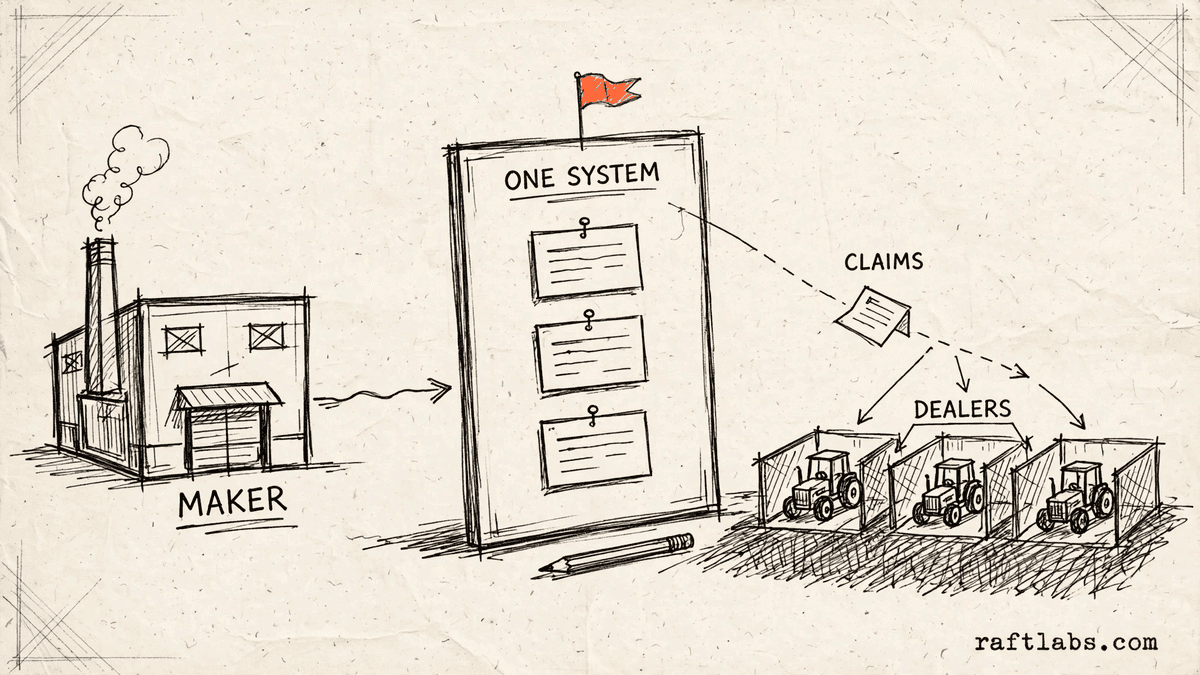
Custom dealer platforms for multi-brand dealer groups and manufacturer networks who need one build that holds sales, workshop, spares, and claims together, instead of a separate portal and spreadsheet for every brand they sell.
One dealer platform for machine sales, workshop job cards, spares, and field service across every brand and branch
Manufacturer rules held per brand: service points in hours run, claim evidence, and report formats
Connections to manufacturer systems, parts catalogues, and accounting built as part of the scope
One machine record by serial number from sale to last service, shared by sales, workshop, counter, and accounts
The problem
Sound familiar?
Each manufacturer you represent sets different service points, claim rules, and report formats, so your team re-enters the same machine and the same job in three or four places?
Branches and brands run on different tools, so group owners cannot see stock, open job cards, or claim status across the network without calling around?
Short answer
RaftLabs builds custom dealer platforms for agricultural equipment dealer groups and manufacturer networks. One system holds each machine by serial number, its sale paperwork, job cards, hour-meter services, spares, and manufacturer claims across every brand and branch. A validated v1 takes 12 to 16 weeks, typically $50K to $100K. A full network platform is typically $150K to $350K. We scope before pricing, with fixed cost agreed before work starts.
Who this is for
Dealer groups and networks we build for
Multi-brand dealer groups
One platform across every brand you sell, with each manufacturer rule held per brand instead of worked around branch by branch.
Manufacturer networks
One dealer-facing platform across your network, so every dealer reports, claims, and services the same way.
Multi-branch dealerships
Sales, workshop, spares, and claims on one record per machine, with a group view across branches.
Groups replacing a patchwork
Per-brand portals, shared spreadsheets, and branch tools replaced by one build your group owns.
When each brand you sell runs your dealership a different way
A single-brand dealer can often live inside one manufacturer portal. A dealer group cannot. Each brand sets its own service points in hours run, its own claim rules and evidence, and its own report format. The group sells the machines, runs the workshop, and answers to the customer, but the rules come from several manufacturers at once.
So the same work gets done several times. A sale is entered in one place, copied to the accounts, and reported again per brand. A job card is written for the workshop, then rewritten as a claim. Stock is counted at the counter while the workshop picks from the same shelf on paper. At harvest, when a machine is down in a field and the crop is waiting, nobody can wait for that copying to catch up.
We build one platform that holds those rules side by side: a machine record by serial number, a job card that can become a bill or a claim, and a stock record shared by the counter and the workshop. The brands stay different where the manufacturers make them different, and the group stops paying for the gaps between them.
01 Diagnosis
Where dealer groups lose time and money
- 01Problem
Every manufacturer sets different rules, and your team holds them in their heads
CostService points differ by brand and model. Claim rules differ by manufacturer: what evidence is needed, what is covered, and how long a decision takes. Report formats differ too. When those rules live in staff memory and separate portals, a free service that falls due by hours run gets missed, a claim goes in without the hour reading it needed, and the office rebuilds the same facts for each brand at month end.
SolutionWe hold the rules in the platform, per brand and per model: service points in hours run against each machine record, claim evidence built from the job card, and each manufacturer report produced from the same sale and service record. Staff follow the rule the system shows, not the rule they remember.
- 02Problem
One machine, four records, none of them complete
CostA machine is sold with a loan, a subsidy application, and often an old machine taken in part-exchange. When the sale sits in a register, the paperwork sits in the office, the service history sits in the workshop, and the parts sit at the counter, no single record shows the whole life of that machine. Questions from owners, auditors, and manufacturers take hours of searching to answer.
SolutionWe build one record per machine, keyed by its serial number, from the sale onward. The buyer, price, loan, subsidy, and part-exchange sit on that record. Job cards, hour readings, parts fitted, field visits, and claims are added to the same record, so one search answers the question.
- 03Problem
Harvest breakdowns expose every gap at once
CostA machine down in the field during harvest outranks everything else, because every day it stands still can cost the owner the crop. If the technician leaves without the machine history, its warranty position, and the parts it is likely to need, the trip is wasted. If the visit is never written down, the parts from the van and the hours worked are never billed or claimed.
SolutionA field breakdown is raised against the machine record, so the technician sees its history, warranty position, and likely parts before leaving the yard. The visit is recorded on the day, with the fault, the parts used, and whether the machine is running again, and routine workshop work is reordered around it openly.
- 04Problem
The group cannot see itself without calling every branch
CostBranch stock, open job cards, and claim status sit in separate tools, so group owners learn about a problem when a customer or a manufacturer raises it. A part sits on a shelf two branches away while the workshop orders another one. Claims are filed and then forgotten because nobody tracks them to the manufacturer decision across the group.
SolutionWe build the group view into the same platform: stock checked across branches before a part is ordered, open job cards visible by branch, and every claim tracked from filing to decision. Branches keep their own records, and the group reads one current picture.
02 What we ship
Dealer platform software we build
Machine sales and sale paperwork
Each machine is recorded once, by its serial number, at the sale. The buyer, model, price, delivery date, and implements sold with it sit on that record. The loan entry holds the lender, stage, and payment status. The subsidy entry holds the scheme, the amount applied for, and where the application stands. A part-exchange machine is recorded with the value agreed and what happened to it afterwards. Sales, the office, and accounts read the same deal, so a correction is made once.
Workshop job cards and hour-meter services
A job card opens with the machine serial number, the owner complaint in their own words, and the hours the machine has run. The technician records the work, the time, and every part picked. On close, the card becomes the bill or the evidence for a manufacturer claim. Free services included by the manufacturer are held per model in hours run, and hour readings from visits, deliveries, and services flag a machine before its due service is missed.
Manufacturer warranty claims
When a part fails under the manufacturer warranty, the dealer does the work and claims the cost back. The platform builds the claim from the job card: what failed, the hour reading, the parts replaced, and the labour recorded. Each manufacturer rule for evidence and cover is held per brand, so the claim matches what that manufacturer asks for. Claims are tracked from filing to decision across every branch, so none are filed and forgotten.
Spares counter and branch stock
The counter sells parts to owners and other workshops, and the workshop picks parts for job cards, from one stock record by part number. A part picked for a job is off the shelf and cannot be sold twice. Stock can be checked across branches before a new part is ordered. Fast movers are visible by season, so ordering for sowing and harvest follows what the group actually sold and fitted, not memory.
Field service and harvest breakdowns
A field visit is a job card for work done at the farm. It records the machine, the fault, the parts taken from the van, the hour reading, and the outcome, the same as workshop work, so it can be billed, claimed, or checked later. Breakdowns at harvest jump the workshop queue openly, with the machine history and warranty position in front of the technician before the trip.
Group reporting and manufacturer formats
The group reads sales, open work, stock, and claims across branches and brands from the same records the branches work in. Each manufacturer report is produced in that manufacturer format from the shared record, without a second entry for reporting. Your team screens, the job card board, claim tracking, stock counts, and who did what, are scoped as their own product, not squeezed into one admin line in the quote.
One build, scoped around your network, not a feature list
The scope of a dealer platform is set by your network, not by a menu. Branch count sets how stock, job cards, and permissions must work across sites. Manufacturer count sets how many rule sets, claim flows, and report formats the platform must hold. Portal and catalogue connections set how much of the daily copying the build can remove on day one.
That is why we scope before pricing. We follow one machine through your group: sold with its paperwork, serviced by hours run, repaired under a claim, and broken down in a field at harvest. We name who uses each screen, including your own team, what each connection sends, which records move over from your current tools, and what is excluded. The first release takes one complete path and proves it in a quieter season where possible. Later phases add branches, brands, and connections in an order your group can absorb.
Integrations
Built to connect to the systems around the dealership
Connections are named in the scope before work starts: what each one sends, what it receives, and what happens when a manufacturer offers no connection at all.
- Manufacturer systems
- Manufacturer portals · Warranty claim submission · Service and campaign reporting · Model and service point data
- Parts and pricing
- Parts catalogues · Supplier ordering · Branch stock lookup
- Business systems
- Accounting · Payment services · Messaging for service reminders
03 Buy, build, or wait
Buy the product while one product fits.
The dealer platform decision is usually about rules: how many brands, how different their demands are, and who ends up copying between systems.
Buy a product
One brand, standard rules
When a maintained product holds your sales, job cards, spares, and claims the way your group runs them.
Gaps you can close by setup
When configuration, a connector, or a small change in how the office works removes the problem.
Build custom
When brands pull in different directions
Different service points, claim rules, and report formats per manufacturer, held in one platform your group owns.
When a network needs one front door
A manufacturer network that wants every dealer on one dealer-facing platform, reporting and claiming the same way.
When copying is the daily cost
The same sale, job, and claim re-entered across portals and spreadsheets, with errors that reach owners and manufacturers.
Bottom line
Buy while one product holds your brands and branches. Build when the rules differ per manufacturer, the network needs one platform, or the copying has become the cost.
04 How we work
How we build dealer platforms
Every build starts with your branch structure, your manufacturer rules, and your current portals and spreadsheets mapped before the data model is designed, with go-live planned around harvest and sowing. Our farm equipment dealer management service covers the operating workflows a dealer platform has to hold, from serial-number sales records to job cards and claims.
05 Track record
What you get working with RaftLabs
- Weeks to a validated v1, then iterate
- 12-16
- Cost, agreed before we build
- Fixed
- Building custom software for operating businesses
- Since 2015
08 Why us
Why choose us?
- 01
Your rules are the scope, not a workaround
We quote your team screens, claim flows, and manufacturer formats as their own scope with their own users, so the back office is not squeezed into one admin line that becomes the overrun. - 02
You own the platform from day one
Code, cloud accounts, data, and operating notes are in your name from the start. Another capable team can take over from the notes as they stand. - 03
Fixed cost, scoped before pricing
Branch count, manufacturer count, and connections are mapped first. You get a fixed price for an agreed scope before work starts, and changes are priced before they are built.
Frequently asked questions
Straight answers to what buyers ask before they scope. Still stuck? .
Buy when a maintained product holds your brands, your branches, and your claim rules without daily workarounds, and its price makes sense. Build when each manufacturer sets different service points, claim rules, and report formats and no single product holds them all. Build also when a manufacturer network needs one dealer-facing platform across the whole network. The same applies when your team copies the same sale, job, and claim between portals and spreadsheets every day and that copying has a clear cost. If your sales and service rules are still changing every month, settle them first, then build.
Each brand sits in the system as its own set of rules on a shared machine record. Service points are held per model in hours run, so a machine is flagged when its next included service is due. Claim rules are held per manufacturer: what evidence a claim needs, which parts and labour it covers, and how the decision comes back. Report formats are held per manufacturer too, so the same job card and the same sale produce the right report for each brand without re-entry. When a manufacturer changes a rule, that brand changes in one place and the rest of the network is untouched.
Connections are part of the build scope, named in writing before work starts. Typical scope covers manufacturer portals and reporting feeds where the manufacturer allows a connection. It also covers parts catalogues, so the counter and the workshop price and pick from the current list. Your accounting system is in scope too, so sales, parts, and service bills land in the accounts without a second entry. Where a manufacturer offers no connection, the platform produces the file or report in the format that manufacturer asks for, from the same record. We name each connection, what it sends, and what it cannot do, before you sign.
A validated v1 typically takes 12 to 16 weeks and costs $50K to $100K. A full network platform, covering sales, workshop, spares, claims, and manufacturer reporting across branches and brands, typically costs $150K to $350K. Price moves with branch count, manufacturer count, and the number of portal and catalogue connections. We scope every project before pricing. Fixed cost, agreed before work starts.
A validated v1 takes 12 to 16 weeks. That first release covers one complete path, usually a machine sold by serial number, through its first service, with a claim filed from its job card. A full network platform takes longer, and the plan is set once branch count, manufacturer count, and connections are known. Go-live is planned around harvest and sowing, not a calendar date, because a new system landing in the busiest weeks gets its hardest test on day one. Dates slip when records arrive late, manufacturer approvals wait, or rules change mid-build, so those risks are named in the plan.
A dealer platform holds customer contact details, loan and subsidy paperwork, machine records, prices, and claim history, so who can see and change what is designed per role and per branch from the start. While we work, penetration testing is taken care of. No production data is used in development, ever. Testing runs on made-up machine, customer, and parts records. Backups are tested. Offboarding steps exist for when someone leaves a team. The third-party services the platform sends data to are named in the scope documents before you sign. We describe practices we can show you, not certifications.
You own it, from day one. The code built for you, the cloud accounts, your machine, customer, and parts data, and the operating notes are in your name from the start, not handed over at the end. Outside services and open-source parts keep their own licence terms. Because ownership sits with you throughout, nothing about the platform is locked inside our team.
You already hold everything you need. The code, the accounts in your name, your data, and the operating notes stay with you from day one, so there is no unlock step and nothing to extract from us. The notes stay current during the build, so another capable team can pick up the platform and run it. Exit is a normal handover from records you already own, not a negotiation.
Yes. We sign your NDA before anything sensitive is shared. Dealer margins, claim volumes, branch numbers, and customer counts stay confidential. The stronger protection is ownership: the code, accounts, and data are yours from day one.
We work on five principles. 01 Switch to Async: updates are written so you can read them between customers, not in a meeting you have to attend. 02 Be Prepared: calls cover decisions that are ready to be made. 03 Write: decisions and changes are written down where both sides can find them. 04 Ask/tell: questions and bad news are raised in writing as soon as they appear. 05 Own: the person working on a piece owns its outcome and says so plainly. You need one person who owns the workflow, access to the users and systems involved, and timely answers on business rules.
No. The team that scopes your platform builds it, and the people on your calls are the people on your project. Our teams are in India and Ireland. Systems named in the scope, such as manufacturer portals, parts catalogues, payment services, and accounting, are systems the software connects to, not a handoff of your project.
RaftLabs builds with its own AI workflow called RaftKit, which you can read about at raftkit.com. In plain terms, work moves through five stages. First a blueprint of what is being built and why, then a written plan, then the build itself. Next comes a two-stage review, where work is checked before it can move on. The final stage writes down what was learned for the next piece of work. Problems found in review are graded, and the most serious grade stops work from going out until it is fixed. For you that means sales, workshop, and claim flows are planned in writing and checked in stages, not produced in one pass nobody reviewed.
After the first release, work can continue as another fixed phase, as an ongoing product engagement, or with your own team running the platform from the operating notes. Support arrangements are agreed in writing rather than assumed. Whoever maintains it, the standing costs keep running: hosting, connected-service subscriptions, messaging charges, and any manufacturer or catalogue service fees your platform uses. The code and accounts stay under your control either way.
Dealer and agriculture software
- 01
Farm equipment dealer management software
Serial-number machine records, job cards, hour-meter services, spares, and manufacturer claims for dealerships
- 02
Agriculture software development
Farm management, precision agriculture, traceability, and agricultural ERP for large operations
- 03
Farm management software
Crop planning, field records, input tracking, and harvest reporting
- 04
Custom software development
Custom platforms scoped, priced, and built for operating businesses
- 05
ERP development
Connected operations, stock, and accounts in one system
- 06
Web application development
Browser-based platforms for teams across branches and roles
Get a build, buy, or wait plan for your dealer network
Tell us how many branches and manufacturers you handle, and which portal, claim, or reporting task costs your team the most time. We will tell you what we would build first, what it would connect to, and what it would cost.
- Scope and cost agreed before work starts. No surprises. No obligation.
- Working prototype within 3 weeks of kickoff.
- Pay by milestone. You see progress before each invoice.
- 60-day post-launch warranty. Bug fixes, UI tweaks, and deployment support. No retainer.
- All conversations are NDA-protected.