What we find in prototype audits: the recurring patterns
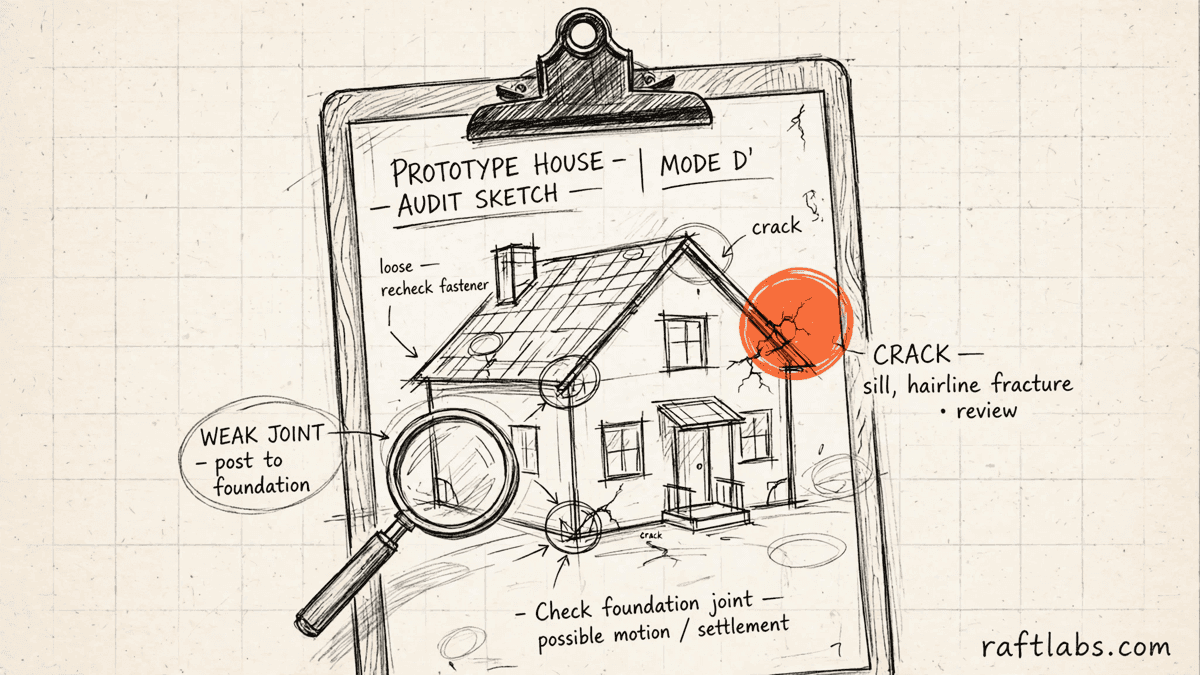
Prototypes prove an idea can work. Audits check whether it can be trusted with real customers. These are the patterns our live case work and audit pages return to most.

In this article
Short answer
Prototype audits most often find the same patterns: access that is broader than the job needs, writes with no human approval, unclear data ownership between systems, retries that can duplicate work, missing records of what the software did, and notes too thin for another team to take over. The demo path usually works. The edges are where prototypes break.
Key takeaways
- The happy path is rarely the problem. Audits focus on errors, duplicates, permissions, and recovery, because real customers reach those edges quickly.
- Broad access is the most serious recurring pattern: one shared account or credential that can read or change far more than the task requires.
- Missing approval points turn small errors into customer-facing ones. A preview and a human confirmation fix many of them cheaply.
- Ownership is a finding in itself. If notes, accounts, and code do not sit with the client, every later fix becomes a negotiation.
- A prototype is not a failure because it has these gaps. It was built to prove an idea. The audit prices what production trust requires.
Every prototype tells the same story at first. The main path works. A founder can show the idea in minutes, and the idea is often good.
Then someone asks harder questions. What happens when a customer submits twice? Who can see this record? Why did the system change that entry? The room goes quiet, not because the team was careless, but because a prototype was never meant to answer those questions.
This piece collects the patterns that recur across our published work: our case studies, our service pages, and our audit guidance. Our companion piece on what a prototype to production audit checks covers the audit process itself. It names no client audit results and invents no statistics. It describes the findings themselves, so you can check your own prototype against them.
The short answer
Audits rarely condemn the idea. They find broad access, unapproved changes, unclear data rules, fragile failure handling, thin records, and weak handover notes. Each is repairable. Together, they are the real distance between a prototype and a product.
Finding one: access broader than the job
The most serious pattern is a single powerful account doing everything. The prototype reads, writes, and deletes through one credential because that was fastest to set up.
Our MCP server development page opens with this exact risk: a tool that could update a customer could also update every customer. The fix is narrow access per job, with reading separated from writing.
Ask your prototype a simple question. If one part misbehaves, how much can it reach? If the answer is everything, that is finding one.
Finding two: changes with no approval point
Prototypes often act immediately. A form submits, a record changes, a message sends. Nobody sees an in-between step.
In production, material changes deserve a preview and a confirmation. The pattern across our AI agent development work is consistent: the software drafts, a person approves, and only then does the change land.
This is not slowness. It is how a small error stays small. A wrong draft costs a minute. A wrong sent message costs a customer.
Finding three: two systems, no agreed truth
Prototypes grow by connecting what is nearby. Customer data ends up in the app database, a spreadsheet, and a CRM, with no rule for which one wins.
When the copies disagree, the software picks one silently. Customers see the wrong price, the wrong status, or the wrong address, and nobody can explain why.
A production system names one source of truth for each kind of data. That decision is business logic, and it belongs in writing before more features are added.
Finding four: retries that do the work twice
Networks fail and users double-click. Prototypes rarely handle either case, so a retried action can charge twice, book twice, or send twice.
The repair is a marker on each action so the system can recognise a repeat and refuse it safely. Our service pages return to this point because it is invisible in demos and expensive in real use.
Test it yourself. Submit the same important form twice, slowly and then quickly. Watch what the system creates.
Finding five: no record of what happened
When a customer disputes a change, a prototype often has nothing to show. No log of who asked, what changed, or when.
Production software keeps that record as a matter of course. It is also the record your own team needs when something breaks at an awkward hour.
Our published case work shows why this matters at scale. UrShipper moved 214 existing customers without service disruption, as reported on our custom software development page. Migrations like that depend on records you can reconcile, step by step.
Finding six: success with no safety basics
Prototypes skip ordinary protections because they slow the first version down. Backups are untested. Access is not removed when people leave. Production data is used during development.
Our service pages state the opposite habits plainly: no production data in development, tested backups, and offboarding steps that remove access. An audit checks whether those habits exist, not whether they are promised.
Finding seven: notes nobody could take over from
The last pattern is quiet. The code works, but the reasoning lives in one person head, or in a chat thread nobody can find.
City Break grew self check-ins 7x and direct revenue by 25% after launch, as reported by the client on our site. Results like that compound only when the system can be run, changed, and extended without archaeology.
At RaftLabs, clients own 100% of the code. Ownership also means usable notes: what was decided, why, and what remains open. An audit should test whether a competent stranger could continue from the notes alone.
What to do with these findings
Do not treat an audit list as a verdict on the idea. Treat it as a priced repair order, sorted by risk.
Fix access and approvals first, because they bound the damage. Settle data truth and duplicate handling next, because they protect customers. Then records, safety basics, and notes, because they protect the future.
Some prototypes will need a part rebuilt. That is still useful news, delivered before real customers paid the price for it.
A note on evidence
This piece is a pattern summary, not a study. It draws only on patterns named in our published pages and case studies, and it reports no audit counts or percentages.
If you want your own prototype assessed, the honest starting point is the same: findings first, in plain language, ordered by risk, with the repair price attached to each one.
Ask an AI
Get an instant summary of this post from your preferred AI assistant.
Frequently asked questions
Straight answers to what buyers ask before they scope. Still stuck? .
- It is a structured review of a working prototype before it is given to real customers. It checks access and permissions, data rules, error and duplicate handling, records of actions, security basics, and whether the code and notes are complete enough for a team to run and extend safely.
- A demo follows one prepared path with clean data and a friendly user. Real use adds wrong inputs, slow systems, duplicate requests, and people with different access levels. Audits test those edges deliberately, so gaps appear in review instead of in front of customers.
- Broad access. When software acts through one powerful shared account, a single mistake or misuse can reach every record. Narrow, separate access per job limits the damage any one error can do, and it makes the action record meaningful.
- Usually yes, if the core idea and the main path are sound. Findings become a priced list of repairs, ordered by risk. Some prototypes need only permission and record-keeping work. Others need parts rebuilt. The audit exists to tell you which case you are in before you commit.
- You should. At RaftLabs, clients own 100% of the code, and accounts and data stay in the client name. An audit should confirm that position in practice, not just in a contract: repositories, hosting, and notes should already be in your hands.
- An audit reports findings and orders them by risk, with evidence for each one. A rewrite quote assumes the answer before the review. Starting with findings keeps the option to repair, rebuild parts, or replace the prototype entirely, based on what the evidence shows.