Building & tuning
What is semantic search?
Customers and staff rarely use the words your documents use. Keyword search punishes them for it and returns nothing, which reads as 'we do not cover that'. Meaning-based search closes that gap, and it is the retrieval layer most AI assistants stand on.
In plain terms
Semantic search is search that matches meaning instead of exact words, so a question finds the right document even when it is phrased differently.
Semantic search matches what a question means rather than the words it uses. It works by turning documents and questions into meaning maps, the embeddings covered in this glossary, and finding the closest matches. 'How do I stop my plan' and 'subscription cancellation policy' land near each other, so the second is offered as the answer to the first.
For a business, this changes who can find things. Staff stop needing the official name of a document. Customers stop hitting dead ends in the help center. The limit is judgment: the system returns the closest meaning it has, even when the real answer is not in the library at all, so it should say so rather than offer the nearest wrong document.
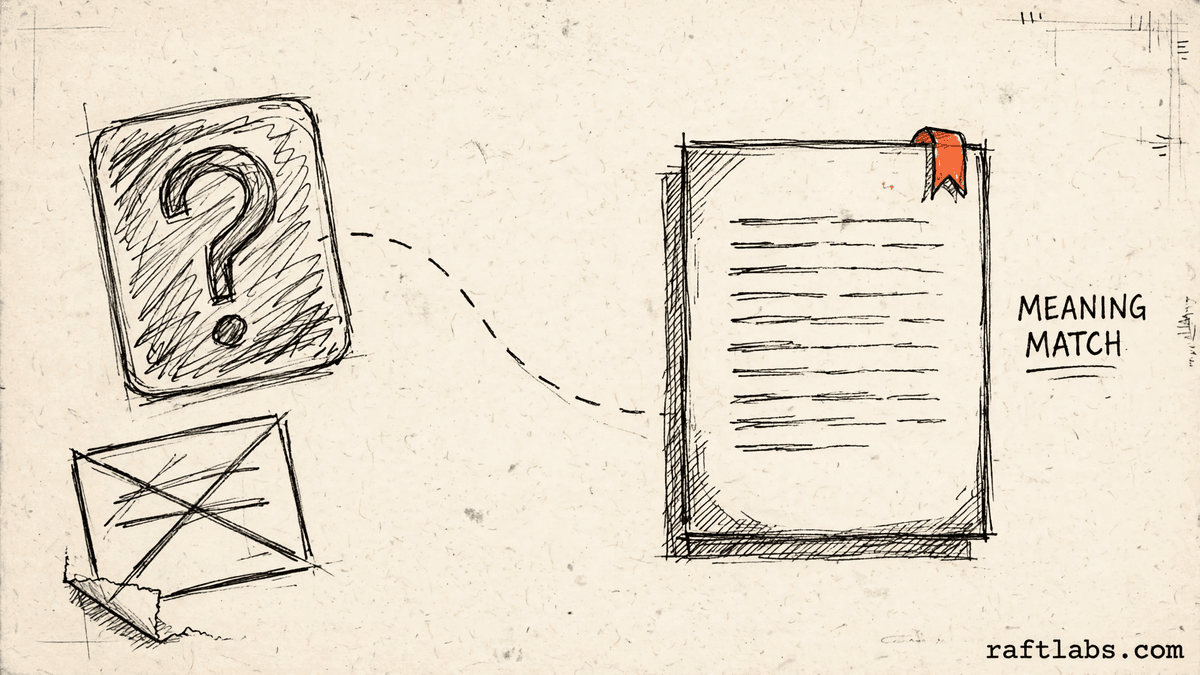
Think of it this way: Keyword search is a librarian who fetches only the exact title you name. Semantic search is a librarian who listens to what you are trying to do and brings the book that covers it, whatever its title says.
On a bank's help center, a customer types 'stop paying for the account I closed'. Keyword search finds nothing. Semantic search returns the account closure and final billing policy, because that is what the question means.
A law firm's juniors search past matters by describing the situation instead of guessing the file name. A query about a supplier who missed deliveries during a strike surfaces a five-year-old dispute with the same shape, which becomes the starting draft.
When people search in their own words across policies, manuals, contracts, or a help center, and the cost of 'no results' is a support ticket or a lost customer. For exact lookups: an order number, a policy code, a name. Keyword and database search are exact, faster, and cheaper there. Most strong setups run both and route by the kind of query.
RaftLabs points the model at your documents and your rules, then checks the answers against cases you already trust. That surrounding work is where these projects succeed or stall. The related work on our side is AI search and semantic search.
This sits with the other building & tuning terms on the glossary. How a general model gets pointed at your documents, your tone, and your workflow. Worth reading next: Fine-tuning, Retrieval-Augmented Generation (RAG), and Prompt Engineering.
Frequently asked questions
Straight answers to what buyers ask before they scope. Still stuck? .
- Your current search most likely matches words. If the document says 'termination' and the customer says 'cancel', there is no match. Semantic search compares meaning, so those two meet. The visible difference is fewer zero-result searches and fewer tickets that a document already answered.
- No. It sits on top of them as the finding layer. Your documents stay where they are; the system keeps a meaning map of them and points each question at the right one. If the underlying documents are outdated, semantic search finds the outdated answer faster, so the library still needs an owner.
Work with us
Tell us what's broken.
Tell us what's not working in your business. We'll find the real problem and tell you exactly what it would take to fix it.
- Scope and cost agreed before work starts. No surprises. No obligation.
- Working prototype within 3 weeks of kickoff.
- Pay by milestone. You see progress before each invoice.
- 60-day post-launch warranty. Bug fixes, UI tweaks, and deployment support. No retainer.
- All conversations are NDA-protected.