Foundations
What is natural language processing?
It is the layer under most AI features a customer ever touches: the assistant that reads a message, the tool that sorts documents, the search that understands a plain question. When it misreads intent, every feature built on it misfires.
In plain terms
Natural language processing is the part of AI that lets software read, sort, and write everyday human language, in messages, documents, and speech.
Also called NLP.
Natural language processing, usually shortened to NLP, is how software works with language the way people actually write and speak it, with typos, shorthand, and half-finished sentences. It covers reading a message and working out what it means, sorting it, pulling facts out of it, and writing a reply that makes sense.
Most AI features your customers will ever touch sit on top of it. The assistant that answers a support question, the tool that files a document, the search box that understands a plain question: each one starts by reading language and deciding what the person wants. When that reading is wrong, the rest of the feature is wrong too, however good it looks.
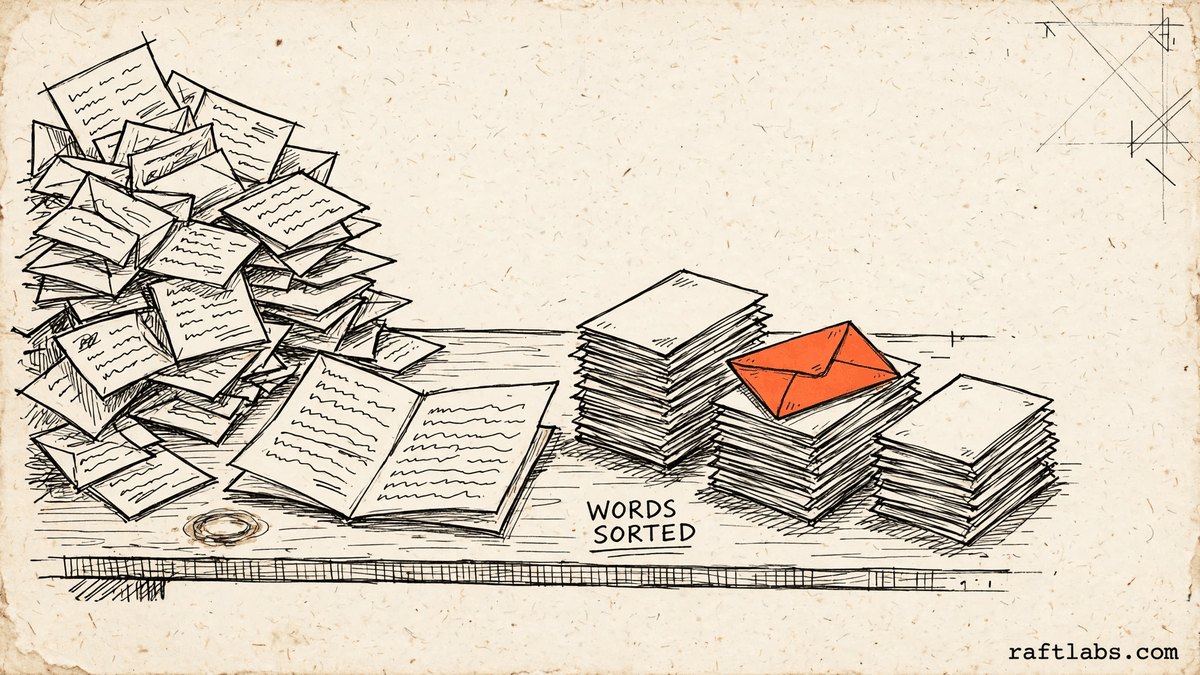
Think of it this way: Think of it as a clerk who reads every incoming letter, works out what the writer wants, and routes it to the right desk, at a volume no team of clerks could match.
An insurer uses natural language processing to read claim emails, pull out the policy number and the type of loss, and file each one under the right queue before a handler opens it.
A property manager gets 300 tenant emails a week. The system reads each one, marks the leaks and lockouts as urgent, files the rent questions, and drafts replies for the routine ones. The manager starts the day on the five messages that actually need judgment.
When the input arrives as ordinary language: emails, tickets, contracts, reviews, or spoken requests, and a person currently reads it just to decide what it is and where it goes. When the input is already structured, like a form with fixed fields or a spreadsheet of figures. Plain rules or a database query handle that faster and with fewer surprises.
You do not need to pick a model from this page. RaftLabs starts from the job: the documents, the decision, and what a wrong answer costs. You see a working version before a large build. The related work on our side is NLP development.
This sits with the other foundations terms on the glossary. The words under every AI conversation, from the model itself to the data it learned from. Worth reading next: Artificial Intelligence (AI), Machine Learning (ML), and Large Language Model (LLM).
Frequently asked questions
Straight answers to what buyers ask before they scope. Still stuck? .
- No. NLP is the job: reading and writing human language. A large language model is one tool for doing that job, and currently the strongest one. Older NLP used smaller, narrower tools trained for one task, such as spotting names in a contract, and those still run plenty of production systems.
- It usually means the model is not the hard part. The cost sits in your language: how messy the documents are, how many ways customers say the same thing, and how you will check the reading is right. A pilot on your own messages shows that cost faster than any proposal.
Work with us
Tell us what's broken.
Tell us what's not working in your business. We'll find the real problem and tell you exactly what it would take to fix it.
- Scope and cost agreed before work starts. No surprises. No obligation.
- Working prototype within 3 weeks of kickoff.
- Pay by milestone. You see progress before each invoice.
- 60-day post-launch warranty. Bug fixes, UI tweaks, and deployment support. No retainer.
- All conversations are NDA-protected.