Foundations
What is data labeling?
It is the quiet line item that decides whether a model learns the right lesson. Rushed or inconsistent labeling teaches the system the inconsistency, and the project pays for it later as accuracy problems nobody can trace.
In plain terms
Data labeling is the human work of marking examples as right, wrong, or sorted into categories, so a model has something clear to learn from.
Also called Data Annotation.
Data labeling is the work of marking examples with the right answer so a model can learn from them. This photo shows a defect. This email is a complaint. This transaction is fraud. The model never sees your intention, only these marked examples, so they are the most direct statement of what you want it to learn.
It is also where projects quietly succeed or fail. Two people labeling the same cases differently teach the system to be inconsistent, and no model choice fixes that. The fix is unglamorous: written rules, a small test set everyone labels the same way, and a named person who settles disagreements. Budget for that before you budget for volume.
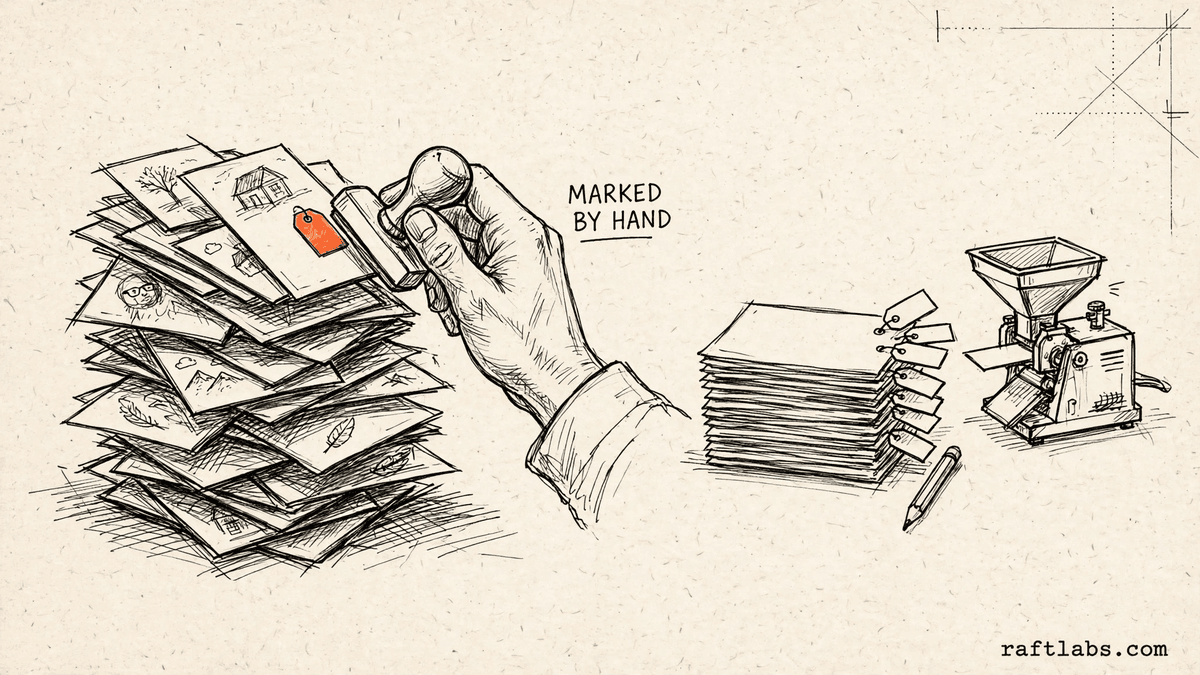
Think of it this way: Labeling is marking the answer key before the exam. The student can only learn what the key says is right, so a sloppy key produces a confidently wrong graduate.
Before training a system to sort support tickets, a company has two staff members label 5,000 old tickets. Where they disagree, a lead decides the rule and writes it down. That rulebook, not the model, is what makes the sorting consistent.
A retailer labels product photos for a visual search feature. Early on, one labeler tags a handbag by color and another by style, and the search results feel random. A one-page rule, tag by style first, then color, fixes more than a month of model tuning had.
Whenever a model must learn a judgment from your examples: sorting, scoring, flagging, or recognizing. Label a modest set carefully, with written rules, before paying to label a large one. When the answers already sit in your documents and the system can look them up at question time instead. Retrieval needs no labeled training set, and it is the cheaper first step for most knowledge questions.
You do not need to pick a model from this page. RaftLabs starts from the job: the documents, the decision, and what a wrong answer costs. You see a working version before a large build. The related work on our side is Data engineering.
This sits with the other foundations terms on the glossary. The words under every AI conversation, from the model itself to the data it learned from. Worth reading next: Artificial Intelligence (AI), Machine Learning (ML), and Large Language Model (LLM).
Frequently asked questions
Straight answers to what buyers ask before they scope. Still stuck? .
- Your team should label the first set, because the disagreements are where your real rules live. Once the rules are written and tested, a service can label volume against them, with your team checking samples. Outsourcing the first set outsources the decisions the whole system will learn.
- Less than vendors often suggest, if it is consistent. A few thousand well-labeled examples usually teach more than tens of thousands of rushed ones, and a pilot shows the real number: label a small set, train, measure, then decide if more data or better rules is the gap.
Work with us
Tell us what's broken.
Tell us what's not working in your business. We'll find the real problem and tell you exactly what it would take to fix it.
- Scope and cost agreed before work starts. No surprises. No obligation.
- Working prototype within 3 weeks of kickoff.
- Pay by milestone. You see progress before each invoice.
- 60-day post-launch warranty. Bug fixes, UI tweaks, and deployment support. No retainer.
- All conversations are NDA-protected.