Poultry Hatchery Software Development
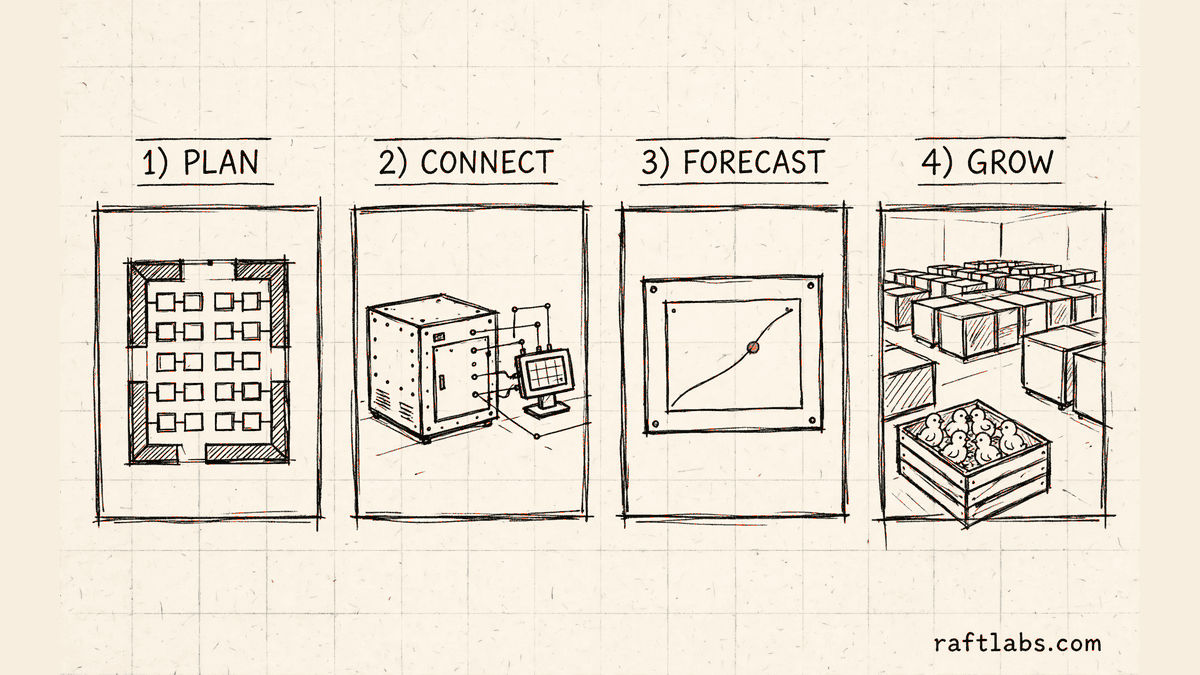
A hatchery sells chicks that do not exist yet. Orders are promised weeks ahead, against eggs still on breeder farms and machines that hold only so many trays. When egg supply, machine capacity, and chick orders live in separate spreadsheets, every promise is a guess. We build the system that holds one record per batch, from egg receipt to chick delivery.
One batch record per egg lot, from receiving through setting, candling, and hatch to delivery
Hatch forecasting from breeder flock supply, so orders are promised against eggs that will exist
Setter and hatcher capacity planned as one calendar, so a set is never planned into a machine that is already full
Chick orders allocated from real hatch output, with grading, vaccination, and dispatch on the same record
The problem
Sound familiar?
Egg supply in one spreadsheet, setter capacity in another, and chick orders in a third, so nobody can say whether next month's orders fit the eggs and machines you actually have?
Finding out on hatch day that a batch underperformed, because fertility and hatch results were never held against the flock and machine that produced them?
Short answer
RaftLabs builds custom poultry hatchery software for broiler, layer, and breeder hatcheries: one batch record from egg receipt through setting, candling, and hatch to chick delivery, hatch forecasting from breeder flock supply, incubator capacity planned against real orders, and chick order fulfilment, scoped and priced before work starts.
Who this is for
Hatchery teams we build for
Broiler hatcheries
High-volume chick production for meat bird farms, with orders promised against forecast hatches weeks ahead.
Layer and breeder hatcheries
Smaller, higher-value batches where flock identity and grading accuracy matter more than raw volume.
Integrated poultry groups
A hatchery supplied by several breeder farms, where egg supply, machines, and customer orders have to be planned as one operation.
Independent and specialist hatcheries
Turkey, duck, quail, and game bird hatcheries whose timings and grading rules no general product models.
01 Diagnosis
Problems we solve in poultry hatchery software
- 01Problem
Orders are promised against eggs and machines nobody has checked together
CostA chick order is a promise about biology and machinery at once: enough fertile eggs from the right flocks, setter space on the right day, hatcher space three weeks later, and a hatch rate that holds. On most hatcheries those four facts live in four places: an egg supply sheet, a machine plan on a whiteboard, an order book, and the planner's memory of what each flock usually hatches. Each one looks right on its own. Together they disagree quietly, and the disagreement surfaces on hatch day, when the chicks either exist or they do not and the customer is already waiting.
SolutionHatch planning that combines customer demand, forecast egg supply, hatch assumptions, and machine capacity in one workspace means an order is confirmed against all four facts at once. A shortfall shows weeks ahead, while eggs can still be sourced, sets can still be moved, and the customer can still be told the truth early.
- 02Problem
Egg lots lose their identity between receiving and setting
CostAn egg lot arrives with a history that decides how it should be handled: the breeder farm and flock it came from, the day it was laid, and how long it has been stored. At receiving that history is on the delivery paperwork. By setting day it is often a tray count and a date, because each hand-off, warehouse, reservation, set, is recorded in a different place and the lot identity is the first thing dropped. When the hatch disappoints, nobody can say whether the flock, the storage, or the machine was responsible, so the same mistake is available again next week.
SolutionA lot record that carries farm, flock, collection date, and storage age through receiving, reservation, and the actual set, with candling and hatch results read back against the same lot, turns a disappointing hatch into evidence. The hatchery learns which flocks and which storage patterns produce chicks, from its own records.
- 03Problem
Hatch results are known too late to change anything
CostFertility, the share of eggs that were fertile, is only visible at candling, partway through incubation, and the final hatch result is known on hatch day. On most hatcheries those results are written on hatch cards and filed, batch by batch, and never held against the flock, the egg age, or the machine that produced them. The planner setting next month's eggs is working from habit and reputation, not from the hatchery's own recent results, and a flock in decline or a machine drifting out of calibration is discovered by its cost, in chicks that never hatched.
SolutionCandling and hatch outcomes recorded on the batch and read by flock, by machine, and by egg age turn last month's results into this month's forecast. A falling flock or a failing machine shows as a trend while it is still a planning problem, not a hatch day surprise.
- 04Problem
Chick orders are fulfilled from memory on the busiest day of the week
CostHatch day compresses the whole business into a few hours: chicks are pulled, graded, counted, vaccinated where the customer requires it, boxed, allocated to orders, and dispatched, while the next set waits for the machines being emptied. Allocation done from a printed order list and memory produces the classic hatch day errors: a short order filled in full while a priority customer waits, grades mixed between boxes, and paperwork rebuilt at the end of the day from counts nobody fully trusts. The customer argument that follows costs more than the chicks.
SolutionAllocation built from the actual hatch output on the batch record, with grading, customer services such as vaccination, boxing, and delivery documentation drawn from the same figures, means the busiest day runs from one set of numbers. What was promised, what hatched, and what was delivered can be compared line by line.
02 What the system covers
Software for each part of the hatchery cycle
Egg receiving and lot records
One record per egg lot, from receiving to hatch: breeder farm, flock, collection date, storage age, cracks and rejects at intake, and reservation status. The lot identity follows the eggs through storage and setting instead of being retyped at each stage.
Hatch planning and forecasting
A planning view that holds customer demand, expected egg supply from your breeder flocks, hatch assumptions, and machine capacity in one place. Scenarios can be tested before a set is confirmed, so a promise to a customer rests on eggs and space that exist.
Setter and hatcher capacity
Every setter and hatcher planned on one calendar at its real tray capacity, with transfers scheduled when the set is planned. A machine due for service can be held out of the plan, and a set that does not fit shows before the eggs are moved.
Candling and hatch results
Fertility and embryo results captured at candling against the batch, then hatch output, culls, and breakout findings at pull. Results are reported by flock, by machine, and by egg age, so the forecast for the next set learns from the last one.
Grading, services, and order fulfilment
Chicks graded and counted at pull, customer services such as vaccination recorded per order, and boxes allocated from real hatch output. Shortfalls are shared by the rule you set, not by whoever shouts loudest on hatch day.
Delivery, settlement, and reporting
Delivery notes and settlement worked out from boxes actually delivered at the agreed grade. Period reports for owners and integrated group management export cleanly, and a closed period stays closed once it is signed off.
Integrations
Connected to the breeder farm and the office
Egg supply, machine data, and accounting connect into one batch record, because a forecast built on retyped numbers helps nobody.
- Production data
- Breeder farm egg dispatch records · Incubator controller readings · Grading and counting equipment
- Office systems
- Accounting integration · ERP integration · Excel and PDF reporting exports
03 Buy, rent, or own
Stay on the platform while your species, machines, and sites fit what it assumes.
The hatchery software question is really about whether your production model fits the product, or the product has started deciding how you plan.
Buy or rent
A hatchery platform, while your operation fits its model
Faster to start and sound when your species, machine layout, grading rules, and site structure match what the product assumes.
Spreadsheets, while one planner can still hold the hatchery
Keep the sheets while volumes are small, the planner is not a single point of failure, and customers accept informal answers.
Own custom software
When your machines or grading rules do not fit the product model
Your team records the real operation in side notes because the system has no place for it.
When breeder supply, machines, and orders need to meet in one record
Egg lots, capacity, and customer promises only become reliable when they land on the same batch.
When the batch record is an asset you want to own
The history of every flock, machine, and hatch stays in systems you control, with no per-seat lock-in.
Bottom line
Stay on the platform while your operation fits its model and the fees stay reasonable. Own the system when the workarounds, the disconnected supply records, or the hatch day burden cost more than running your own record.
04 How we work
How a poultry hatchery software project runs
- Step 0101
Discovery and connection scoping
Two to three weeks mapping how your hatchery actually runs: the species and breeds you set, your setter and hatcher layout, your breeder farm supply, and every farm record, controller, and office system the software has to talk to. This step surfaces the connection requirements that cause rework when they are found halfway through a project.
- Step 0202
Data model around lots and batches
We design the record around egg lots and batches, the objects your team actually works in, and the connection layer for breeder farm records and accounting. The riskiest connection, usually a farm supply feed or a capacity rule, is tested with real hatchery data early, because it is the most common cause of a timeline slip.
- Step 0303
Working software in two-week cycles
You review working software every two weeks, not wireframes. Each cycle delivers a usable slice: the lot record, then planning and forecasting, then candling and hatch results, then fulfilment and reporting. Scope is fixed and priced before the work starts, so the number does not move unless you change what you are asking for.
- Step 0404
Testing on the hatchery floor and handover
We test egg room and hatch day entry under your real conditions, including the pace of a pull morning, because a record with gaps fails exactly when it matters. You get a documented, tested system, your data in your control, and a handover so your team or ours can run it.
05 Track record
What we have shipped in operations software
- Countries reached on a multi-carrier shipping platform we shipped
- 70+
- Shipments processed in year one on that platform
- 2K+
- Customers migrated to it with zero downtime
- 200+
- Fixed-cost rebuild, scoped up front
- 14 wk
07 Client voices
What our clients say
Three-year average engagement. Founders and operators describing the work in their own words. No marketing varnish.
08 Why us
Why choose us?
- 01
The record is designed around your hatchery
Species, machine layout, grading rules, and supply structure are set up for your operation, not picked from a fixed list written for someone else's hatchery. - 02
Connections are scoped before the price
Breeder farm records and accounting connections are mapped in discovery, so the fixed price covers the part that usually breaks a hatchery project. - 03
Fixed cost before work starts
Scope is agreed and priced before development, and you review working software every two weeks, so surprises surface while they are still cheap to fix.
Frequently asked questions
Straight answers to what buyers ask before they scope. Still stuck? .
Poultry hatchery software runs a hatchery day to day. It holds egg lot and batch records from receiving to delivery, hatch planning and forecasting, setter and hatcher capacity, candling and hatch results, chick grading and order fulfilment, and delivery settlement. It differs from poultry farm software because the farm manages birds alive on the ground over months, while the hatchery manages eggs and chicks on a fixed incubation clock, against orders promised before the chicks exist.
A simple percentage takes last season's average hatch rate and applies it to every set alike. A forecast built on the batch record uses the evidence for this set: the flock's recent fertility at candling, the age of the eggs at setting, and the machines the batch will pass through. The number moves as candling results arrive, so the orders depending on that hatch can be confirmed, trimmed, or topped up from another batch while there is still time.
No. Existing machines and controllers usually stay in service. We scope what each controller can send during discovery, connect the ones that expose their readings, and keep manual entry at the machine for the rest, so a reading lands on the same batch record either way. Replacing working incubation hardware is rarely the right first spend.
First phases start at $10K. A focused single-system build typically takes 10 to 16 weeks. A multi-site platform with breeder farm connections and accounting integration typically runs 4 to 6 months. We scope every project before pricing. Fixed cost, agreed before work starts, with every figure derived from a two-person team at $35 to $40 an hour. A discovery phase scopes the connections, because they drive most of the variance.
No. We often start with the part that hurts most, the batch record or the planning and forecast view, and connect or replace the rest in stages. If a full replacement is the right call, we scope it honestly, but the default is to fit what you already run rather than force a hatchery-wide change in the middle of a setting cycle.
Related farming and operations software
- 01
Poultry hatchery management software
day-to-day hatchery management: egg sets, capacity, forecasts, and chick orders
- 02
Agriculture software development
crop production, field operations, and farm records for growers
- 03
Aquaculture software development
pond, tank, and hatchery records for fish and shrimp operations
- 04
Custom software development
owned software for workflows standard tools cannot handle
Get a buy-or-own plan for your hatchery.
Tell us how many setters and hatchers you run, where your eggs come from, and where the plan breaks down today. We will tell you how we would approach it.
- Scope and cost agreed before work starts. No surprises. No obligation.
- Working prototype within 3 weeks of kickoff.
- Pay by milestone. You see progress before each invoice.
- 60-day post-launch warranty. Bug fixes, UI tweaks, and deployment support. No retainer.
- All conversations are NDA-protected.