From prototype to production: the process and the timeline
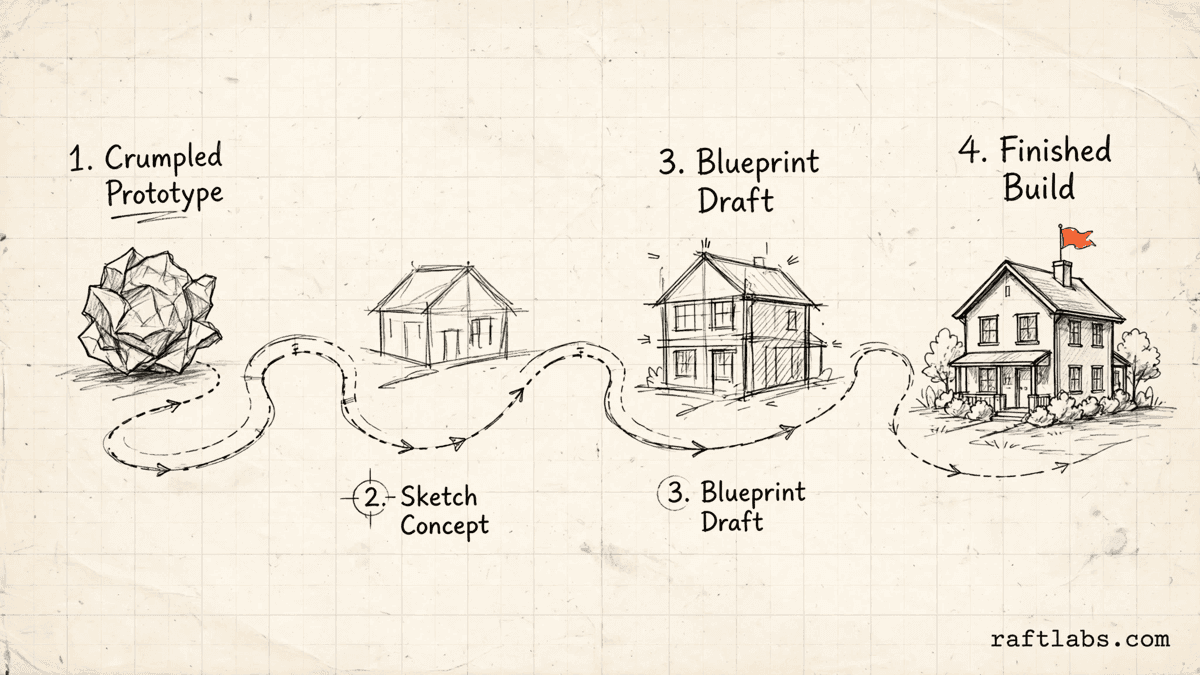
Moving a prototype into production is four phases of work, not one long rewrite. Here is the process RaftLabs follows, what happens in each phase, and the timelines real projects have actually taken.

In this article
Short answer
The move from prototype to production runs in four phases: name the decision the release must support, cut the scope to one complete user journey, release to controlled real users, then decide what the evidence earns. Comparable RaftLabs projects have taken about 12 to 14 weeks.
Key takeaways
- Production is not a bigger prototype. It is the same core journey, carried by real sign-in, real data, and safeguards a demo never needed.
- The process has four phases: name the decision, cut to one complete journey, release and observe, then decide what the evidence earns.
- Timelines depend on scope, not optimism. Comparable RaftLabs projects include a booking platform released in 14 weeks and a telehealth rollout reaching 50+ clinics in 12 weeks.
- An audit before the work starts is what keeps the timeline honest, because the parts marked replace are known before anyone promises a date.
Every founder with a working prototype asks the same two questions. What happens next, and how long will it take? The honest answer to the second question depends entirely on the first. Production work is not one long effort. It is four phases, each with a clear job, and the timeline follows from how much of your prototype survives the first phase.
This article walks through the process RaftLabs describes on its MVP development page, phase by phase, with the timelines that real projects have taken.
The short answer
The process has four phases. Name the decision the release must support. Cut the scope to one complete journey. Release to controlled real users and observe. Then decide what the evidence earns. Before phase one, a prototype-to-production audit grades what can stay, what needs hardening, and what must be replaced. That grading is what makes the rest of the timeline predictable.
Phase one: name the decision
Every production release should exist to answer one expensive question. Will serviced-apartment guests complete a booking without staff help? Will clinics actually run their day through this system? Phase one turns your brief into that question, names the risky assumption underneath it, and defines the signal that would settle it.
This phase feels slow to founders who want to see screens. It is the phase that saves the most time. A release without a named decision collects a feature from everyone with an opinion, and a release that tests everything tests nothing. Write the decision down. Every later argument about scope gets settled against it.
Phase two: cut to one complete journey
Phase two takes the prototype and reduces it to the smallest journey a real user can finish end to end. Not the smallest feature list. The smallest complete journey, carried properly: real sign-in, clear permissions for who can see and change what, data organized so records stay trustworthy, and measurement that records what users actually did.
The audit grades drive this phase. Parts graded keep stay as they are. Those graded harden get their production safeguards here. Parts graded replace are redone, and anything graded defer waits outside the release, however much someone loves it. This is also where connections to payment, email, and other systems get their failure handling, so a problem in an outside service does not strand your customer mid-journey.
Phase three: release and observe
Phase three puts the working product in front of controlled real users. Controlled matters. The first group should be small enough that the team can watch closely, respond fast, and separate two kinds of problems that look identical from the outside: the product confusing people, and the product breaking. One is a design lesson. The other is a defect. Treating them as the same problem wastes the whole release.
Observation is not a victory lap. The team watches where users hesitate, where they abandon the journey, and what they ask support instead. That record is the evidence the release existed to produce.
Phase four: decide what the evidence earns
The final phase is a decision meeting, not a celebration. Based on observed use, the options are to improve the journey, expand to the next one, reposition the product, pause, or stop. All five are legitimate outcomes. A release that produces a confident stop has done its job, because it spent a bounded budget instead of an unbounded one.
This is also where the next phase gets priced. A broader product is priced after the evidence shows which workflows have earned further investment, not before.
What the timeline actually looks like
Timelines follow scope, so treat any date promised before an audit with suspicion. That said, real projects give useful reference points. The City Break Apartments booking and keyless-entry platform, which took serviced-apartment bookings online, was released in about 14 weeks, and the business went on to record 7x more self check-ins and 25 percent more direct revenue. A telehealth product reached 50+ clinics in 12 weeks. UrShipper, a shipping platform taken over after earlier teams had stalled, saw 214 existing customers moved into the working portal on a similar initial timeline of about 14 weeks.
Read those numbers correctly. They are not a promise that your product takes 12 to 14 weeks. They show what focused scope looks like when it is timed: one core journey, a team that has done the audit first, and no mid-project change of destination. A wider first release takes longer. A prototype with more parts graded replace takes longer. The audit exists so you hear that before signing, not after.
Where timelines usually slip
Three patterns account for most delays. The first is scope growth during phase two, where deferred features sneak back in one small request at a time. The second is late discovery: a connection, a data problem, or a permissions rule that nobody checked until it blocked real users. The audit is designed to surface these early, while they are still cheap. The third is decision delay on the client side. The process needs one person who can answer questions about the business within days, not weeks.
What it costs, and what you own
RaftLabs MVP development engagements start at $10K, with scope and price agreed in writing before work starts. Each phase carries written scope and a clear statement of what done looks like, and new work enters only after it is priced and approved. Clients own 100 percent of the code, and the studio holds a 4.9 rating on Clutch.
If your prototype is winning interest but raising questions about data, sign-in, connections, or ownership, the sequence is simple. Audit first. Then run the four phases with the grades as your map. The founders who move fastest are rarely the ones who skipped steps. They are the ones who knew, in writing, what each step had to prove.
Ask an AI
Get an instant summary of this post from your preferred AI assistant.
Frequently asked questions
Straight answers to what buyers ask before they scope. Still stuck? .
- It depends on how much of the prototype can be kept and how wide the first release is. As reference points from RaftLabs case studies, a serviced-apartment booking platform was released in about 14 weeks, and a telehealth product reached 50+ clinics in 12 weeks. A narrow first journey usually lands faster than a broad one.
- Four phases. First, name the decision the release must support and the signal that would prove it. Second, cut the scope to one complete journey a real user can finish. Third, release to controlled real users and watch what happens. Fourth, decide from the evidence whether to improve, expand, reposition, pause, or stop.
- Usually not. A prototype-to-production audit grades each part keep, harden, replace, or defer. Sound parts stay, close parts get safeguards, and only parts that cannot carry real users safely are replaced. Throwing everything away is the expensive option, not the default.
- Because the release exists to answer one expensive question with real evidence. One complete journey, finished properly with sign-in, permissions, and measurement, produces a clear answer. Five half-finished journeys produce confusion about what users actually wanted.
- RaftLabs MVP engagements start at $10K, with scope and price agreed in writing before work starts, and clients own 100 percent of the code. The audit grades determine where the money goes, so the price reflects known work rather than guesses.