Human in the loop design for AI agents: where people stay in charge
An AI agent should not need a human for every step, and should never act alone on the steps that matter most. This guide shows how to split work between agent, approver, and reviewer.
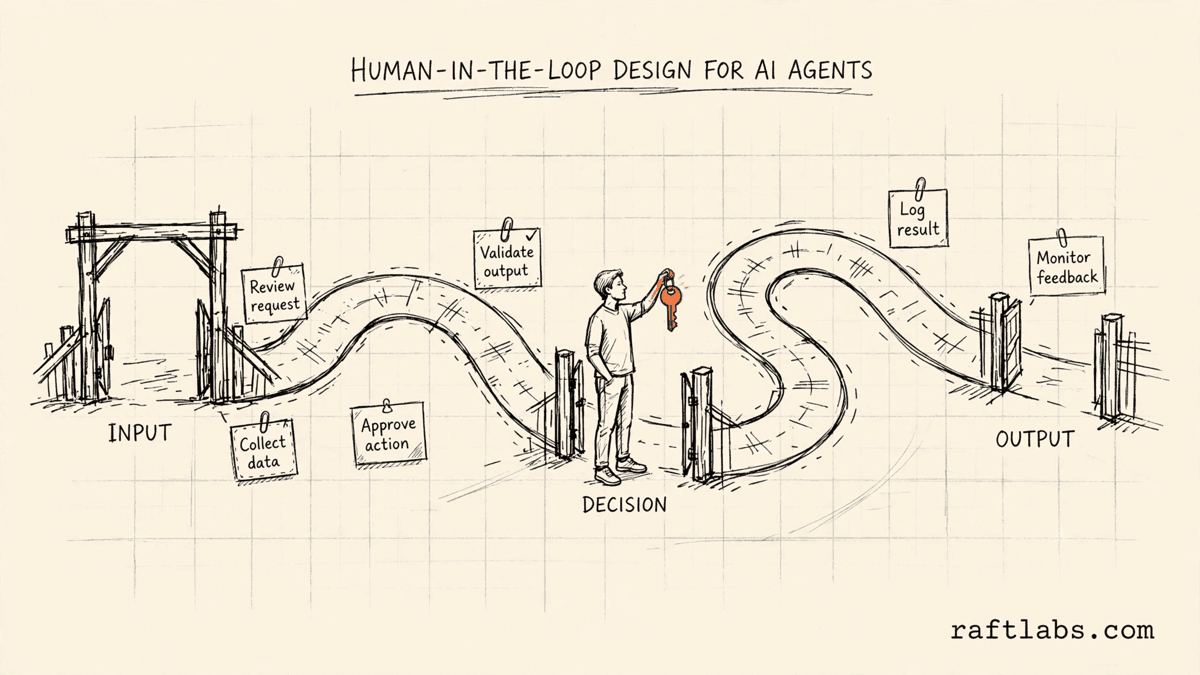

In this article
Short answer
Human in the loop design decides, action by action, what an AI agent may do alone, what needs a person to approve first, and what a person reviews afterwards. High cost, hard to reverse, or customer facing actions need approval first. Routine, reversible work can run alone with a clear audit trail and a fast escalation path.
Key takeaways
- Sort actions by cost of a mistake and how hard they are to undo. That sort decides where humans belong.
- Approval before the action suits refunds, cancellations, and anything a customer will feel. Review after the action suits summaries, drafts, and tidy up work.
- An approval step only works if the person sees the reason, the source data, and the exact change proposed.
- Escalation needs a named owner, a time limit, and a safe pause. A queue nobody owns is not an escalation path.
- The audit trail should let a manager rebuild any decision later: what ran, who approved it, and what changed.
An AI agent that asks a person about every step is just slow software with extra questions. An agent that never asks can spend money, change records, and message customers before anyone notices a mistake. Good design sits between those two failures.
This guide shows how to make that call, action by action. It is written for founders and operations leads who will own the agent after it goes live, not for the team writing the code.
The short answer for busy founders
Human in the loop design decides, action by action, what an AI agent may do alone, what needs a person to approve first, and what a person reviews afterwards. High cost, hard to reverse, or customer facing actions need approval first. Routine, reversible work can run alone with a clear audit trail and a fast escalation path.
Start with the cost of being wrong
Do not start by asking what the agent can do. Start by listing what it might do wrong, and what each mistake would cost.
A wrong summary costs a few minutes. A wrong refund costs money and trust. A wrong message to a customer in your name can cost the relationship. Those three mistakes should not share the same level of human involvement.
Use two questions for every action the agent can take. How much does a mistake cost? And how hard is the action to undo? High cost or hard to undo means a human approves first. Low cost and easy to undo means the agent can act, with review later.
The three levels of human involvement
| Level | When to use it | Examples |
|---|---|---|
| Agent acts alone | Low cost, easy to undo, easy to check later | Drafting a summary, sorting requests, gathering records |
| Person reviews after | Work is routine but patterns matter | Daily reports, tagged conversations, suggested replies |
| Person approves first | High cost, hard to undo, or customer facing | Refunds, cancellations, contract changes, outbound promises |
Most useful agents use all three levels in one workflow. An agent might gather records alone, draft a reply for review, and wait for approval before sending it. That mix is the design. It is not a sign of weak automation. It is how you get speed where speed is safe and care where care matters.
Our AI agent development service scopes this split during design, because adding approval steps after launch is slower and more expensive than planning them from the start.
Design approval steps people can actually use
An approval step fails when the person cannot judge what they are approving. A screen that says "approve this action" with no context trains people to click yes.
Show four things every time. What the agent proposes to do, in plain language. Why it proposes it, with the source data visible. What will change if the person says yes. And what happens if they say no or do nothing.
Make saying no as easy as saying yes. Add a simple way to edit the proposal instead of only accepting or rejecting it. Many proposals are almost right. An edit button turns a rejection into a correction the system can learn from.
Watch approval time as a health signal. If approvers take seconds on complex cases, they have stopped reading. If they take days, the queue design is wrong. Both problems are design problems, not people problems. The NIST AI Risk Management Framework treats this kind of human oversight as part of managing AI risk, not as an optional extra.
Design review so it improves the system
Review after the action is not a rubber stamp. Its job is to find patterns.
Each week, a named reviewer should read a sample of completed work and all of the failures. Group what they find. Repeated small errors usually share one cause, such as unclear source data or a rule the business changed without telling the agent team.
Feed those findings into testing. Our AI agent testing and evaluation guide shows how real failures become the test set that stops the same mistake returning, and the companion AI agent evaluation framework piece sets out how to structure that scoring over time.
Review also decides when an action can move levels. If an agent has handled a task well for months, with review showing steady quality, that task may move from approval first to review after. Make that change on evidence, in writing, not on a feeling that things seem fine lately.
Escalation: the path for "I do not know"
Every agent will meet a case it should not decide. Escalation is the designed path for that moment.
A working escalation has five parts. The agent pauses the task safely, so nothing half happens. It explains its uncertainty in plain language. It passes the full context, not just the last message. It goes to a named person or a staffed queue, never to a general inbox. And it has a time limit, after which the task stays paused and a manager is told.
Test escalation before launch with awkward cases on purpose. Give the agent a request that conflicts with a company rule. Give it missing data. Give it an angry customer. Each case should arrive with a person, complete and calm, with no silent guessing along the way.
The human side of this pattern connects to the operations routine in our guide to deploying conversational AI in production. Agents and conversational systems fail in different ways, but both need owners, queues, and time limits that a real team can honour.
Keep an audit trail a manager can read
An audit trail is your memory of every important decision. Build it for the manager who will ask questions in three months, not for the engineer who wrote the code.
For each significant action, record the task, the data used, the action proposed, who approved or edited it, the final action, and the time of each step. Store it where the business can read it without asking the development team for a special report.
That record does three jobs. It settles disputes about what happened. It shows regulators and customers that a person stayed in charge where it mattered. And it gives your review process the raw material to improve the system. The Anthropic guidance on building effective agents makes a related point: simple, transparent patterns are easier to check and trust than complex ones nobody can follow.
A worked example in plain terms
Imagine an agent that handles booking changes for a serviced apartment business. It can check availability alone. It can draft the new booking for review. It must get approval before charging a difference in price or cancelling the old booking. If the guest asks for something outside policy, it escalates with the full conversation attached.
That design is not cautious for its own sake. Availability checks are cheap to redo. Charges and cancellations are not. The human effort lands exactly where a mistake would hurt.
RaftLabs has live work in this area of operations: City Break recorded 7x self check-ins and 25% more direct revenue, and UrShipper migrated 214 customers onto a new platform. Those results came from systems where routine work ran automatically and people kept control of the decisions that carried risk. For the wider service picture, see our AI development service.
A checklist before your agent goes live
Every action the agent can take sits at one of the three levels, in writing.
Approval screens show the proposal, the reason, the source data, and the result of saying yes.
Review has a named owner and a weekly slot, not a vague intention.
Escalation pauses safely, carries full context, and has a time limit.
The audit trail can be read by a manager without technical help.
Someone has tested the awkward cases, not only the happy path.
If any line is missing, fix it before launch. Human in the loop design is cheapest on paper, most expensive after a public mistake, and most valuable on the ordinary days when it quietly keeps good work fast and risky work supervised.
Ask an AI
Get an instant summary of this post from your preferred AI assistant.
Frequently asked questions
Straight answers to what buyers ask before they scope. Still stuck? .
- It is the design of where people stay involved when an AI agent works. For each action, you decide whether the agent acts alone, a person approves before it acts, or a person reviews after it acts. The choice depends on the cost of a mistake and how hard the action is to reverse.
- Actions that spend money, change customer records, cancel or promise something, send messages in your name, or touch regulated data should need approval first. If a mistake would be expensive, embarrassing, or hard to undo, a person should see it before it happens.
- Approval happens before the action, so a person can stop a mistake. Review happens after the action, so a person can spot patterns and correct the system. Approval protects single high risk actions. Review improves the whole system over time.
- The agent should pause the task safely, explain what it is unsure about in plain language, and pass the full context to a named person. Set a time limit for a reply. If nobody replies in time, the task stays paused rather than guessing.
- It should include the task, the data the agent used, the action proposed, who approved or changed it, the final action, and the time of each step. A manager should be able to rebuild any decision later without asking the agent team to explain it from memory.