Cost to Build a Vacation Rental App Like Airbnb or Vrbo in 2026
A vacation rental marketplace MVP costs $55K to $95K over 14 to 20 weeks. This guide breaks down the full cost across guest app, host dashboard, and booking engine, explains how Airbnb's search and trust systems actually work in plain language, covers online-travel-agency (OTA) commission math, and shows why clone scripts end up costing more than custom builds.


In this article
Short answer
Building a vacation rental app like Airbnb costs $55K-$95K for a web-only MVP (14-20 weeks) with listings, location-based (geo) search, booking, Stripe escrow (money held until after check-in), messaging, and reviews. A full platform with native apps, instant book, and dynamic pricing runs $100K-$160K (22-34 weeks). Multi-region scale with listings and calendars kept in sync across Airbnb, Booking.com, and Vrbo runs $150K-$240K+.
Key takeaways
- You are building three products, not one: a guest app, a host dashboard, and an admin panel, each with completely different workflows. The host product takes as much engineering effort as the guest product.
- Your V1 needs six things: listings, geo-filtered search, an availability calendar with double-booking prevention, Stripe escrow payments, messaging, and two-way reviews. Everything else is V2.
- The payment escrow system is the most expensive single component at $20K to $45K. Do not build your own escrow; Stripe Connect handles multi-party payout routing (splitting each booking payment between host and platform) out of the box.
- Airbnb's search ranks listings by the probability of a completed booking across 100+ signals: listing quality, popularity, total price, and host reliability. Availability is a hard filter, not a ranking factor.
- The 2026 commission math is stark: Airbnb now takes a 15.5% host-only fee, Vrbo 12%, and Booking.com around 15%. At $400K in annual GMV (total booking value), a 15% OTA fee (OTA: online travel agency) costs $60K a year. A custom platform pays for itself in 12 to 24 months.
- Supply is the product. Seed at least 50 hosts and personally recruit them before opening to guests. A polished booking platform with 40 listings is a portfolio website, not a marketplace.
You run a boat charter company in the Florida Keys. You list on Airbnb Experiences and a couple of specialty directories. Guests find you, but then the platform takes 18% of every booking, you cannot pre-qualify charterers for safety certifications, and the platform shows your $1.2K sunset charter next to a $45 kayak rental. The category is wrong. The margins are wrong. The audience quality is wrong.
Or you manage 80 vacation rentals across the Smoky Mountains and Gulf Coast. You pay your channel manager per listing per month, plus transaction fees on top of what Airbnb, Booking.com, and Vrbo already take. Every time you add a listing, your software bill goes up and you own none of the infrastructure it pays for.
These are the real businesses that commission vacation rental and booking platforms. Not clones of Airbnb. Platforms that solve one inventory problem an OTA handles badly. This guide covers what it costs to build them, what the alternatives cannot do, and where these projects break down.
The cost, up front
A web-only vacation rental marketplace MVP costs $55K to $95K and takes 14 to 20 weeks. The full category range:
| Scope | Timeline | Cost |
|---|---|---|
| Prototype (clickable demo to validate the idea before a full build) | varies | from $10K |
| Vacation rental marketplace MVP (web-only, one niche or region) | 14-20 weeks | $55K-$95K |
| Full platform (web + native apps, instant book, dynamic pricing) | 22-34 weeks | $100K-$160K |
| Scale (multi-region, channel sync, fraud systems) | 32-44 weeks | $150K-$240K+ |
| Short-term rental (STR) management platform like Guesty (V1 to full platform) | 14-20 to 30-40 weeks | $90K-$280K |
| Hotel direct booking engine (one chain or group, PMS (property management system) sync) | 6-10 to 12-20 weeks | $15K-$120K+ |
| Niche OTA like Expedia or Booking.com (one inventory vertical) | 16-22 weeks | $70K-$130K |
| Tours and activities platform like GetYourGuide (V1) | 12-16 weeks | $65K-$120K |
| Monthly running costs (hosting, maps, messaging, ID verification) | ongoing | $1K-$4K at launch, $5K-$15K at scale |
The range inside each tier moves with payment complexity, calendar concurrency requirements, channel integrations, and whether you run native apps.
Who actually builds a vacation rental marketplace
Niche rental operators whose assets do not fit Airbnb's model. Boat fleets needing captain availability tracking alongside vessel availability, hourly pricing, and damage deposits tied to hull value. RV fleets needing inspection documentation and delivery logistics. Equipment rental needing condition verification at checkout and return. These booking models are genuinely different from home rentals, and they do not map onto Airbnb's checkout flow.
Regional luxury villa managers selling an experience, not a bed. A villa collection in one geography competes on curation and concierge service. Airbnb's listing page cannot carry that context. A dedicated platform controls the guest experience from first browse to post-stay follow-up, including pre-arrival requests, in-stay requests, and repeat guest pricing at zero OTA cost.
Property management companies outgrowing their software bills. At 50 to 100 listings, per-listing SaaS fees plus per-booking transaction fees become a real line item. These operators do not need a marketplace at all. They need operator software: calendar sync, a unified inbox, housekeeping tools, and owner statements. That is the Guesty-style build, covered later in this guide.
Hotel networks shifting volume to direct booking. A group of 8 to 15 properties paying 15 to 17% commission on $2M+ in OTA bookings recovers a $50K direct booking engine in under 90 days if it shifts 30 to 40% of bookings to direct.
"You need to own the guest. Not just the listing, not just the booking, the relationship. Every transaction through an OTA is a lease on a customer, not an owned relationship. And the rent goes up every year."
Simon Lehmann, co-founder and CEO of AJL Atelier, former President of Phocuswright, speaking at the Short Stay Summit 2023.
How the real product thinks: search, trust, and the calendar
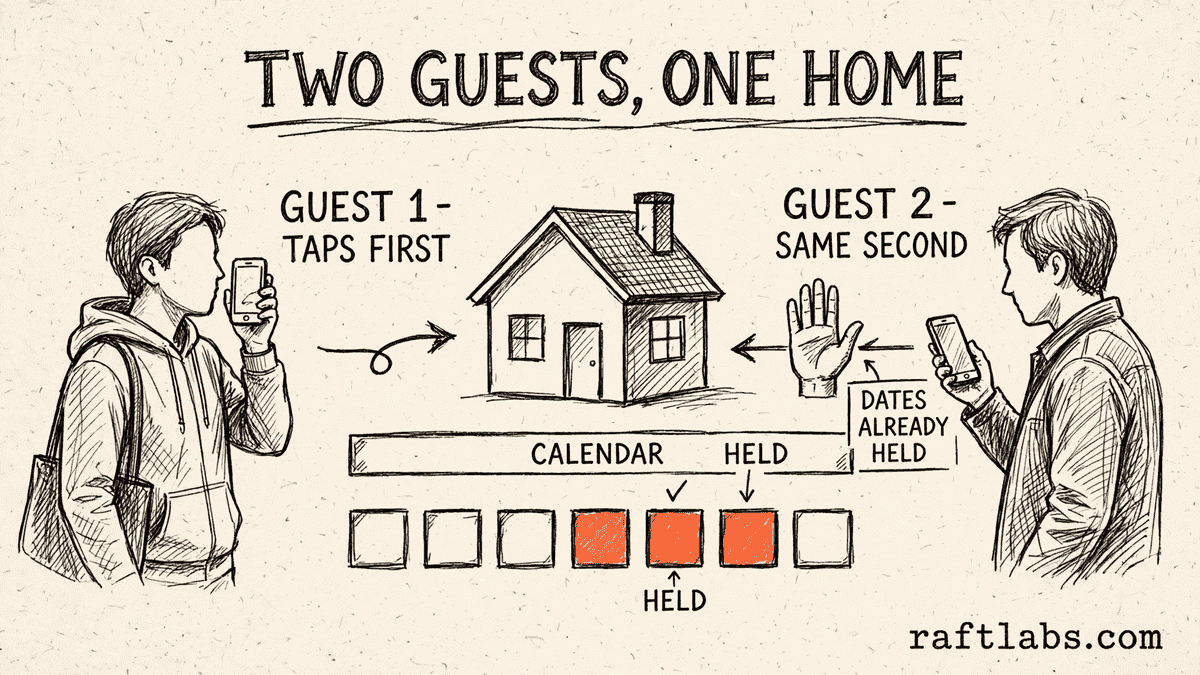
Two guests find the same home, choose the same nights, and tap book in the same second. Both see the dates as free, because a moment earlier they were. Only one guest can sleep there, so the other booking must fail cleanly, with no charge taken and no host left explaining a double booking. The calendar, not the checkout screen, is what has to settle it.
Airbnb is not a listings site with a checkout button. It is three machines working together: a ranking system that predicts bookings, a trust engine that lets strangers transact, and a calendar that cannot be allowed to lie. Understand these three and you understand what you are actually building.
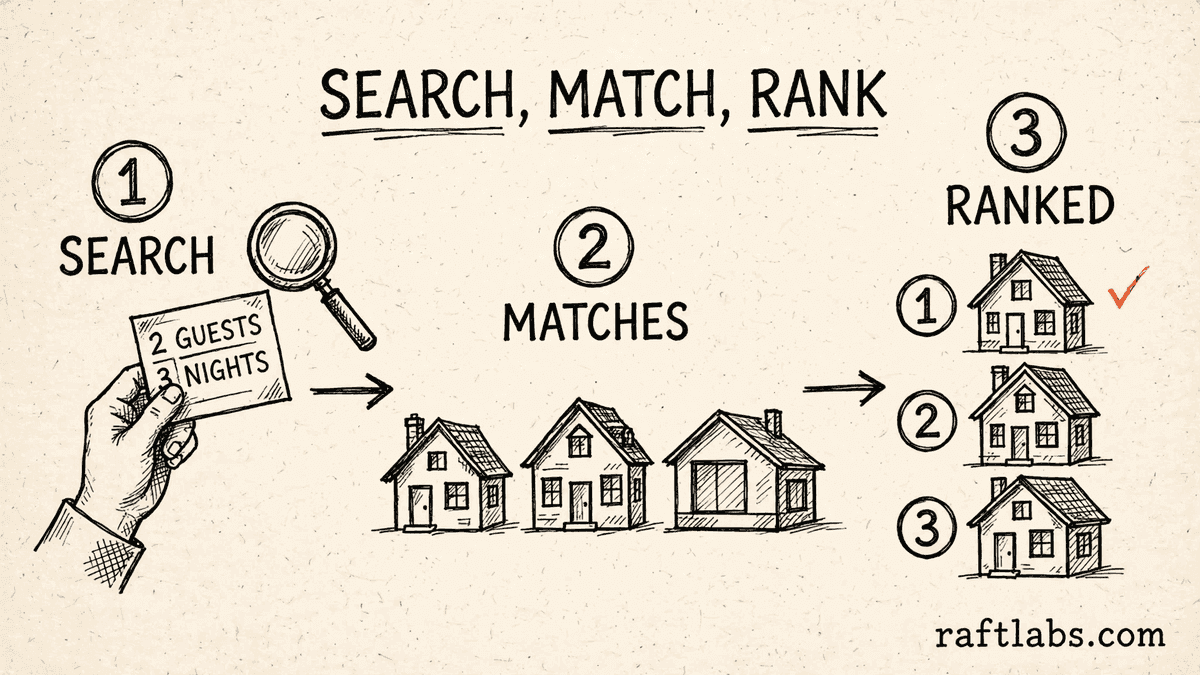
Search ranks the probability of a booking, not the prettiest photo. Airbnb scores every listing against more than 100 signals in four buckets: listing quality (photos, reviews, accuracy), popularity (clicks, wishlists, booking frequency), total price competitiveness (nightly rate plus cleaning and extra fees, compared to similar listings), and host reliability (response time, acceptance rate, cancellations, Superhost status). The order is the system's best guess at which listing this guest will actually book. And availability is not a ranking factor at all. It is a hard filter: a listing with no availability for the guest's dates simply does not exist in that search. (Hostaway's breakdown of Airbnb's ranking factors and Hostfully's ranking guide document these signal groups from Airbnb's own public materials.)
The practical consequence for your build: your search needs relevance scoring that weighs host performance signals alongside price and filters, and your host dashboard must show hosts the levers they control. Airbnb's lesson, free of charge: hosts who respond fast and keep calendars accurate earn visibility, and the platform that surfaces those levers gets more supply.
Trust is the product, not a feature. Strangers hand over $500 or more to stay in someone else's home. That transaction does not happen without ID verification on both sides, double-blind two-way reviews that prevent gaming, and a damage backstop big enough to matter. Airbnb's AirCover ships up to $3M in host damage protection and $1M in host liability insurance on every booking, at no direct cost to the host. Your marketplace needs its own trust stack: ID checks at host onboarding, escrow held until after check-in, reviews locked until both parties submit, and a damage policy backed by real money.
The calendar is the hardest real-time data in the system. A guest's dates, a host's availability, and every OTA the listing appears on must agree at the exact moment a booking confirms. Get it wrong and two guests believe they have the same property for the same weekend, which is the fastest way to destroy trust on both sides. The correct design treats the calendar as a single source of truth that updates in one indivisible step from day one: temporary holds during checkout, locking when the booking confirms, and for multi-channel operators, live availability updates pushed to every channel within seconds of a confirmation.
This is the teardown we run in discovery before we ever quote you. If a vendor cannot explain how search should rank your listings, how trust gets built for your asset type, and how the calendar stays consistent under load, they have not thought about your product yet.
Where the budget actually goes
You are building three products plus the engine that connects them. Typical component costs for a web-only MVP:
| Build | Share of budget | What it includes |
|---|---|---|
| Guest product (web) | 20-25% | Geo-search with maps, date and amenity filters, listing detail pages, booking flow, guest accounts, reviews |
| Host dashboard (web) | 20-25% | Listing creation, photo management, availability calendar with pricing rules, booking request management, payout history and tax documents |
| Admin panel (web) | 10-15% | Listing approval queue, user management, dispute resolution, payout controls, basic analytics |
| Booking and payment engine | 30-40% | Availability calendar that updates as one indivisible step, Stripe Connect escrow, multi-party payout routing, cancellation and refund logic, messaging, search index |
The booking and payment engine is the largest line because it handles real money under concurrency: escrow holds until after check-in, payouts to hosts minus your commission, cancellation enforcement, and consistency when dozens of guests book at once. Component-level ranges from real builds: search and discovery $10K-$25K, listing management $15K-$35K, booking and payments $20K-$45K, messaging $8K-$18K, reviews $4K-$10K, admin $8K-$20K.
The host dashboard deserves equal billing, not leftover budget. Hosts are your supply. If listing creation is painful and payout history is opaque, hosts stop listing, availability drops, and guests find nothing to book. Teams that spend 70% of the budget on the guest product and scramble to build a host dashboard with the rest end up with a marketplace that looks busy and has no quality supply.
"The two-sided marketplace model demands equal attention on both supply and demand. Platforms that neglect the provider experience end up with a marketplace that looks busy but doesn't have enough quality supply to satisfy demand." - Andrew Chen, General Partner at Andreessen Horowitz and author of "The Cold Start Problem," writing on marketplace dynamics.
What drives the price up or down
Payment escrow complexity. Stripe Connect handles multi-party payout routing natively: guest pays, platform holds, host receives minus commission on your schedule. Do not build your own escrow. But budget payments honestly: connected-account setup for each host, escrow holds, cancellation and refund logic, deposit holds, and tax reporting consistently account for 25 to 30% of total development effort.
Calendar concurrency. Checking availability only on the screen looks fine in demos and fails on launch day. Locking the dates in the database while a guest checks out is the correct design and it is real engineering work, typically 3 to 4 weeks. For operators who also list on Airbnb and Booking.com, API-level channel sync adds another layer: connectivity partner program approvals take 4 to 12 weeks per OTA and are not self-service.
Native mobile apps. Responsive web is the right V1 choice. Native iOS and Android apps for guests and hosts add $30K-$60K. Cross-platform (React Native or Flutter) cuts that to $20K-$40K for two apps. Build native when your data shows mobile web conversion is significantly below desktop conversion, or when hosts demand phone-based management.
Dynamic pricing. Rule-based pricing (weekend premiums, seasonal rates, minimum-stay discounts) costs $8K-$15K. Machine-learning (ML) pricing that adjusts on demand signals and booking pace costs $20K-$50K and needs 6+ months of transaction history to work well. You do not have the data to train a pricing model at launch. Let hosts set rates manually in V1.
Global payments and compliance. Multi-currency Stripe setup plus local payment methods (iDEAL, Klarna, UPI) add $15K-$35K. GDPR requirements (Europe's privacy law) for European guest data (privacy notice, consent management, guest data deletion workflow) must be designed in from V1 if you operate in European markets.
V1, V2, V3: what to build and when
A web-only MVP needs exactly six things. Everything else is V2 or V3. Launch with the core booking loop working: host lists a property, guest finds it, guest books it, payment processes, host gets paid.
Feature priority by version
V1
Launch ($55K-$95K, 14-20 weeks)
The six things your MVP needs. Ship with these and nothing else.
- Guest search with date, location, and category-specific filters
- Host listing creation with photos and availability calendar
- Booking request and confirmation flow with escrow via Stripe Connect
- In-platform guest-host messaging
- Two-way reviews (locked until both parties submit)
- Admin panel with listing moderation, user management, and dispute handling
V2
Growth (add post-launch, +$40K-$70K)
Add these after you have real hosts and bookings. Each one is expensive to build before usage data justifies it.
- Native guest and host apps ($20K-$40K cross-platform)
- Instant book ($8K-$15K)
- Rule-based dynamic pricing ($8K-$15K)
- Host dashboard analytics: views, conversion, occupancy ($10K-$18K)
- Niche pre-qualification gates: license uploads, certification checks
- Condition documentation module with photo upload ($12K-$20K)
V3
Scale (only at real volume, +$50K-$80K)
Infrastructure that only matters with hundreds of listings and real booking history.
- Machine-learning (ML) dynamic pricing ($20K-$50K, needs 6+ months of data)
- Multi-currency and multi-language ($15K-$35K)
- API-level channel sync with Airbnb, Booking.com, Vrbo
- Fraud detection and trust scoring ($25K-$45K)
- AI-powered search ranking (justified above 500 active listings)
How the timeline breaks down
| Phase | Duration | What happens |
|---|---|---|
| Discovery and architecture | 2 weeks | Inventory model, booking rules, payment flow mapping, host onboarding design, OTA partner program applications submitted |
| Guest product + host dashboard | 6-8 weeks | Search, listing creation, booking flows, messaging, in parallel with backend |
| Booking and payment engine | 8-10 weeks | Availability calendar that updates as one indivisible step, Stripe Connect escrow, payout routing, admin panel; the longest step |
| Integration and hardening | 2-3 weeks | Real-device testing, payment edge cases, concurrent booking load testing |
| Pilot with real hosts | 2-4 weeks | 10-20 hosts live with real bookings before public launch |
Total: 14 to 20 weeks to a web-only beta. The booking and payment engine is almost always the longest step. Any vendor promising 8 weeks is quoting the listing pages, not the platform.
For multi-channel operators, one scheduling risk sits outside development: OTA connectivity partner program approvals take 4 to 12 weeks and are not self-service. Start those applications on day one. Development can proceed in parallel for everything except the live sync module, but the sync cannot be fully tested until API access is confirmed.
The tech stack, without the sales pitch
Backend: Node.js or similar with PostgreSQL for the booking calendar and PostGIS for location-based search, Redis to hold search results and temporary booking holds in memory. The availability calendar must be transaction-safe; that is a database design decision, not a feature.
Payments: Stripe Connect is the industry standard. Guests pay your platform, the platform takes its commission, hosts receive the remainder on your payout schedule. It handles multi-party routing natively. Building a custom escrow adds 3 to 6 months and requires card-industry security (PCI DSS) compliance work. Use Stripe Connect and invest that engineering effort in the product.
Search: Geospatial queries with date-range filtering and amenity filtering in real time. Start with database search, not a dedicated search engine. Add a dedicated search tool (like Elasticsearch) only when listing volume justifies it.
Maps: Google Maps Platform is the default and costs about $7 per 1K map loads; budget $3K-$10K per month at scale. MapLibre with self-hosted tiles cuts that by 60 to 70% but needs more engineering.
Messaging: Use a managed messaging API (Stream, SendBird, or Firebase) for thread-based in-platform messaging. Do not build live-messaging infrastructure from scratch for V1. Messaging stays in-platform to prevent off-platform payment fraud.
The business math
Every booking platform runs on one equation: your annual OTA commission bill versus the annualized cost of owning the channel.
The 2026 commission landscape, verified across current platform documentation:
| Channel | Host-side cost | Guest-side cost |
|---|---|---|
| Airbnb | 15.5% host-only fee on the booking subtotal | None (fee removed from checkout) |
| Vrbo | 12% host fee on bookings made from 29 October 2026 (payment processing included where Vrbo processes payment) | 6% to 15% traveler service fee |
| Booking.com | Around 15%, varies by market | Generally none |
| Expedia | 15% to 25% depending on program | None |
| GetYourGuide | 20% to 30% on experience bookings | None |
| Your own direct booking site | About 3% (Stripe processing only) | None |
The payback math is straightforward. At $400K in annual GMV (total booking value; say 800 bookings averaging $500), a 15% OTA commission costs $60K per year. A $55K-$95K custom platform pays for itself in 12 to 24 months, and from then on your cost drops to payment processing at roughly 3%. Drive 30% or more of bookings through a direct channel and you pay 4% in processing versus 14 to 18% through OTAs, according to Phocuswire's direct booking research.
Monthly infrastructure after launch: $1K to $4K per month early (hosting, messaging, verification), rising to $5K to $15K per month at meaningful scale (map API bills, larger hosting footprint, ongoing engineering).
Supply-side reality: hosts first, guests second
Here is the sentence most vacation rental guides bury: a polished booking platform with 40 listings in a metro area is not a product. It is a portfolio website. The supply problem kills marketplaces before the technology does.
Seed supply before opening to guests. Personally recruit the first 50 hosts. Build host onboarding flows that make listing as fast as possible. Sign operators before the platform is finished and run their bookings manually on a spreadsheet during development. On launch day, migrate those bookings in and go live with a real supply base. According to a16z's Marketplace 100 data from 2023, the top-performing niche rental marketplaces had 3x the supply density of failed attempts in the same category. Supply density, not technology quality, predicted success.
Build the host product first, not as an afterthought. Hosts are running a business, not browsing. They need calendar management, pricing controls, payout tracking, and analytics that show them views, conversion, and occupancy. Hosts who can measure their performance stay on the platform and optimize. Those who cannot see their numbers eventually move to a competitor who shows them.
Model host earnings before writing code. The average Airbnb host earned about $9.6K per year. Your marketplace needs to deliver on that number, or beat it, to attract and retain quality hosts. If the math does not work for the host, no engineering fixes it. The host break-even belongs in the business model, not in a post-launch investigation.
Three cousins of the vacation rental marketplace
The same core architecture, booking engine, payments, messaging, search, powers four related products with different inventory models. Each is a section of this flagship, not a separate page.
STR management platforms like Guesty
This is operator software, not a marketplace. A property management company with 50 to 200 listings needs calendar sync across Airbnb, Booking.com, and Vrbo, a unified OTA inbox, automated messaging, housekeeping management, damage deposit tracking, and owner statements.
| Build option | What it includes | Timeline | Cost |
|---|---|---|---|
| V1 | Property listings, iCal calendar sync, unified OTA inbox, automated check-in instructions, basic housekeeping tasks | 14-20 weeks | $90K-$140K |
| V2 | Real-time OTA API sync, automated messaging workflows, damage deposit management, owner statements, multi-property dashboard | 22-28 weeks | $140K-$200K |
| V3 | Dynamic pricing engine, direct booking site with Stripe, local STR permit compliance module, guest ID verification, white-label option | 30-40 weeks | $200K-$280K |
Three things make this build different from a marketplace. First, the calendar sync is the product: iCal alone cannot prevent double bookings because OTA feeds regenerate on 15-minute to hour-long delays, so real-time API-level availability updates are required. Second, OTA connectivity partner program approvals take 4 to 12 weeks and must start on day one. Third, compliance is built in: GDPR for European guest data, local short-term rental permit tracking (San Francisco, New York City's Local Law 18, Paris), and card-industry security (PCI DSS) for direct bookings.
Since 20 May 2026, EU registration-number verification is live: in-scope hosts must hold a registration number and platforms must verify it or remove the listing, so registration checks belong in the permit module, not on a roadmap.
One proposal to watch, not law yet: the EU Affordable Housing Act, proposed on 9 September 2026, would let local authorities restrict short-term rentals in designated areas under housing stress. The restriction would apply where rentals show significant harm to affordability or availability for at least 3 years. It still needs Parliament and Council approval.
The build-vs-Guesty math: at $7 per listing per month, a 100-listing portfolio pays $8.4K per year before transaction fees. The real thesis is growth: the per-listing fee scales linearly with your portfolio, while a platform you own is a sunk cost that does not grow with listing count.
Hotel direct booking engines
A hotel chain or serviced apartment group does not need a marketplace. It needs a direct booking engine that shifts reservations away from OTAs. An MVP with core booking flow, property listings, search, and secure payments runs $15K to $35K in 6 to 10 weeks. A mid-scale platform with multi-property support, loyalty features, and PMS and channel manager integration runs $30K to $65K. An advanced platform with deep property-management-system sync, OTA integration, analytics, and personalization runs $65K to $120K or more.
The single biggest cost variable is PMS integration, typically $10K to $30K on its own. Real-time availability checking has to sync with the property management system, or rooms show available when they are not. Shifting 500 to 750 room nights per year from third-party platforms to direct bookings recovers a meaningful share of the initial investment through saved commissions within 12 to 24 months. RaftLabs delivered a booking platform with RMS integration and a keyless mobile app for City Break Apartments that drove a 25% rise in direct revenue.
Niche OTAs like Expedia and Booking.com
Expedia owns no flights or hotel rooms. It is an aggregation layer. When you build a niche OTA, you build the same layer tailored to your inventory and audience. A single-vertical MVP (flights or hotels) covering search, pricing calendar, checkout, and itinerary management costs $70K to $130K over 16 to 22 weeks. A dual-vertical platform costs $150K to $260K over 7 to 10 months. A full OTA with package bundling costs $220K to $380K over 11 to 15 months. Monthly API costs once live run $2K to $15K depending on search volume.
You connect to global flight-and-hotel inventory (GDS) via Amadeus, Sabre, or TravelPort, modern alternatives like Duffel, or the Booking.com Demand API for hotels, then build search, checkout, and itinerary management on top. The two hardest parts: the two-step price check (hold search results for 2 to 5 minutes, then fetch a fresh fare guarantee at checkout, or price mismatches destroy trust) and how trips are stored, which must treat each booking as one item inside a trip from day one. White-label OTA platforms (TraveloPro, Juniper, iSell) are faster to launch but lock you into their inventory contracts and charge per-booking fees that erode margin at scale.
Tours and activities platforms like GetYourGuide
A destination management company with 20 to 30 local operators pays GetYourGuide 20 to 30% on bookings the DMC sourced itself. A custom experiences platform has six core parts: listings with time slots and capacity, a real-time availability calendar with 10 to 15 minute inventory holds during checkout, a customer booking flow, Stripe Connect operator payouts, QR voucher generation with a mobile scan app, and an operator dashboard. A production-ready V1 costs $65K to $120K over 12 to 16 weeks. V2 adds a native customer app and corporate group billing (+$40K-$65K, 8-12 weeks). V3 adds dynamic pricing, waitlists, and gift cards (+$30K-$50K, 6-10 weeks).
At $600K GMV (total booking value) with a 20% OTA commission, you pay $120K per year to the platforms. A $90K build plus $30K per year in maintenance breaks even in year two.
Clone scripts and white-label platforms vs. custom build
Sharetribe is the most legitimate starting point for marketplace validation. Go (hosted SaaS) runs $149 to $499 per month; Flex (API-first) runs $299 to $999 per month plus developer costs. You get a working marketplace in days. The failure points show up at 50 to 200 listings: custom booking logic (hourly plus daily pricing, conditional deposit releases, pre-qualification gates) hits the transaction state machine's walls, payment splits are limited to a single commission percentage, and you do not own the guest data in Go. Operators spend $20K-$40K on Flex customization before concluding a rebuild is cheaper.
Cocorico is an open-source PHP marketplace framework, self-hosted, with setup costs of $5K to $25K. The codebase dates to 2014-2016 with limited active maintenance. Its availability calendar uses application-level checks, not database-level locking, so double bookings appear under concurrent load. Mobile is an afterthought, and support is community-only.
Airbnb clone scripts from marketplaces cost $500 to $5K upfront and look complete in demos. The listing model is hardcoded for home rentals, the payment logic cannot handle complex payout rules, and Stripe Connect compliance is usually missing or wrong. App store approval frequently fails on clone codebases that replicate another company's UI patterns without original value. A clone script with repairs typically costs $80K-$120K to fix, comparable to building custom, but with a worse codebase at the end.
| White-label / clone | Custom build | |
|---|---|---|
| Upfront cost | $500-$20K (clone) or $149-$999/mo (Sharetribe) | $55K-$95K (MVP) |
| Time to first booking | Days to 8 weeks | 14-20 weeks |
| Custom booking rules | Limited or requires rewrite | Built to spec |
| Niche listing attributes | Not possible or expensive hacks | Native to the design |
| Payment split flexibility | Single percentage split | Any structure you design |
| Exit flexibility | Data migration risk | Full ownership |
| Total cost at 24 months | $40K-$150K+ with limitations | $55K-$95K |
The clone route looks cheaper at the start. According to a 2024 Phocuswire analysis, travel operators who started with clone scripts and rebuilt spent an average of 2.3x more over three years than operators who built custom from the start.
Build vs. buy: the actual thresholds
Keep listing on the OTAs when you have fewer than 20 listings, your annual OTA commission is under $30K, and you are still testing whether the niche has demand.
Validate on Sharetribe when you want to test a custom marketplace under $30K and your booking rules are simple: dates, prices, reviews. Accept the constraints in exchange for speed to market, and plan to validate before committing to a full custom build.
Build custom when your listing attributes do not fit a generic form, your booking rules require custom logic (captain assignment, hourly plus daily pricing, condition documentation), your commission structure needs splits or delayed payouts that templates cannot handle, or you expect to exceed 200 active listings within 18 months.
Build operator software (Guesty-style) when you manage 50+ listings and per-listing fees have crossed $5K per year, you plan to grow from 50 to 200+ listings, or you want to offer white-label channel management to your own clients.
Build a direct booking engine (hotel-style) when a chain's annual OTA commission exceeds $200K. At 15 to 17% commission on $2M in OTA bookings, a $50K engine pays back in under 90 days if it shifts 30 to 40% of bookings to direct.
Where these projects fail
Setting your own commission rate wrong. Operators who launch at 22% host commission because the financial model demanded it watch their best hosts route bookings off-platform by the fifth transaction. Know your category's alternatives before setting the rate: boat charter operators on Boatsetter (25% commission) see 18% as attractive, while equipment rental competitors charging 15 to 20% make 18% feel high.
Building for scale before validating demand. A founder invests $150K in a full web and mobile platform with channel manager sync and dynamic pricing before proving that 50 hosts will list and 200 guests will book in the first six months. Spend $55K on V1. Spend the next $50K on acquiring hosts and guests. Build V2 when the platform generates revenue.
Underestimating payment complexity. Founders who budget $5K to $8K for "Stripe integration" discover mid-build that connected-account onboarding, escrow hold and release, payout scheduling with fee deduction, cancellation enforcement, deposit holds, dispute handling, and tax reporting are each non-trivial engineering tasks. Budget for all of them from the start.
Skipping the availability lock to save time. Two guests can start checkout for the same dates at the same second. Without a booking lock, both complete payment. Both believe they have a reservation. You cancel one at short notice. A single double-booking incident reduces repeat booking probability by 34% for the affected guest, according to Cornell's Center for Hospitality Research. The lock adds $10K-$20K and 4 to 6 weeks. It costs far less than the refunds, chargebacks, and lost trust that come without it.
Starting OTA partner applications late. A team that submits Airbnb's connectivity partner application in week six is adding 4 to 12 weeks to the V2 go-live timeline unconditionally. The application is a prerequisite for API access, and there is no workaround. Start it on day one.
How to spend less without building junk
Web-first for V1. Responsive web works across all devices and costs 40 to 50% less than native apps. Most hosts manage listings on desktop. Build native in phase 2 once retention data justifies it.
Skip dynamic pricing at launch. Manual host pricing is enough for an MVP. You do not have the booking data to train a demand model anyway. Savings: $15K-$35K.
Stripe cards only for V1. Apple Pay, Google Pay, buy-now-pay-later (BNPL), and local wallets all add engineering effort. Cards via Stripe handle 85% or more of transactions in most English-speaking markets. Add methods based on user demand, not assumption. Savings: $8K-$18K.
Launch with proximity search, not AI ranking. Relevance scoring that learns from conversion is a V3 investment. Start with filter-based search ranked on price, rating, and host performance. Upgrade when you have the booking data to train on.
iCal sync before API sync. For multi-channel operators, ship iCal calendar sync in V1 as the fallback and move to API-level sync in V2 once partner program approvals clear. Just know its limits: 15-minute to hour-long delays mean it cannot reliably prevent double bookings.
Rent the hard parts. ID verification, messaging, maps, payments: all solved, all billed per use. The only thing worth building custom is the booking engine and calendar logic, because that is the product.
Does this cover Vrbo, Agoda, Booking.com, and other regional apps?
Yes. Every regional vacation rental and booking leader runs on the architecture this guide describes: guest product, host dashboard, booking engine, payment escrow. What changes is the market wrapper.
| Region | Leading apps | What differs from the Airbnb template |
|---|---|---|
| US, global | Vrbo (Expedia Group) | Entire homes only, family and group stays, longer booking windows, 12% host cost vs Airbnb's 15.5% from 29 October 2026; the annual subscription option is closed to new hosts |
| Europe | Booking.com | Hotel-heavy inventory, around 15% host commission, no separate guest fee |
| Asia-Pacific | Agoda, Trip.com | APAC hotel and package focus, mobile-first guest flows, local payment rails |
| India | MakeMyTrip, Oyo | Price-sensitive domestic travel, UPI-first payments, budget hotel aggregation |
| Latin America | Decolar (Despegar) | Regional OTA with installment-payment culture built into checkout |
| Niche: boats and RVs | Boatsetter, Outdoorsy | Category-specific booking logic: captain verification, damage deposits, delivery logistics |
If you are building for one of these markets, the cost bands in this guide still apply. The budget moves with inventory complexity, payment rails, and compliance, not with which logo you benchmark against. New regional apps get added to this table as they emerge.
How RaftLabs approaches vacation rental builds
We have built booking and rental platforms across hospitality, property management, and specialized asset categories. One example from our portfolio: a serviced apartment operator needed a direct booking engine with keyless access integration and real-time availability management across 40+ units. We built the platform in one 12 to 14 week cycle. It now handles 72+ self check-ins per week with zero front desk staff required for standard arrivals. The operational cost reduction paid back the build cost in under 18 months.
If you have 20 to 200 listings on Airbnb or a clone script and are running into operational limitations, here is what the first 90 days with RaftLabs looks like: weeks 1-2 are scoping and technical architecture, informed by a review of your current platform's constraints. Weeks 3-14 are the V1 build on a fixed-price contract. You see working software every two weeks. By week 14, you have a production-ready platform your hosts can migrate to. Start your scope and we will run the commission math with you.
Ask an AI
Get an instant summary of this post from your preferred AI assistant.
Frequently asked questions
Straight answers to what buyers ask before they scope. Still stuck? .
- A web-only vacation rental marketplace MVP (listings, geo-search, booking calendar, Stripe escrow payments, messaging, reviews, admin panel) costs $55K to $95K over 14 to 20 weeks. A full platform with native iOS and Android apps (separate apps built for iPhone and Android), instant book, host verification, and dynamic pricing runs $100K to $160K over 22 to 34 weeks. Multi-region scale with channel sync runs $150K to $240K or more.
- A web-only MVP takes 14 to 20 weeks with a team of 3 to 5 developers. A full platform with native mobile apps takes 22 to 34 weeks. Multi-region platforms with channel manager sync (keeping your listings and calendars in step across Airbnb, Booking.com, and Vrbo) take 32 to 44 weeks, partly because OTA partner program approvals (OTA: online travel agency) alone take 4 to 12 weeks and must start on day one.
- Airbnb ranks listings by the probability of a completed booking, using 100+ signals across four groups: listing quality (photos, reviews, accuracy, category scores), popularity (clicks, wishlists, booking frequency), total price competitiveness (nightly rate plus cleaning and extra fees), and host reliability (response time, acceptance rate, cancellations, Superhost status). Availability is a hard filter: a listing with no availability for the guest's dates simply does not appear.
- Most hosts now pay Airbnb a single host-only service fee of 15.5% of the booking subtotal, deducted from the payout. Vrbo costs 12% per booking on bookings made from 29 October 2026 (payment processing included where Vrbo processes payment), and Booking.com charges hosts around 15%, varying by market. A direct booking site costs roughly 3% in Stripe payment processing.
- The booking and payment system is typically the most expensive single component at $20K to $45K: Stripe Connect sub-account setup, escrow holds until after check-in, payout routing, cancellation and refund logic, and tax reporting. Native mobile apps are the second largest cost driver at $30K to $60K. Dynamic pricing adds $20K to $50K if algorithmic rather than host-set.
- Yes, and you should for V1. A responsive web app works across all devices and costs 40 to 50% less than separate iOS and Android apps. Most hosts manage listings on desktop. Add native apps in phase 2 once you have host and guest retention data that justifies the investment.
- Double bookings are prevented where the data lives, not just on the screen. When a guest starts checkout, the dates are held for them for a few minutes; when the booking confirms, the calendar updates in one indivisible step, so two guests can never confirm the same dates. For multi-channel operators, iCal sync (calendar feeds shared between platforms) alone cannot prevent double bookings because OTA feeds (booking-site feeds from Airbnb, Booking.com, and Vrbo) regenerate on 15-minute to hour-long delays; you need live availability updates pushed to every channel within seconds of a booking confirmation.
- Sharetribe Go ($149 to $499 per month) and Sharetribe Flex ($299 to $999 per month plus developer costs) work for validating a concept under $30K. You hit the ceiling when you need niche-specific listing attributes, custom booking rules like hourly plus daily pricing or conditional deposit releases, or commission structures beyond a single percentage split. Most operators past 50 to 200 listings need a custom build. The question is whether you want to discover that limit before or after building your supplier base on a platform you cannot extend.
- An STR management platform is operator software: property listings, calendar sync across Airbnb, Booking.com, and Vrbo, a unified OTA inbox, automated messaging, housekeeping management, and owner statements. A V1 with iCal sync and a unified inbox costs $90K to $140K over 14 to 20 weeks. A full platform with real-time OTA API sync (live, automatic updates between your platform and Airbnb, Booking.com, and Vrbo), dynamic pricing, and a direct booking site costs $200K to $280K over 30 to 40 weeks.
- Yes. This flagship covers the whole vacation-rental and booking marketplace category: vacation rental marketplaces like Airbnb and Vrbo, STR management platforms like Guesty, hotel booking platforms like Booking.com, niche OTAs like Expedia, tours and activities platforms like GetYourGuide, and hotel direct booking engines. Each runs on the same core architecture; what changes is the inventory model (what you list and how it is structured) and the integration layer (how it connects to other systems).