Foundations
What is computer vision?
It turns cameras a business already owns into inspectors and counters. The value is rarely the camera. It is the decision that used to need a person standing there watching: pass or fail, present or missing, safe or not.
In plain terms
Computer vision is software that reads images and video, so a system can count, check, or spot what a camera sees.
Computer vision is how software makes sense of images and video. It learns from many labeled pictures until it can do the visual jobs people do at a glance: find an object, read a label, count items, or notice that something in the frame has changed.
For a business, the honest test is the cost of the human version. If a person now stands and watches, counts, or checks, and the check is the same every time, a camera system can usually do it around the clock. If the human is really exercising judgment about context, the camera can gather the evidence, but the call stays human.
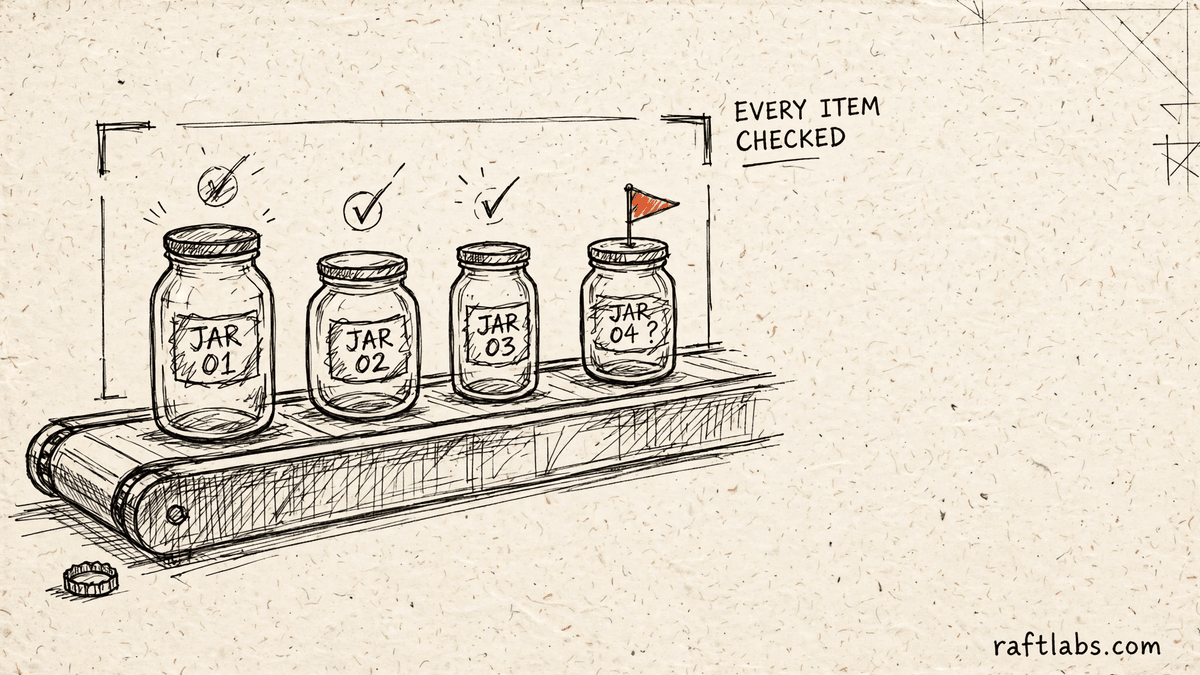
Think of it this way: It is a tireless inspector posted at a camera. It cannot explain the product, but it never blinks, and it checks every single item the same way at three in the morning as at noon.
A food producer points a camera at the packing line. The system reads each label, confirms the date and the allergen line match the batch, and diverts the packs that do not before they are sealed.
A warehouse team stops counting returns by hand. Cameras over the returns bench photograph each item, match it to the order, and record its condition from the photo. Disputes about what came back drop, because the picture is in the file.
When the evidence is visual and the check is repeatable: defects on a line, stock on a shelf, a document or ID to read, a site rule a camera can see being broken. When a person is not really checking the image, but judging the situation around it. A camera system counts helmets on a site. It cannot tell whether the work itself is being done safely.
You do not need to pick a model from this page. RaftLabs starts from the job: the documents, the decision, and what a wrong answer costs. You see a working version before a large build. The related work on our side is Computer vision development.
This sits with the other foundations terms on the glossary. The words under every AI conversation, from the model itself to the data it learned from. Worth reading next: Artificial Intelligence (AI), Machine Learning (ML), and Large Language Model (LLM).
Frequently asked questions
Straight answers to what buyers ask before they scope. Still stuck? .
- Usually not at the start. Most pilots run on the cameras or phone photos a business already has, and the picture quality decides more than the camera brand. Budget first for lighting, angle, and the labeled examples the system learns from. New hardware comes later, if the pilot proves out.
- Accurate enough to quote only against your own test set. A vendor figure from another site means little: your lighting, your products, your angles. Ask for a trial on your images, with the misses shown, and decide which misses you can afford. A system that flags its uncertain cases for a person is worth more than a higher headline number.
Work with us
Tell us what's broken.
Tell us what's not working in your business. We'll find the real problem and tell you exactly what it would take to fix it.
- Scope and cost agreed before work starts. No surprises. No obligation.
- Working prototype within 3 weeks of kickoff.
- Pay by milestone. You see progress before each invoice.
- 60-day post-launch warranty. Bug fixes, UI tweaks, and deployment support. No retainer.
- All conversations are NDA-protected.