Updated August 2026
Top 10 Voice AI Agent Development Companies in 2026
Discover 2026's leading Voice AI agent developers, how they handle compliance, localization, and human handoffs, and what questions to ask before you sign anything.

In this article
Short answer
RaftLabs builds HIPAA-compliant voice AI agents in 8-16 weeks using Deepgram, GPT, and LangChain. Top companies are evaluated on STT/TTS depth, HIPAA/GDPR compliance, sub-300ms latency, and production delivery. Voice AI differs from IVR: it holds context and hands off with full transcript.
Key takeaways
- Voice AI agents are not IVR replacements. They maintain conversation history, understand context across turns, and hand off to humans with full context. A call transfer that starts the conversation over is a failure, not a handoff.
- HIPAA compliance in voice AI covers the entire pipeline: STT transcription, LLM processing, TTS output, and every third-party API in the chain. General AI teams rarely understand this.
- Sub-300ms response latency is the difference between an agent that feels conversational and one that feels robotic. Edge computing and pre-warmed model endpoints determine this, not just model choice.
- End-to-end encryption is architecturally incompatible with enterprise admin access requirements. This decision must be made before architecture begins.
- For mid-to-large enterprises, partnering with a specialized Voice AI firm delivers faster time to value than building in-house, because the underlying models change faster than internal teams can retrain.
A voice AI agent development company builds software that holds natural spoken conversations, handling customer queries, booking appointments, collecting information, or escalating to human agents, without rule-based scripting. Unlike traditional IVR systems that route callers through menu options, modern voice AI agents use large language models combined with speech-to-text and text-to-speech pipelines to understand context, remember prior turns in a conversation, and respond dynamically to what the user actually says.
Demand for these systems is accelerating. Gartner projects that agentic AI will autonomously resolve 80% of common customer service issues without human intervention by 2029, and a February 2026 Gartner survey found 91% of customer service leaders under pressure from executive leadership to implement AI now. Businesses in healthcare, hospitality, banking, telecom, and retail are replacing static phone trees with voice agents that resolve queries in real time, operate 24/7 without staffing cost, and transfer to a human agent with full conversation context when needed.
Not every team that builds software builds voice AI well. It requires specific expertise in STT/TTS pipeline architecture, latency optimization, accent and dialect handling, LLM prompt design for spoken conversation, and compliance with the regulations that govern voice data in healthcare and financial services. Getting those things right is what separates the companies on this list from generalist development agencies.
This guide covers 10 voice AI agent development companies with demonstrated production-grade work. It includes a comparison table, an evaluation framework, industry-specific considerations, and the questions worth asking before you sign anything.
Why trust this list?
RaftLabs has built custom AI and voice-driven solutions across healthcare, media tech, and marketing. The evaluation process for this list focused on what actually matters in production: technical depth, real-world delivery, latency performance, and compliance track record.
According to Gartner's forecast, agentic AI will autonomously resolve 80% of common customer service issues without human intervention by 2029. That's an enormous amount of production load shifting to vendors who need to have actually built these systems before.
Here is what was evaluated:
1. Experience in AI Agent Development: Years of actual deployment experience in conversational AI, not just general software development.
2. Team Strength and Technical Talent: Team size, AI specialization depth, and thought leadership in STT/TTS and LLM applications.
3. Clutch Ratings: Verified B2B ratings and reviews from actual clients, not self-reported.
4. Range of Services: Full product development from design to deployment and ongoing support, not just model training.
5. Client Network: Real-world AI agent deployment case studies with measurable outcomes.
6. Industry Recognition: External recognitions and awards from credible sources.
| Company | Specialization | Industries | Notable Stack | Best For |
|---|---|---|---|---|
| RaftLabs | Custom voice AI agents, production builds | Healthcare, Hospitality, Banking, Telecom, Media | Agora, GPT, Deepgram, LangChain | Production-ready custom builds, LLM-agnostic |
| deepsense.ai | Enterprise GenAI and applied AI | Enterprise, data-heavy sectors | LLMs, RAG, MLOps | Production GenAI apps and agentic RAG |
| Intellectyx | Data and AI platforms | BPO, Healthcare, Finance, Insurance, Retail | Custom ML, NLP pipelines | Large-scale call center automation |
| Distyl AI | Agentic infrastructure, enterprise LLM | Healthcare, Financial Services, Telecom | LLMs, agentic infra | Enterprise LLM systems at scale |
| SoluLab | Blockchain and AI | Healthcare, Finance, Real Estate | GPT integration, custom NLP | Startups needing AI plus blockchain |
| Bluebash | Web and AI development | Healthcare, E-commerce, Finance | React, Node, AI APIs | Mid-market product builds |
| Phaedra Solutions | Custom AI and automation | Fintech, Healthcare, EdTech | ML, NLP, cloud platforms | Complex workflow automation |
| Fractional AI | Custom generative-AI builds | Enterprise LLM, RAG, Agents | LLMs, RAG, agents | Concept-to-production GenAI |
| Pixelette Technologies | Blockchain, AI, data | Gaming, E-commerce, Government | Custom AI models | Niche AI and blockchain projects |
| Appic Softwares | Mobile and AI apps | E-commerce, Healthcare, Retail | Mobile-first, AI APIs | Budget-conscious mobile AI builds |
What AI Voice Agents Are (and What They Are Not)
AI voice agents are conversational tools that understand, process, and respond to human speech. They power virtual assistants, intelligent support bots, and voice-enabled applications across industries.
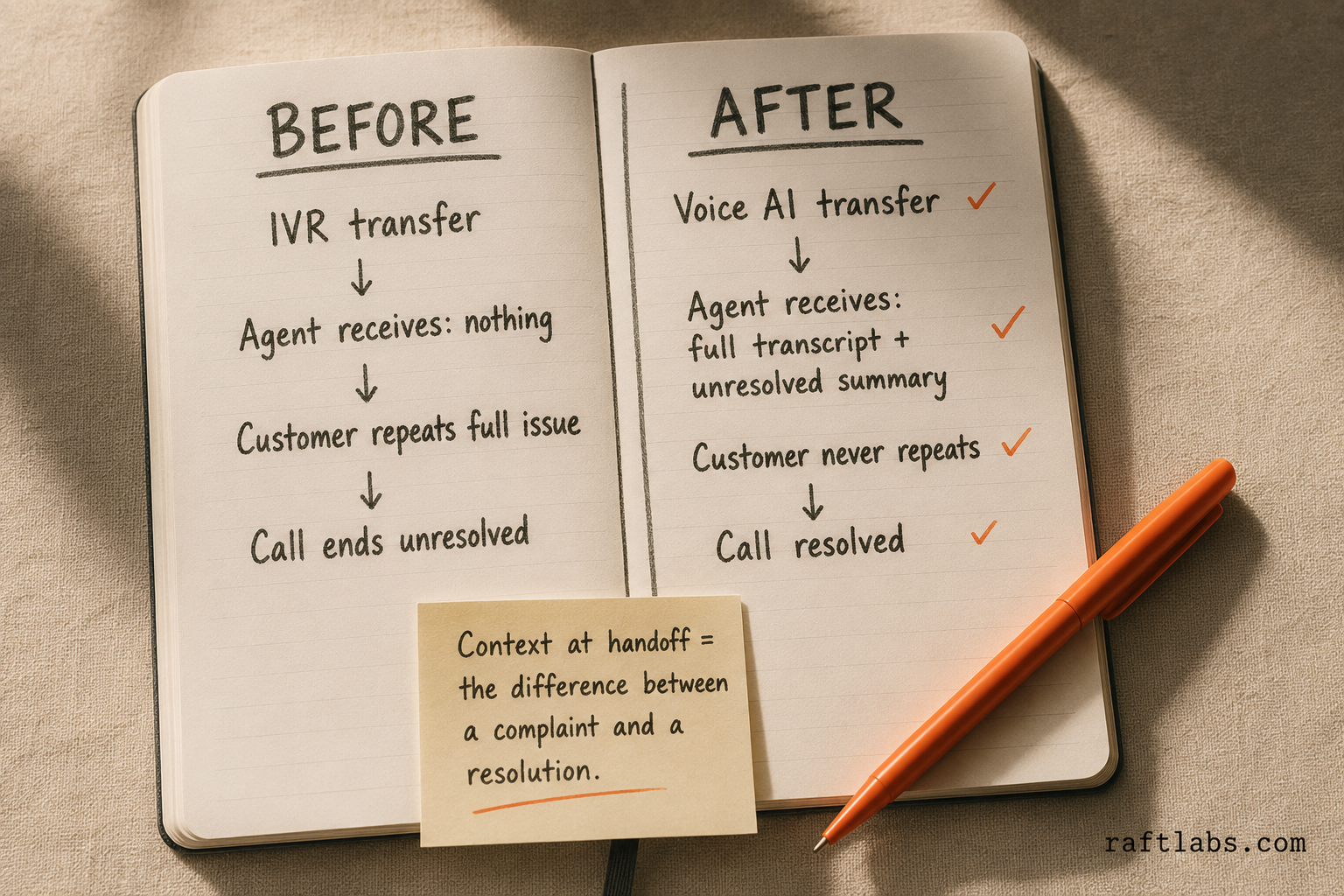
What they are not: a better IVR. IVR routes callers through menus. Voice AI agents hold dynamic conversations, understand intent from natural language, maintain conversation history across turns, and escalate with full context.
The practical difference: an IVR transfers a frustrated caller and makes them start over. A well-built voice AI agent transfers a caller with a real-time transcript and a summary of unresolved issues. That difference is the difference between a complaint and a resolved interaction.
Whether you are a startup founder looking to build your MVP or a product manager at a Fortune 500 company, the companies below have demonstrated the depth to deliver production-grade voice AI.
The Compliance Minefield: US and European Standards
For businesses operating in the US, UK, and Europe, data compliance is not a checkbox. It is an architectural constraint.
In US healthcare, HIPAA compliance is non-negotiable. Every element of your Voice AI pipeline (STT, LLM inference, TTS, third-party APIs) must meet HIPAA standards. Most general AI teams address data storage compliance. HIPAA covers the full pipeline, and teams that have not built healthcare voice AI before regularly miss this.
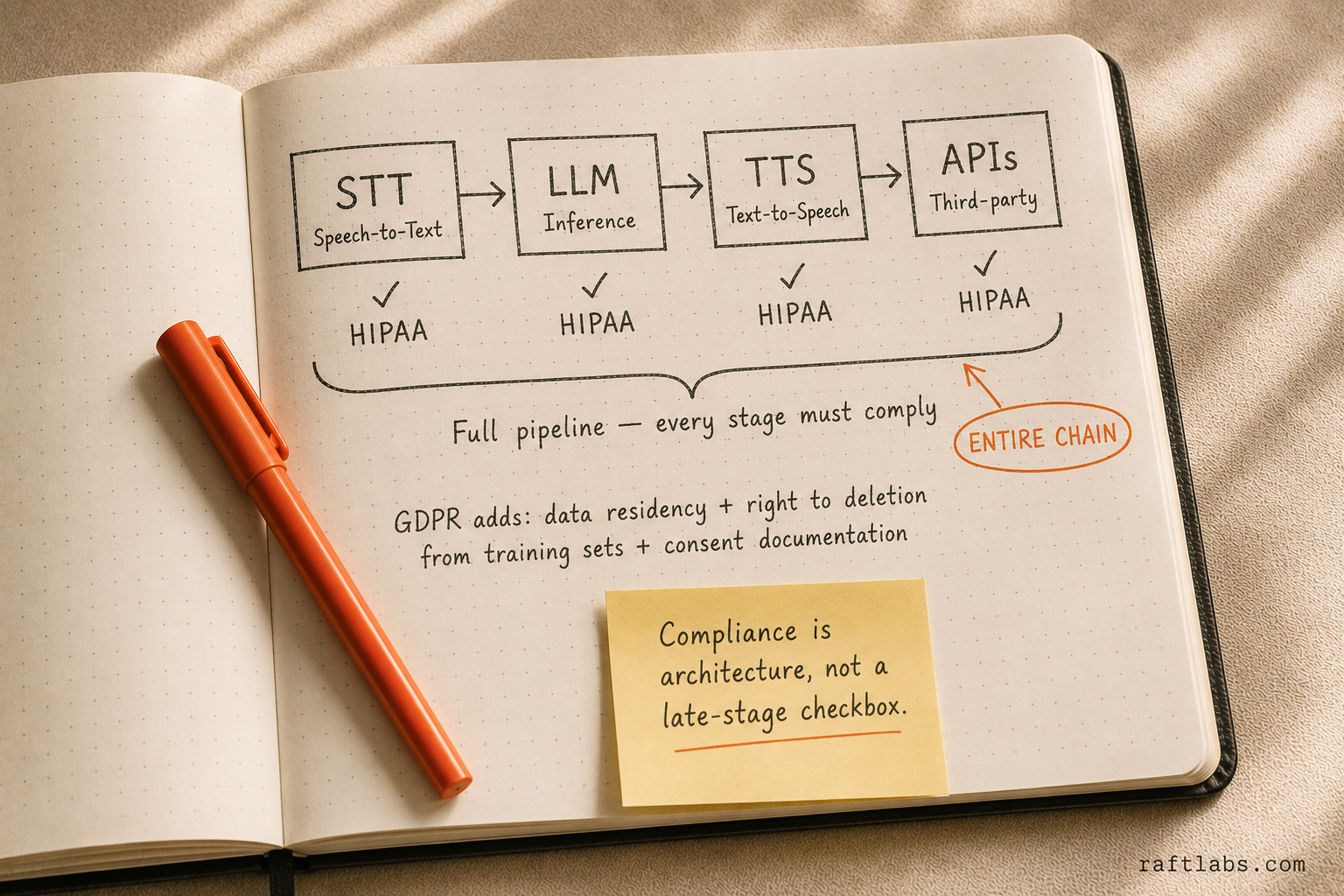
For UK and EU markets, GDPR adds data residency requirements, the right to deletion from LLM training sets, consent documentation for voice processing, and specific restrictions on voice biometrics data. The EU AI Act, which took effect in 2024, adds additional requirements for high-risk AI systems, which most healthcare and financial services voice agents qualify as.
A developer who treats compliance as a late-stage checkbox rather than a design constraint is a liability risk, not just a technical risk.
Already Know Voice AI Is Right for Your Business? If you have done preliminary research and are ready to discuss implementation, you do not need to read all 10 vendor profiles. Request a 30-Min Voice AI Strategy Call
Or continue reading to understand what makes each vendor unique →
Top 10 Voice AI Agent Development Companies
| S.No | Company Name | Clutch Rating | Experience (Years) | Pricing (Hourly Rate) | Industry Focus |
|---|---|---|---|---|---|
| 1 | RaftLabs | 4.9/5 | 9+ | $29 - $49/hr | Media, Health Tech, Marketing, Commerce, EdTech, FinTech |
| 2 | deepsense.ai | Not public | ~10 (claimed) | Not public | Enterprise GenAI, LLM, RAG, MLOps |
| 3 | Pixelette Technologies | 4.8/5 | 8+ | $25 - $49/hr | Data Software, Gaming, Blockchain, Gov, E-commerce |
| 4 | Intellectyx | 4.8/5 | 9+ | $50 - $100/hr | BPO and Call Centers, Healthcare, Finance, Insurance, Retail, eCommerce, Manufacturing, SaaS |
| 5 | Distyl AI | Not public | Not disclosed | Not public | Healthcare, Financial Services, Telecom |
| 6 | Fractional AI | Not public | Since 2024 | Not public | Enterprise LLM, RAG, Agents |
| 7 | SoluLab | 4.9/5 | 10+ | $25 - $49/hr | Healthcare, Finance, Real Estate, Supply Chain, E-commerce |
| 8 | Bluebash | 4.9/5 | 6+ | $25 - $49/hr | Healthcare, E-commerce, Finance, Entertainment, Education |
| 9 | Phaedra Solutions | 4.9/5 | 16+ | $50 - $99/hr | Fintech, Healthcare, Education, E-commerce, Logistics, E-sports and Event management |
| 10 | Appic Softwares | 4.8/5 | 7+ | < $25/hr | E-commerce, Healthcare, Education, Retail, Finance |
1. RaftLabs

RaftLabs is a globally trusted AI software development agency specializing in custom web, mobile, and AI-powered applications for startups, SMBs, and enterprises across media tech, health tech, marketing tech, and digital commerce.
RaftLabs delivers user-focused solutions, from real-time audio/video platforms to AI chatbots and loyalty apps, with clients including Aldi, Vodafone, and Energia.
Key Services: Custom AI application development, AI Chatbot and Voicebot Development, AI agent development, AI MVP development, Conversational AI Development, SaaS Application Development, web and mobile app development, and loyalty and referral platforms.
Industries Served:
Healthcare - HIPAA-compliant voice agents for patient intake, appointment scheduling, medication reminders, and clinical follow-up. The team understands clinical vocabulary, data residency requirements, and the regulatory constraints that govern voice biometrics in healthcare settings. See how RaftLabs approaches voice AI for healthcare.
Hospitality - Multilingual voice agents for guest engagement, concierge services, reservation management, and PMS integration. Built for the conversational patterns of hospitality, accent diversity, informal phrasing, and real-time availability queries. See the voice AI for hospitality approach.
Banking and Financial Services - Voice agents with PCI DSS compliance, fraud detection triggers, identity verification flows, and secure escalation paths. Built for the regulatory and security requirements of financial services environments. See voice AI for banking and financial services.
Telecom - High-volume IVR replacement, call routing automation, and customer self-service agents designed for the concurrent call volumes and system integrations that telecom environments require. See voice AI for telecom.
Known Clients and Projects: Aldi, Vodafone, Sanbra Fyffe, Energia; SaaS platforms for real-time audio and video communication, loyalty and referral platforms, telehealth and remote patient monitoring apps, AI chatbots for customer engagement.
Location: India (Remote and Global delivery) | Hourly Rate: $29-$49/hr
2. deepsense.ai

deepsense.ai is an applied-AI firm headquartered in Warsaw, Poland, with a US office in Palo Alto. They build enterprise generative-AI applications, agentic RAG pipelines, LLM evaluation frameworks, and MLOps to take models into production - the engineering layers a voice AI deployment leans on once it moves past a prototype.
Key Services: Enterprise GenAI application development, agentic RAG pipelines, LLM evaluation, MLOps, applied machine learning
Industries Served: Enterprise clients across data-heavy sectors (not independently verified)
Known Clients and Projects: Per the company, deepsense.ai reports around 10 years of operation and 200+ commercial AI projects delivered; specific client references are not independently verified, so ask for a comparable production build during scoping.
Location: Warsaw, Poland (also Palo Alto, USA) | Hourly Rate: Not publicly listed
3. Pixelette Technologies

Pixelette Technologies ranks in the Top 3 globally for both AI and blockchain, with award-winning innovation and deep expertise in generative AI tools.
Key Services: Generative AI, AI chatbots, smart assistants, recommendation engines, AI security, AIOps, predictive modeling, machine learning (supervised, unsupervised, reinforcement learning)
Industries Served: Data Software, Gaming, NFT/Art Marketplaces, Enterprise, Blockchain, Financial Services, Government, E-commerce
Known Clients and Projects: AI-driven predictive modeling for New York data company; NFT marketplace development for art collective; Secretariat of the British Government's AI policy body
Location: United Kingdom, United States (Global presence across 15+ locations) | Hourly Rate: $25-$49/hr
4. Intellectyx

Intellectyx is a Voice AI Agent development company that helps businesses bring voice AI agents into real-world operations. They focus on creating voice AI agents that listen, comprehend, and respond naturally to speed up and improve customer conversations. Their agents connect directly with CRMs, contact center solutions, and enterprise software to scale voice automation.
Key Services: Voice AI agent development, conversational AI and IVR automation, speech-to-text and text-to-speech systems, LLM-powered voice assistants, agentic workflow orchestration, AI integration with CRM and contact center platforms
Industries Served: BPO and Call Centers, Healthcare, Finance, Insurance, Retail, eCommerce, Manufacturing, SaaS
Known Clients and Projects: AI voice agents for customer support automation, voice-enabled appointment scheduling for healthcare, AI-driven sales qualification agents, multilingual contact center voice bots, IVR modernization projects
Location: United States | Hourly Rate: $50-$100/hr
Building on the technical standards set by the first few companies, there is one critical challenge worth addressing before continuing: regional performance.
What Could Voice AI Save You? Before you continue comparing vendors, run some quick math on potential ROI. Get Custom ROI Calculation (Free)
Why Accents and Latency Define Your ROI
A Voice AI agent that works perfectly in a Silicon Valley lab often fails when it hits the streets of London, Manchester, or Berlin. Localization goes beyond translation. It requires dialect and sentiment understanding.
If your AI cannot distinguish between a Scottish lilt and a London accent, your customer churn will increase. That is a measurable business outcome, not a preference.
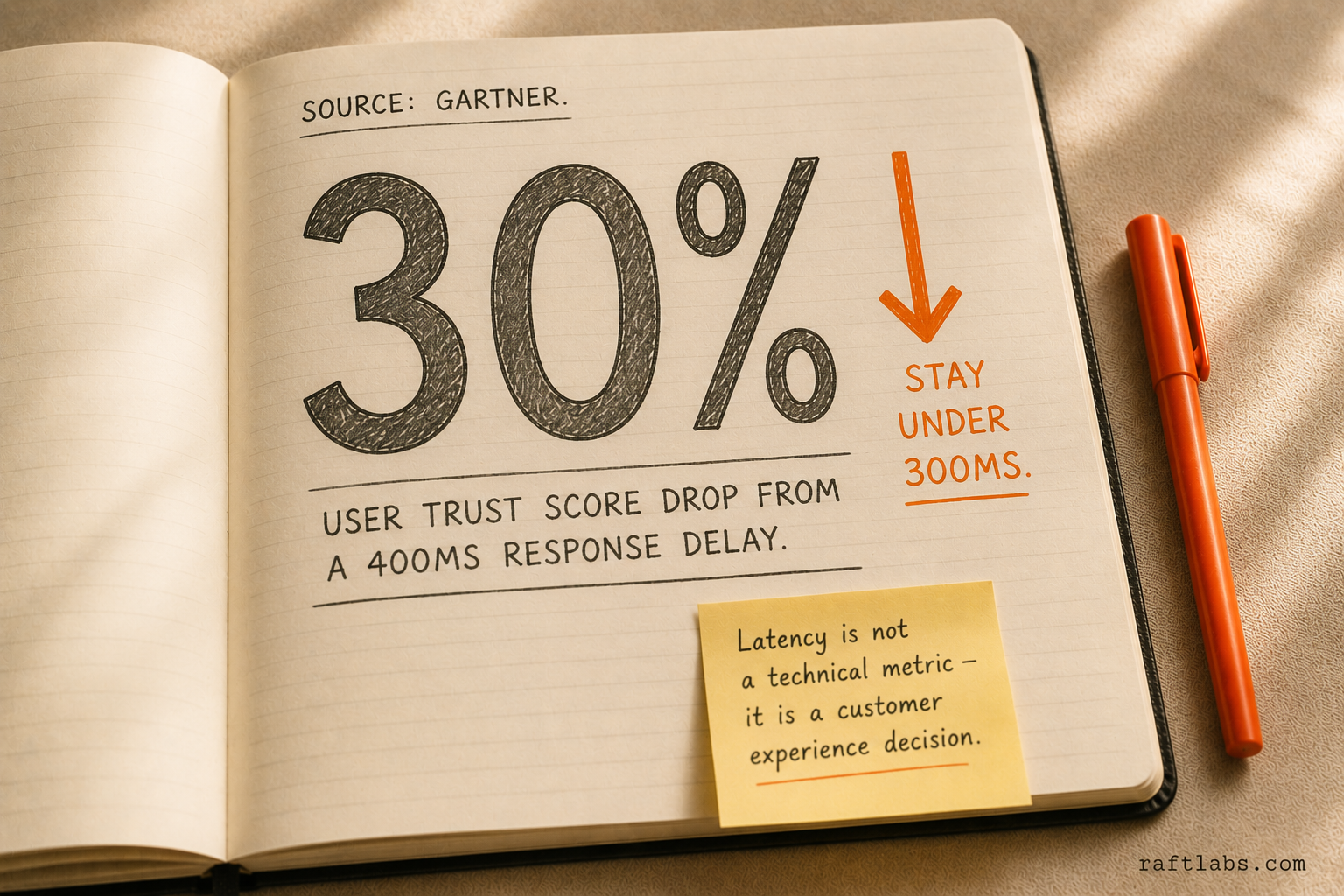
Latency is the silent killer of voice AI adoption. A 2-second delay might not seem significant on paper, but in a live conversation, it makes the AI feel robotic and untrustworthy. Gartner data shows that response delays over 400ms drop user trust scores by 30%. The top-tier developers on this list prioritize edge computing and low-latency architectures to keep response times under 300ms for most intents.
5. Distyl AI
Distyl AI is a US-based applied-AI firm that builds agentic infrastructure and enterprise LLM systems, with a focus on healthcare, financial services, and telecom - regulated, high-volume environments where a voice deployment has to integrate with core systems and stay compliant.
Key Services: Agentic infrastructure, enterprise LLM systems, applied AI for regulated industries
Industries Served: Healthcare, Financial Services, Telecom
Known Clients and Projects: Per the company, Distyl AI's investors include OpenAI, Microsoft, Coatue, Lightspeed, and Khosla; specific client references are not independently verified, so ask for a comparable production deployment during scoping.
Location: United States | Hourly Rate: Not publicly disclosed
Also read: Best SaaS Development Companies
6. Fractional AI
Fractional AI is a San Francisco-based custom generative-AI development shop that takes enterprise LLM, RAG, and agent projects from concept into production. Their model is engineering-led: build the custom system and get it running in production rather than sell a packaged platform.
Key Services: Custom generative-AI development, enterprise LLM systems, RAG pipelines, AI agents, concept-to-production delivery
Industries Served: Enterprise LLM, RAG, and agent builds across sectors
Known Clients and Projects: Per the company, Fractional AI is seed-funded (2024) with public case work cited for Change.org and Airbyte; treat these as self-reported and confirm relevance to your use case during scoping.
Location: San Francisco, USA | Hourly Rate: Not publicly listed
7. SoluLab

SoluLab, a Los Angeles-based digital solutions company, offers AI agent development tailored to enterprise needs. With expertise in LLMs and autonomous systems, they build scalable, context-aware voice agents for dynamic, human-like conversations. SoluLab's AI services span consultation to optimization, enabling 24/7 automation, multimodal data handling, and direct integration across industries like healthcare, retail, and finance.
Key Services: Custom AI development, machine learning, blockchain integration, chatbot development, enterprise software
Industries Served: Healthcare, Finance, Real Estate, Supply Chain, E-commerce, Enterprise
Known Clients and Projects: AI-powered automation and AI projects across industries
Location: United States, India | Hourly Rate: $25-$49/hr
Also check out: Top ReactJS Development Companies to build web and mobile applications.
8. Bluebash

Bluebash is a tech-focused software development company that helps startups and businesses with AI, cloud, and custom web solutions. Their core strengths include AI agent development, cloud infrastructure, and scalable platforms for healthcare and e-commerce.
Key Services: AI chatbot and cobot development, NLP, machine learning, Hugging Face integration, multilingual chatbot solutions
Industries Served: Healthcare, E-commerce, Financial Services, Entertainment, Education
Known Clients and Projects: AI chatbot development for healthcare and e-commerce; Hugging Face AI agents for customer support
Location: United Kingdom, India | Hourly Rate: $25-$49/hr
9. Phaedra Solutions
Phaedra Solutions is a technology and digital innovation firm established in 2013. Their areas of specialization are custom software development with AI, product design, web and mobile application development, MVP builds, and digital transformation. With 700+ digital deliveries and clients who have raised over $300M using Phaedra-built products, they have a verifiable track record.
Key Services: AI agent development and intelligent automation, custom AI software development, AI and machine learning software, AI MVP development, web and mobile app development, UI/UX design, digital transformation
Industries Served: Fintech, Healthcare, Education, E-commerce, Logistics, E-sports and Event management, Enterprise Platforms
Known Clients and Projects: 700+ digital deliveries; clients have raised on average $300M+ using Phaedra solutions
Location: Head office in Dubai, UAE, with presence in the United Kingdom and United States | Hourly Rate: $50-$99/hr
10. Appic Softwares
Appic Softwares delivers custom mobile and web app development, AI and GenAI services, machine learning, blockchain, DevOps, and digital transformation. Their work spans fintech, healthcare, e-commerce, real estate, and more. Notable case studies include AI-powered loan platforms, eco-emission tracking tools, healthcare e-commerce apps, and real-time legal chat systems.
Key Services: Custom AI agent development, machine learning, NLP, conversational chatbots, product recommendation engines
Industries Served: E-commerce, Healthcare, Education, Retail, Financial Services
Known Clients and Projects: Custom AI agent solutions for e-commerce platforms; AI-powered recommendation engines
Location: India | Hourly Rate: < $25/hr
Also read: Voice AI for Healthcare: Use Cases, Cost, and What Works
Voice AI Agent Development by Industry
Voice AI does not work the same way across industries. The technical requirements, compliance obligations, and conversation design principles that make a voice agent effective in healthcare are completely different from what works in telecom or hospitality.
1. Healthcare
Voice AI in healthcare operates under strict regulatory constraints that most general AI teams are not equipped to handle. HIPAA compliance covers not just data storage but the entire voice pipeline: STT transcription, LLM processing, TTS output, and every third-party API in the chain.
Clinical vocabulary is a distinct challenge. Medical terms, drug names, and procedure codes require custom vocabulary training that general-purpose STT models miss at rates that matter clinically. Patient intake agents, appointment scheduling, and medication reminder systems also need to handle emotionally sensitive conversations with accuracy and care that generic voicebot templates do not provide.
Healthcare software development for voice AI is a different discipline from general AI development. The compliance architecture must be designed in from day one, not retrofitted after a security review.
2. Banking and Financial Services
Financial services voice agents face PCI DSS compliance for any flow that touches payment card data, identity verification requirements before account-level information can be disclosed, and fraud detection triggers that must be built into the conversation logic. Voice biometrics for caller authentication adds a layer of security but requires careful handling under both GDPR and emerging US state-level biometric data laws.
The voice AI calculator is a useful starting point for estimating cost and ROI of a voice agent deployment in a financial services context.
3. Hospitality
Hospitality voice agents handle a unique combination of requirements: multilingual support for international guests, integration with property management systems for real-time availability and reservation data, and the conversational informality of guest interactions that does not translate well to rigid dialogue trees.
A guest asking about checkout in French, switching to English mid-sentence, and asking a follow-up about late checkout is a realistic production scenario. The voice agent needs to handle that gracefully.
Hotel booking app development and travel and hospitality software development are the adjacent capabilities that determine how well the voice agent connects to the broader tech stack.
4. Telecom
Telecom is the highest-volume voice AI use case by call count. IVR replacement at the scale of a telecom carrier requires concurrent call handling in the thousands, sub-second response latency to avoid the perception of lag, and deep integration with BSS/OSS systems that most AI teams have never worked with.
Conversational AI and real-time streaming is the infrastructure layer that makes high-volume telecom voice deployments viable.
5. Insurance
Insurance voice agents handle first notice of loss calls, policy queries, claims status updates, and renewal conversations. All of these require accurate information retrieval from policy databases, compliance with state-level insurance regulations, and conversation design that handles customers in stressful situations.
The voice AI development process for insurance builds escalation paths, compliance guardrails, and database integrations into the agent architecture from the start.
The human handoff: where Voice AI either succeeds or fails
The most sophisticated implementations do not use Voice AI to replace humans entirely. They use it to handle routine work while humans handle what AI cannot.
"The handoff moment is the single biggest predictor of customer satisfaction in a voice AI deployment. A smooth handoff with full context converts a frustrated customer into a resolved one. A blind transfer does the opposite." - Niki Hall, Chief Marketing Officer, Dialpad, published in Dialpad's 2024 AI in Business Communications Report
The failure point in many Voice AI strategies is not planning for the moment the AI reaches its limit. A capable Voice AI developer builds sentiment triggers into the conversation logic. When the AI detects a customer becoming frustrated or presenting a complex emotional query, it transfers the call to a human agent with a full real-time transcript of what has already happened.
The customer never has to repeat themselves. That single design decision is the difference between a complaint and a resolved interaction.
The 2026 Strategic Choice: Build vs. Buy
For mid-to-large enterprises, partnering with a specialized Voice AI firm delivers faster time to value than building in-house. The AI field moves fast enough that by the time an internal team is hired and trained, the underlying models have changed significantly.
Partnering allows you to use a vendor's ongoing R&D investment rather than funding your own. The critical contractual requirement: you retain ownership of your customer data and your custom conversation flows. You should be a partner, not a permanent dependency.
When auditing vendors, look for time to value. The right development partner moves you from pilot to a live, revenue-generating agent in weeks, not months, while your team retains full ownership of the customer data and conversation flows.
Red Flags to Watch For
Strategic and Sales Red Flags
Vague pricing and timelines: Promises of an enterprise-grade system in 3 weeks without a detailed scope are a sign of shortcuts ahead.
The bait-and-switch: If you meet senior architects during sales but only see junior developers after signing, your project quality will suffer. Ask specifically who will be your lead architect and developer.
Technical and Security Red Flags
Proprietary black boxes: Avoid companies that insist on using their own closed-source AI with no path to model transparency. This leads to vendor lock-in with no exit path.
No proactive compliance discussion: If they do not mention GDPR, HIPAA, or SOC 2 in the first technical call, compliance is not a design constraint for them. It is an afterthought.
"No training needed" claims: Any firm claiming their AI performs perfectly out of the box for your use case is not being straight with you. High-performing Voice AI requires your specific industry data and continuous fine-tuning.
Commercial and Legal Red Flags
Murky IP ownership: You must own your data and your custom conversation flows. If the contract says the agency retains ownership of code built for you, walk away.
Aggressive payment terms: Demanding 100% upfront is a red flag for non-delivery. Milestone-based payments (30% start, 40% mid-project, 30% post-launch) are standard for professional firms.
No exit strategy: A professional partner provides a clear path for data portability and knowledge transfer if the relationship ends. You should be a partner, not a permanent dependency.
Communication Red Flags
If the sales team spends 80% of the call talking about themselves and asks nothing about your existing tech stack or KPIs, they are not trying to solve your problem. If they repeatedly push a solution at 3x your stated budget without a clear ROI justification, they are not respecting your business reality.
How to Validate Claims in 5 Minutes
Check team retention on LinkedIn: High turnover usually means project delays and lost institutional knowledge.
Ask for "the ugly" reference: Do not just talk to happy clients. Ask for a reference whose project had challenges. How the agency handled problems tells you more than their success stories.
Request a security packet: If they cannot produce a SOC 2 report or ISO certification quickly, their security posture is likely an afterthought.
Your 2026 Voice AI Partner Scorecard
Use this checklist to grade potential partners. A capable development firm should confirm every item.
Strategic cross-pollination: Can they demonstrate how experience in high-stakes sectors (like healthcare) has hardened their security and UX protocols for your specific project?
Global privacy compliance: Do they proactively address GDPR and HIPAA without being prompted?
Transactional capability: Can the AI actually execute tasks (updating CRMs, modifying bookings, updating patient records) rather than just answering FAQs?
Sentiment handoff: Is there built-in logic to transfer to a human agent when a user sounds distressed or frustrated?
IP and data ownership: Does the contract explicitly state that you own the custom conversation flows, fine-tuned models, and all sensitive data?
Engineering transparency: Do you have direct access to senior architects and developers, or are you shielded by a sales-only layer?
Ready to build a Voice AI agent that checks every box? Schedule a Strategy Call with RaftLabs
What to do next
Voice AI is changing how businesses connect with customers: making support faster, reducing operational load, and enabling 24/7 coverage without proportional staffing cost.
The companies on this list have demonstrated production-grade work in the space. Some focus on healthcare compliance, others on high-volume call center automation, others on developer-friendly API-first builds. Selecting the right one depends on your industry, your compliance context, and the specific conversation flows you need to automate.
RaftLabs builds voice AI in spaces where compliance and production reliability are non-negotiable. If you are ready to scope a voice AI deployment, let's talk.
Ask an AI
Get an instant summary of this post from your preferred AI assistant.
Common questions
- The technical markers: proven STT/TTS pipeline design for low latency (under 300ms), LLM prompt engineering for spoken rather than written conversation, accent and dialect handling across your target markets, and compliance documentation that covers the full data pipeline, not just encryption at rest. The business markers: references from production deployments, not proofs-of-concept, and transparency about who actually builds the project versus who sells it.
- A basic voice AI agent with single-intent handling and CRM integration runs $15,000-$40,000. A production-grade agent covering multiple intents, compliance requirements, and human handoff logic runs $40,000-$120,000. Ongoing costs include LLM inference fees (typically $0.002-$0.02 per conversation minute depending on the model), infrastructure hosting, and monthly model retraining. Getting specific figures requires scoping your call volume, intent complexity, and integration requirements first.
- Capable teams address compliance at the architecture stage, before any code is written. HIPAA requires that STT transcription, LLM inference, TTS synthesis, and any third-party APIs in the chain all meet compliance standards. GDPR adds data residency requirements, the right to deletion from training sets, and consent documentation. Voice biometrics data has additional requirements under GDPR and emerging US state biometric laws. Ask any vendor for their compliance architecture documentation, not just a verbal assurance.
- A basic agent with 5-10 intents and standard CRM integration takes 6-10 weeks. A production agent covering 20+ intents, compliance requirements, multilingual support, and human handoff takes 14-20 weeks. The deployment phase (stress testing concurrent call handling, accent calibration, and latency optimization) adds 2-4 weeks that teams routinely underestimate.
- Build in-house when you have an existing ML team with STT/TTS and LLM experience, your call volume justifies training proprietary models, and you are prepared to retrain every 6-12 months as underlying models improve. Partner when you need a production deployment in under 6 months, your team lacks conversational AI depth, or your volume does not justify the infrastructure investment. Most enterprises with fewer than 500,000 monthly call minutes are better served by a specialized partner than an internal build.