Future of AI in the Hospitality Industry: What’s Next for Smart Hotels
- Trinankur Bera
![Trinankur Bera]()
- Travel and Hospitality
- Last updated on
Key Takeaways
AI is transforming hospitality by automating tasks, improving operations, and creating personalized guest experiences.
Core AI technologies like machine learning, NLP, computer vision, generative AI, and IoT work with hotel systems such as PMS, CRS, CRM, booking engines, and RMS.
AI is becoming critical due to rising guest expectations, staffing shortages, cost pressures, and competition from smart, tech-enabled hotels.
Hotels already use AI for chatbots, virtual concierges, dynamic pricing, personalization, security, and fraud detection.
Future trends include hyper-personalized guest journeys, generative AI for communication, fully contactless stays, voice-controlled smart rooms, workforce optimization, robots, sustainability, and predictive maintenance.
Adopting AI brings challenges like data privacy, legacy system integration, high upfront costs, AI bias, and the need for staff training and change management.
To prepare, hotels should assess AI readiness, modernize data infrastructure, train staff, decide between custom and ready-made tools, and start with small pilot projects or MVPs.
When implemented well, AI can increase revenue, reduce labor and energy costs, and significantly improve guest satisfaction and long-term profitability.
The hospitality industry is undergoing a rapid digital transformation, and artificial intelligence (AI) is at the center of this shift. Hotels, resorts, and travel businesses are increasingly adopting AI to streamline operations, improve decision-making, and deliver highly personalized guest experiences.
From AI-powered chatbots and dynamic pricing engines to predictive analytics and smart guest personalization, AI is reshaping how hospitality businesses manage bookings, optimize revenue, and engage with guests across every touchpoint.
According to recent studies, 58% of guests believe that AI can enhance their hotel stays, and the global market for AI in hospitality is projected to exceed $1.2 billion by 2026. The future of the hospitality industry is closely tied to AI, and those who adapt early will likely lead the market.
In this blog, we explore the future of AI in the hospitality industry, the core technologies transforming hotels today, and how hospitality businesses can start leveraging AI strategically to gain a long-term competitive advantage.
Who Should Read This Guide
This guide is designed for hospitality professionals and decision-makers who want to understand how artificial intelligence is transforming the hospitality industry and how to apply it in real-world hotel operations.
Hotel Owners and General Managers:
Looking to improve operational efficiency, enhance guest experiences, and increase profitability using AI-powered hotel solutions.Revenue Managers and Operations Directors:
Focused on leveraging AI-driven revenue management, dynamic pricing, and workflow automation to optimize performance and reduce costs.IT Directors and Technology Leaders:
Who are responsible for evaluating new AI technologies, managing system integrations (PMS, CRM, RMS), and ensuring scalable, secure AI adoption.Hospitality Entrepreneurs and Startups:
Developing new properties or launching innovative concepts, needing guidance on integrating AI from the ground up to differentiate their offerings.Property Management Companies:
Managing multiple properties and locations that require scalable AI solutions for centralized operations, analytics, and guest personalization.Consultants and Investment Analysts:
Advising hotel chains, properties, and stakeholders on technology adoption, AI strategies, and investment opportunities within the hospitality space.Hospitality Students and Professionals:
Seeking to deepen their understanding of AI use cases, emerging technologies, and the future of hospitality innovation.
What You’ll Discover in This Guide
This guide provides a clear, actionable roadmap to understanding and implementing artificial intelligence in the hospitality industry, from foundational concepts to real-world execution.
Here’s what you’ll learn:
AI Technologies in Hospitality:
A deep dive into core AI technologies transforming hotels, including machine learning, predictive analytics, AI chatbots, and personalization engines used across guest services and operations.Real-World AI Use Cases & Case Studies:
Examples of how hotels and hospitality brands are successfully using AI to improve operational efficiency, guest satisfaction, and revenue performance.The Business Impact of AI:
Insights into measurable outcomes such as cost reduction, AI-driven revenue growth, demand forecasting, and smarter pricing strategies.AI Implementation Strategies for Hotels:
Practical guidance on integrating AI into existing systems, addressing challenges like data integration, PMS/CRM compatibility, security, and staff adoption.Emerging AI Trends in Hospitality:
A preview of future AI innovations shaping hospitality industry, including personalized experiences, AI agents, robots, and intelligent automation.Choosing the Right AI Solutions:
A guide to selecting the best AI tools based on business goals, operational needs, and budget constraints.Building AI for the Long Term:
How to build scalable and future-proof AI strategies that evolve with the changing guest expectations and technology advancements.
Before deep diving into the specific AI technologies, let’s first clarify what the term “AI in hospitality” really means and why it matters for modern hotels.
What Is AI in Hospitality?
AI in hospitality industry is all about using smart technologies like machine learning, natural language processing, computer vision, and predictive analytics to automate tasks, analyze guest data, and improve decision-making across hotel operations.
These AI technologies enable hotels to respond faster to guest requests, understand customer preferences, and manage day-to-day operations with significantly less manual effort. From AI-powered chatbots and smart pricing systems to demand forecasting and sentiment analysis, AI helps hospitality businesses operate more efficiently while delivering more personalized guest experiences.
By analyzing patterns, behavior, and real-time data with AI, hotels can offer more personalized services, predict what guests may need next, and solve issues before they turn into complaints.
For many hotels, AI has become a quiet partner that supports the team by managing patterns, preferences, and real-time data. This shift is helping properties move from basic service to more thoughtful, tailored guest journeys.
In simple words, AI helps hotels deliver smoother stays for guests and more efficient workflows for staff. Next, let’s explore the core AI technologies shaping the hospitality industry today.
Key AI Technologies Used in Hotels
The adoption of artificial intelligence in hospitality is powered by several core technologies that enable digital transformation across hotel operations, guest services, and revenue management.

1. Machine Learning (ML):
Machine learning is a foundational AI technology that allows systems to learn from historical and real-time data, identify patterns, and improve predictions over time. In hospitality, ML algorithms analyze guest behavior, booking trends, and demand patterns to support dynamic pricing, occupancy forecasting, and personalized service recommendations.
By leveraging machine learning, hotels can optimize revenue management strategies, increase upsell opportunities, and enhance overall guest satisfaction.
2. Natural Language Processing (NLP):
Natural language processing enables systems to understand, interpret, and respond to human language.In the hospitality industry, NLP powers AI chatbots and virtual assistants that handle guest inquiries, manage reservations, and provide 24/7 support across websites, mobile apps, and messaging platforms.
NLP is also crucial in sentiment analysis, helping hotels analyze guest feedback, surveys, and reviews for actionable insights that drive service improvements.
3. Computer Vision:
Computer vision allows AI systems to interpret and understand visual data analyze visual data from cameras and sensors. In hotels, this technology is primarily used for security purposes (e.g., identifying suspicious activity) and operational efficiency (e.g., tracking inventory).
Technologies like facial recognition are also enabling faster, contactless check-in and identity verification, helping reduce wait times and improve the guest arrival experience.
4. Generative AI:
Generative AI helps create content such as personalized messages, marketing materials, and customized offers. This technology can automate guest communication, ensuring that each guest receives a personalized experience based on their behavior and preferences.
For example, if a guest frequently books spa services, generative AI systems can proactively send personalized promotions or pre-arrival offers, increasing engagement and ancillary revenue.
5. Internet of Things (IoT) + AI:
IoT devices such as smart thermostats, voice assistants, connected lighting, and occupancy sensors, collect real-time data about guest behavior and room conditions. AI uses this data to optimize the in-room experience by adjusting settings like temperature, lighting, and entertainment preferences based on guest choices.
When combined, IoT and AI help hotels improve comfort, reduce energy costs, and maintain consistent service quality across properties.
AI technologies deliver the greatest impact when they are integrated with existing hospitality systems rather than operating in isolation. Next, let’s explore how AI connects with the tools hotels rely on for daily operations.
Core Hospitality Systems AI Integrates With
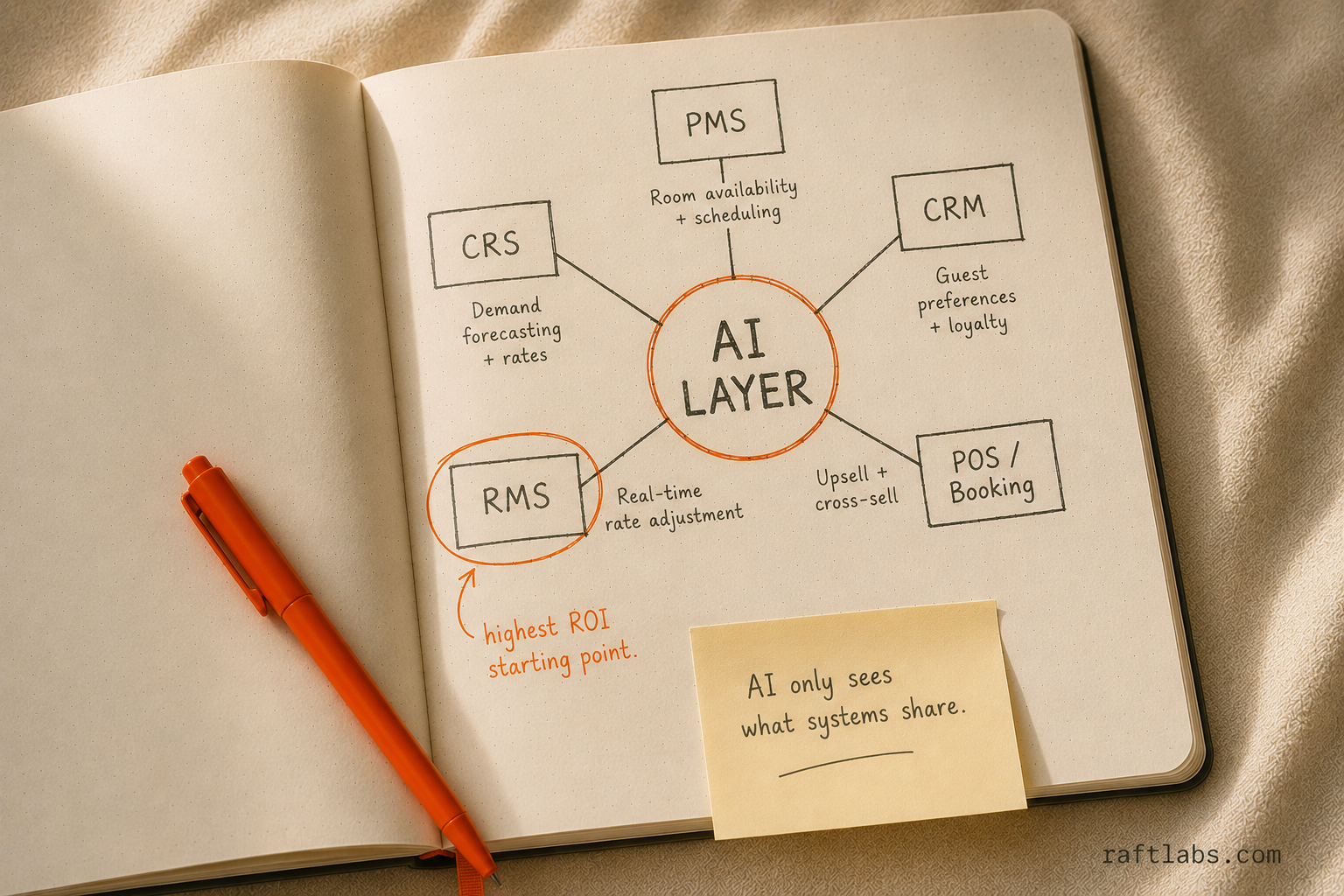
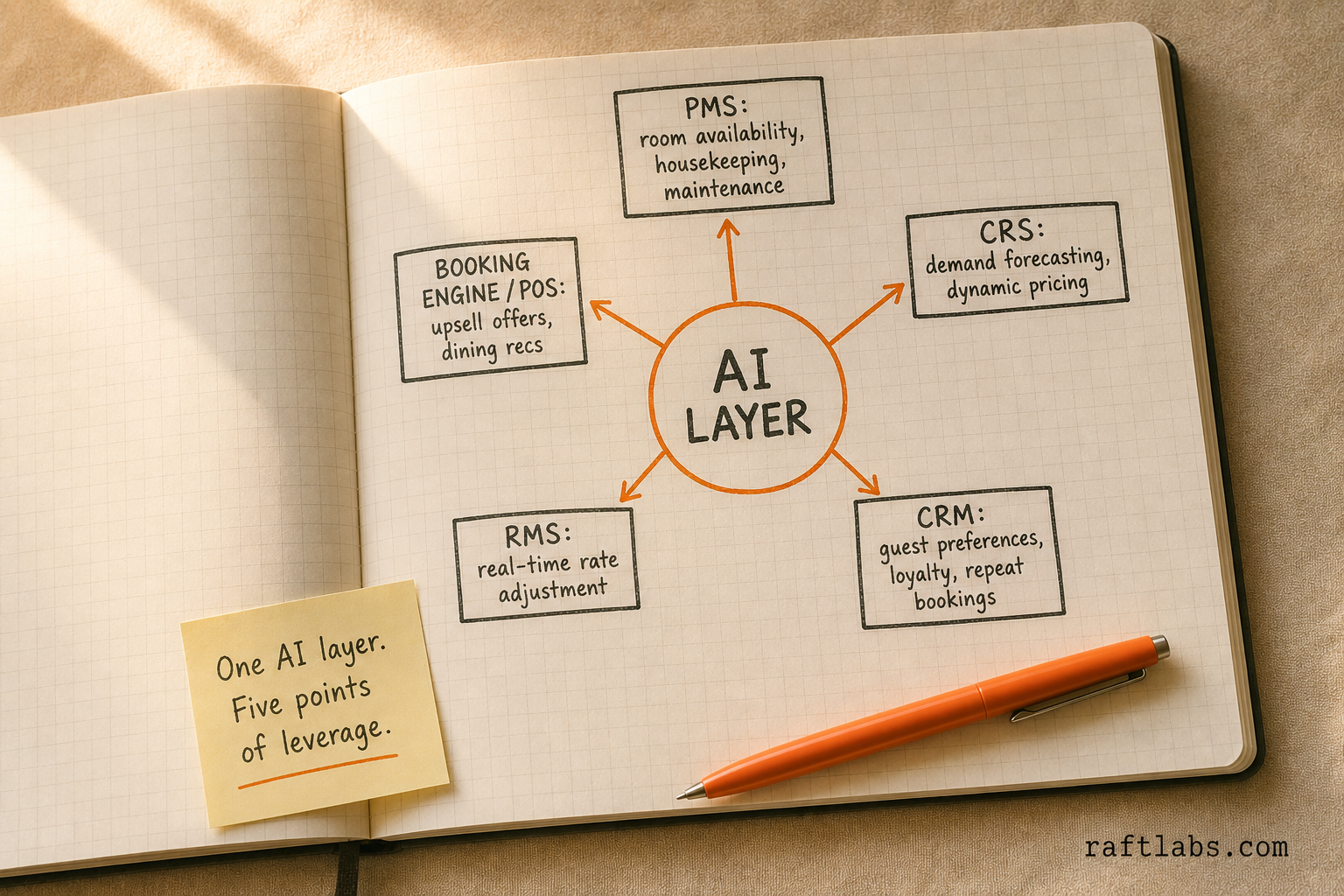
AI delivers the greatest value in hospitality when it is integrated with core hotel systems that manage operations, bookings, guest data, and revenue. By connecting AI with these platforms, hotels can unlock real-time insights, automation, and smarter decision-making across the entire guest lifecycle.
1. Property Management System (PMS):
When integrated with a Property Management System (PMS), AI provides real-time visibility into operational data such as room availability, housekeeping schedules, maintenance requests, and guest arrival patterns.
AI-enhanced PMS platforms help hotel teams:
Optimize room turnover and availability
Improve staff coordination
Anticipate operational issues before they escalate
2. Central Reservation System (CRS):
AI integration with Central Reservation Systems (CRS) enables advanced demand forecasting, dynamic pricing, and inventory optimization. By analyzing historical data, market conditions, and booking trends, AI helps hotels predict peak periods and adjust rates accordingly.
This results in improved occupancy rates and revenue performance across channels.
3. Customer Relationship Management (CRM):
AI-powered Customer Relationship Management (CRM) systems analyze guest profiles, booking history, preferences, and engagement behavior to deliver highly personalized marketing and communication.
With AI-driven CRMs, hotels can:
Predict guest behavior
Tailor offers and loyalty programs
Improve repeat bookings and customer retention
4. Booking Engines:
AI-powered booking engines use behavioral data and real-time signals to personalize the booking experience. These systems can recommend room upgrades, add-on services, or special offers during the booking flow.
By optimizing user journeys, AI helps increase conversion rates and average booking value.
5. Revenue Management Systems (RMS):
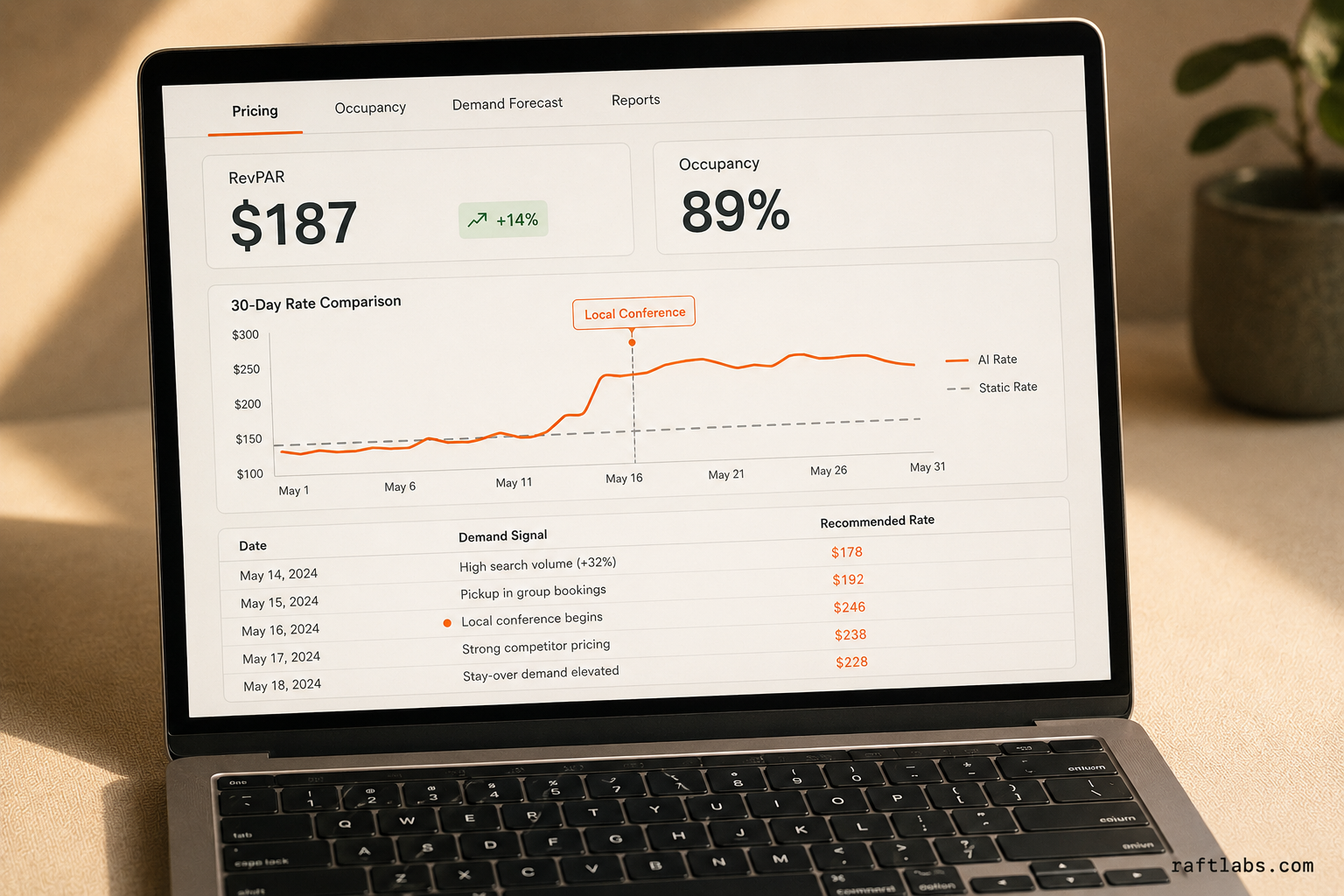
AI and machine learning are transforming Revenue Management Systems (RMS) by enabling real-time price adjustments based on demand fluctuations, competitor rates, and external events.
For example, if a major event or concert suddenly increases local demand, AI-powered RMS platforms can update room prices within seconds, ensuring maximum revenue capture.
6. POS and Guest Engagement Platforms:
AI enhances Point of Sale (POS) and guest engagement platforms by automating interactions such as check-in, room service orders, concierge requests, and reservations.
These systems provide:
Instant responses to guest requests
Personalized recommendations
Faster service delivery with reduced staff workload
Integrate AI into your hospitality operations
We specialize in helping businesses adopt AI solutions that drive revenue growth.

Why AI Is Becoming Critical for the Hospitality Industry
AI is no longer a future concept in hospitality, it is quickly becoming a business necessity. Several industry-wide shifts are accelerating AI adoption across hotels, resorts, and travel businesses.
There are several key reasons why AI is becoming indispensable in hospitality:
1. Rising Guest Expectations:
Today’s guests expect more than a comfortable room. They want stays that feel tailored to them, almost like the hotel already knows what they prefer.
AI enables hotels to deliver this level of personalization by analyzing guest behavior and responding in real time. whether it is preparing room preferences in advance or suggesting things they are likely to enjoy.
For example, if a guest frequently prefers early breakfast options or higher-floor rooms, AI systems can automatically surface these preferences during . during their next stay.
2. Staffing Shortages & Cost Pressure:
Labor shortages and rising operational costs are pushing hospitality teams to do more with fewer resources. AI-powered automation helps handle routine tasks such as guest inquiries, arrival coordination, task scheduling, and service requests.
By automating repetitive workflows, hotels can free up staff to focus on high-value, human-centric interactions that directly impact guest satisfaction.
3. Demand for Personalization:
Modern hospitality is judged by the end-to-end guest experience, not just the quality of accommodation. AI allows hotels to adjust in-room comfort levels and suggest food experiences based on guest history, creating a more personal stay.
This level of personalization helps create more memorable stays while increasing guest loyalty and repeat bookings.
4. Competitive Pressure from Smart Hotels:
As more hotels adopt AI technologies, there is increased pressure on others to follow suit. Hotels that embrace AI can create smarter, more efficient operations, while also providing better service, giving them a competitive edge.
Hotels that delay adoption risk falling behind competitors who are already using AI to optimize pricing, operations, and guest engagement.
These factors are pushing the industry to adopt AI solutions that can handle these challenges while elevating the guest experience.
Now, let's see how AI is already being implemented in hospitality to drive operational improvements.
Current State of AI in Hospitality
AI is already making a significant impact in various areas of hospitality. Here’s a look at some of the ways AI is being implemented today:
1. AI Chatbots and Virtual Concierges: AI-driven chatbots help hotels handle guest inquiries 24/7, provide instant answers, and assist with bookings. This reduces wait times, improves guest satisfaction, and enables hotels to scale customer support without adding more staff.
2. Revenue Management and Dynamic Pricing: AI systems help hotels adjust prices in real-time based on demand forecasts, occupancy rates, and competitive analysis.
This allows hotels to maximize revenue while staying competitive.
3. Personalized Guest Experiences: AI-driven personalization tailors guest experiences by analyzing past interactions, preferences, and behaviors. This includes customized dining recommendations, service timing, and even curated activity suggestions.
4. Computer Vision for Security and Operations: AI-powered computer vision enhances hotel security by monitoring surveillance footage and detecting potential threats. It can also improve operational efficiency by tracking room conditions and inventory levels.
5. AI-powered Fraud Detection: AI systems are increasingly used to detect fraudulent activities by analyzing booking patterns, payment data, and guest behavior in real-time.
With AI already reshaping the hospitality sector, the next wave of innovation is on the horizon. Let's explore the future trends that will shape this transformation in the coming years.
Future of AI Trends in the Hospitality Industry
As AI continues to evolve, the hospitality industry will experience significant changes, driven by several emerging trends. From hyper-personalized guest journeys to autonomous robots, AI is poised to transform hotel operations.

Below are the key trends that will shape the future of AI in the hospitality industry:
1. Hyper-Personalized Guest Journeys
AI is set to take personalization to new heights by creating unique, tailored experiences for each guest. Beyond basic preferences, AI will analyze past stays, reservation choices, and even social media activity to deliver hyper-personalized experiences in real time.
Examples:
Room Customization: AI can automatically adjust room settings (temperature, lighting, and entertainment) before the guest even enters the room based on their previous preferences.
Personalized Recommendations: AI can offer tailored dining options, activities, and local attractions based on the guest's interests and past behavior.
A hotel chain like Marriott is already testing AI-driven personalization that includes an AI concierge assistant, designed to help guests discover local experiences and suggestions.
Hospitality businesses of any scale can start with tools like these to offer quicker support and build more personalized stays without overwhelming their staff.
2. Generative AI for Guest Communication and Content
Generative AI in hospitality will revolutionize guest communication by enabling real-time, dynamic, and context-sensitive responses. This technology can create tailored content and recommendations for each guest, enhancing their overall experience.
Examples:
Custom Itineraries: AI can generate personalized itineraries for guests, including dining options, nearby attractions, and even spa or wellness activities based on their preferences.
Personalized Messaging: AI can craft customized messages, promotional offers, and marketing content to suit individual guests.
Suppose after a family weekend stay, the hotel sends a thank-you message offering a discount on a future family package, highlighting activities enjoyed during the stay. This personalized follow-up encourages the guest to book again.
AI-driven platforms like OpenAI and Google DeepMind are already enabling highly personalized guest interactions, and this technology will soon be commonplace in popular travel and hospitality enterprises.
3. Fully Contactless Hotel Journeys
The push for contactless experiences is growing fast as guests now expect smoother, faster, and more private interactions during their stay. Many travelers prefer doing things on their own through their phones, the same way they handle banking or food delivery.
Examples:
Mobile Check-ins: Guests can check in, select their room, and unlock their doors using their smartphones or mobile apps, powered by AI and facial recognition.
Automated Requests: Guests can make requests (room service, housekeeping) via mobile apps or voice assistants, without ever needing to interact with hotel staff.
YOTEL (a hotel chain) has implemented automated check-in kiosks and mobile app-based room unlocking systems, paving the way for fully contactless stays in the future.
4. Voice AI & Smart Rooms
Voice AI technology will further enhance smart room capabilities, offering a completely hands-free experience for guests. With voice-activated assistants like Amazon’s Alexa or Google Assistant already being used in many hotel rooms, the future of AI will see these systems evolve into highly intuitive, personalized tools.
Examples:
Room Customization: Guests can use their voice to control lighting, climate settings, and in-room media. Maybe a guest could say, “Set the room to 70°F, dim the lights, and play some relaxing music.”
Concierge Services: Voice AI can act as a personal assistant, helping guests schedule wake-up calls, request extra amenities like pillows or towels, or provide real-time updates on hotel events and services.
A hospitality company like Hilton is already using voice assistants in its rooms, allowing guests to control their environment with voice commands, and this technology will only improve as AI evolves.
By implementing such technology, any vacation rental or serviced apartment can offer travelers a more comfortable stay without searching for switches or menus.
5. AI-Powered Workforce Optimization
AI will play a key role in optimizing hotel staffing, ensuring that the right number of employees are scheduled based on real-time data about guest arrivals, occupancy rates, and local events. This ensures that hotel staff are allocated efficiently, optimizing both service and labor costs.
Examples:
Predictive Scheduling: AI can predict peak periods, like holidays or major events, helping hotels adjust staffing levels for busy times with contractual hires and reduce labor costs during slower periods.
Task Automation: AI can automate repetitive tasks, such as room cleaning schedules or inventory tracking, freeing up staff to focus on guest interaction.
Accor Hotels (a hospitality group) uses AI-powered systems to optimize staffing levels based on real-time occupancy data, ensuring that the right number of staff are available to meet guest demand. Even boutique property operators can benefit from the same idea.
6. Autonomous Service Robots
Robots are becoming increasingly popular in hotels, handling everything from room service delivery to cleaning tasks. With AI, these robots will become more intelligent, taking on more sophisticated roles that traditionally required human interaction.
Examples:
Room Service Delivery: Autonomous robots could deliver room service, luggage, or toiletries directly to guest rooms.
Hotel Navigation: Robots could guide guests to their rooms, the restaurant, or other hotel amenities.
The Yotel has robot staff that assist with luggage handling and room service. This is just a glimpse into the future of hotel technology.
7. Sustainability and Energy Optimization with AI
Sustainability is becoming increasingly important in the hospitality industry, and AI is playing a major role in helping hotels reduce their environmental footprint. AI-powered systems can monitor energy usage, optimize heating and cooling, and minimize waste.
Examples:
Energy Management: AI can analyze occupancy data and adjust lighting, heating, and air conditioning systems to reduce energy consumption when rooms are unoccupied.
Waste Reduction: AI can help hotels track inventory and reduce food waste by predicting demand based on guest preferences and local events.
For instance, the Hilton Group has implemented AI-driven energy management systems that help reduce energy consumption and operational costs.
You don’t need to be a market leader to take advantage of AI. Enterprises can start with AI-driven solutions in key areas and see immediate improvements in operational efficiency and cost reduction.
8. Predictive Maintenance
AI’s ability to analyze data from hotel systems and equipment will lead to more efficient maintenance. Predictive maintenance uses AI to forecast when equipment, such as HVAC systems or elevators, is likely to fail, allowing hotels to address issues before they cause disruptions.
Examples:
Maintenance Alerts: AI can identify wear and tear in specific components, such as worn-out filters in air conditioning units or damaged seals in refrigerators, and recommend parts replacement before the systems fail.
Optimal Scheduling: AI can also suggest the best time for maintenance tasks to be carried out, minimizing disruption to hospitality operations.
Ready to embrace the future of AI in hospitality?
From AI-driven personalization to seamless guest services, we’ll help you integrate smart solutions that enhance every stay.

Challenges and Risks of Adopting AI in Hospitality
While AI offers significant benefits, there are challenges that need to be addressed:
1. Data Privacy and Security Concerns: AI systems rely on guest data to deliver personalized experiences. Hotels must ensure that this data is protected and comply with data privacy regulations like GDPR.
2. Integration with Legacy Systems: Many hotels still use outdated systems that may not be compatible with AI technologies. Integrating AI with legacy systems can be complex and expensive.
3. High Initial Investment Costs: The cost of implementing AI can be high, especially for small-sized hotels. However, the long-term benefits in terms of operational efficiency and guest satisfaction can justify the investment.
4. AI Bias and Model Accuracy: AI models might need regular monitoring to ensure that they are accurate and unbiased. Poor data quality or incorrect algorithms can lead to inaccurate predictions and decisions.
5. Change Management and Staff Training: AI adoption requires hotels to train staff on new technologies and manage change effectively. Without proper training, staff may resist using AI tools, which could limit their effectiveness.
While there are challenges to implementing AI in hospitality, the benefits it brings are clear. The next step is to ensure your business is prepared to integrate these transformative technologies.
Let's dive into how your hospitality business can effectively embrace the AI-enabled future.
How Hotels Should Prepare for the AI-Driven Future
Integrating AI into hospitality operations is a strategic move that requires careful planning and execution.
Here’s how hotels can prepare for the AI-driven future:
1. Conduct an AI Readiness Audit
Before implementing AI, hotels should evaluate their existing technological infrastructure to identify gaps and areas where AI can provide the most value. This involves reviewing systems like Property Management Systems (PMS), Customer Relationship Management (CRM), and booking engines to ensure they’re ready for AI integration.
The audit should also assess data security, compatibility, and any legacy systems that may require upgrades.
2. Modernize Data Infrastructure
AI relies on large volumes of accurate, high-quality data. To make the most of AI, hotels need to upgrade their data infrastructure to support real-time data processing and storage.
This includes ensuring data is accurate, cleaned, and well-organized, as AI models rely on historical and real-time data to make informed decisions.
Proper data governance practices should also be put in place to protect guest privacy and ensure compliance with regulations like GDPR.
For example, hotels should consider investing in cloud-based data storage and analytics tools that allow them to gather guest preferences, booking data, and service requests in real-time.
3. Invest in Staff AI Training
AI tools are only as effective as the people using them. Hotels should invest in staff training programs to ensure employees are comfortable and proficient in using AI-driven tools.
This includes educating staff on how to interact with AI systems, manage guest interactions, and interpret AI-generated insights. Additionally, staff should be trained on handling any AI-related issues or troubleshooting.
4. Build vs Buy: Custom AI Solutions or Ready-Made Tools
Hotels often face a choice between developing AI tools internally or using out-of-the-box products. Building AI in-house sounds flexible, but it usually demands a large team, long timelines, and deep technical skills, which many hotels don’t have the bandwidth for.
Ready-made tools are quicker to install, but they can feel limiting once you try to fit them into your unique workflows or long-term digital plans.
This is why many hotels choose to work with a dedicated software team like us that can design custom AI features while still moving fast. It gives them the benefits of tailored development without taking on the heavy cost and complexity of building everything themselves.
5. Start with Pilot Programs & a Minimum Viable Product (MVP) Approach
Rather than rushing into large-scale AI implementation, hotels should begin with pilot programs to test the effectiveness of AI tools on a smaller scale.
An MVP approach allows hotels to experiment with a limited set of features, gather feedback, and assess results before scaling solutions across the entire hotel.
This approach reduces risks and helps make data-driven decisions about broader implementation.

Cost, ROI, and Business Impact of AI in Hospitality
AI is an investment. When it is planned well, it brings higher revenue, stronger guest experience, and lower operating costs. Below is a simple way to understand what hotels usually spend and what they can expect in return.
Typical AI Implementation Costs
You can think of AI costs in three stages. Each stage fits a different level of digital maturity.
| Type of AI Project | What You Get | Timeline | Typical Cost |
|---|---|---|---|
| Entry Level SaaS Tools | Chatbots, review analysis, simple automation, PMS or CRM add ons | Fast setup | Monthly fee from a few hundred to a few thousand USD plus setup |
| AI MVP for Your Hotel | One or two focused AI features like demand forecasts or a WhatsApp concierge | About 6 to 8 weeks | USD 10,000 to 20,000 |
| Full AI Layer Across Operations | Multiple modules such as pricing, guest messaging, scheduling, and dashboards | About 12 to 14 weeks or more in phases | USD 20,000 to 40,000 plus depending on integrations |
| Advanced AI and Innovation | Large projects with AR, VR, computer vision, or deep personalization | Custom timeline | Custom quote after assessment |
Higher costs usually come from the number of tools you need to integrate, not just the AI models themselves.
Expected ROI Benchmarks
Industry forecast reports show that AI-powered dynamic pricing can increase hotel revenue by up to 15%.
Similarly, lightweight AI tools like chatbots or simple workflow automation often show quick returns. Larger rollouts, including full revenue management, predictive analytics, and connected guest experience systems, take more time but deliver stronger results.
Common ROI Patterns
Narrow use cases like food cost control or guest messaging can usually pay back within a year.
Larger programs that support many parts of the business, like pricing, housekeeping, and maintenance, might show strong results after a year.
The quickest ROI can come from automation of repeated tasks and improvements to existing revenue streams.
The key is to decide your success metrics early and measure them every month.
As you can see, the gains from AI show up in different ways depending on how wide your rollout is.
With this in mind, it helps to look at how AI can lift your revenue in day-to-day operations.
Revenue Uplift Potential
AI helps revenue grow in a few direct ways.
Smarter Pricing
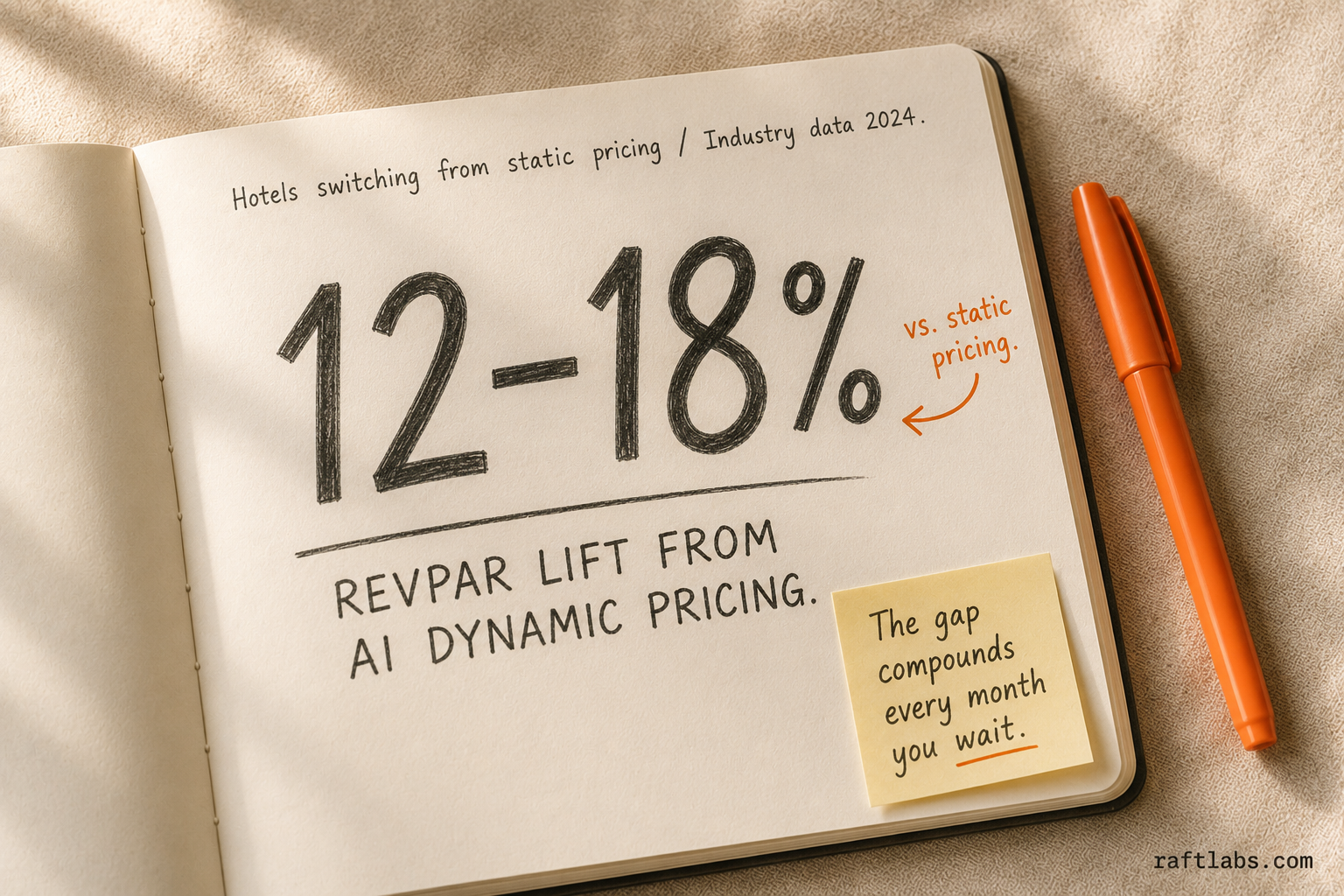
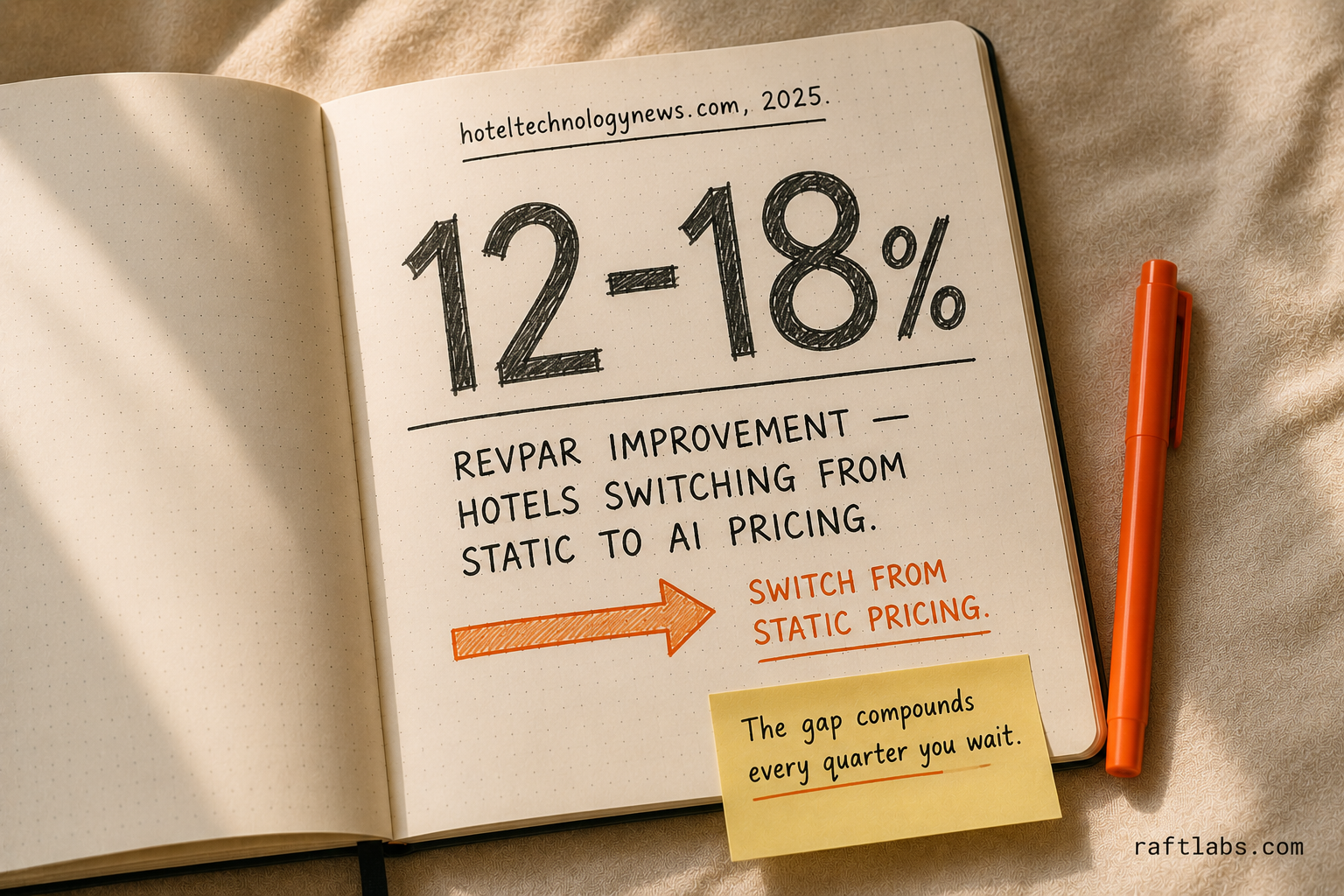
AI pricing tools adjust room rates based on demand, events, and booking pace. Hotels that switch from static pricing often see a 12 to 18 percent increase in RevPAR (Revenue Per Available Room).Better Upsells and Cross Sells
AI can suggest upgrades or add ons that match guest behavior. Many hotels see more bookings for breakfast, spa, parking, and premium rooms once these offers become more personal.Higher Conversion on Direct Channels
AI improves search results, shows real time availability, and nudges guests at the right moment. This helps reduce abandoned bookings.
If a hotel can shift just a few OTA bookings to direct channels and get guests to spend a bit more during their stay, the added revenue each year often covers the full cost of an AI project.
Operational Cost Savings
AI usually reduces costs even faster than it increases revenue.
Energy and building use
AI learns patterns in occupancy and adjusts heating, cooling, and lighting. Hotels often see a clear drop in monthly utility bills.Fewer errors and refunds
AI can flag wrong rates, double charges, risky bookings, or missing data. This prevents costly corrections later.Less waste in food and beverages
AI demand forecasts help restaurants and banquet teams plan better inventory. Many trials across hospitality kitchens have demonstrated a strong decrease in food waste.
When you combine these savings, AI often pays for itself through lower costs and smoother operations.
With the cost and value picture in mind, it becomes easier to plan your next move. The section that follows explains how to introduce AI into your operations without overwhelming your team.
How to Implement AI in Your Hospitality Business
Introducing AI into your hospitality operations works best when done step by step. You do not need to overhaul everything at once.
Below is a detailed version of each stage so your team can understand what to do and why it matters.
Step 1: Identify High-Impact Use Cases
The easiest way to begin with AI is to look at where you feel the most pressure today. These are usually areas where teams lose time or where guests face friction.
Good places to start include:
Guest communication
Simple questions about check-in times, parking, or amenities take up a lot of staff time. AI can handle these instantly, so your team can focus on guests who need real help.Reservation support
AI can guide staff during calls or chats by suggesting the best room types, upgrades, or add-ons based on guest preferences and availability. This makes the booking process smoother for both sides.Revenue management
AI-powered pricing tools can adjust rates on their own by tracking demand, seasonality, and occupancy forecasts. This helps you stay competitive without constant manual checks.Housekeeping planning
AI can predict busy days and build fair, balanced schedules for your housekeeping team. This reduces delays and helps rooms get ready faster during peak times.Guest service routing
AI tools can understand requests like extra pillows or towels and send them to the right staff member right away. Guests get faster service, and your team avoids back-and-forth confusion.Marketing automation
AI can group guests based on interests, stay history, or behavior, then send offers that actually matter to them. This increases repeat bookings without adding extra work for your staff.
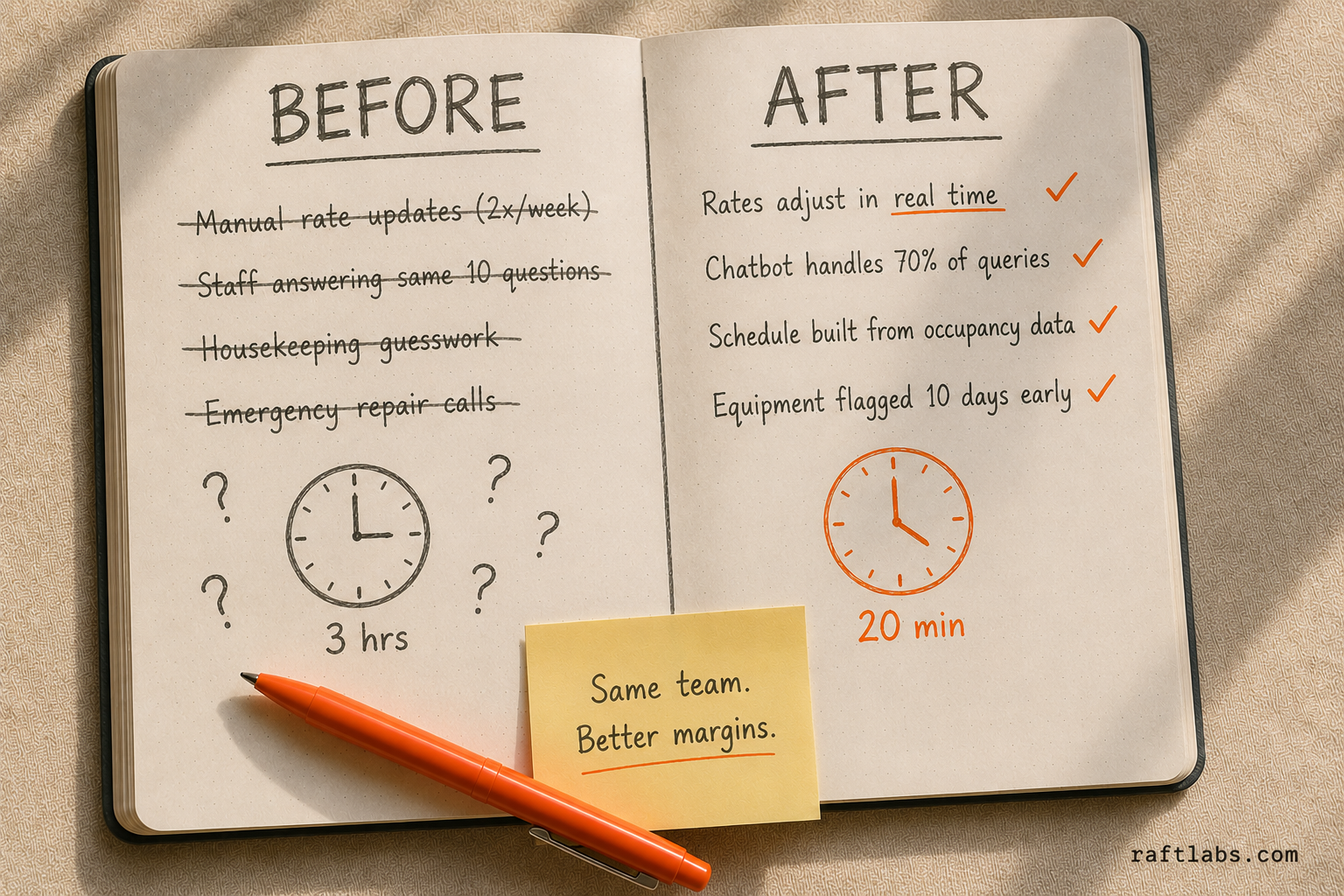
Suppose a beachfront resort receives over 300 WhatsApp messages a day about airport pickups, room upgrades, and pool timings. Staff used to answer everything manually. After adding an AI assistant, 70 percent of messages get answered instantly, while only the tricky ones pass to the team.
Guests are happier, and the staff gets more time to focus on service that truly needs a human touch.
Step 2: Audit Your Existing Tech Stack
Before adding AI, you need to understand how your current systems work. Many hospitality businesses use a mix of old and new tools, which can make AI adoption harder if not reviewed properly.
Look at your core operational systems:
Property Management System (PMS)
Booking engine or central reservation system
Channel manager
CRM or guest engagement platform
POS for restaurants, spa, or bar
Task management tools used by housekeeping or maintenance
Guest messaging tools like WhatsApp or SMS platforms
For each system, check:
Can you access your data easily?
Does the system have APIs to connect with AI tools?
What version are you on, and does the vendor support AI add-ons?
Is your data kept in one place or scattered across systems?
AI becomes effective only when it can read, analyze, and act on good data. If your systems do not talk to each other, AI will stay stuck because it cannot see the full picture of your guest journey.
Step 3: Prepare and Clean Your Data
Even the best AI models fail when the data is messy. Clean, organized data leads to better predictions, smoother automation, and more accurate guest personalization.
Focus on cleaning the data you already have:
Merge duplicate guest profiles.
Fix inconsistent phone numbers or email formats.
Standardize room names and rate codes.
Organize service request logs so patterns are visible.
Remove outdated records that create noise.
AI learns patterns from the past. If the past is chaotic, the predictions will be chaotic too.
Step 4: Choose Between SaaS Tools and Custom AI Development
The right approach depends on your goals, timeline, and internal resources.
SaaS Tools vs Custom AI Development
| What You Need | SaaS AI Tools | Custom AI Development |
|---|---|---|
| Setup speed | Fast to set up and start using | Takes longer but aligns fully with your workflow |
| Cost | Lower upfront cost | Higher initial investment |
| Features | Basic automation for chat, FAQs, simple tasks | Advanced features built exactly for your operations |
| Integrations | Works with common PMS or CRM systems | Connects deeply across PMS, POS, CRM, housekeeping, and more |
| Flexibility | Limited customization | Built to match your unique processes |
| Long-term value | Good for small improvements | Better for long-term digital strategy and full guest personalization |
You can treat this choice as a roadmap decision. If you only need quick wins and simple automation, SaaS tools are a good start. If your goal is deeper control, richer guest experiences, and long-term digital growth, custom AI development will serve you much better over time.
Step 5: Pilot, Measure, and Scale
After choosing the right AI tools or building custom solutions, the best way to move forward is with a small pilot. This keeps things manageable and helps you understand the real impact before rolling it out across your whole operation.
Start by selecting one focused area. Examples include slow guest replies, unpredictable pricing, or inconsistent service routing. Introduce the AI tool to a single team or one property so you can see how well it fits into your daily workflow.
During the pilot, measure simple and meaningful metrics such as:
• Response time improvements for guest questions
• Reduction in manual work for front desk or housekeeping
• Changes in occupancy, ADR, or forecast accuracy
• Staff feedback about ease of use and workload
• Guest sentiment and satisfaction trends
Use these insights to adjust the tool, refine processes, or provide extra training where needed. Small improvements at this stage help avoid bigger issues later.
When the pilot delivers steady results, begin scaling:
• Roll out the AI tool to more departments or properties
• Move in phases, so staff do not feel overwhelmed
• Continue monitoring results as usage grows
• Keep refining based on real-world behavior
Scaling AI in hospitality works best when you approach it slowly, learn from each stage, and build confidence across your team.
Over time, the technology becomes a natural part of how your business runs each day.
From here, the next important step is choosing a partner who can support your goals the right way.
Choosing an AI Development Partner for Your Hotel
AI can unlock a lot of value for hospitality, but the results depend heavily on who builds the system for you. A good partner makes AI feel simple and practical. A weak one creates more confusion than progress.
This section helps you understand what to look for so you can make a confident decision.
What to Look for in a Hospitality AI Vendor
Not every tech company understands how hotels or a hospitality business works. You want a partner who knows how a front desk runs during rush hour, how housekeeping schedules shift, and what guests expect when they ask for support at 3 AM.
Look for a team that can blend this understanding with solid technical skills.
Key factors to consider:
• Proven hospitality experience
A strong vendor has worked with hotels, resorts, serviced apartments, or property operators before. They understand PMS systems, channel managers, and real guest workflows.
• Clear communication style
You need a team that explains things in simple terms, stays in touch, and shares updates without you chasing them.
• Ability to build custom AI features
Some vendors only resell off-the-shelf tools. You want someone who can build features that match your operations, not force you to change your workflow.
• Strong security practices
Guest information must be safe. Your partner should follow global standards like PCI and GDPR and help you avoid risks.
• A full team that can support you long-term
This usually includes AI engineers, software developers, data specialists, QA testers, and project managers who work together as one team.
• A practical, step-by-step delivery process
Great partners move in small steps, test early, and gather feedback before scaling across your properties.
• A mindset that supports growth
Hotels evolve fast. Your vendor should design AI that can grow with you.
When these pieces come together, you get a partner who understands hospitality challenges and builds solutions that make your operations smoother day by day.
Questions to Ask Before Signing a Contract
Talking to a vendor is similar to hiring a new team member. Your questions help reveal their experience and whether they truly understand your business.
Good questions include:
• Have you worked with hospitality teams or systems before?
• How will you integrate AI with our PMS, POS, or CRM?
• What results can we expect in the first three months?
• What will the project look like week to week?
• How do you handle data security and guest privacy?
• What support do you offer after launch?
• How do you measure success for AI projects?
Their answers should feel clear and honest. If something sounds vague, rushed, or overly complicated, it is a good sign to step back and compare options before committing.
When to Choose Custom AI Development
Some teams begin with SaaS AI tools because they are quick to install. That works well for tasks like simple chat replies or basic automation. But there comes a point when hospitality businesses need deeper control.
Custom AI is a better choice when:
• Your workflows do not fit standard software
• You need automation that touches multiple systems, not just one
• You want guest personalization that actually feels personal
• Your goal is long-term digital transformation, not temporary fixes
• You want AI that reflects how your brand thinks, responds, and serves guests
For instance, a growing hotel group may want an AI system that connects with PMS, POS, housekeeping, maintenance, loyalty, and guest messaging. Rarely can a SaaS tool match that level of integration.
This is where custom AI becomes the right path, because it shapes itself around your operations instead of forcing you to adjust to a generic product.
Choosing a custom partner also means you get someone who can stay with you for years, improve the system as your needs change, and make sure the AI stays accurate and stable.
Why Choose Us for Hospitality Development Solutions
Choosing the right tech partner matters when you want to bring AI and modern software into your hospitality business. To understand what makes the right partner, here are a few things that shape how we work.
- Proven Understanding of Hospitality Needs
We work closely with hospitality businesses to understand how their teams operate and what problems they want to solve. Our focus is on building software that fits real workflows, whether it is simplifying bookings, improving communication, or helping teams respond faster to guest needs.
This hands-on approach helps us design solutions that feel practical and natural to use in day-to-day operations. - Custom Solutions Built for Your Workflows
Every hospitality business runs differently. We design systems that fit your processes instead of forcing you to change them. Whether you need a custom booking flow, a PMS integration, or an AI concierge, we shape the solution around your goals. - Human-Led AI Development
AI is powerful, but only when used with care. Our team blends AI with human thinking so your product stays accurate, safe, and useful. You work directly with designers, engineers, and testers who guide you through every step.
We help you choose where AI makes sense and avoid places where it adds unnecessary noise. - Clear and Simple Communication
We work as an extension of your team. You get updates on Slack, Asana, and short calls, so there is no confusion or guesswork. We take your input seriously and adjust fast when needed. This keeps the project moving with steady progress and no surprises. - Fast Delivery Without Cutting Corners
We follow small, focused sprints that help us deliver features quickly. You see progress early, and you can test ideas before scaling them. This keeps budgets healthy and reduces the risk of rework. - Designed to Grow With You
Your first version is just the start. We build systems that can grow with more properties, more users, and more integrations. When you want to add AI-driven personalisation, loyalty features, or a smarter operations dashboard, the platform is ready for the next step. - A Partnership That Feels Supportive
We work closely with founders, managers, and leadership teams. Whether you run a chain or an independent hospitality brand, our goal is to make the journey simple and stress-free. You get a partner who listens, understands your challenges, and stays with you beyond launch.
AI Solutions We Develop
We build custom AI tools that support real hospitality operations. These solutions can run as standalone apps or connect with your PMS and other systems already in use.
| Category | What We Build | How It Helps |
|---|---|---|
| Automation and Daily Operations | Data processing automation, inventory tracking tools, AI chatbots for common requests, workflow automation systems | Reduces manual work, lowers errors, speeds up daily tasks, and improves team productivity |
| Forecasting and Analytics | Demand forecasting tools, guest behavior insights, dynamic pricing support, trend prediction dashboards | Helps managers predict busy periods, understand patterns, and make confident, data-backed decisions |
| Personalized Guest Experience | Recommendation engines, automated marketing tools, segmentation systems, user behavior tracking | Offers tailored suggestions, boosts repeat bookings, and improves the journey from search to stay |
| AI for Digital Marketing | AI content generation, social media automation, AI-based design tools, campaign insights | Saves time for marketing teams, produces faster content, and improves campaign performance |
| Customer Service and Support | Smart chatbots, voice assistant tools, AI ticketing systems, 24/7 support systems | Provides instant responses, handles routine queries, and routes requests to the right teams |
| Accuracy and Error Reduction | Data validation tools, automated calculations, predictive quality checks, compliance tracking | Improves accuracy in operations, prevents mistakes, and keeps systems aligned with regulations |
| Decision-Making Tools | Predictive analytics, real-time decision support, AI collaboration tools, strategy dashboards | Gives leaders clear insights, supports quick actions, and strengthens long-term planning |
| Loyalty and Retention | Personalized reward engines, churn prediction tools, automated engagement flows, fraud detection | Improves loyalty programs, prevents point misuse, and helps retain more guests |
Conclusion
AI is already shaping the hospitality industry and driving significant change. Hotels that embrace these technologies are meeting guest expectations while also improving efficiency and profitability.
We specialize in helping hospitality businesses integrate AI solutions to drive efficiency and enhance the guest experience.
If you want to explore how AI can revolutionize your hotel operations, we’re here to help.