Updated November 2025
QR Code Loyalty Programs for Hotels: A Complete Implementation Guide
How QR-powered hotel loyalty systems cut OTA dependence, automate integrations, and turn anonymous guests into repeat direct bookers. No physical cards, no manual work.

In this article
Short answer
RaftLabs builds QR hotel loyalty systems with real-time PMS integration that shift guests to direct bookings. OTAs charge 15-30% per booking. A well-integrated QR loyalty program achieves positive ROI within 12-18 months by eliminating that commission on repeat stays.
Key takeaways
- OTAs charge 15-30% commission per booking. A QR loyalty program shifts members to direct bookings within 12-18 months, but only if PMS integration runs in real time.
- Dynamic QR codes let you update destinations, offers, and incentives across all printed materials without reprinting a single card.
- The enrollment form needs exactly three fields: first name, email, and phone. More fields cut completion rates sharply.
- Batch PMS integration creates a 24-hour sync lag. Members who enroll and book the same day won't be recognized, which breaks trust on their first interaction.
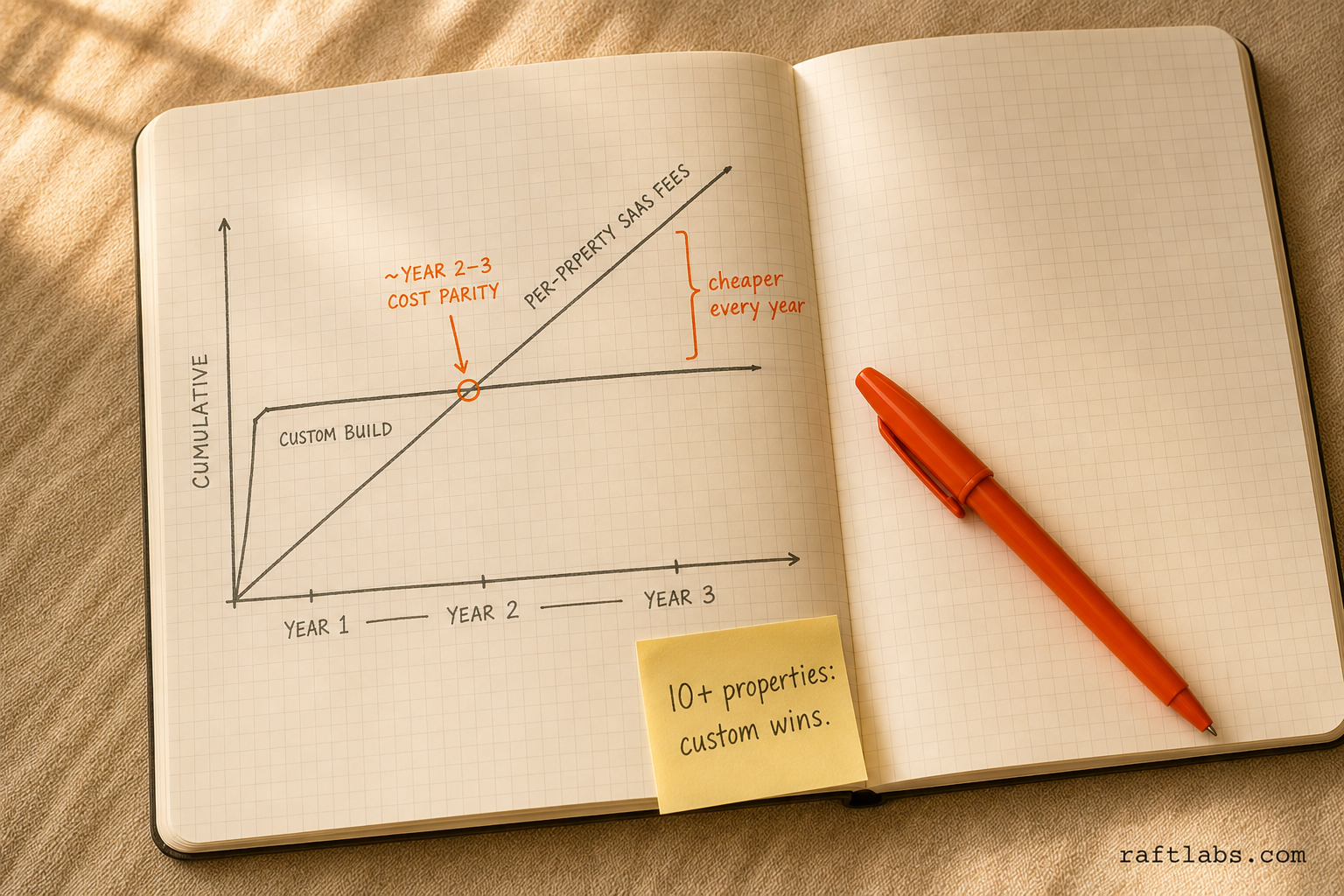
- Custom-built loyalty platforms reach cost parity with per-property SaaS fees between year two and three for portfolios of 10+ properties.
You're losing 15-30% of every booking to OTA commissions. Your guests check in, check out, and rebook their next stay on Booking.com. The profit from that first visit funds OTA growth, not yours.
The old answer was hotel loyalty programs. But traditional programs created friction: plastic cards, membership numbers, front-desk staff entering guest data into outdated systems. By the time you enrolled one guest, three more had already walked past.
QR code loyalty programs changed the math. A guest scans a code in their room, enrolls in under 30 seconds, and every subsequent touchpoint reinforces the relationship. No app download. No card to lose.
This guide covers exactly how to build a QR loyalty program that delivers measurable business results: technical requirements, integration traps, and the pilot roadmap that prevents the failures most hotels experience.
Who should read this guide
This guide is for hospitality leaders who want to reduce OTA dependence and build a direct booking engine powered by technology, not manual effort.
Hotel owners and general managers who want to protect margins and turn one-time guests into repeat customers will find a breakdown of what a QR loyalty system actually requires behind the scenes.
Revenue managers and marketing heads focused on channel mix and OTA commission savings will find detail on how QR programs influence booking behavior and channel shift.
IT managers and technology decision-makers responsible for PMS integrations and data security will find the technical realities that vendors typically skip over.
Hotel groups and multi-property operators evaluating a centralized loyalty rollout will find the pilot-to-portfolio roadmap laid out step by step.
Why QR codes work for hotel loyalty
According to McKinsey's 2023 hospitality report, OTA commissions average 18-25% across independent and boutique properties, making direct booking conversion one of the highest-ROI levers in hospitality. QR loyalty programs directly attack that cost.
The shift to QR-based loyalty isn't about following a trend. It's about meeting guests where they already are.
Every smartphone has a built-in QR scanner in the camera app. Guests don't need to download anything, remember login credentials, or keep track of a physical card between stays. They point their phone at a code in their room and they're enrolled.
Traditional loyalty programs failed because of friction. A guest arrives after a long flight and wants to drop their bags and find food. Your front desk hands them a loyalty card application asking for their name, email, phone number, mailing address, and preferences. Most guests pocket the card and never fill it out. You've lost the enrollment opportunity and have no way to contact them about their next stay.
QR codes reduce enrollment to a single scan. Place a code on the nightstand. The guest scans it, lands on a mobile-optimized page, enters their email and phone number, and that's it. You can collect preferences later, after you've demonstrated value.
The contactless expectation solidified during COVID and never reversed. Guests comfortable with QR menus, mobile check-in, and digital room keys won't return to physical processes.
"The hotels winning on direct bookings are treating loyalty as a data infrastructure problem, not a marketing one. The QR code is just the front door. The PMS integration is where the money is."
Larry Mogelonsky, partner at Hotel Mogel Consulting and author of "Are You an Ostrich or a Llama?" (as cited in Hotel Management, 2023)
But here's what separates a working QR loyalty system from one that generates signups and no business impact: what happens after the scan.
The QR code is the entry point. The real system lives in three places: your PMS, your booking engine, and your guest communication platform. If those three systems don't communicate in real time, your loyalty program creates manual work instead of removing it.
Core components of a QR hotel loyalty system
Phocuswire's 2024 loyalty benchmark study found that hotels with fully integrated loyalty programs (PMS + booking engine + CRM) saw 31% higher direct booking rates among members versus non-members. Hotels with disconnected systems saw no measurable lift.
A working QR loyalty system isn't just a QR code generator. It's a connected set of components that must function as an integrated system. Get any single component wrong and the entire program creates friction instead of removing it.
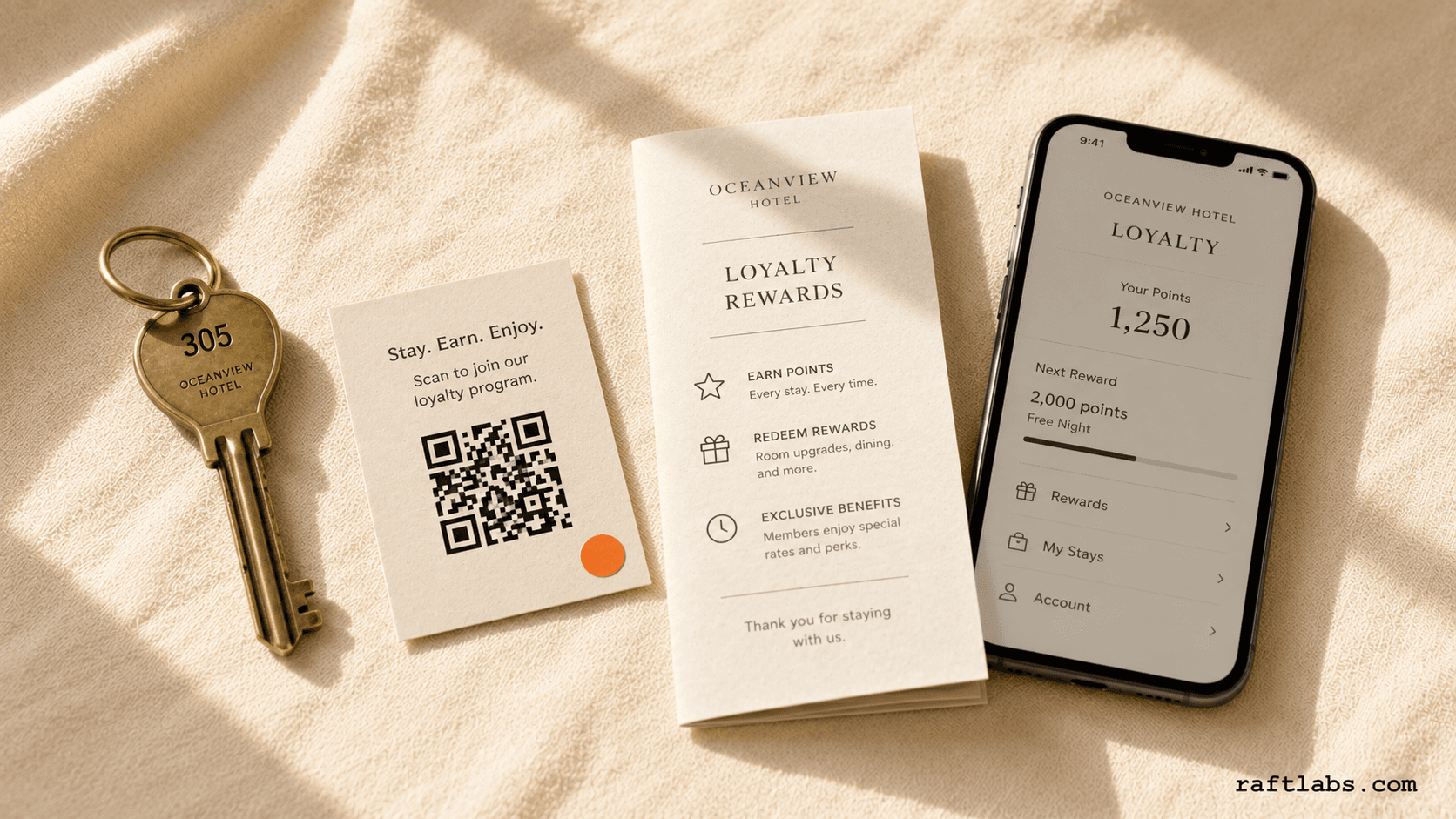
1. The QR Code Layer
You need dynamic QR codes, not static ones. A static QR code encodes a URL directly into the image. Once printed, you can't change it. If you need to update the destination (adding a seasonal promotion, for example), you must reprint and replace every code in every room.
Dynamic QR codes work differently. The code points to a redirect URL you control. When a guest scans the code, the redirect sends them to whatever destination you've configured in your dashboard. You can update the destination instantly across all printed codes without touching a single piece of paper.
This matters more than it sounds. Loyalty programs need to evolve. You'll run promotions, test different enrollment incentives, and adjust messaging based on what converts. Dynamic codes let you iterate without replacing physical materials.
Place codes at multiple touchpoints:
In-room nightstand or desk: Primary enrollment point when guests are settling in
Bathroom mirror: High-visibility when guests are getting ready and have their phone in hand
Room service menu: Enrollment offer tied to immediate benefit (10% off current order)
Checkout folio: Last-chance enrollment with post-stay incentive
Welcome email: Digital touchpoint before arrival for guests who book direct
Multi-touchpoint placement increases total enrollment rates by roughly 40% compared to single-placement strategies. Each placement serves a different guest mindset at a different moment.
2. The Enrollment Platform
When a guest scans your QR code, they land on a mobile-optimized page that must work on iOS and Android and load in under two seconds on hotel WiFi. Pages that take longer lose roughly half their visitors before the form completes.
The enrollment form should capture exactly three fields:
First name
Email address
Phone number
Don't ask for more. You collect preferences, birthdays, and other data later through email campaigns, after you've established value.
The enrollment page needs specific benefit messaging. "Join now and save 10% on your next booking" converts. "Exclusive benefits" doesn't. Guests need to know exactly what they're getting.
After enrollment, the confirmation page must do three things:
- Confirm membership with a unique member ID or QR code they can screenshot
- State the immediate benefit they'll receive, if any
- Set expectations for what happens next ("Check your email for your welcome offer")
3. The Integration Layer
This is where most hotel loyalty programs fail. The QR codes work fine. Guests enroll without issues. Then nothing happens because the loyalty platform doesn't connect to the systems that matter.
Your QR loyalty platform must integrate with four critical systems.
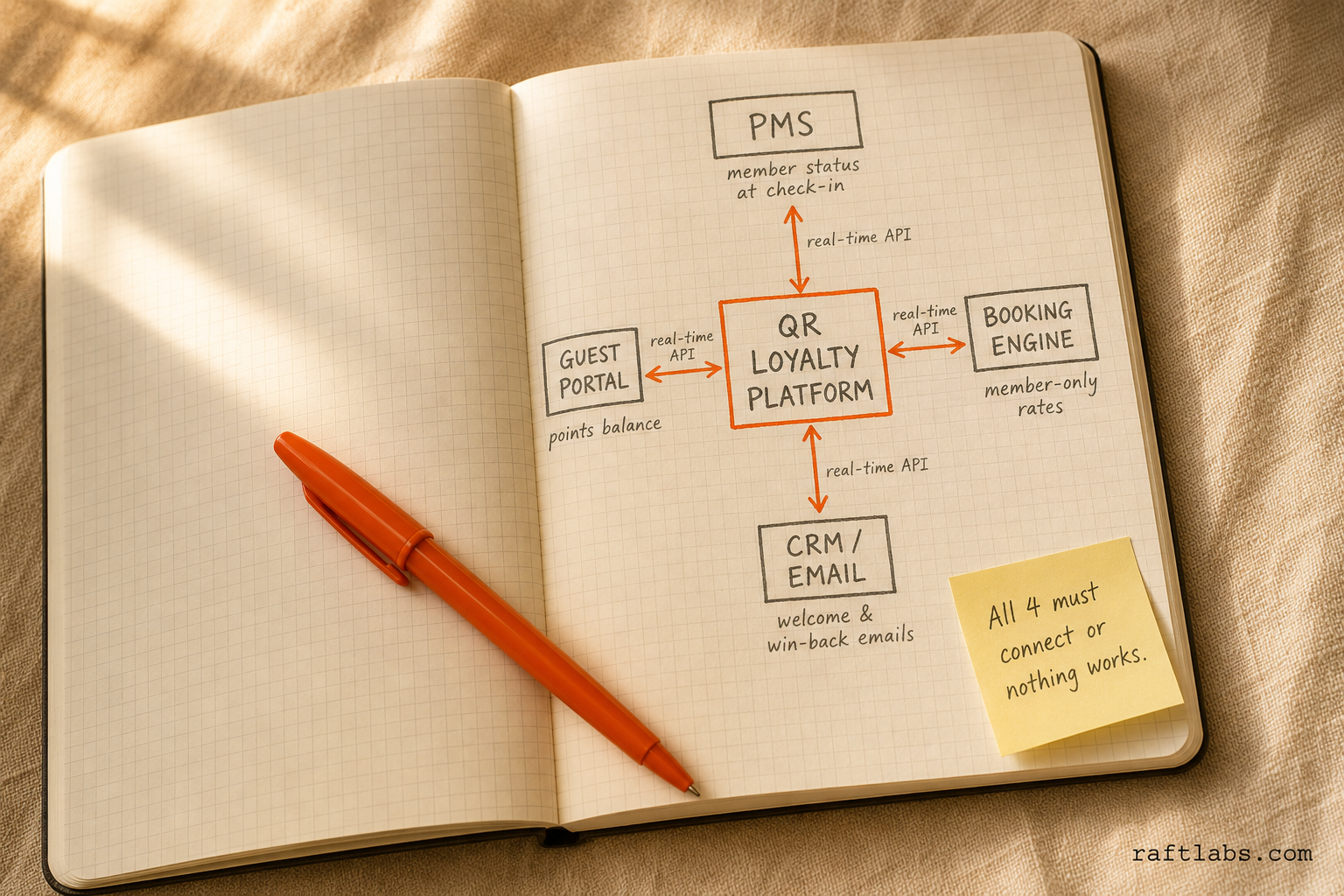
Property Management System (PMS) Integration
PMS integration links loyalty member status directly to guest reservations. When a loyalty member books a room, front desk staff should automatically see their member status, points balance, and earned perks.
Without PMS integration, staff must manually check loyalty status in a separate system. That check gets skipped during busy check-ins, and loyalty members get treated as regular guests.
Real-Time vs. Batch Integration
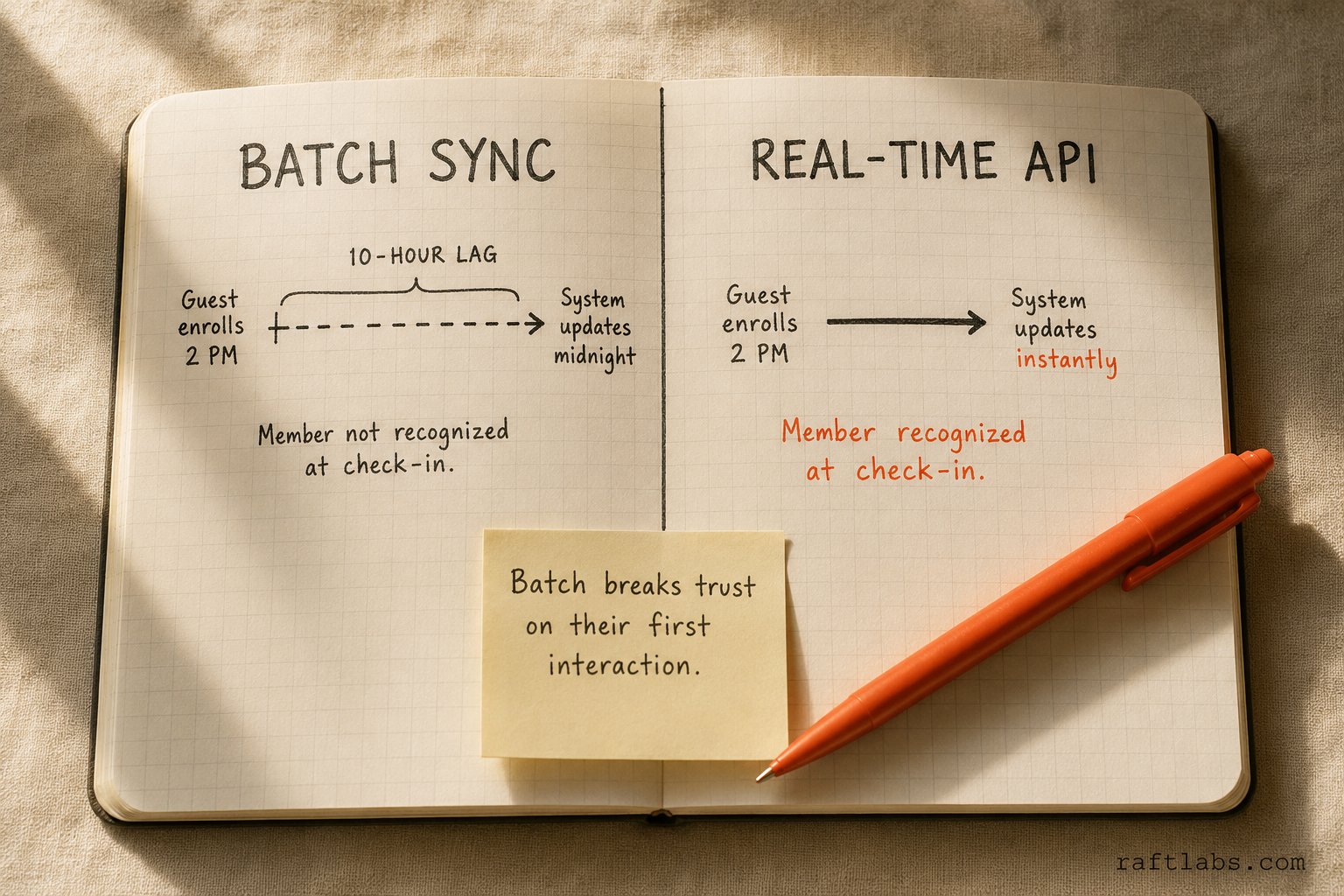
Real-time API integration is the only approach that enables in-stay benefits without manual staff intervention. A loyalty member checks in, your system recognizes them automatically, and applies their earned perks without front desk staff needing to remember anything.
Batch integration (typically a nightly file transfer between systems) creates a 24-hour lag. A guest who enrolls in your QR loyalty program and books a stay six hours later won't be recognized as a member until the next day. That damages the guest relationship before it starts.
Batch integration works acceptably for passive loyalty perks like post-stay points accumulation. If guests need to use benefits during their stay, batch creates too much lag.
Ask your PMS vendor directly: "Does your API support webhook notifications for check-in and checkout events, or do I need to poll for updates?" Webhooks push notifications when events happen. Polling requires your loyalty platform to repeatedly check for updates, typically every 5-15 minutes.
Booking Engine Integration
Your loyalty program must drive direct bookings. That means members need a financial incentive to book through your website rather than an OTA. The standard approach: offer rates 5-10% below public pricing to logged-in loyalty members.
This requires your booking engine to recognize authenticated users, check loyalty status via API, and present special rates. Most hotel booking engines don't support this natively. You'll need either custom development or a booking engine built specifically for loyalty integration.
CRM or Marketing Automation Integration
When a guest enrolls via QR code, their profile should transfer automatically to your CRM so they immediately receive welcome messages, promotional offers, and abandoned booking nudges.
If you're relying on manual CSV exports from your loyalty platform into your email system, you've created a 24-hour delay. Guests expect acknowledgment within 10 minutes of enrolling. If they don't receive a welcome email quickly, they assume something went wrong.
4. The Guest Communication Platform
Your loyalty members need timely, relevant messages. The minimum communication flow:
Instant welcome email (within 5 minutes of enrollment)
Post-stay thank you (24 hours after checkout with points summary)
Promotional offers (monthly or when running special rates)
Abandoned booking nudges (if a member searches availability but doesn't book)
Win-back campaigns (for members who haven't stayed in 6+ months)
Each message type requires different data from your PMS and booking systems. Abandoned booking reminders should reference the specific dates the guest searched, creating a personalized follow-up that feels relevant rather than generic.
This automation requires real-time data exchange between your loyalty platform, PMS, and email system. If any system in the chain uses batch processing, your communication timing breaks.
5. The Rewards Management System
Guests need to know what they've earned and how close they are to rewards. Your loyalty platform needs a guest-facing portal where members can:
View current points balance
See points earned from recent stays
Browse available rewards
Redeem points for perks
Track progress toward status tiers
The redemption process must be frictionless. If a guest wants to use points for a free night, they should be able to select dates and book directly through the loyalty portal. Requiring them to call or email to redeem creates friction that kills redemption rates.
Low redemption rates aren't a win for your program. They're a sign that guests don't perceive value. High redemption drives repeat visits. Every redeemed reward brings a member back for another stay where they'll spend on extras not covered by points.
6. The Reporting Dashboard
A functional reporting dashboard shows:
Enrollment metrics: Daily enrollment volume, completion rate, enrollments by QR placement
Member behavior: Booking frequency, direct vs. OTA booking ratio for members vs. non-members
Program ROI: Commission savings from channel shift, repeat booking rate, member lifetime value vs. non-member lifetime value
Redemption analytics: Most popular rewards, redemption rate, time from earning to redemption
Campaign performance: Email open rates and booking conversion per campaign
The minimum reporting frequency is weekly. Monthly is too slow to catch problems before they compound.
Turn loyalty into a direct booking engine RaftLabs builds custom hotel loyalty systems aligned with your tech stack and revenue goals. Talk to us
Integration requirements your vendor won't tell you about
Many vendors claim their solution offers "clean integration." The actual experience depends on your PMS's API capabilities, the type of integration, and how data flows between systems.
Before signing any agreement, you need to understand how data syncs, how quickly updates happen, and what technical limitations will affect guest experience.
PMS Integration: Three Approaches
Manual integration means your loyalty platform operates separately from your PMS. Staff manually note member status in the PMS at check-in and manually enter points at checkout. This works for properties under 10 rooms where volume is low enough that manual entry doesn't create meaningful labor costs. For anything larger, it creates inconsistent guest experiences and frustrated staff.
Batch integration means your PMS exports a file of check-ins and checkouts once per day, usually overnight. Your loyalty platform imports the file and updates member profiles. This is better than manual but creates timing problems. A guest who checks in at 2 pm won't be recognized by your loyalty platform until midnight. If they try to redeem a perk during their stay, your system can't confirm their reservation. If they scan your QR code to enroll and they already have an upcoming reservation in the PMS, the system might create a duplicate profile because it doesn't see the existing record yet.
Real-time API integration connects your loyalty platform and PMS via synchronous API calls. When a guest checks in, your PMS sends an instant notification to the loyalty platform. When a guest enrolls via QR code, the loyalty platform instantly checks your PMS for existing reservations. This is the only approach that enables in-stay benefits without manual intervention.
Booking Engine Integration
When a loyalty member logs into your booking engine, the engine needs to make an API call to your loyalty platform to verify member status and retrieve their tier. The engine then applies the appropriate discount and displays the member rate.
This requires three pieces:
- Authentication system (guests can log in using their loyalty credentials)
- API connection between booking engine and loyalty platform
- Business logic in the booking engine to apply rate discounts based on member tier
Most hotel booking engines don't include this functionality. They're designed to show publicly available rates to anonymous users. Adding member-only rates requires custom development unless you're using a booking engine specifically built for loyalty integration.
An alternative: use your loyalty platform's built-in booking capabilities. Guests access member rates by booking through the loyalty portal instead of your main website. This creates a split experience: regular guests use your main site, loyalty members use a different interface. That's acceptable when loyalty members represent a small booking percentage but awkward when they drive 30-40% of volume.
Data Schema Compatibility
Here's a technical problem that surprises hotels during implementation: your loyalty platform and PMS may define guest records differently, causing data sync errors.
If your PMS uses email addresses as the unique guest identifier and your loyalty platform uses phone numbers, a guest who updates their email in one system but not the other creates orphaned records. The systems can't match records, and the guest's loyalty profile becomes disconnected from their PMS profile.
The solution is to establish a shared unique identifier (usually email address, since it's most stable) and implement validation rules in both systems to confirm data stays in sync.
Ask your integration developer: "What happens if a guest changes their email address in the PMS? How does that sync to the loyalty platform, and how do we prevent orphaned records?"
Integration Testing Requirements
Before launching, test these key scenarios in a staging environment:
QR Enrollment Test: Confirm the profile is created correctly in the loyalty platform and syncs to the PMS
Direct Booking Test: Confirm the PMS recognizes loyalty status and applies the correct member rate
Check-In Recognition Test: Confirm earned perks appear in the PMS automatically without manual input
Points Accrual Test: Confirm loyalty points are credited accurately within the expected timeframe
Reward Redemption Test: Confirm the redemption processes correctly and the points balance updates immediately
Profile Update Sync Test: Confirm updated information syncs to the loyalty platform without creating duplicate records
Plan for 2-4 weeks of structured integration testing before going live.
Implementation roadmap: from pilot to portfolio
Hotels that launch QR loyalty programs across all properties simultaneously face a high failure rate. Hotels that succeed start with a pilot, validate the approach, and then scale.
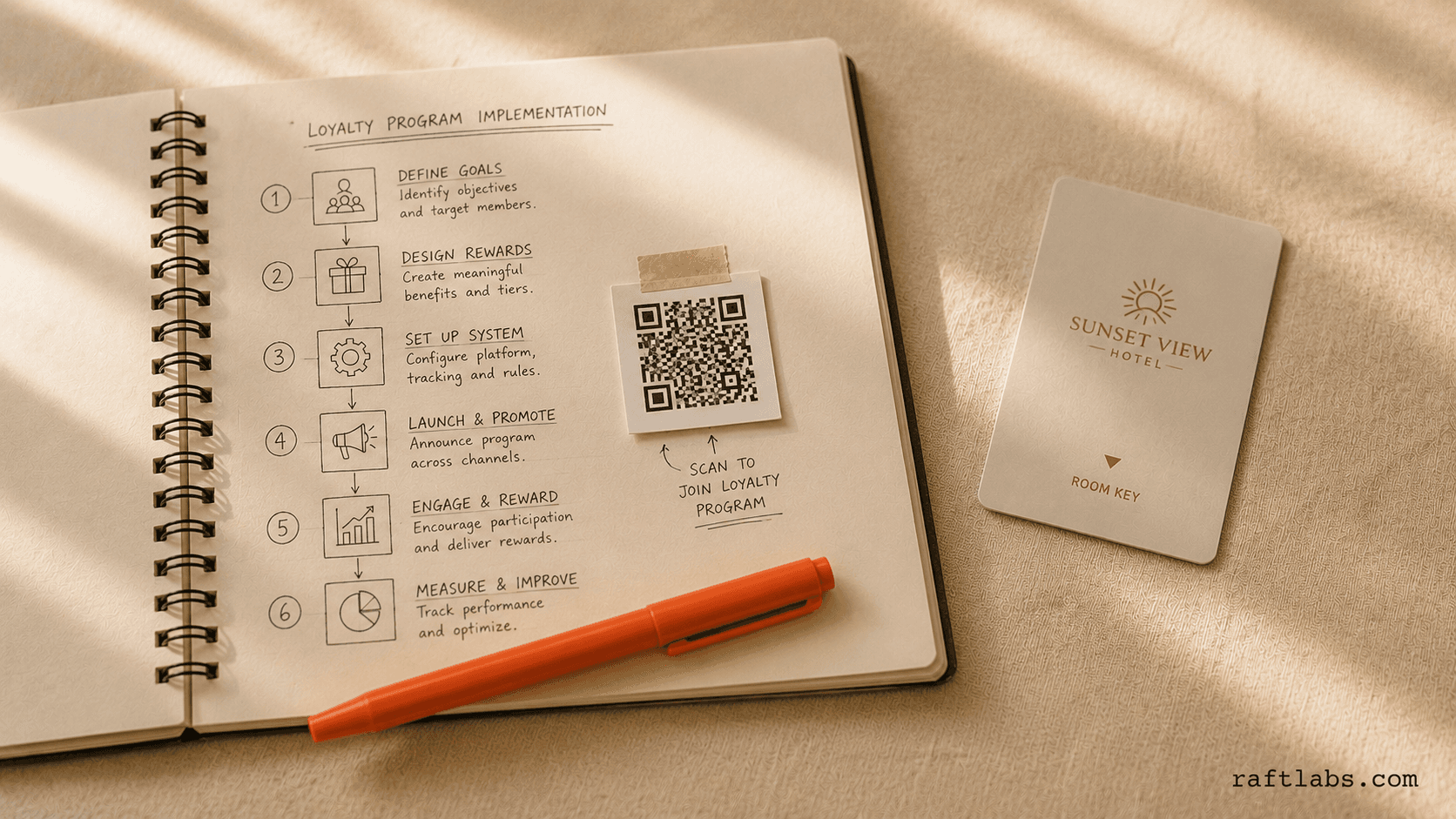
Weeks 1-2: Pilot Property Selection and Planning
Choose your pilot property carefully. The ideal pilot property:
Has 25-75 rooms: large enough to generate statistically significant data, small enough to manage issues without overwhelming your team
Has stable operations: don't pilot during renovations or major operational problems
Has a tech-forward GM who actively supports the project and will give honest feedback
Has a representative guest mix: avoid properties with unusual demographics that won't validate learnings for your broader portfolio
Define success metrics before you launch. Track enrollment rate (percentage of staying guests who enroll), direct booking impact (whether enrolled members show more direct bookings than non-members), redemption activity, system uptime, and staff feedback.
These metrics give you a structured way to evaluate performance without tying success to rigid benchmarks.
Weeks 3-4: Technical Setup and Integration
Configure your loyalty platform and integrate it with your pilot property's PMS, booking engine, and communication systems.
Priority integration sequence:
- PMS integration first. Without this, you can't attach loyalty status to reservations.
- Email integration second, so enrolled guests receive confirmation and welcome offers.
- Booking engine integration third, to enable member rates for direct bookings.
During technical setup, create these assets:
One unique QR code per placement location so you can track which drives most enrollments
Mobile-optimized enrollment landing page with your three-field form
Welcome email template sent instantly when guests enroll
Loyalty portal where guests can view points balance and redeem rewards
Admin dashboard where your GM can monitor enrollment and program performance
The most common technical issue at launch: broken QR codes that link to 404 pages because the URL wasn't configured correctly. Test every code before anything goes live.
Weeks 5-6: Staff Training and Soft Launch
Your front desk and housekeeping teams need to understand what's changing. Don't just send a memo. Run hands-on training sessions covering:
How guests enroll (show staff how to scan the QR code and complete enrollment on their own phone)
What benefits members get (staff need to explain the value proposition when guests ask)
How to look up member status in the PMS during check-in
How to handle redemptions step by step
Common issues (what to do if a guest says they enrolled but aren't showing as a member)
Run a soft launch week with QR codes live in just 5-10 rooms. Common problems discovered during soft launch:
QR codes didn't survive housekeeping's cleaning process (laminate them or use waterproof materials)
Guests couldn't find QR codes even when placed on nightstands (add a small "Scan here for rewards" tent card)
WiFi in some rooms was too slow for the enrollment page to load (network infrastructure issue)
Some staff couldn't answer guest questions (reinforcement training needed)
Fix these immediately rather than waiting for the pilot to end.
Weeks 7-12: Full Pilot Deployment and Measurement
Roll out QR codes to all rooms at your pilot property. Monitor daily metrics:
Enrollments per day (should stabilize at 3-8% of check-ins daily within two weeks)
QR scan volume by location (reveals which placement drives most activity)
Enrollment completion rate (percentage of guests who start enrollment and finish it; target 50%+)
PMS sync errors (any reservations where member status didn't sync correctly)
Guest feedback from post-stay surveys
At week ten, conduct a mid-pilot review. If the enrollment rate is below 10-15%, consider:
Adding visual prominence: brightly colored tent cards instead of just printed QR codes
Strengthening the value proposition: "Scan for 10% off your next stay" instead of "Join our loyalty program"
Having front desk verbally mention the program during check-in
Testing immediate incentives: 10% off room service on the current stay for enrolling
Weeks 13-14: Pilot Analysis and Go/No-Go Decision
At pilot completion, evaluate results against your success metrics. Create a report covering enrollment metrics, direct booking impact, operational impact, and financial analysis.
The go/no-go decision has three options:
- Go: Results met or exceeded targets, proceed to portfolio rollout
- Adjust and re-pilot: Results were mixed, make specific improvements and test for another 60 days
- No-go: Fundamental issues indicate this approach won't work for your operation
Be honest in your assessment. Hotels that rationalize poor pilot results and scale anyway waste money deploying a program that doesn't work.
Weeks 15-20: Portfolio Rollout Preparation
If your pilot succeeded, prepare to scale across your portfolio. Each property needs customized setup: different PMS configurations, brand-specific loyalty messaging, in-person staff training, and site-specific QR placement.
Stagger implementation by 2-4 weeks per property. This lets you:
Apply lessons learned from each property to the next
Avoid overwhelming your support team if issues arise
Manage cash flow as implementation costs spread over time
Create templates for QR code designs, staff training materials, enrollment pages, and email templates. Standardize what you can. Customize what you must.
Weeks 21+: Ongoing Portfolio Management
After rollout, assign clear ownership at both levels:
Corporate level (Director of Marketing or Revenue Manager):
Monitor portfolio-wide performance metrics weekly
Coordinate promotional campaigns across all properties
Manage vendor relationship for loyalty platform
Property level (GM or Front Desk Manager):
Monitor property-specific enrollment and redemption rates
Confirm QR codes remain in place and undamaged
Conduct quarterly staff refresher training
Properties that treat QR loyalty as a one-time setup see performance plateau after a few months. Properties that keep refining the program (testing new messaging, adjusting reward structures, running targeted campaigns) see results build steadily over time.
Build a QR loyalty system that drives revenue RaftLabs integrates QR loyalty platforms with your PMS and booking engine to increase direct bookings. Talk to us
Build vs. buy: when custom development makes economic sense
Skift Research's 2024 hotel technology report found that 67% of independent hotel groups on off-the-shelf loyalty platforms cited "PMS integration limitations" as their top pain point within the first 18 months.
The decision to build custom versus buying an off-the-shelf QR loyalty platform isn't just about upfront cost. It's about whether the platform becomes a competitive advantage or just another subscription expense.
Most hotels start their evaluation assuming off-the-shelf is the obvious choice. Lower entry cost, faster implementation, vendor support included. But the economics shift when you look beyond year one.
Understanding Your Options
Off-the-shelf platforms are ready-made SaaS solutions. You sign up for a subscription, configure basic settings, and launch within weeks. These work for 1-3 property groups validating whether loyalty matters for their business at all.
Where off-the-shelf platforms hit limitations:
Your PMS isn't among the vendor's pre-built integrations (requiring expensive custom integration work on top of subscription fees)
You operate multiple brands with different loyalty rules (most platforms assume single-brand logic)
You need loyalty features that aren't on the vendor's roadmap
Your booking engine doesn't natively support member-only rates
When you encounter two or more of these constraints, the "simple" off-the-shelf option disappears. You're paying base subscription fees plus custom development work to make the platform fit your operation.
White-label solutions sit between off-the-shelf and custom. You get a pre-built platform you can rebrand and configure more extensively. These work well for 3-8 property groups needing more customization than off-the-shelf allows but not ready to build a fully custom platform. The downside: you're still dependent on the vendor's underlying architecture. If they make changes to the core platform, you're forced to adapt.
Custom development builds a loyalty platform designed specifically for your business. Higher upfront cost, but three things change the economics:
| Factor | Off-the-Shelf Platform | White-Label Solution | Custom Development |
|---|---|---|---|
| Best For | Single properties testing loyalty | 2-5 property groups | 5+ properties with specific requirements |
| Time to Launch | 4-8 weeks | 6-10 weeks | 12-14 weeks |
| Monthly/Ongoing Costs | Per-property fees scale linearly | License fee + customization | Hosting + maintenance (relatively fixed) |
| PMS Integration | Pre-built for major systems only | Standard + some customization | Built for your specific PMS environment |
| Feature Customization | Limited to vendor roadmap | Moderate flexibility | Complete control |
| Data Ownership | Typically vendor-controlled | Varies by contract | Full ownership |
| Scalability Economics | Costs increase linearly per property | Tiered pricing | Costs stay relatively stable as you add properties |
The Custom Build Case
Off-the-shelf platforms charge per-property fees. Whether you operate 5 properties or 50, the per-property cost stays constant or increases with volume. Custom development has higher fixed costs but those costs don't multiply with every new property.
For a 10-property group, custom development often reaches cost parity with off-the-shelf platforms by year two or three. For 20+ property portfolios, custom typically becomes cheaper within 18-24 months.
Custom platforms also integrate precisely with your existing tech stack. Hotels that try to retrofit off-the-shelf loyalty platforms into complex existing systems often end up with manual workarounds that defeat the purpose of automation. A custom build eliminates those workarounds.
With custom-built platforms, your member database lives in infrastructure you control. You own complete access to the data, can run any analytics queries you want, and integrate loyalty data with other business systems without vendor permission or API limitations.
For detailed cost breakdowns, see our complete guide to loyalty program development costs.
The decision isn't permanent. You can start with the lower-risk option and move to custom development when the business case justifies the investment. Be honest about current needs versus aspirations.
Measuring ROI: metrics that actually matter
Hotels obsess over enrollment numbers while ignoring whether those members actually drive profitable behavior. These are the metrics that determine if your QR loyalty program is working.
Metric 1: Channel Shift Percentage
This is the most important number. Are loyalty members booking direct more often than non-members?
Track the OTA booking ratio for both groups. If non-members book through OTAs 50% of the time and loyalty members book through OTAs only 25% of the time, that 25-point difference represents real commission savings on every repeat stay.
If you're not measuring this, you don't know if your loyalty program is doing its job or just rewarding guests who were going to book direct anyway.
Metric 2: Member Repeat Booking Rate
How frequently do loyalty members come back compared to non-members?
Calculate what percentage of each group books a second stay within 12 months. Loyalty members should come back at substantially higher rates. If the gap is minimal, your loyalty program isn't driving repeat behavior. Either your rewards aren't compelling enough or members don't remember they're part of the program.
Metric 3: Points Redemption Rate
What percentage of loyalty members actually redeem rewards?
Look at members who've been active for at least six months. A healthy program sees regular redemption activity. Low redemption usually signals that members don't perceive value. They're accumulating points but not using them because rewards aren't appealing or redemption is too difficult.
High redemption drives repeat visits. Every time a member redeems a reward, they're booking another stay, ideally directly with you.
Metric 4: Member Lifetime Value
How much revenue does a loyalty member generate over time compared to a non-member?
Calculate average total revenue per member over two years and compare it to non-member revenue over the same period. If the difference is marginal, your program is attracting guests who were going to be repeat customers anyway. You're not converting occasional guests into frequent guests.
Metric 5: Enrollment Completion Rate
Of guests who start the QR enrollment process, how many complete it?
Low completion rate indicates friction in your enrollment form. Common causes: too many required fields, slow page loading on hotel WiFi, broken mobile experience, or unclear value proposition. Track completion rate by device type and QR placement location.
Metric 6: Cost Per Enrolled Member
How much does it cost to acquire each loyalty member?
Include all program costs: platform fees, QR materials, staff time, and marketing. Divide by total enrollments in the period. Your initial cohort has the highest acquisition cost because it includes implementation and setup. Steady-state operations should cut cost per enrollment substantially as you spread fixed costs across more enrollments.
Metric 7: Program ROI
The complete ROI calculation:
Benefits: OTA commission savings from channel shift, increased direct booking revenue, higher average booking value from loyalty members, reduced marketing cost (loyalty members respond better to direct campaigns)
Costs: Platform subscription or development costs, ongoing management labor, reward fulfillment costs, physical materials
Most functional hotel QR loyalty programs reach breakeven within 12 months and generate clear positive returns by month 18-24.
Why consider RaftLabs for custom loyalty platform development
A QR loyalty program only works when it fits your real operations. That means deep integrations, clean data flow, and systems that scale as you grow.
RaftLabs has built loyalty platforms for Energia, a leading utility provider, with full-scale loyalty infrastructure handling large user volumes and complex reward logic. The system integrated with internal infrastructure, supported secure transactions, and allowed flexible campaign management.
For Aldi, RaftLabs developed a receipts and rewards web application that managed high traffic, automated validation workflows, and distributed rewards at scale. The platform required strong backend architecture, smooth user journeys, and performance stability under load.
What RaftLabs brings to hotel loyalty builds:
Custom loyalty platform development, not third-party setup
Real-time PMS, booking engine, CRM, and payment integrations
API-first architecture built for multi-property environments
Full data ownership with no vendor lock-in
Direct booking growth as the measurable outcome, not just enrollment numbers
Conclusion: loyalty as infrastructure, not marketing
Hotel loyalty programs fail when treated as marketing campaigns instead of operational systems. A QR code alone doesn't create loyalty. Points alone don't drive repeat bookings.
Real impact comes from aligning technology, staff processes, and guest communication around a clear goal: reducing OTA dependence and protecting direct booking margins.
If you're evaluating QR loyalty for your property, start with the questions that matter. Does it integrate with your PMS in real time? Does it support member-only rates in your booking engine? Can you pilot before rolling out portfolio-wide?
If you need a QR loyalty system that integrates with your actual PMS, handles multi-property complexity, and drives direct bookings rather than just collecting email addresses, let's talk.
Ask an AI
Get an instant summary of this post from your preferred AI assistant.
Common questions
- A QR code loyalty program lets guests scan a code placed in the hotel and enroll in a rewards program in under 60 seconds using their smartphone. Membership connects directly to the hotel's PMS, booking engine, and CRM. No physical cards, no manual front-desk entry.
- Members receive exclusive rates 5-10% below public pricing, visible only after logging in through the booking engine. According to Phocuswire research, loyalty members who receive a personalized rate offer are 2.4x more likely to complete a direct booking versus an OTA booking.
- No. Modern programs run on mobile-optimized web pages. Guests scan with their phone camera, complete a three-field form, and receive confirmation within 5 minutes. No app download required.
- Custom development starts around $40,000-$80,000 for a single-brand platform with real-time PMS integration. For a 10+ property group, that cost reaches parity with per-property SaaS subscription fees by year two or three, after which the custom platform is cheaper every year.
- Yes. Independent hotels with direct booking goals benefit most. Without a global OTA-competing brand, independent properties need every margin point they can protect. A properly integrated QR program shifts even small guest volumes from 25% OTA commission to zero-commission direct bookings.