Top 11 AI Software Development Companies in 2026 (Comparison)
Discover why 85% of AI projects fail, what truly matters in 2026 AI development, and which 11 partners can actually deliver production-ready impact.

In this article
Short answer
85% of AI projects never reach production. The ones that do prioritize data readiness, deployment infrastructure, and business ROI over demo polish. RaftLabs ships production AI products in 12-week sprints starting from $25,000, evaluated on the same production-experience and MLOps criteria that separate a working system from a demo.
Key takeaways
- Most AI projects fail to reach production because of poor implementation, not because the technology does not work.
- Strong AI partners focus heavily on data strategy, including collection, cleaning, labeling, governance, and security before building models.
- MLOps capabilities for deployment, monitoring, retraining, and maintenance are what separate production-ready AI from lab experiments.
- Regulatory, security, and ethical issues such as GDPR, EU AI Act, HIPAA, bias, and explainability must be built into AI systems from the start.
- When evaluating vendors, look for business outcome focus, clear ownership of IP, and avoid red flags like overpromising, vague answers, and ignoring data questions.
You’ve seen the demos. You’ve heard the promises. You’re trying to figure out which AI development company can actually ship something that works in production.
That’s harder than it sounds. 85% of AI and machine learning projects never make it to production. Organizations spend millions on data scientists and still end up with models that don’t work in the real world.
The problem isn’t the technology. AI works. The problem is finding a partner who knows how to design, build, deploy, and maintain AI solutions tied to real business outcomes, not polished demos.
We've been building AI software since before it was trendy. At RaftLabs, we've seen what works and what doesn't across industries such as healthcare, fintech, manufacturing, and retail. We've watched companies waste budgets on flashy demos that never scale. We've also seen businesses transform their operations using production-ready AI systems that actually deliver measurable value.
That experience went into creating this guide.
Over the past three months, we evaluated AI software development companies across the US, UK, Europe, and India. We analyzed their technical capabilities, interviewed clients, reviewed their actual project outcomes, and assessed their expertise across areas like machine learning, generative AI, data engineering, model deployment, and MLOps, using 2026 industry standards as a benchmark.
Whether you’re a CTO exploring enterprise AI initiatives, a product leader integrating AI into an existing application, or a founder building an AI-first startup, the companies featured in this guide could be the partners you need.
This guide is built around one question: how do you evaluate whether an AI development company can actually ship something that works in production, not just talk a good game in a sales call. If you want a broader market landscape across consultancies, product studios, and nearshore providers, see our comparison of AI development companies. If your specific need is AI features shipped inside an existing software product, see our narrower AI-in-product vendor comparison, evaluated specifically on product-and-AI delivery in one team.
Why Trust This List?
At RaftLabs, we’ve been building AI products for the past 2+ years, focusing on practical implementation rather than hype-driven experimentation. This hands-on work has given us a clear understanding of what real AI expertise looks like in practice.
That experience helped us separate teams that genuinely deliver AI solutions from those relying mostly on marketing claims.
To create this list, we went beyond surface-level research. We followed a structured evaluation process centered on the factors that actually matter when you’re placing a real business bet on an AI initiative.
Here’s how we evaluated these companies:
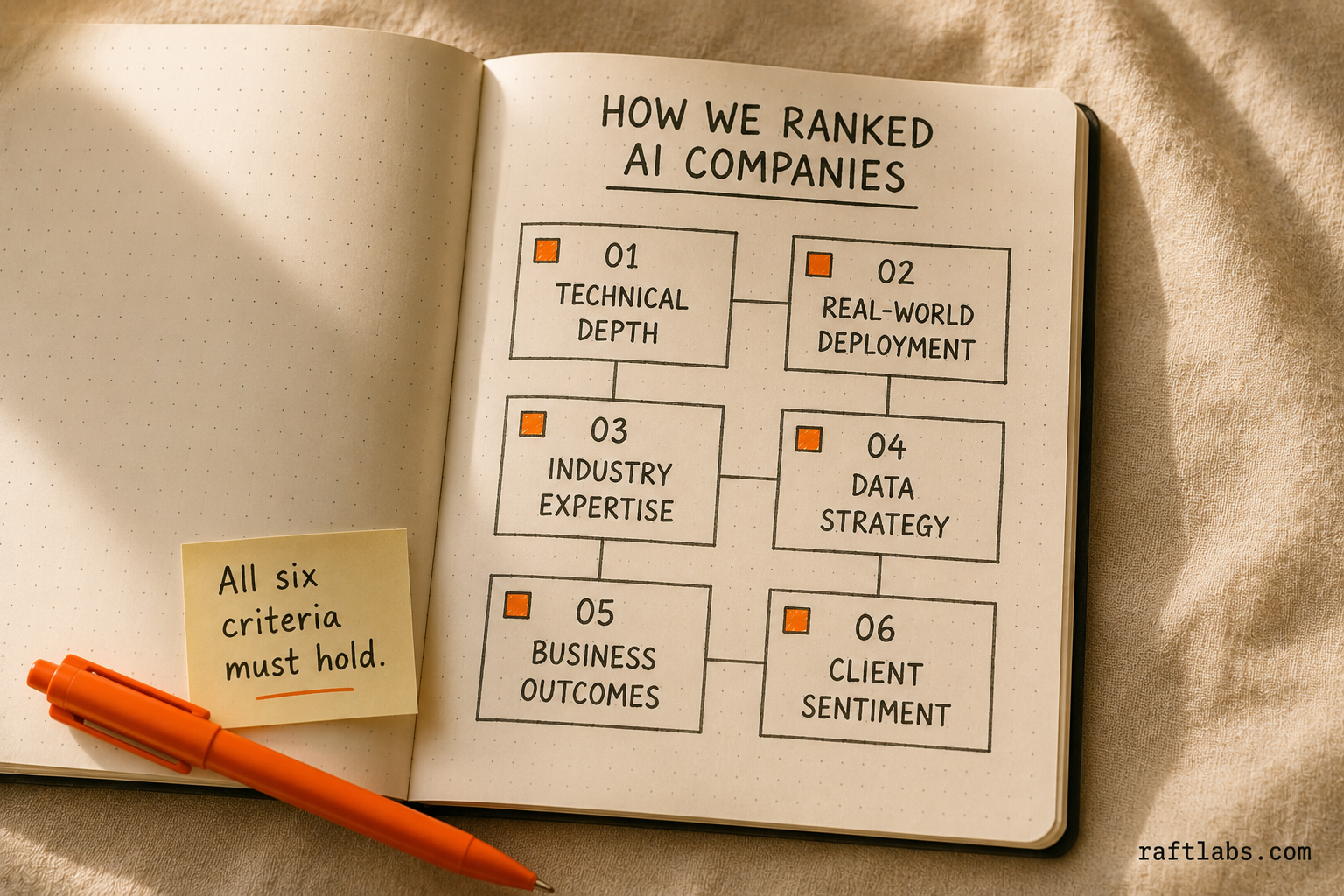
1. Technical Depth Across AI Disciplines
We didn't just check if they do "AI." We assessed their actual expertise across machine learning, deep learning, natural language processing, computer vision, and generative AI.
Do they have data scientists who can build custom models?
Can they fine-tune large language models? Do they understand the mathematics behind the algorithms?
We reviewed their technical blogs, examined their open-source contributions, and analyzed the complexity of projects in their portfolios. Surface-level knowledge is easy to spot when you know what to look for.
2. Real-World Implementation Experience
Building AI models in notebooks is one thing. Deploying them to production where they handle millions of requests per day is entirely different. We evaluated their MLOps capabilities, their experience with model deployment, their approach to monitoring and retraining, and their understanding of AI infrastructure.
3. Industry-Specific Expertise
Healthcare AI is nothing like retail AI. Financial services AI has completely different requirements than manufacturing AI. We assessed whether these companies actually understand the industries they claim to serve. Do they know the regulations? Do they understand the data challenges? Have they solved similar problems before?
4. Data Strategy and Engineering
Great AI starts with great data. We evaluated their approach to data collection, cleaning, labeling, storage, and governance. How do they handle data quality issues? What's their strategy for dealing with biased data? How do they ensure data security and privacy?
5. Business Outcome Focus
The best AI companies don't just deliver models. They deliver business results. We looked for evidence of ROI in their case studies, client testimonials about actual business impact, and their approach to defining success metrics before a project starts.
6. Client Sentiment and Long-Term Partnerships
We aggregated ratings from Clutch, G2, and similar platforms. We conducted direct interviews with their clients. We asked hard questions about communication, responsiveness, and how they handle problems. Most importantly, we looked for evidence of long-term partnerships, not just one-off projects.
With that rigorous evaluation framework in place, we identified the companies that consistently deliver real AI solutions.
Top 11 AI Software Development Companies
| Company | Clutch Rating | Experience (Years) | Pricing (Hourly Rate) | Best For |
|---|---|---|---|---|
| Biz4Group LLC | 4.9/5 | 21+ | $25 - $49 / hr | Enterprise AI Solutions |
| BotsCrew | 4.9/5 | 9+ | $50-$99/hr | Enterprise AI Agents |
| DevTeam.Space | 4.9/5 | 9+ | $50-$99/hr | Full-Stack AI Development |
| Innowise | 4.8/5 | 18+ | $50-$99/hr | Computer Vision & Predictive Analytics |
| Kanerika | 4.7/5 | 8+ | $100 - $149 / hr | Manufacturing & Industry 4.0 |
| Master of Code Global | 4.8/5 | 20+ | $50-$99/hr | Conversational AI & NLP |
| Nadcab Labs | 5/5 | 9+ | $20-$50/hr | AI-powered software development |
| Netguru | 4.8/5 | 15+ | $50-$99/hr | AI for Established Businesses |
| RaftLabs | 4.9/5 | 9+ | $29 - $49 / hr | Product-Focused AI Applications |
| Rapidops | 4.9/5 | 18+ | $50 - $99 /hr | Enterprise-grade AI platform development |
| Scopic | 4.7/5 | 19+ | $50-$99/hr | Healthcare & Regulated Industries |
The eleven companies on this list, in alphabetical order, are Biz4Group LLC, BotsCrew, DevTeam.Space, Innowise, Kanerika, Master of Code Global, Nadcab Labs, Netguru, RaftLabs, Rapidops, and Scopic. RaftLabs is on this list. We wrote our own entry with the same directness we applied to everyone else, and we did not place ourselves first. No company paid for placement on this list. The order below is alphabetical, not a performance ranking - we did not score or rank these companies against each other.
1. Biz4Group LLC
Biz4Group LLC is a US-based AI development company with over two decades of experience helping startups and enterprises build scalable, business-ready AI solutions that solve real problems.
With a team of 200+ AI engineers and data scientists, they've successfully delivered 700+ AI projects since their founding in 2003. What's impressive about Biz4Group is their focus on applied AI rather than research projects. They help companies build AI systems that actually generate revenue, reduce costs, or improve operations.
Their approach emphasizes clear communication, transparency, and close collaboration with clients throughout the development process. They're particularly strong in agentic AI and AI automation systems that can execute complex workflows autonomously.
Core AI Strength: Applied AI solutions with proven business outcomes
Key AI Services: AI strategy and discovery, AI agents and autonomous systems, generative AI and LLM solutions, AI-powered chatbots and virtual assistants, custom AI application development, AI automation
Industries Served: Healthcare, Real Estate, Finance, Human Resources, Legal, Education, Insurance, Sports Betting, Trading
Notable AI Projects: AI agents for coaches and educators, custom enterprise AI systems, AI workout applications, AI-powered HRMS solutions
Minimum Budget: $50,000
Location: Orlando, Florida, USA
Number of Employees: 50+
Hourly Rate: $25 - $49 / hr
2. BotsCrew
BotsCrew is a specialized AI development company focusing on AI agents and generative AI solutions that deliver measurable business outcomes. Founded in 2016, they partner with global brands like Samsung NEXT, Honda, Mars, Adidas, and Virgin.
With 150+ successful projects and a library of proven accelerators, BotsCrew combines discovery-led strategy with rigorous engineering. They're particularly strong at moving beyond pilots to production AI systems that actually generate value.
Their enterprise-grade compliance includes GDPR, HIPAA compliance, and SLA-backed support, making them suitable for regulated industries and large organizations with strict requirements.
Core AI Strength: Enterprise AI agents and conversational AI platforms
Key AI Services: AI agent development, generative AI solutions, LLM customization and fine-tuning, conversational AI (chatbots and voice), enterprise integrations and lifecycle management, AI readiness and knowledge retrieval
Industries Served: Healthcare, Customer Service, Marketing, Travel & Hospitality, Retail & E-commerce, Logistics, Banking & Financial Services, Public Sector
Notable AI Projects: Enterprise AI agent platforms, AI-powered customer service automation, intelligent virtual assistants
Minimum Budget: $50,000
Location: San Francisco, CA, United States
Number of Employees: 50+
Hourly Rate: $50-$99/hr
3. DevTeam.Space
DevTeam.Space is a software development company with expertise in custom AI development. Since 2016, they've successfully delivered close to 400 projects for global clients including Airbus, NEC, Disney, and Paramount.
The company is built around a vetted community of senior developers and data scientists, supported by dedicated project managers and structured agile processes. This model ensures predictable delivery, transparent communication, and consistently high-quality engineering.
DevTeam.Space focuses on building scalable, secure, and ROI-driven AI solutions that align directly with business goals, from intelligent automation to advanced analytics and generative AI integration.
Core AI Strength: Full-stack AI development with proven delivery processes
Key AI Services: Custom AI development, machine learning model design and optimization, predictive analytics and big data solutions, NLP and conversational AI, robotic process automation, generative AI integration, computer vision, cloud-native AI applications
Industries Served: FinTech, Healthcare, Logistics, Retail & E-commerce, Manufacturing, Automotive, Banking and Finance, Education, Real Estate
Notable AI Projects: Predictive analytics platforms, intelligent automation systems, AI-powered business intelligence
Minimum Budget: $50,000
Location: Los Angeles, CA, United States (global delivery)
Number of Employees: 50+
Hourly Rate: $50-$99/hr
4. Innowise
Innowise develops AI solutions focused on practical business impact, with over 2,500 specialists and 18 years in software development. Their work encompasses computer vision systems that identify defects in real-time, NLP systems processing thousands of customer messages daily, and predictive models driving data-backed decisions.
What makes Innowise particularly effective is their approach to AI implementation. They build solutions for specific business contexts, not from templates. Some clients engage them to fill skill gaps in their teams, while others entrust entire projects to them.
Their ISO 27001 certification and mature security practices make them suitable for enterprise deployments where security and compliance are paramount.
Core AI Strength: Computer vision and predictive analytics at enterprise scale
Key AI Services: Custom AI/ML model development and deployment, generative AI integration and LLM fine-tuning, NLP and speech recognition, computer vision for image/video analysis, predictive analytics, AI-powered automation
Industries Served: Healthcare, FinTech, Manufacturing, Retail & E-commerce, Transportation & Logistics, Education, Entertainment & Media, Real Estate, Energy, Telecom
Notable AI Projects: Computer vision quality control systems, predictive maintenance platforms, NLP customer service automation
Minimum Budget: $50,000
Location: Europe (multiple offices), global delivery
Number of Employees: 1000+
Hourly Rate: $50-$99/hr
5. Kanerika
Kanerika is a leading AI development company specializing in Agentic AI, machine learning, and custom generative AI models that solve real business problems in manufacturing and industrial sectors.
Their AI solutions go beyond theory, enabling faster information retrieval, smart video analysis, and real-time data monitoring. Businesses rely on their tools for smart surveillance, inventory optimization, vendor evaluation, and automated data validation.
By combining industry knowledge with AI, Kanerika helps manufacturing and industrial teams work more productively and make quicker, data-backed decisions. Their expertise in Industry 4.0 applications sets them apart.
Core AI Strength: AI for manufacturing and Industry 4.0 applications
Key AI Services: Agentic AI and multi-agent systems, machine learning and deep learning, custom AI development and model engineering, MLOps and AI infrastructure, generative AI with LLM and RAG, conversational AI and chatbots, process automation
Industries Served: Manufacturing, Retail, Finance, Healthcare
Notable AI Projects: Smart manufacturing systems, predictive maintenance platforms, intelligent quality control, supply chain optimization
Minimum Budget: $50,000
Location: Austin, TX, United States
Number of Employees: 250+
Hourly Rate: $100 - $149 / hr
6. Master of Code Global
Master of Code Global is a custom AI development company specializing in conversational AI, with over 500 projects delivered since their founding in 2004, impacting more than a billion users globally.
Their particular expertise lies in natural language processing and conversational AI systems. If you need chatbots, voice assistants, or any system that understands and generates human language, they're specialists in this domain.
What's particularly valuable about Master of Code is their approach to conversation design. They don't just build the technical infrastructure. They design conversation flows that actually work for real users, combining AI expertise with user experience design.
Core AI Strength: Conversational AI, NLP, and dialogue systems
Key AI Services: AI chatbot and conversational AI development, conversation design and AI agent development, ML, NLP, and deep learning, generative AI development and integration, LLM development and fine-tuning, voice AI solutions
Industries Served: E-commerce, Finance, Education, Airports, Travel & Hospitality, HR & Recruiting, Retail, Healthcare, Insurance, Telecom, Automotive, Banking
Notable AI Projects: Enterprise chatbot platforms, AI-powered customer service systems, voice assistants, multilingual conversation systems
Minimum Budget: $50,000
Location: United States (multiple offices)
Number of Employees: 50+
Hourly Rate: $50-$99/hr
7. Nadcab Labs
Nadcab Labs is a technology company that works on AI software development, blockchain solutions and custom digital platforms for different businesses. The company helps startups and growing companies use new technology to improve their work, build better digital products and manage systems more easily.
In 2026, Nadcab Labs is getting more attention for its work in AI based applications and simple automation tools. Their team builds smart software that can help businesses save time, improve decisions and handle daily tasks in a better way. The company also works on AI integration with existing platforms so companies can use AI.
Nadcab Labs works with startups and businesses that want to use AI for automation, analytics and modern software solutions. Their services start from idea discussion and small prototype development to full product launch and long term support so businesses can grow with technology.
Core AI Strength: AI-powered software development and intelligent automation solutions for modern businesses
Key AI Services: AI software development, AI consulting, AI-powered application development, automation solutions, chatbot development, AI integration for business platforms
Industries Served: Fintech, Blockchain, Software, E-commerce, Healthcare, and Startups
Notable AI Projects: AI-powered chatbots, intelligent automation systems, AI-based analytics platforms, and smart business applications
Minimum Budget: $10,000
Location: India
Number of Employees: 300+
Hourly Rate: $20-$50/hr
8. Netguru
Netguru is a European software development company with significant AI capabilities, combining technical expertise with design thinking to deliver intelligent applications that users actually want to use.
With over 15 years of experience and 800+ projects delivered, Netguru brings mature processes and strong project management to AI development. They're particularly good at working with established businesses that need to integrate AI into existing products and workflows.
Their strength lies in balancing innovation with pragmatism. They'll push you toward AI solutions that make sense for your business, but they won't oversell AI where traditional approaches would work better.
Core AI Strength: AI integration into existing products and business workflows
Key AI Services: AI development and integration, machine learning and predictive analytics, natural language processing, computer vision, generative AI solutions, AI consulting and strategy
Industries Served: FinTech, HealthTech, Retail, E-commerce, Education, Real Estate
Notable AI Projects: AI-powered recommendation engines, predictive analytics platforms, intelligent automation systems, NLP-based applications
Minimum Budget: $50,000
Location: Poland (HQ), global operations
Number of Employees: 250+
Hourly Rate: $50-$99/hr
9. RaftLabs
RaftLabs is a globally trusted AI software development company specializing in building intelligent applications for startups and enterprises across healthcare, fintech, media tech, and digital commerce.
What sets RaftLabs apart is their product-focused approach to AI. They don't just build models in isolation. They integrate AI capabilities into complete product experiences, from real-time audio/video platforms with intelligent content moderation to healthcare applications with predictive analytics to customer engagement systems powered by natural language understanding.
Their team combines AI expertise with full-stack development capabilities, meaning they can build the entire application around your AI features, not just deliver a model that you need to figure out how to deploy.
Core AI Strength: End-to-end AI product development with production deployment expertise
Key AI Services: AI MVP Development, Voice AI Development, AI Chatbot Development, AI Agent Development, Generative AI Integration, Conversational AI Development, predictive analytics, AI-powered automation, Custom machine learning models, NLP and computer vision.
Industries Served: Healthcare, Media & Communication, Marketing Tech, Travel and Hospitality.
Notable AI Projects: Remote patient monitoring with predictive health analytics, AI chatbots for customer engagement, intelligent content moderation systems, recommendation engines
Minimum Budget: $25,000
Location: India (Remote & Global delivery)
Number of Employees: 50+
Hourly Rate: $29 - $49/hr
10. Rapidops
Rapidops is a well-known AI and digital product development company that builds modern and sustainable platforms to unlock real growth for businesses. Since 2008, they have created hundreds of digital products and completed thousands of projects, serving millions of users around the world in retail, manufacturing, and distribution.
What makes Rapidops different is the way they use AI. Instead of creating AI models that sit unused, they put AI directly into products people actually use. From customized online buying stories and clean product discovery to automation systems and equipment that help businesses make better decisions, their solutions are designed to make a real impact. Their AI Lab works with business leaders to transform AI ideas into solutions that deliver cost, not just experimentation.
They combine deep AI expertise with strong product engineering abilities, allowing them to build and scale stop-to-stop AI structures. They deal with planning and setting up data to distribution and continuous improvement, ensuring that every answer offers real effect.
Core AI Strength: Enterprise-grade AI platform development with business-outcome alignment and production deployment at scale
Key AI Services: AI Software Development, AI Agent Development, Generative AI Consulting, Enterprise AI Strategy, LLM Development, Product Development, Data Analysis, Digital Transformation, etc.
Industries Served: Retail & eCommerce, Manufacturing, Distribution, etc.
Notable AI Projects: AI-powered product discovery platforms, enterprise personalization engines, composable commerce platforms, intelligent automation systems, large-scale digital transformation initiatives
Minimum Budget: $25,000+
Location: United States (HQ) with global delivery across North America, Europe, and Australia
Number of Employees: 350+ experts
Hourly Rate: Not Disclosed
11. Scopic
Scopic is an end-to-end software development company with deep AI capabilities, particularly in healthcare and other regulated industries. Founded in 2006, they've delivered over 1,000 completed projects with a team of 250+ specialists across six continents.
What sets Scopic apart is their combination of AI expertise with regulatory compliance knowledge. They hold HIPAA and SOC 2 certifications, making them a trusted partner for healthcare, finance, and other industries where compliance is critical.
Their AI services span the full development lifecycle, from strategy and model development to deployment and ongoing optimization, with particular strength in healthcare AI applications.
Core AI Strength: Compliant AI systems for regulated industries, especially healthcare
Key AI Services: Machine learning and deep learning, predictive analytics, natural language processing, computer vision, conversational AI, AI strategy consulting and deployment, cloud-based ML deployments
Industries Served: Healthcare, Finance, Education, Manufacturing, Real Estate, E-commerce, Blockchain
Notable AI Projects: Healthcare diagnostic AI systems, predictive analytics for financial services, intelligent automation platforms
Minimum Budget: $50,000
Location: Marlborough, MA, United States (global delivery model)
Number of Employees: 250+
Hourly Rate: $50-$99/hr
Also Read: Top SaaS Development companies if your want to build SaaS products
So those are the top 11 AI software development companies we've vetted. But having a list of great companies doesn't solve your problem. You still need to choose the right one for your specific situation.
Also check out: Top 10 ReactJS Development Companies
What Makes AI Software Development Different in 2026?
If you're coming from traditional software development, AI projects will feel different from day one. The rules have changed, the risks are different, and the skills required go way beyond knowing how to code.
Let's talk about what actually makes AI development unique and why it matters for choosing the right partner.
The data problem is usually bigger than the AI problem.
In traditional software, you write code that does what you tell it to do. In AI software, you're building systems that learn from data. That means the quality, quantity, and structure of your data matters more than the algorithms you choose.
Most companies massively underestimate the data work required. You need data collection pipelines that actually work at scale. You need labeling processes that produce consistent, accurate annotations. You need storage infrastructure that can handle potentially terabytes of training data. You need data cleaning processes because real-world data is always messy.
A great AI development partner will spend significant time on data strategy before writing any model code. If they're not asking detailed questions about your data in the first meeting, that's a red flag.
1. Models are Iterative, Not Deterministic.
Traditional software development is relatively predictable. You write specifications, developers build to those specs, you test, and you deploy. It works or it doesn't.
AI development is fundamentally iterative and experimental. You build a baseline model. You evaluate its performance. You try different architectures. You tune hyperparameters. You experiment with different training approaches. What works for one problem might completely fail for another similar-looking problem.
This means your AI partner needs to be comfortable with ambiguity and experimentation. They need strong processes for tracking experiments, versioning models, and measuring improvement. If they're promising exact timelines and guaranteed accuracy numbers before seeing your data, they don't understand how AI development actually works.
2. Production Deployment is Where Most Projects Die.
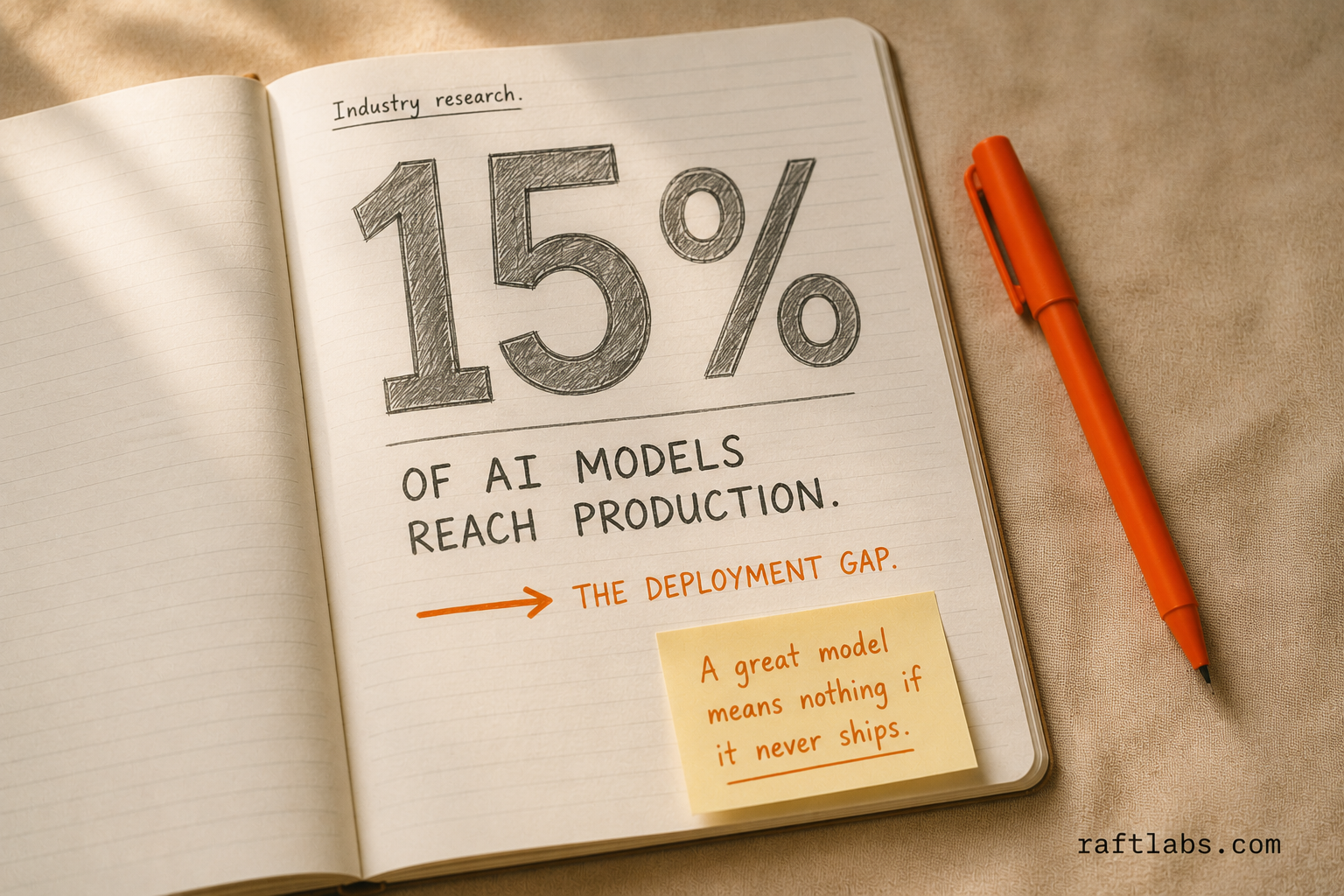
Research shows that only 15% of AI models actually make it into production. Why? Because getting a model to work on your laptop is completely different from running it in production at scale.
Production AI systems need to handle millions of predictions per day with acceptable latency. They need monitoring to detect when model performance degrades. They need automated retraining pipelines because models go stale as data distributions change. They need fallback mechanisms for when predictions fail. They need to integrate with your existing systems, databases, and workflows.
MLOps expertise, the practice of deploying and maintaining machine learning systems in production, is what separates companies that ship working AI from companies that deliver science experiments. When evaluating partners, dig deep into their deployment experience and infrastructure capabilities.
3. AI systems Require Ongoing Maintenance, Not Just Initial Development.
Traditional software can run for years with minimal changes. AI systems require continuous monitoring and improvement. Model performance degrades over time as the real world changes. New edge cases appear that your training data never covered. User behavior shifts, requiring model updates.
The best AI partners build systems with this reality in mind from day one. They implement monitoring dashboards that alert you to performance degradation. They create retraining pipelines that can be triggered automatically or manually. They design architectures that allow for easy model updates without system downtime.
If your potential partner isn't talking about maintenance, monitoring, and model lifecycle management, they're selling you an experiment, not a production system.
4. Regulatory and Ethical Landscape Keeps Evolving.
In 2026, AI systems face increasing regulatory scrutiny. The EU AI Act is in force. GDPR has specific implications for AI and automated decision-making. Industry-specific regulations like HIPAA for healthcare or financial services requirements add additional layers of compliance.
Beyond regulation, there are legitimate ethical concerns. Bias in training data can lead to discriminatory outcomes. Lack of explainability can make systems impossible to audit. Privacy violations can occur if personal data isn't properly anonymized.
Your AI development partner needs to understand these issues deeply. They need experience building explainable AI systems. They need solid processes for detecting and mitigating bias. They need to stay current on evolving regulations in your industry.
With all these unique challenges in mind, choosing an AI development partner becomes critical. The companies we've evaluated understand these realities and have the battle scars to prove it.
The Reality of AI Implementation: Why Most Projects Fail
Before engaging with AI vendors, it’s important to understand why nearly 85% of AI projects fail. Knowing these failure patterns helps you ask sharper questions and avoid costly mistakes.
1. Solving the Wrong Problem
Many teams start with AI and then look for problems to apply it to. Successful projects do the opposite. Strong AI partners will challenge you if AI isn’t the right solution, question assumptions, and flag gaps early. Blind agreement is a red flag.
2. Unrealistic Data Expectations
Most companies overestimate the quality and quantity of their data. Preparing data often takes longer than building models. Reliable partners audit your data upfront and are transparent about constraints, timelines, and trade-offs.
3. Models that Don’t Scale to Production
High accuracy in a test environment doesn’t guarantee real-world performance. Production AI requires deployment experience, monitoring, retraining, cost control, and resilience. Ask vendors how they handle these realities.
4. Ignoring Change Management
Even great AI fails without adoption. Training, workflow redesign, trust-building, and ongoing support matter as much as the model itself. The best partners plan for people, not just technology.
Understanding these failure modes gives you a clear framework to evaluate AI partners. Next, let’s look at the criteria that separate strong AI companies from the rest.
How to Choose the Right AI Development Partner
Choosing an AI partner is a high-impact decision. The right one delivers measurable business value. The wrong one delivers polished demos and missed outcomes.
What to Look For
Relevant technical experience, not generic “AI expertise”
Production-grade delivery, including deployment, monitoring, and retraining
Strong data discipline, with upfront audits and realistic expectations
Industry understanding, including regulations, data constraints, and success metrics
Business-first thinking, focused on ROI, not just model accuracy
What to Ask
What similar AI systems have you built and deployed in production?
How do you evaluate data readiness and handle data quality issues?
How do you monitor, maintain, and retrain models after launch?
What industry-specific challenges and regulations should we expect?
How do you measure and report business impact from AI projects?
The strongest AI partners challenge assumptions, surface risks early, and stay accountable to business outcomes, not just technical delivery.
Red Flags When Evaluating AI Development Companies
Choosing an AI development partner is a high-impact decision. The right one delivers real business value. The wrong one costs time, money, and momentum.
The AI space is crowded with vendors who sound impressive but fail in execution. These red flags consistently predict broken timelines, wasted budgets, and failed deployments.
These are some major red flags to watch for:
1. Overpromising Results or Speed
Guaranteeing accuracy or committing to aggressive timelines before reviewing your data is a clear warning sign. Real AI work involves uncertainty, phased validation, and iteration.
What good looks like: realistic ranges, phased plans, and transparency about unknowns.
2. No Serious Questions about Your Data
If they are not asking about data quality, volume, structure, labeling, and privacy early, they either do not understand AI or plan to figure it out on your budget.
3. Vague or Generic Technical Answers
“We do AI” is not expertise. Strong partners explain how they build, deploy, monitor, and maintain models. Weak ones hide behind buzzwords and vague best practices.
4. Poor Industry Understanding
A lack of familiarity with industry regulations, data constraints, and success metrics leads to costly mistakes. If they cannot speak your domain fluently, move on.
5. Weak or Missing MLOps Capabilities
Building a model is easy. Running it reliably in production is not. If they cannot clearly explain deployment, monitoring, retraining, and rollout strategies, expect lab-grade results instead of production systems.
6. Treating AI as a One-Time Project
AI systems need ongoing monitoring, retraining, and optimization. Partners who disappear after delivery leave you with degrading performance and no support.
7. Unclear Ownership of Data, Models, or Code
Ownership must be explicit. You should fully own the models, code, data, and IP without licensing it back or paying to use what you funded.
If multiple red flags appear early, they will not disappear later. They only get more expensive.
Conclusion
The AI software development landscape in 2026 is more mature than it's ever been. The technology works. The tools are powerful. The frameworks are strong. But success still comes down to choosing the right partner who understands both the technology and your business.
The companies we've listed here represent the best in the industry. Some specialize in conversational AI and NLP. Others excel at computer vision or predictive analytics. Some bring deep expertise in healthcare or finance. Others have proven themselves across multiple industries.
Choosing the right partner depends entirely on your specific situation, your data, your industry, and your goals.
So, choose the one one who understands your business problem deeply enough to tell you when AI isn't the answer. The one who asks hard questions about your data before making promises. The one who focuses on business outcomes, not just technical metrics. The one who builds systems that actually make it to production and deliver value.
The companies listed here can all deliver real AI solutions. Your job is finding the one that matches your specific needs, your industry, your data situation, and your working style.
If you are evaluating AI initiatives and want an honest conversation about feasibility, risks, and next steps, contact us to discuss whether AI is the right solution for your use case and what it would take to build it.
Ask an AI
Get an instant summary of this post from your preferred AI assistant.
Common questions
- AI software development is fundamentally different in several ways. First, it's experimental and iterative rather than deterministic. You can't just write specifications and expect predictable results because machine learning models require experimentation with different approaches, architectures, and hyperparameters. Second, data quality and quantity matter more than the algorithms you choose. Most of the work in AI projects involves getting data into shape through collection, cleaning, labeling, and validation. Third, AI systems require ongoing maintenance and monitoring because models degrade over time as real-world data distributions change. Finally, you need specialized expertise in statistics, machine learning, data engineering, and MLOps, not just traditional programming skills.
- Top AI development companies follow strict data protection practices. They encrypt data at rest and in transit, enforce access controls, anonymize or pseudonymize personal data, and comply with regulations like GDPR, CCPA, HIPAA, or PCI-DSS. They perform regular security audits, use secure cloud infrastructure, monitor for threats, and maintain certifications such as ISO 27001 or SOC 2. For regulated industries, they implement compliance measures, audit trails, and explainable systems for regulatory review.
- The cost of developing an AI application depends on the complexity, features, and platforms you need. Here’s a breakdown by product type: Minimum Viable Product (MVP): Basic AI-enabled web or mobile app with 1-2 core features and simple design. Turnaround: 6-8 weeks. Cost: USD 10,000 - 20,000. Full-Featured Product: Market-ready web and mobile apps with multiple features, custom design, and integrations. Turnaround: 12-14 weeks. Cost: USD 20,000 - 40,000. Innovative Tech Product: Complex AI, AR, VR, or next-gen solutions with custom designs and advanced problem-solving. Turnaround and cost: custom quote. These estimates help you plan your budget, but the final cost may vary based on your specific requirements, integrations, and design complexity.
- Development time depends on the product type and complexity. Here’s what you can expect: MVP: 1-2 months Full-Featured Product: 3-4 months Innovative Tech Product: Timeline varies depending on complexity and requires a custom plan These timelines give you a realistic idea of how long it takes to go from concept to a working AI application, helping you plan your launch and milestones effectively.
- AI is versatile, and top development companies can create solutions across a wide range of applications depending on your business needs Predictive Analytics: Forecast trends, user behavior, or business outcomes using historical data. Natural Language Processing (NLP): Chatbots, virtual assistants, sentiment analysis, and automated customer support. Computer Vision: Image and video recognition, object detection, quality inspection, and AR/VR experiences. Recommendation Systems: Personalized product or content recommendations for users. Generative AI: Content creation, text generation, image or video synthesis, and creative automation. The type of AI application you choose should align with your business problem, data availability, and target users. A strong AI partner will help you identify the right solution and scale it effectively.