Short answer
RaftLabs built a native iOS and Android mobile trivia platform for GE that gamifies company knowledge, product training, and culture content for a large enterprise workforce. The platform features personalized quiz difficulty, leaderboards, badges, and 200+ content modules across multiple question formats. It reached 5,000+ daily active users with an 85% quiz completion rate (client-reported). Built in 16 weeks using native Kotlin for Android, Swift for iOS, AWS for content delivery and auto-scaling, and MongoDB for flexible content data models.
The situation
Company knowledge, product information, and culture content reaches most employees through emails they skim, intranets they rarely visit, and annual training modules they complete and forget. The content exists. The engagement does not.
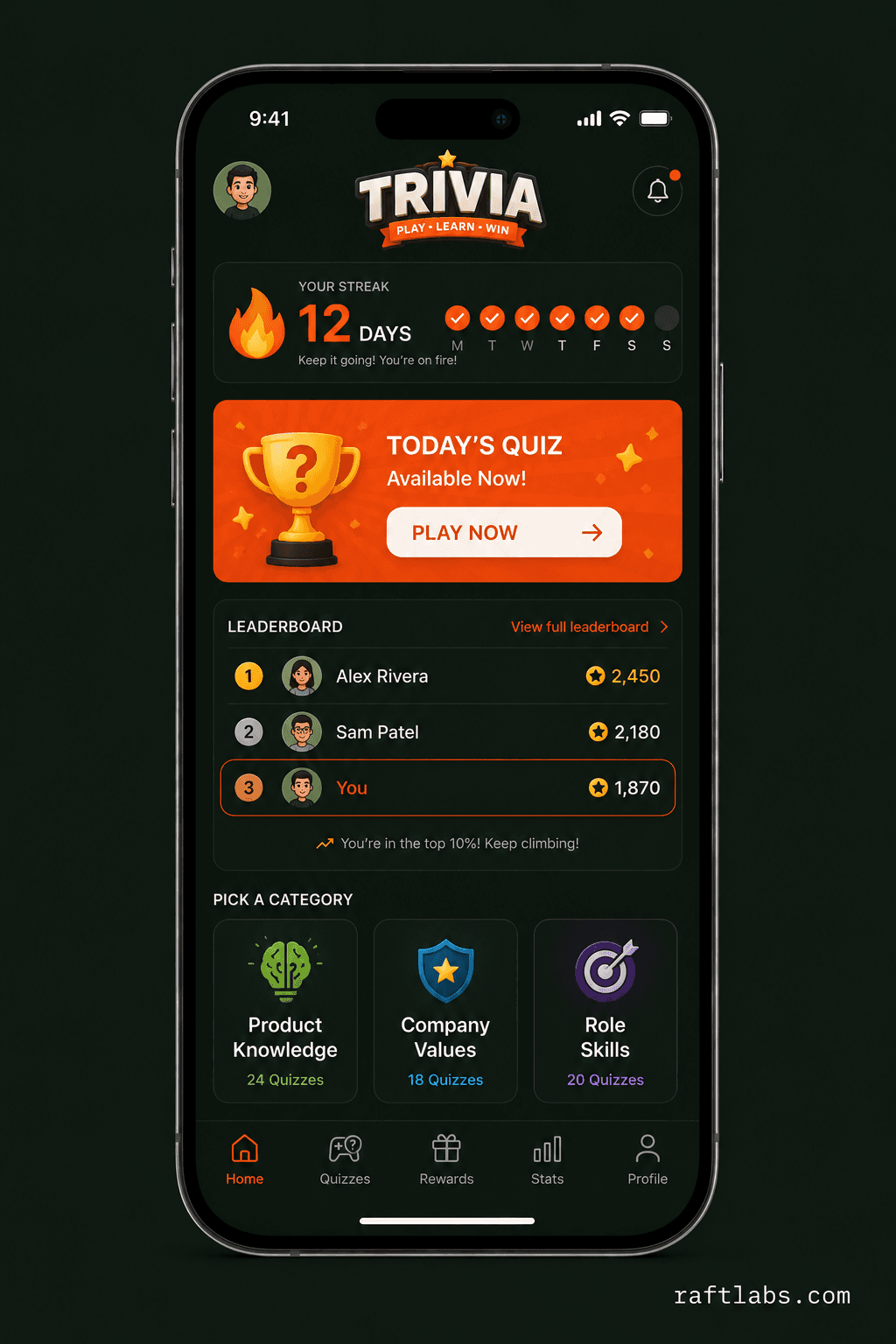
GE needed a different delivery mechanism. We built a native iOS and Android trivia platform where company knowledge becomes daily competitive quizzes. Employees answer questions about product lines, company history, and values to climb a leaderboard and earn badges. Content managers configure 200+ modules across multiple question formats. The client reported that 5,000 employees use it daily, and 85% complete each quiz they start.
The failure mode is well known: a leaderboard goes up, performance spikes for two weeks, and by month three half the team resents the top performer while the other half has stopped trying. A single global leaderboard punishes newer employees and rewards whoever had the most time. The competition had to be segmented so every employee had a board they could realistically compete on.
Engagement
The GE engagement
- Client
- GE, a dispersed workforce needing company knowledge to stick
- What we built
- A native iOS and Android trivia platform: daily competitive quizzes on product lines, company history, and values, with leaderboards, badges, personalized difficulty, and a content manager analytics dashboard
- Stack
- Native iOS and Android, real-time scoring and ranking backend
- Status
- Live. The client reported 5,000+ daily active employees and 85% quiz completion
Before and after
What changed
- Company knowledge and product training was distributed across emails, intranets, and static documents that most employees opened once and ignored
- Training participation was passive: employees completed required modules because they had to, not because the format held their attention
- High-performing employees had no recognition mechanism tied to knowledge; there was no visibility into who understood the product and culture best
- Content managers could see module completion rates but had no data on where employees abandoned content or which question formats produced the most retention
- A dispersed workforce across multiple locations had no shared experience or competitive context that reinforced company culture
- Employees engage with company knowledge through a daily trivia habit instead of a mandatory training module; the format drives return visits on its own
- Leaderboards and badges give high-performing employees visible recognition tied to knowledge, creating a new status signal alongside traditional performance metrics
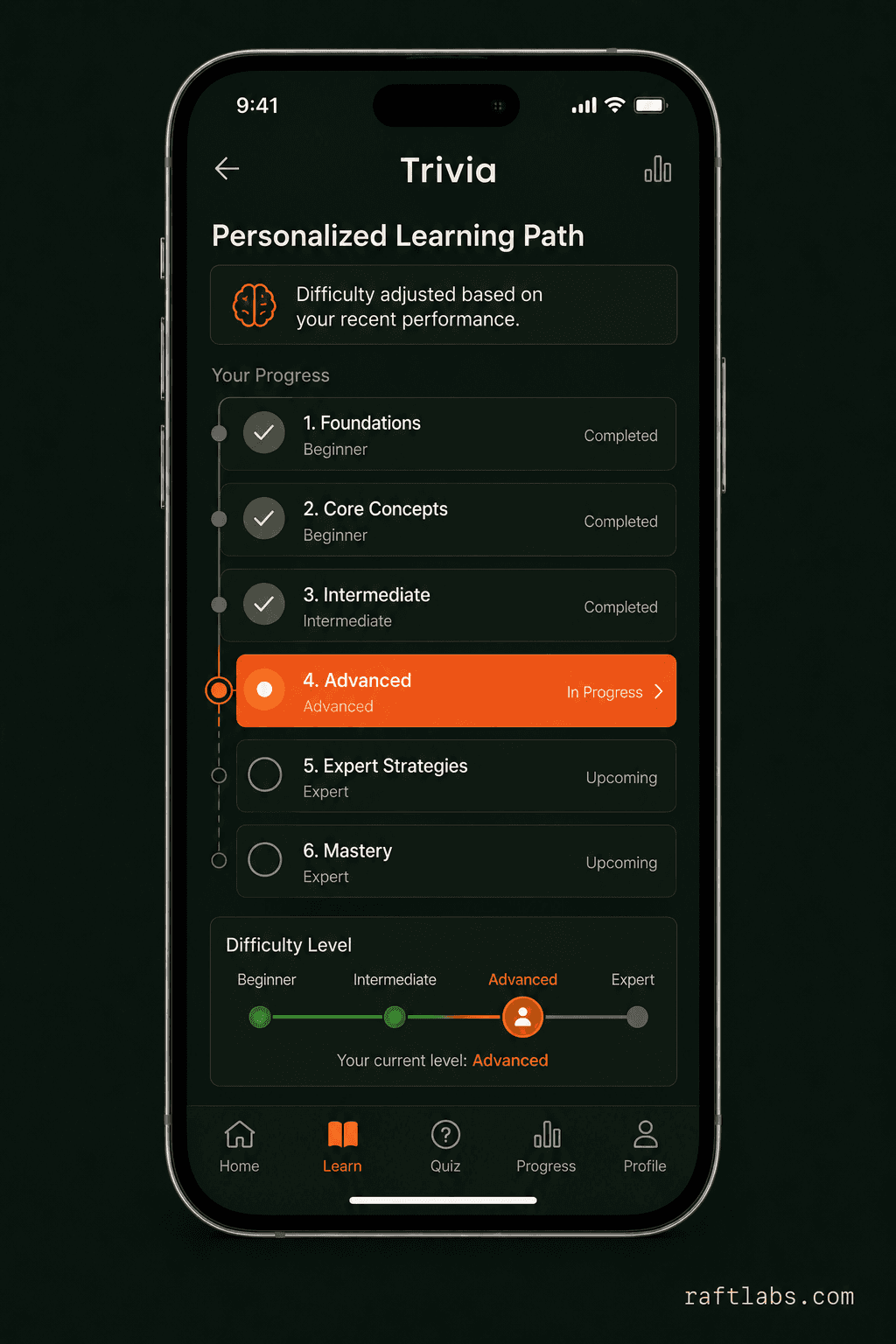
- Personalized quiz difficulty adjusts to each employee's knowledge level so the content stays challenging without becoming inaccessible to newer hires
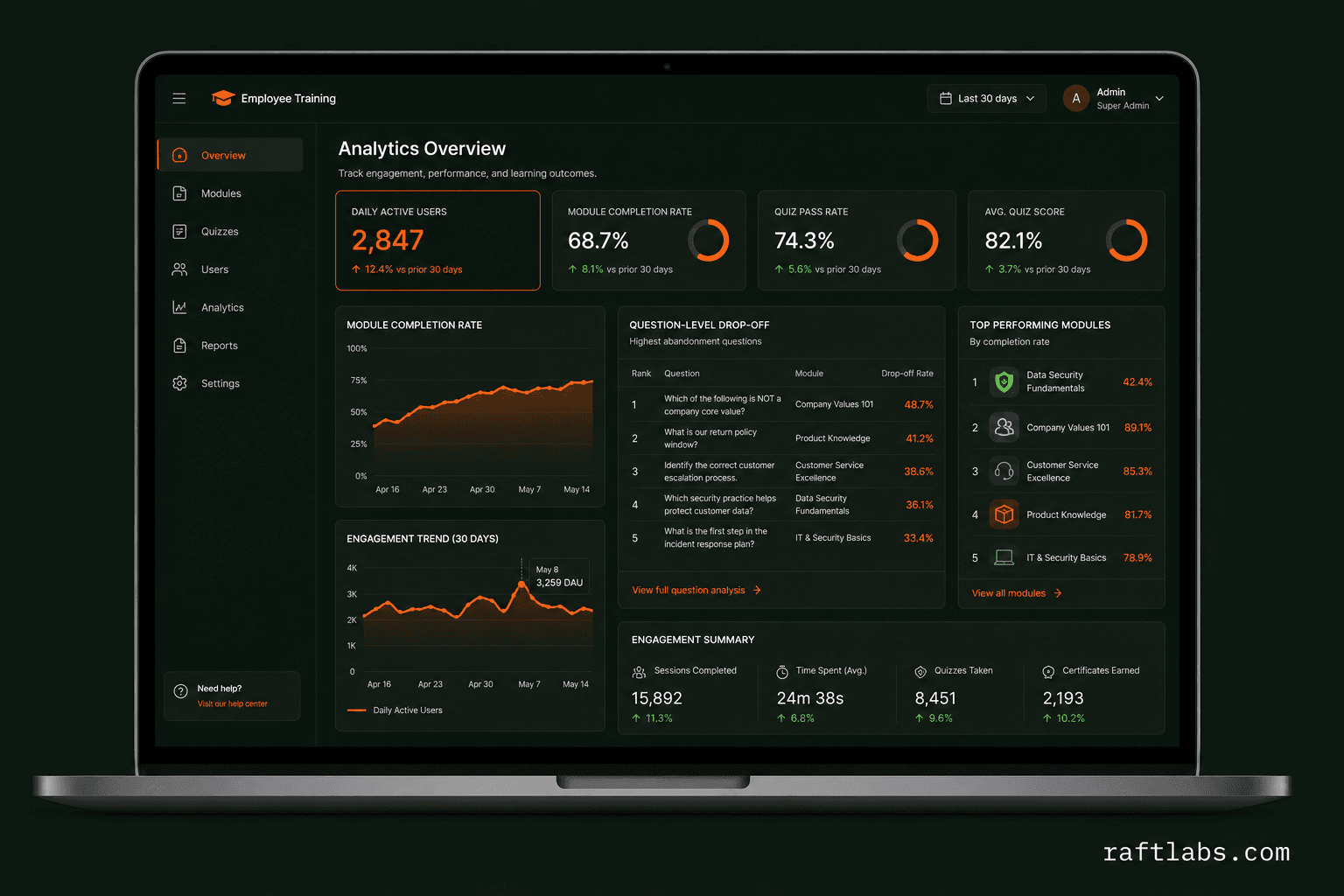
- Content managers track module completion rates, question-level drop-off data, and daily active user trends from an analytics dashboard
- 200+ content modules covering product knowledge, company history, values, and role-specific information run across multiple question formats in a single platform
What we had to solve
Building gamification mechanics that a corporate workforce would return to voluntarily, not just early adopters who like games
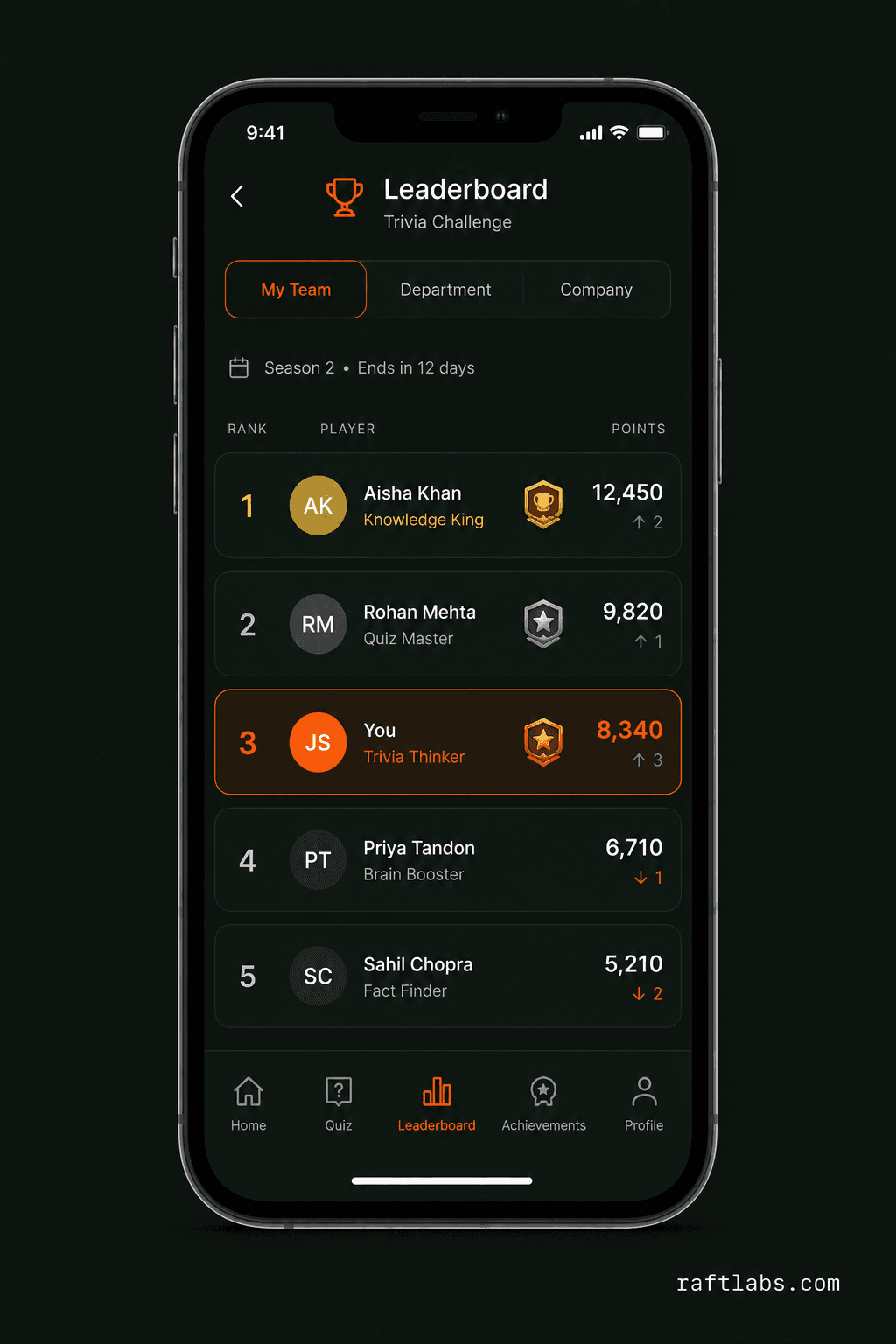
Leaderboards and badges work when the competition feels meaningful. In a large workforce, a single global leaderboard punishes newer employees and rewards whoever had the most time, which is the opposite of what the program was trying to reinforce. The design challenge was segmenting competition by role, tenure, or team so every employee had a leaderboard they could realistically compete in, while keeping the overall structure simple enough for content managers to configure and employees to understand in under a minute.
Keeping leaderboard updates real-time for 5,000 concurrent users without adding noticeable latency
A leaderboard that updates in the background every few minutes is a report, not a competition. The engagement value depends on employees seeing their position change immediately after answering. Delivering real-time scoring and rank updates to thousands of concurrent users required a backend architecture that processed quiz submissions, recalculated rankings, and pushed updates to individual devices within seconds, while the quiz interface itself stayed responsive throughout.
Proof
What the client reported, and what this page can't claim
Engagement figures reported by the client. These are operator reports, not independently audited measurements.
| Result | What changed | Period or context | Evidence and limitation |
|---|---|---|---|
| Daily engagement | 5,000+ employees using the platform daily | A dispersed workforce across multiple locations, engaging with company knowledge through daily trivia instead of mandatory modules | Client-reported |
| Completion | 85% of started quizzes completed | Personalized difficulty keeps content challenging without becoming inaccessible to newer hires | Client-reported |
| Content scale | 200+ content modules across multiple question formats | Product knowledge, company history, values, and role-specific information in a single platform | Product-recorded |
the build
What we built
The platform is built around one principle: the format has to make employees want to come back tomorrow, not just satisfy a training requirement today.
Daily experience varies, so the format stops feeling predictable
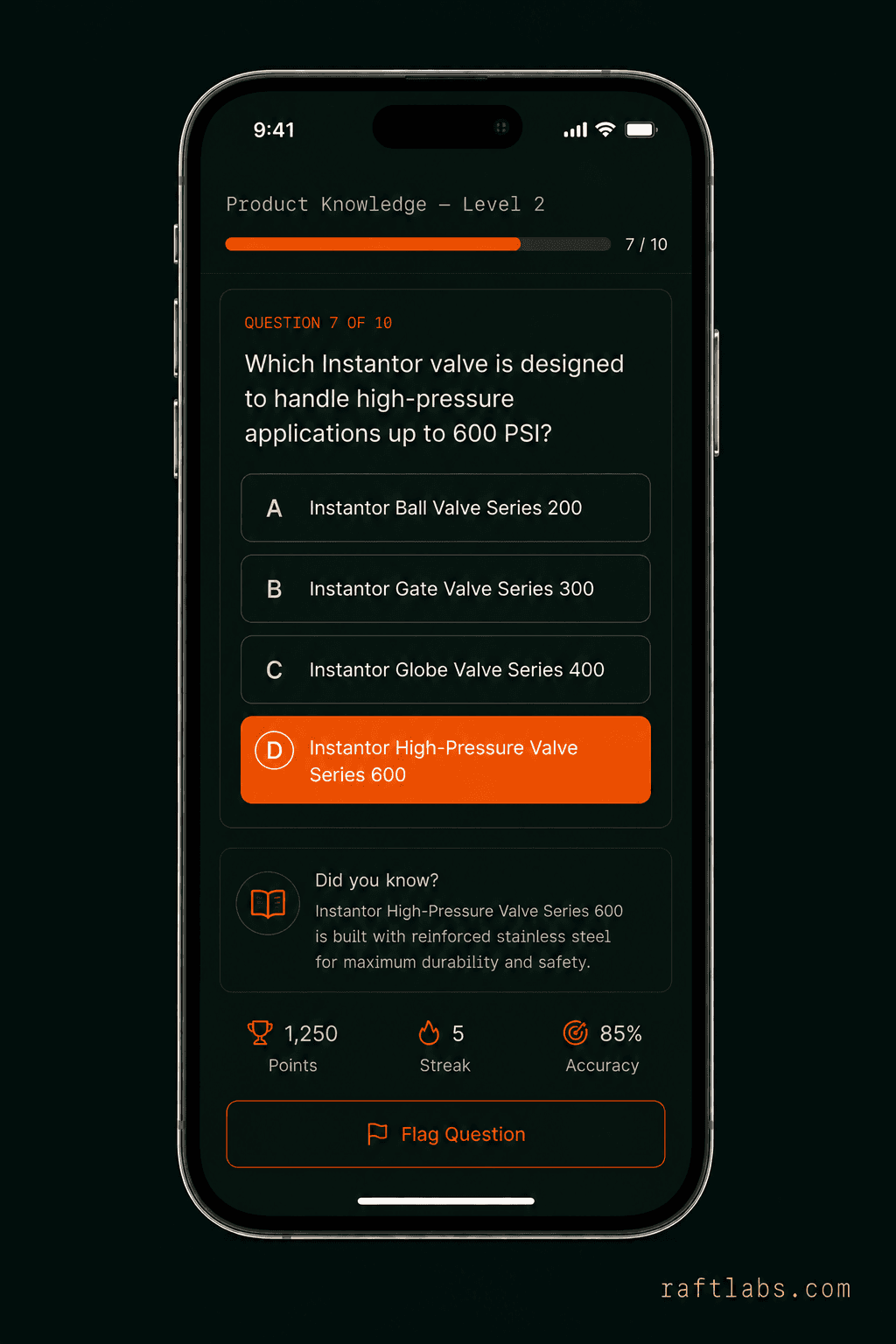
200+ content modules cover product lines, company history, values, and role-specific knowledge. Questions use multiple formats (multiple choice, image-based, video-anchored, and open-ended) so the daily experience varies rather than becoming predictable. Content managers add and update modules from the admin panel without developer support.
Questions stay relevant as employees improve, so it doesn't get too easy after a few weeks
Quiz difficulty adjusts based on each employee's performance history. A new hire and a ten-year veteran answering the same product knowledge category receive questions calibrated to their level. The effect is that the platform stays relevant as employees improve, rather than becoming too easy once they have spent a few weeks on it.
Consistent performers get visible recognition alongside standard performance processes
Employees compete within segmented leaderboards (by team, role, or tenure) so the competition is meaningful rather than dominated by whoever has the most available time. Badges mark achievement milestones and surface in employee profiles. Both mechanics give consistent performers a visible recognition layer that operates alongside standard performance processes.
Content managers see where employees abandon content: future investment targets what holds attention
Content managers see daily active users, module completion rates, question-level drop-off points, and engagement trends over time. The data shows which modules drive return visits and where employees abandon content, so future module investment targets the formats and topics that actually hold attention.
The lesson
Competition has to feel winnable
Leaderboards are the most misused mechanic in workplace gamification. The only people who actually enjoy them are the ones already on them. For everyone else, a global board is a daily reminder that they cannot win, and by month three they have stopped trying. The game has to create many winners, not one.
That meant segmenting competition by role, tenure, and team, so every employee had a leaderboard they could realistically compete on, and calibrating difficulty so the questions stay challenging without locking out newer hires. The test for every mechanic: would an employee feel motivated or crushed by this board? Only a motivated answer ships.
How it runs
- Kotlin
- Native Kotlin gave us the performance for real-time quiz rendering, push notifications, and leaderboard updates at 5,000+ concurrent users. Cross-platform frameworks introduce latency on the range of enterprise Android devices a large workforce uses; native eliminated that variable.
- Swift
- The same performance requirement applied on iOS. Direct access to Apple's notification and hardware APIs meant quiz transitions and real-time leaderboard pushes fired consistently across every device in GE's iOS device pool.
- AWS
- Delivering 200+ content modules including video-based questions to thousands of simultaneous users required a CDN and auto-scaling compute. Lambda handled quiz submission scoring and leaderboard recalculation without dedicated server infrastructure to maintain.
- MongoDB
- Quiz content models vary by question type: multiple choice, image-based, video, open-ended, role-specific. A document model let content managers add new question formats without schema migrations or developer involvement.
Common questions
Standard e-learning modules get completed because the system requires it. Gamification platforms get opened voluntarily because the competitive mechanics and visible progress make return visits feel worthwhile. For GE, the shift from mandatory modules to daily trivia produced an 85% quiz completion rate, not because completion was required, but because the format was worth engaging with. The business case for gamification is not that it makes training more fun; it is that it produces higher retention without enforcement.
The platform tracks each employee's answer history per content category. Employees who consistently answer product knowledge questions correctly receive harder variants; employees who struggle in a category receive questions pitched at their current level. The adjustment is automatic and continuous: it does not require employees to self-select a difficulty setting, which most people either avoid or pick incorrectly. The practical outcome is that the platform remains challenging enough to be worth competing in even for employees who have used it for months.
Content managers access a web admin panel to create and publish modules, configure leaderboard segments, view analytics, and manage the question library. New question formats are added via the module builder without code changes. Analytics show daily active users, completion rates per module, and question-level drop-off so content managers can see which formats produce the most engagement and invest future content effort accordingly.
Yes. The module structure is content-agnostic: the same quiz mechanics apply whether the content covers company history, product specifications, compliance requirements, or regulatory procedures. For compliance use cases, completion tracking and audit-ready reporting can be added so HR or legal teams have a record that each employee completed specific modules. The content itself is managed by the customer's internal team, so compliance modules can be updated as regulations change without involving development.
We delivered the native Android and iOS apps, content library, personalized difficulty engine, leaderboards, badges, push notifications, and analytics dashboard in 16 weeks. The native-first decision extended the timeline compared to a cross-platform build but was the right choice for the performance and notification reliability GE's workforce size required. For smaller workforces where cross-platform performance is acceptable, a React Native or Flutter build would be faster. Contact us to estimate based on your workforce size, content requirements, and device mix.
Related work
More work like this

Elearning app development case study: a creator-led music learning platform built on Flutter, Hasura, AWS, and RevenueCat over two years
A creator-led music learning platform for Irish traditional music, built over two years across four releases. 48,100 tracked practice minutes, 100+ learners, and a subscription model built on RevenueCat rather than raw store APIs.

ULT Movies reaches 4,000 remote theaters with custom OTT app
Leading Indian movie distributor, ULT Movies, solved the challenge of delivering new releases to remote theatres with an Android app for STBs. Now, the distributor delivers smooth movie access even in areas with limited internet connectivity.

PSi: anonymous real-time voice discussions for 300+ simultaneous participants
PSi replaced slow, expensive in-person deliberation sessions with anonymous real-time voice discussion. 300+ users in simultaneous audio. Delivered in 14 weeks.