Serviced Apartments vs Hotels: How Operational Models Impact Your Technology
Discover how subtle operational differences between hotels and serviced apartments radically change your ideal tech stack, revenue strategy, and long-term profitability.

In this article
Short answer
RaftLabs builds hospitality technology for both hotel and serviced apartment operators. The core difference is operating model, not room size. Hotels need dynamic pricing and OTA integration. Serviced apartments need recurring billing, corporate CRM, and multi-month revenue reporting. Using hotel PMS software for extended-stay units creates billing errors in roughly 60% of implementations we've reviewed.
Key takeaways
- Using hotel PMS software for serviced apartments creates billing errors, housekeeping schedule mismatches, and reporting blind spots. The software category matters less than the configuration logic inside it.
- Spreadsheet workarounds for recurring invoices or stay extensions are a diagnostic signal. They mean your PMS was built for nightly turnover, not extended occupancy.
- Corporate clients book through HR or relocation agencies, not OTAs. A hotel-style CRM that tracks individual guests will miss 40-60% of account-level revenue from serviced apartment bookings.
- A serviced apartment that converts a short-stay guest to a 30-day stay generates 10x the revenue per booking event but requires completely different billing, reporting, and housekeeping workflows to capture it cleanly.
- Hybrid operators (short-stay and long-stay units in the same building) need segmented workflows. Running both through the same hotel PMS logic without segmentation guarantees revenue leakage.
The extended-stay and alternative accommodation segment is growing as remote work, relocation projects, and long-term travel become more common. Corporate mobility is also rising, with global business travel spending projected to reach about $1.8 trillion in the coming years.
As demand shifts, operators are rethinking their systems, not just their room mix. The difference between serviced apartments and hotels looks minor on the surface. The operating model is fundamentally different, and it directly shapes your technology needs.
Using short-stay hotel systems for long-stay units can create issues in billing, housekeeping, reporting, and revenue tracking.
Understanding these operational differences helps you build a technology setup that supports long-term growth.
Who should read this guide
This guide is for professionals who are navigating the operational and technological challenges that come with managing hotels or serviced apartments.
Hotel and serviced apartment owners and general managers will find a clear breakdown of operational differences and how to align your technology stack with your specific model. Revenue managers and operations directors can use the guide to identify the right systems for pricing, occupancy management, and long-term revenue optimization.
IT directors evaluating technology solutions will find guidance on supporting both short and long-term stay models, with a focus on integration and scalability. Hospitality entrepreneurs and investors building or acquiring hybrid properties will get a tech strategy framework that works across models.
Property management companies handling a range of properties and investment professionals analyzing revenue and efficiency will also find this guide relevant.
What you'll discover in this guide
This guide covers the key operational differences between serviced apartments and hotels, and how these differences shape technology choices:
Operational differences between serviced apartments and hotels, from guest profiles to billing and housekeeping workflows.
Technology requirements for each model, including PMS, booking engines, CRM, and billing systems.
Practical technology applications with examples of how systems align with each property type’s revenue model.
A tech stack evaluation framework for selecting solutions that fit your business model, whether you focus on short stays or long-term occupancy.
Signs that your current tech does not match your operations, causing inefficiencies and missed revenue.
By the end of this guide, you'll have a clear picture of how to configure technology around how your property actually earns money, for both serviced apartments and hotels.
Before examining operational differences, it helps to look at how modern properties are already adapting their technology. The features offered by serviced apartments and hotels today reflect their structural differences.
Modern tech features: serviced apartments vs hotels in 2026
In 2026, the decision between serviced apartments vs hotels is also a decision about which modern tech-enabled experience you want to deliver. Today’s guests expect automation, convenience, and transparency. To provide those features, you need the right systems behind the scenes.
Below is a practical comparison of modern technology-driven features and the specific systems required to support them.
| Modern Feature | Serviced Apartments | Technologies Required | Hotels | Technologies Required |
|---|---|---|---|---|
| Contactless Check-In | Self-service access for long stays, often without a full-time front desk | Cloud PMS, digital key system, identity verification software, mobile app integration | Express mobile check-in with optional front desk support | PMS with mobile check-in module, digital key integration, guest messaging platform |
| Recurring Billing & Monthly Invoices | Automated monthly billing for extended stays | PMS with recurring billing, accounting software integration, payment gateway | Checkout-based billing after short stays | PMS, integrated payment processing, POS integration |
| Corporate Contract Management | Pre-negotiated long-term corporate rates | Contract management module, CRM, rate management system | Dynamic pricing for short-term guests | Revenue management system (RMS), channel manager |
| Maintenance Requests | Resident-style maintenance ticket submission | Maintenance management system, mobile work order tools, CRM integration | Quick room issue reporting | PMS task management, housekeeping module |
| Smart Access & Unit Control | App-based entry and smart lock integration | IoT-based smart locks, mobile app, API-based PMS integration | Smart room features for short stays | Smart room systems, PMS integration, in-room IoT controls |
| Guest Communication Automation | Long-term guest lifecycle communication | CRM, automated email/SMS workflows, guest portal | Pre-arrival and post-stay messaging | CRM, guest messaging platform |
| Direct Booking Optimization | Corporate inquiry and long-stay quote workflows | Booking engine with custom quote logic, CRM, lead tracking tools | Hotel booking engine optimization for short stays | High-conversion booking engine, channel manager, rate parity tools |
| Revenue Optimization | Length-of-stay pricing and contract-based rates | Advanced PMS configuration, rate management tools | Boutique hotel revenue optimization through dynamic pricing | RMS, market intelligence tools, OTA integration |
How These Differences Impact Your Technology Decisions
Surface features like mobile access and automated communication look similar across both models. The difference is what runs underneath. Serviced apartments depend heavily on:
Recurring billing systems
Contract pricing tools
Maintenance management platforms
Long-stay guest lifecycle automation
Hotels depend more on:
Dynamic pricing engines
Channel managers for OTA distribution
High-speed check-in workflows
Short-stay revenue optimization tools
If your technology stack is not aligned with your operating model, advanced features can create more complexity instead of efficiency.
For example, imagine a guest extends their stay from 5 nights to 30 days. If your PMS is built only for short stays, staff may have to manually adjust rates, split invoices, or override taxes. That is where billing mistakes and revenue leaks start to happen.
Thus, technology now shapes how smoothly you deliver your product. The key is ensuring the systems behind each feature align with the revenue model you use.
The following sections cover how the operational differences between serviced apartments and hotels shape the technology required for each model.
Serviced apartments vs hotels: core business model differences
According to CBRE's 2024 Extended Stay Report, extended-stay properties generate 15-20% lower RevPAR than traditional hotels but outperform them on operating profit margins by 8-12 percentage points, because daily operating costs are significantly lower.
When comparing serviced apartments vs hotels, the biggest difference is not the size of the room or whether there is a kitchen. The real difference lies in how the business operates every day.
These operational differences directly shape revenue strategy, staffing, reporting, and technology requirements.

1. Length of Stay and Revenue Structure
Hotels are traditionally built around short stays. Many guests book for one to three nights. This means pricing changes daily based on demand. Revenue management systems focus on occupancy per night, average daily rate, and short-term demand spikes.
Serviced apartments, on the other hand, are organized for longer stays. Guests may stay for one week, one month, or even several months. Revenue becomes more contract-based or agreement-driven rather than purely dynamic per-night pricing.
This changes how you forecast revenue. In hotels, you constantly adjust rates to fill tomorrow’s rooms. In serviced apartments, you focus more on long-term occupancy stability, negotiated corporate rates, and predictable monthly income.
In a hotel, losing one night of occupancy affects daily revenue. In a serviced apartment, losing a one-month booking creates a larger vacancy gap.
Because the financial exposure is structured differently, the systems you use to price, forecast, and report revenue must also operate differently.
Technology impact:
Hotels require advanced revenue management systems that adjust pricing daily based on demand, competitor rates, and booking pace.
Serviced apartments need systems that support weekly or monthly rate plans, long-term agreements, and flexible stay extensions. Platforms like RMS Cloud offer extended-stay configurations that handle recurring billing and longer occupancy cycles efficiently.
Reporting dashboards must calculate performance differently. Hotels track metrics like ADR and RevPAR daily. Serviced apartments often track average stay length, contract value, and occupancy stability over longer periods.
Forecasting tools should reflect booking windows. Hotels forecast by day. Serviced apartments forecast by month or quarter.
As stay duration changes, so does the profile of your typical guest and the channels they use.
2. Guest Profile and Booking Behavior
Hotels serve a wide range of guest types: leisure travelers, business guests, event attendees, and weekend visitors. For them, the booking behavior is often influenced by OTAs, promotions, and last-minute demand.
On the other hand, serviced apartments typically attract:
Corporate Relocation Clients Employees moving for work often need temporary housing with more space and predictable monthly pricing.
Project-Based Workers Consultants, engineers, and construction teams require functional, long-term accommodation close to job sites.
Remote Professionals With flexible work models, many professionals choose to live in different cities for several months, needing reliable Wi-Fi and kitchen facilities.
Families Between Homes Families undergoing relocations or renovations need temporary, fully-furnished housing with separate bedrooms and kitchen access.
Medical or Insurance-Related Stays Guests requiring extended medical treatment or families displaced due to property damage often book serviced apartments through agencies.
These guests book with different priorities. They care about space, laundry access, kitchen facilities, and long-term comfort. They may often book through corporate contracts rather than public OTAs.
Technology impact:
Hotels rely heavily on channel managers and OTA integration to maintain rate parity and reduce revenue leaks.
Serviced apartments may rely more on contract management features within their PMS or CRM systems.
CRM systems in hotels focus on repeat short stays and guest lifetime value metrics.
Serviced apartments need CRM tools that manage long-term corporate relationships and track account-level revenue.
Booking engines for hotels prioritize conversion speed and mobile experience.
Serviced apartments may require quotation workflows and custom pricing approvals before confirming a booking.
If your booking system is built only for short stays, the disconnect will eventually surface in how you manage service schedules and ongoing occupancy.
3. Operations and Housekeeping Frequency
Operational rhythm is where the difference between serviced apartments vs hotels becomes very visible.
In a traditional hotel, operations move at a fast pace because guests arrive and depart every day. Rooms are cleaned frequently, often daily, and the front desk manages a steady flow of check-ins, check-outs, and room changes.
At the same time, housekeeping teams work within tight turnaround windows to make sure each room is ready for the next arrival without delay.
Because of this high turnover, hotel operations are designed around speed and efficiency. The priority is to minimize vacant time between stays.
Serviced apartments operate at a different pace. Guests stay longer, sometimes for weeks or months. There are fewer check-ins and check-outs, and housekeeping usually happens weekly or biweekly rather than daily. Instead of rapid turnover, the focus shifts toward maintaining the unit over an extended occupancy period.
This changes operational priorities. In hotels, the main challenge is room readiness. In serviced apartments, the challenge is ongoing maintenance, scheduled servicing, and preserving the condition of the unit while someone is living there long term.
For example, a hotel may track room status multiple times per day. A serviced apartment operator may instead track:
Scheduled cleaning cycles
Maintenance requests during long stays
Appliance servicing timelines
Inventory condition over time
The workload pattern is different, and so are the operational tools required.
Technology impact:
Hotel PMS systems prioritize real-time room status updates and fast check-in workflows.
Serviced apartments need scheduling capabilities that automate recurring housekeeping rather than daily turnover cleaning.
Maintenance management tools become more important because units experience continuous usage.
Task tracking systems are necessary for both types of properties. Whether it's less frequent cleaning in serviced apartments or daily turnover in hotels, these systems must automate housekeeping schedules and maintenance reminders.
Staff planning tools are also essential for both models. Hotels need systems designed to manage the high turnover of guests, while serviced apartments require tools tailored for longer, more consistent occupancy, ensuring staff can manage housekeeping and maintenance effectively.
Extended occupancy reshapes service schedules and changes the timing and structure of payments.
4. Billing Complexity and Payment Cycles
Hotels usually charge per stay. Payments are processed at booking, arrival, or checkout, and charges are grouped into one guest bill.
While serviced apartments often require recurring billing structures. Guests may:
Pay monthly
Split payments between personal and corporate accounts
Receive invoices instead of instant charges
Extend stays mid-contract
This creates more complex accounting flows.
Technology impact:
Hotels need integrated payment gateways that handle deposits, pre-authorizations, and final settlement.
Serviced apartments require recurring invoice generation, automated reminders, and installment tracking.
Accounting integration becomes more critical for long-stay operators.
Revenue recognition reporting for apartments may need to allocate income across multiple months rather than a single booking window.
Payment systems must support both online payments and manual invoicing workflows.
Once payment structures grow more complex, revenue strategy can no longer rely on simple nightly metrics.
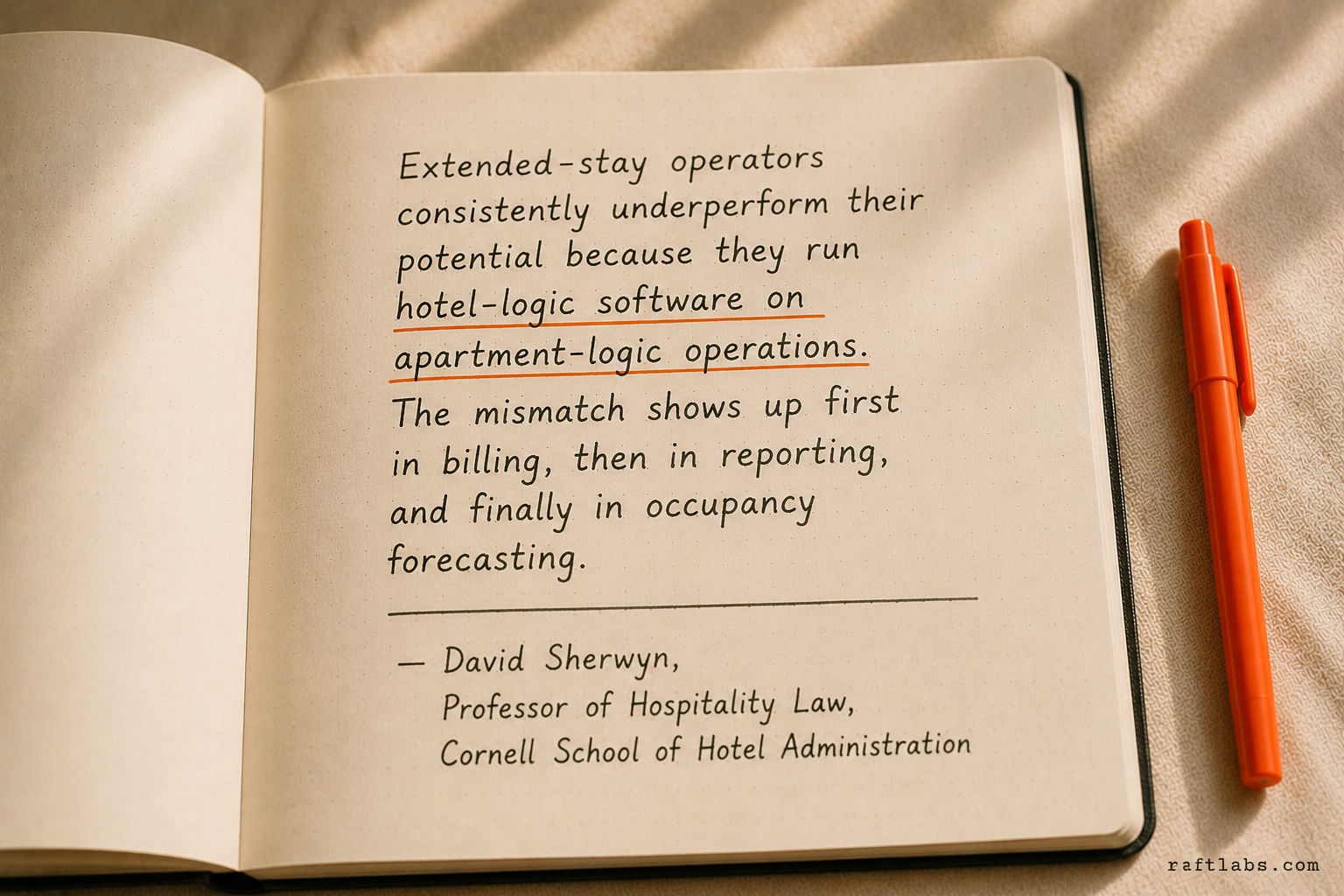
"Extended-stay operators consistently underperform their potential because they run hotel-logic software on apartment-logic operations. The mismatch shows up first in billing, then in reporting, and finally in occupancy forecasting."
David Sherwyn, Professor of Hospitality Law, Cornell School of Hotel Administration (Cornell Hospitality Quarterly, 2023)
Fix recurring billing without manual workarounds We build PMS configurations that automate recurring billing, split invoicing, and usage-based charges. Let’s discuss
5. Revenue Optimization Approach
Hotel revenue optimization is largely driven by dynamic pricing. Rates rise when demand increases and drop during slower periods, with revenue managers closely monitoring booking pace, competitor pricing, and market signals to prevent hotel revenue loss.
Serviced apartments approach revenue from a different angle. Instead of chasing short-term price spikes, the focus is often on occupancy stability and predictable income. Securing a reliable long-term tenant can be more valuable than maximizing a single night’s rate.
As a result, hotels tend to compete aggressively on nightly pricing and short booking windows, while serviced apartments compete on overall value, contract flexibility, and long-term occupancy consistency.
Technology impact:
Hotels require real-time revenue management systems tightly integrated with the channel manager.
Serviced apartments benefit from contract performance tracking and long-term occupancy analysis.
Revenue reports should compare long-term contract revenue with potential short-term bookings. This is key for serviced apartments, but also relevant for hotels with extended-stay units.
For both hospitality models, systems must calculate profitability beyond ADR, including operational cost per occupied unit.
Pricing tools must handle tiered rates for longer stays.
Once revenue logic is defined, the focus shifts toward retaining and expanding the value of each guest or account.
6. Guest Lifetime Value and Relationship Strategy
In hotels, guest lifetime value strategies are built around repeat visits. Marketing efforts focus on encouraging guests to return multiple times throughout the year, whether for business trips, weekend getaways, or seasonal travel.
In serviced apartments, the revenue pattern looks different. A single extended stay can generate significant income, and future bookings often depend less on individual travelers and more on corporate relationships. These may involve HR teams, relocation agencies, or procurement departments managing housing for employees.
As a result, the relationship model shifts from individual, transaction-based interactions to longer-term, account-based partnerships.
Technology impact:
Hotels need CRM systems that automate post-stay campaigns and upsell opportunities.
Serviced apartments need CRM tools that manage long-term account relationships and renewal cycles.
Data segmentation also differs. Hotels segment by stay behavior. Serviced apartments segment by contract type and corporate client.
Especially for serviced apartments, reporting should calculate revenue per account, not only per guest.
Understanding the core distinctions and lifetime value in each model helps you configure your systems around the right metrics.
Having outlined the operational nuances, it’s crucial to now evaluate whether your technology is in sync with your business structure.
Signs your technology doesn't match your operating model
Hospitality Technology's 2024 Lodging Technology Study found that 58% of extended-stay operators reported "billing and invoicing mismatches" as their top PMS pain point, compared to just 21% of traditional hotel operators.
Understanding the operational difference between serviced apartments vs hotels is one step. The next step is checking whether your current systems truly align with how you operate.
Many properties struggle not because their software is bad, but because it was designed for a different operating model.
Here are clear signs that your technology may not match your business structure.

1. You Rely on Spreadsheets to Fill System Gaps
If your team regularly exports data into spreadsheets to manage:
Long-stay billing
Corporate contracts
Recurring invoices
Stay extensions
It usually means your PMS or accounting setup was built for short-stay logic.
Manual workarounds often signal hotel PMS limitations when applied to extended stays.
2. Your Reports Do Not Reflect How You Earn Revenue
If your dashboards focus only on:
ADR
RevPAR
Daily occupancy
But your revenue mainly comes from multi-week or multi-month stays, your reporting structure may be misaligned.
Serviced apartments need visibility into contract value, occupancy stability, and revenue allocation over time. On the other hand, hotels need daily yield precision. If your reports highlight the wrong metrics, decision-making suffers.
3. Billing Adjustments Happen Frequently
If your team makes frequent manual corrections for:
Monthly invoicing
Split payments
Corporate reimbursements
Revenue recognition
It suggests that your billing workflows are not designed for your stay pattern.
A system built for nightly checkouts may struggle with recurring payment cycles.
4. Housekeeping and Maintenance Feel Disorganized
If recurring cleaning schedules, preventive maintenance reminders, or long-stay unit tracking are handled outside your PMS, your operational logic may not be fully supported.
Hotels need fast room status turnover. Serviced apartments need structured long-term service tracking. If your system prioritizes the wrong workflow, efficiency drops.
5. Your CRM Tracks Guests, But Not Accounts
If your CRM captures individual guests well but does not provide clear visibility into corporate accounts, relocation partners, or agency-based bookings, it may be optimized for traditional hotel repeat stays rather than account-based revenue.
For serviced apartments, relationship management often centers around companies, not just individuals.
6. Revenue Strategy Feels Reactive
If pricing decisions feel disconnected from your actual occupancy model, your revenue tools may not match your stay structure.
Hotels require agile, real-time pricing adjustments to avoid revenue loss. Serviced apartments require stability-focused forecasting and contract tracking. When systems are misaligned, revenue optimization becomes inconsistent.
When technology matches your operating model, processes feel smooth. Reporting reflects reality, billing runs predictably, and teams spend less time fixing errors and more time improving performance.
The objective is not to choose software labeled “hotel” or “serviced apartment”. The goal is to choose systems configured around how you actually generate revenue, manage occupancy, and build long-term relationships.
That alignment is what protects profit margins and supports sustainable growth.
Build systems that match your operating model We design PMS, billing, and booking systems configured for how your property actually operates. Talk to us
Serviced apartments vs hotels: should the tech stack be different?
After reviewing the operational differences, the real question becomes practical.
Should the technology stack for serviced apartments vs hotels be completely different?
The short answer is no. The core systems may look similar. The configuration, priorities, and integrations are what truly change.
Both models still require a property management system, payment processing, reporting tools, and guest communication workflows. At a foundational level, the architecture can overlap.
However, the way these systems are structured and used must reflect how the property generates revenue and manages occupancy.
The Real Difference Is in Configuration and Logic
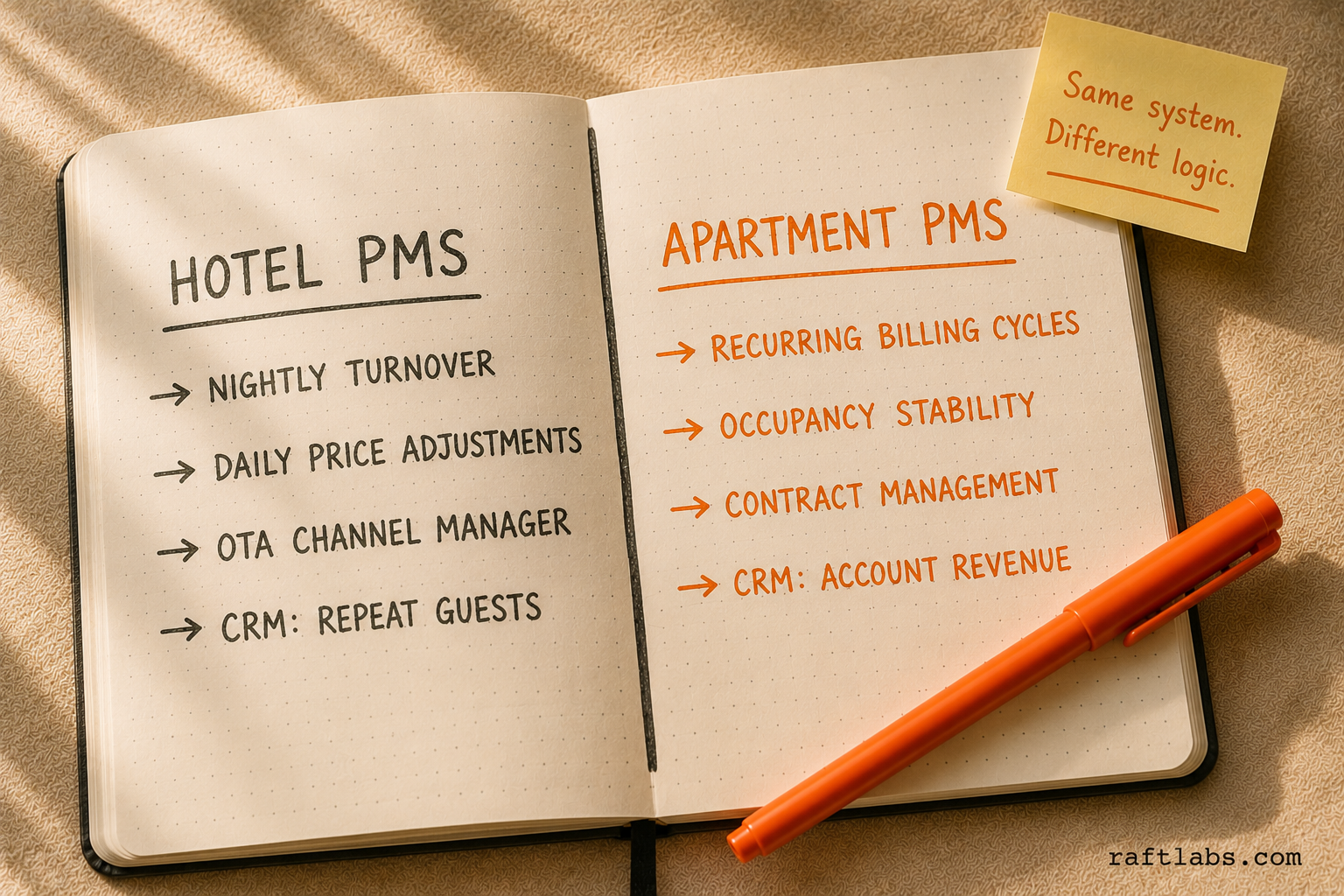
In a hotel-focused environment:
The PMS is optimized for nightly turnover
Revenue tools prioritize daily price adjustments
Channel managers are critical to avoid hotel revenue leaks
CRM focuses on repeat short stays
In a serviced apartment environment:
The PMS must support recurring billing and contract tracking
Revenue logic focuses on occupancy stability
CRM must handle account-based relationships
Reporting must allocate revenue across multiple months
If you deploy the same system without adapting it to your operating model, friction appears. Billing becomes manual, reporting becomes misleading, and staff create workarounds.
The issue is rarely the software category itself. It is the operational logic embedded inside it.
When Does the Tech Stack Truly Need to Differ?
A serviced apartment operator may require:
Extended-stay modules within the PMS
Flexible rate structures for weekly and monthly plans
Stronger accounting integrations
Corporate contract management features
A hotel may prioritize:
Advanced dynamic pricing engines
Deep OTA connectivity
Real-time room status automation
Conversion-focused hotel booking engine optimization
If your business model leans heavily toward one side, your stack must lean with it.
How to choose the right technology approach for your model
Once you understand the operational differences between serviced apartments vs hotels, the next step is practical. How do you decide what your technology stack should look like?
Instead of starting with vendors, start with your operating reality.
The table below helps you evaluate your property and identify which direction your technology approach should lean toward.
Operational Self-Assessment Framework
| Key Question | Short-Term, Transient-Focused Operations | Long-Term, Contract-Focused Operations | What Your Tech Must Prioritize |
|---|---|---|---|
| How long do guests typically stay? | 1-3 nights | Several weeks or months | Short stays require fast turnover workflows. Long stays require recurring billing and contract tracking. |
| How do guests usually book? | OTAs and direct website | Corporate agreements or negotiated contracts | OTA-heavy models need strong channel management. Contract-heavy models need approval workflows and account tracking. |
| What creates the most revenue risk? | Unsold nights | Vacant units for extended periods | Hotels need dynamic pricing tools. Serviced apartments need occupancy forecasting over longer windows. |
| How complex is your billing? | Single payment per stay | Monthly invoices, split payments, extensions | Long-stay models need flexible billing logic and revenue allocation tools. |
| What matters more in reporting? | ADR, RevPAR, daily occupancy | Average length of stay, contract value, monthly revenue | Your analytics layer must reflect the right performance indicators. |
| Where does relationship value come from? | Repeat individual guests | Corporate accounts and agencies | CRM setup must align with individual or account-based tracking. |
How to Use This Framework
If most of your answers fall in the “short stay” column, your stack should lean toward:
Real-time revenue management
Strong OTA integration
Hotel booking engine optimization
Rapid room status updates
If most answers fall in the “long stay” column, your stack should lean toward:
Recurring billing systems
Contract-based pricing logic
Account-level CRM tracking
Revenue allocation across months
If you operate a hybrid model, your technology must support segmentation. Short-stay and long-stay logic should not compete inside the same workflow.
The purpose is not to label your property as a hotel or a serviced apartment. The objective is to align your systems with how revenue is actually generated and managed.
When your technology reflects your operational model, decisions become clearer, reporting becomes accurate, and profitability becomes easier to control.
Conclusion
Serviced apartments vs hotels is not just a comparison of amenities. It is a comparison of revenue models, operational workflows, and guest lifecycle management.
Those differences directly impact your property management system configuration, billing logic, distribution strategy, and reporting architecture.
If you operate in hospitality today, your technology must reflect how you actually earn revenue and manage guests.
We work with hospitality operators to design and build systems that align with their real-world workflows.
Whether you run boutique hotels, serviced apartments, or hybrid models, the right architecture ensures your technology supports growth instead of slowing it down. Talk to our team to discuss how we can bring growth to your establishment.
Ask an AI
Get an instant summary of this post from your preferred AI assistant.
Common questions
- The main difference lies in the operating model. Hotels focus on short-term stays with daily turnover, while serviced apartments are built for longer stays of weekly or monthly occupancy. This impacts pricing, housekeeping frequency, billing cycles, and technology requirements.
- Serviced apartments offer more predictable revenue due to longer stays and lower daily operating costs. Hotels may generate higher short-term revenue through dynamic pricing, but face higher staffing and turnover costs. Profitability depends on location, demand mix, and how well technology supports the chosen model.
- Often, yes. Traditional hotel PMS platforms are optimized for nightly stays and frequent check-ins. Serviced apartments need systems that support recurring billing, long-term contracts, flexible extensions, and monthly reporting. If the PMS can't handle extended-stay workflows, operational gaps appear.
- Serviced apartments attract corporate relocations, project-based workers, remote professionals, families between homes, and insurance-related stays. These guests typically stay longer and book through corporate contracts rather than public OTAs.
- In most cases, yes. Hotels depend heavily on OTA distribution for short-term bookings. Serviced apartments rely more on direct contracts, corporate partnerships, or relocation agencies, which means their tech stack needs stronger contract management and account-based CRM features.