Keyless Entry for Serviced Apartments: Cost, ROI & Implementation Guide
Physical keys cost time, money, and guest trust. This guide covers how serviced apartment operators build reliable keyless entry systems, what smart locks and software cost, and how to recover your investment in 12-24 months.

In this article
Short answer
Keyless entry for serviced apartments is a three-layer system: smart lock hardware, access management software, and integrations with your PMS and booking tools. Guests enter using PIN codes, mobile app keys, QR codes, or a hybrid of methods. Most operators recover the investment within 12-24 months through reduced staff time, fewer locksmith calls, and higher guest satisfaction. RaftLabs has built keyless check-in systems for serviced apartment brands, including a Bluetooth-based self check-in app for an Irish operator, delivering the full build in 12-14 weeks at $20,000-$40,000. The biggest ROI driver is software, not hardware.
Key takeaways
- Keyless entry is a full access control system combining smart lock hardware, access management software, and PMS integrations, not just a door lock swap.
- Software is where most of the value comes from: automated access tied to bookings, digital wallets, and branded guest apps deliver more ROI than the hardware itself.
- Hybrid access (mobile key as primary, PIN as backup) is the most reliable setup for serviced apartments with varied guest tech comfort levels.
- A structured rollout maps every access point and defines user roles before touching hardware, a step most teams skip and later regret.
- Long-term ROI is driven by software that automates access at scale: the same platform handles more units and bookings without adding staff or cost.
Keyless entry for serviced apartments has shifted from a luxury feature to an operational necessity. Travelers now expect the same self-service convenience they get from modern hotels.
They want to arrive late, skip the front desk, and enter their apartment without waiting for staff or collecting physical keys.
Nearly 70% of U.S. travelers say they would rather use an app or self-service kiosk for hotel check-in than visit the front desk.
This is where keyless entry for serviced apartments shifts from being a nice feature to a core operational system.
This guide focuses on how to build that system for serviced apartment and hospitality operators. Not just what to buy, but how to think about guest flows, benefits, cost, ROI, and long-term operations.
Who should read this guide
This guide is written for people who are directly involved in running, growing, or modernizing serviced apartment businesses.
Owners and founders of serviced apartment brands:
If you are evaluating keyless entry, self check-in, or guest apps to reduce manual work and improve guest experience.
General managers and operations leads:
If you manage day-to-day operations and want smoother check-ins, better access control, and fewer coordination issues for staff.
Property and portfolio managers:
If you oversee multiple apartments or locations and need a scalable, consistent way to manage guest and staff access.
Hospitality and proptech decision makers:
If you are responsible for choosing IoT smart locks, PMS (Property Management System) integrations, or custom software for serviced apartments.
Teams planning digital upgrades:
If you are exploring keyless entry, mobile apps, or automation as part of a broader digital transformation.
This guide is especially useful if you want practical clarity, not vendor hype, before making technology decisions.
What you’ll find in this guide
This guide walks you through keyless entry for serviced apartments from both a technical and business point of view.
You’ll discover:
What keyless entry really means for serviced apartments: how hardware, software, and integrations work together as a full access control system, not just a smart lock on the door.
Core business problems keyless entry solves: how it reduces staff dependency, improves security, supports self check-in, and helps you operate across more units and buildings.
The main types of keyless entry systems: where PIN codes, mobile app keys, QR code access, and hybrid setups fit in serviced apartment operations.
How to think about smart lock hardware and software: what to check before choosing locks, and where the software comes from after you buy the hardware.
Why custom software and guest apps matter: how custom flows, digital wallets, and mobile apps make self check-in smooth for guests.
The benefits, costs, and ROI of keyless entry: how keyless systems affect guest experience, operations, software investment, and when you can expect payback.
A step-by-step implementation roadmap: a clear sequence from planning access points and roles to piloting, training staff, and rolling out across your portfolio.
How to choose the right software partner: what to look for and a real example of how we helped a serviced apartment brand deliver Bluetooth-based self-check-in.
With that context in mind, the first step is to understand what keyless entry really represents for serviced apartments beyond just replacing physical keys.
What keyless entry means for serviced apartments
Many teams still think keyless entry means replacing a metal key with a keypad or a phone app. In reality, keyless entry for serviced apartments is a broader system that controls who can enter which space, at what time, and under what conditions.
A true digital key system for apartments includes three core layers:
1. Hardware layer
Smart locks installed on apartment doors, shared area entrances, and service rooms. These locks must work reliably and continue functioning even during internet or connectivity issues.
2. Software layer
The system that creates, manages, and tracks access rules. It controls when guest access starts and ends, and defines entry permissions for staff, like housekeeping or maintenance.
3. Integration layer
The link that connects the access system with booking tools, the PMS, and guest apps. Without this layer, access creation and cancellation stays manual and error-prone.
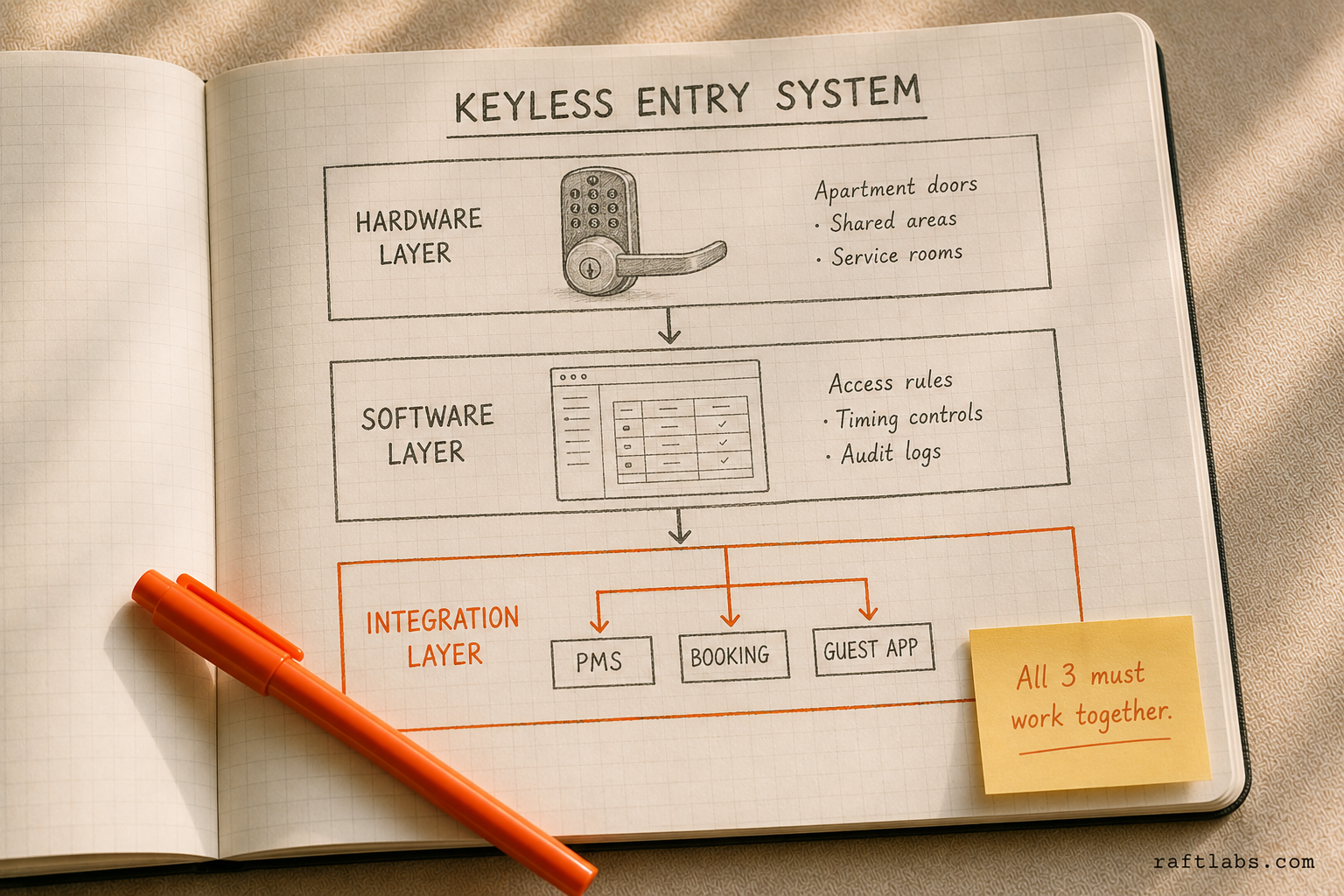
These layers matter because access requirements in serviced apartments are very different from other accommodation types.
Serviced apartments differ from hotels because stays are often longer, check-in times vary widely, and staffing is leaner. They also differ from residential buildings because access must change frequently and align with reservations.
So when we talk about keyless entry for serviced apartments, we are talking about an access control system that serviced apartments can rely on for daily operations, not just door locks.
Check our serviced apartment software development services to build or integrate keyless entry systems as per the business needs.
Core business problems keyless entry solves for serviced apartments
Keyless entry solves real, day-to-day problems that serviced apartment operators face as they scale.
1. Staff dependency and manual work
Physical keys require staff for handovers, returns, and coordination. This creates higher staffing costs and operational stress, especially when check-ins happen outside office hours.
For instance, a guest can arrive at 11 pm and call the manager because no one is on-site to hand over the keys.
2. Security risks from physical keys
Lost or copied keys are hard to track. Once a key is missing, access control is compromised, and there is no clear record of who entered a unit.
So whenever a guest loses a key, often the lock must be replaced to avoid unauthorized entry.
3. No clear access audit tied to bookings
Traditional keys offer no audit trail. Operators cannot see when a unit was accessed or by whom, which makes issue resolution difficult. With physical keys, access is not linked to reservations or roles.
Even if CCTV exists, it does not tell you which guest or staff member was authorized at that time. For example, a cleaner enters a unit earlier than scheduled, but there is no system record showing whether that access was approved or accidental.
4. Limited support for true self check-in
Without digital access, self check-in cannot work reliably. Manual steps like sharing digital keys or codes break automation and create dependency on staff.
For example, a guest is promised self check-in but still needs to message support to get the entry codes, which affects their overall stay experience.
To address these operational and guest experience issues, serviced apartment operators need hospitality software solutions that go beyond basic smart locks they need systems that integrate with reservations, automate access lifecycle, and provide audit trails.
Benefits of keyless entry for serviced apartments
Once keyless entry is in place, serviced apartment operations become more predictable, scalable, and guest-friendly.
Here are the main benefits keyless entry brings to serviced apartment operations:
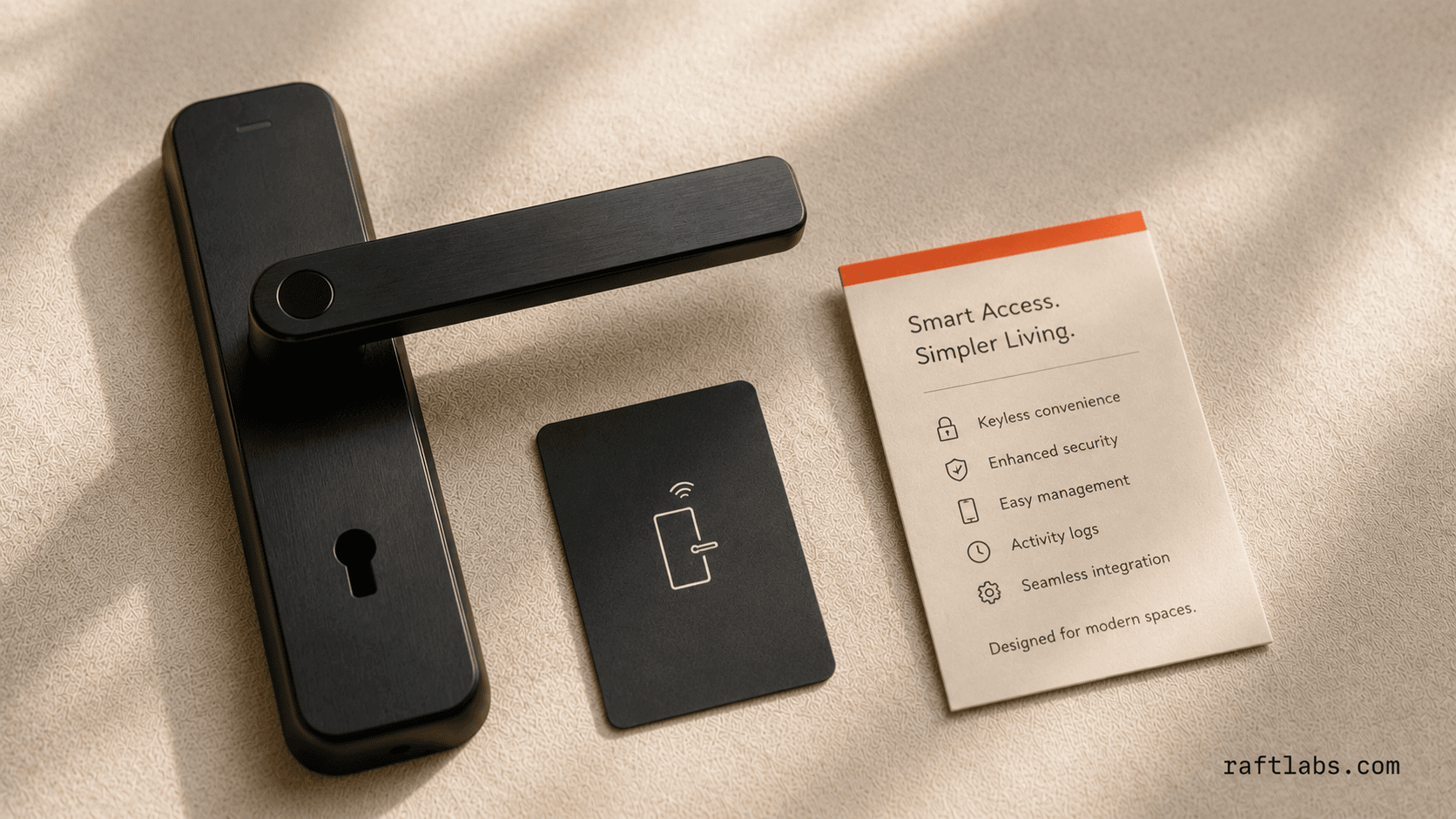
1. Faster and more predictable guest onboarding
A 24/7 keyless entry removes uncertainty from arrivals. Guests know exactly how and when they can access the apartment, which reduces anxiety and confusion.
For example, a guest arriving from another time zone can enter the apartment directly without coordinating arrival times or waiting for instructions.
2. Consistent experience across all properties
Keyless systems standardize how access works, regardless of location or unit type. Additionally, the key loss troubles are also eliminated for the guests.
For instance, a guest staying at different properties under the same brand experiences the identical keyless check-in flow every time, which builds trust and familiarity.
3. Better control over access rules without manual effort
Access can be scheduled, adjusted, or revoked automatically based on bookings or operational needs.
Consider a guest who requests to extend their stay by a few days. Access can be extended remotely without anyone visiting the property or exchanging keys. Thus also reducing staff time and overhead costs.
4. Improved coordination between teams
Housekeeping, maintenance, and operations teams can work with clearly defined access windows and permissions.
If a cleaner is scheduled to service a unit between 11 am and 1 pm, access works only during that window, reducing the need for coordination.
5. Stronger brand positioning and guest perception
Contactless entry signals modern operations and professionalism, which influences booking decisions.
For example, business travelers choosing between serviced apartments may prefer properties that offer app-based or contactless access.
6. Foundation for future digital experiences
Keyless entry becomes part of a larger digital setup, enabling features like guest apps, automation, and smarter operations.
For example, the access data can later support features such as personalized check-in messages or automated maintenance alerts.
As serviced apartments move toward more digital operations, building these systems correctly becomes important.
But keyless entry only works best when it is designed to integrate with booking flows, PMS systems, guest apps, and day-to-day operations.
Many operators pair keyless access with a web-based guest portal where guests can manage their stay details, extend bookings, request services, and access property information, all without installing an app.
Types of keyless entry systems used in serviced apartments
Serviced apartments use different types of keyless entry systems based on guest behavior, stay duration, and operational needs. Most properties use one main method with a backup option.
1. PIN-based keyless entry
Guests are given a numeric code to enter on the smart-lock keypad, installed on the apartment door. The code works only for the duration of their stay.
This method is simple and works well for guests who prefer not to use mobile apps. However, PINs can be shared easily, which may reduce security if not managed properly.
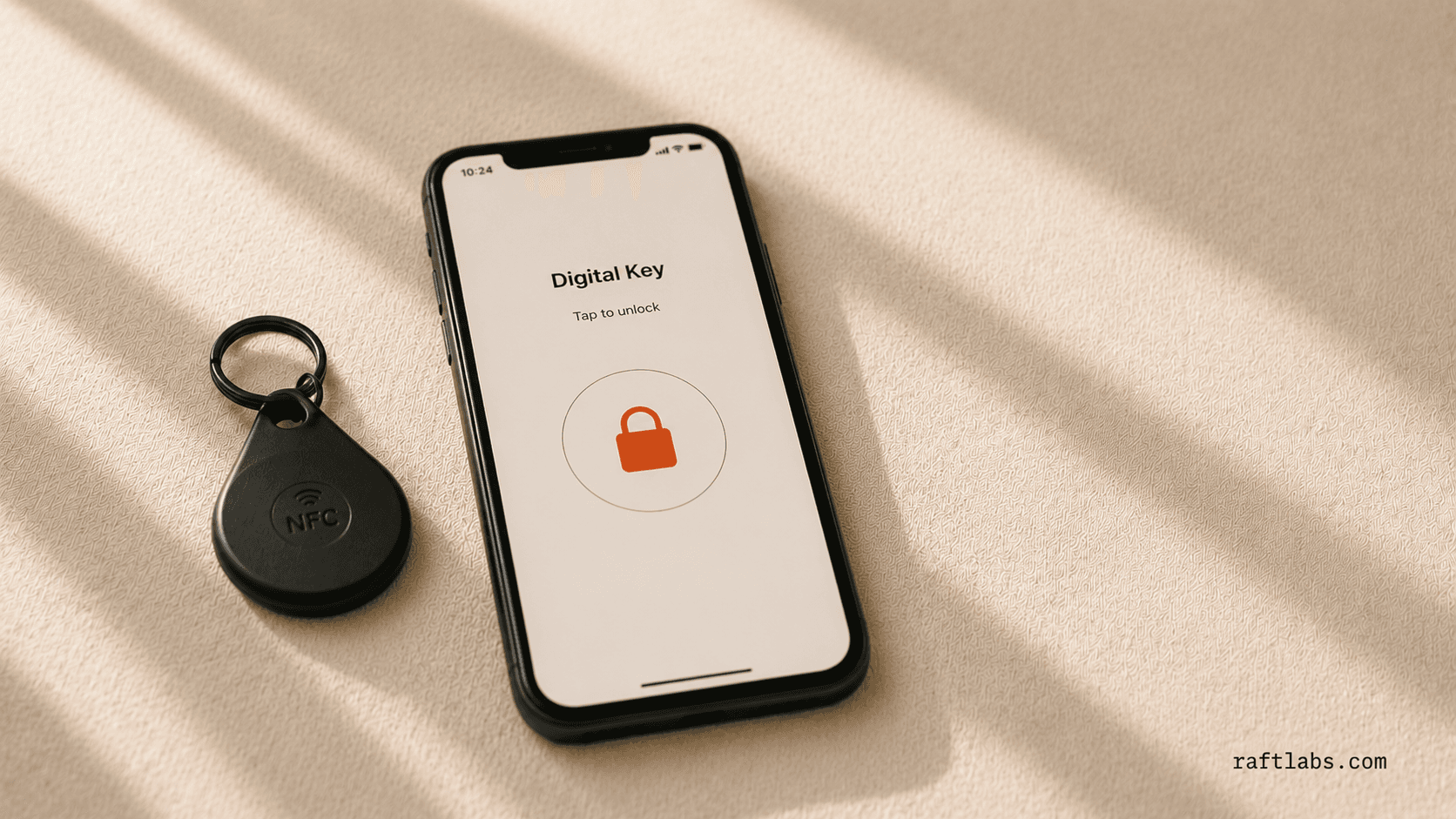
2. Mobile app-based keyless entry
Guests unlock doors using a mobile key app installed on their phone. The app connects to the door locks using Bluetooth or NFC digital keys, with backend API infrastructure managing access credentials, encryption, and real-time synchronization between the PMS and lock systems.
NFC digital keys work like contactless payments, where the phone communicates with the lock when it is brought close.
But in most setups, the guest opens the app and taps an unlock button to open the door. In NFC-based setups, the door unlocks automatically when the phone is held near the lock, without tapping anything.
For such setups, access is issued digitally for the stay period and can be turned on or off instantly without changing the lock.
This option offers strong control and security. It also supports a smoother self check-in experience.
3. QR code-based door access
Guests or vendors scan a QR code to unlock the door. The code can be set to expire automatically after a certain time.
This works well for short stays, visitors, or service staff. It is less common as a primary entry method for apartments because it often depends on camera access and stable connectivity.
4. Hybrid keyless entry systems
Hybrid systems combine two or more access methods, such as a digital mobile key with a backup PIN.
This approach reduces risk and improves reliability. If one method fails, the other ensures the guest can still access the apartment without calling support.
After understanding the different keyless entry methods, it is important to examine the hardware that enables these systems to operate in real-world serviced apartments.
Smart lock hardware considerations for serviced apartments
Choosing the right smart lock hardware is critical. Many smart locks are designed for homes, not for the daily demands of serviced apartments.
When evaluating smart locks for serviced apartments, consider the following:
| Evaluation factor | What to check | Why it matters in serviced apartments |
|---|---|---|
| Reliability under frequent use | Locks should handle high daily open and close cycles | Guest and staff traffic is much higher than in homes |
| Battery life and power alerts | Long battery life with early low-battery notifications | Prevents sudden lock failures and guest lockouts |
| Offline access support | Lock should work without internet or cloud connection | Guests must be able to enter even during outages |
| Compatibility with existing doors | Fits current door type and meets fire safety rules | Avoids costly door modifications or compliance issues |
| Support for multiple access methods | Mobile keys, PIN codes, or both | Provides backup access when devices fail |
| Integration readiness | Ability to connect with PMS or booking systems | Enables automation now and flexibility later |
| Maintenance and support model | Clear firmware updates and replacement policies | Reduces long-term operational risk |
This approach helps ensure the smart lock hardware can scale with your serviced apartment operations instead of becoming a limitation.
Once the right smart lock hardware is in place, the next critical piece is the software that controls how access is created, managed, and automated.
As your keyless entry system matures, consider AI-powered integration to access analytics that can predict maintenance needs, identify unusual access patterns for security, and optimize staff scheduling based on property access patterns."
Where do I get the software for smart lock serviced apartments?
After buying smart lock hardware, the next step is deciding where the software comes from. The hardware alone cannot manage guests, bookings, or access rules. The software is what makes the system usable.
There are three common ways serviced apartment operators get this software.
1. Software from the smart lock manufacturer
Some smart lock companies provide their own software with the hardware. This is usually a cloud access management dashboard, offered either for free or as a paid monthly or yearly subscription.
It allows operators to issue access, revoke keys, and view basic access logs. This works for simple setups but often lacks deeper booking automation or guest experience features.
2. Software through a PMS or guest experience platform
Some PMS or guest experience platforms connect to smart lock hardware using official integrations provided by the lock manufacturer. The lock company exposes APIs, and the PMS uses those APIs to communicate with the locks
Once this connection is set up, the PMS can automatically create, update, and revoke access based on reservation details like check-in and check-out times.
This reduces manual work, but you are limited to the access rules, lock brands, and workflows that the PMS already supports.
3. Custom access management software
Operators can also build custom access management software with a technology partner. This software sits between the locks, PMS, booking systems, and guest-facing interfaces.
This option gives full control over access rules, guest flows, staff permissions, and integrations. It works best for serviced apartment operators managing multiple properties or planning to scale.
Why custom software matters for digital key system apartments
Guests rarely think about locks. They think about how easy it is to enter the apartment.
Custom software makes it possible to design guest access around real behavior. Instead of forcing guests to download unfamiliar apps, access can be delivered through simple links, branded web pages, or digital wallets.
For example, a guest can receive a secure link by SMS before arrival, tap once, and unlock the door from their phone browser. For longer stays, access can be added to Apple Wallet or Google Wallet for an even smoother experience.
Serviced apartment companies can also build a custom mobile app that supports guest self-service check-in and check-out, or add keyless entry features to their existing guest app. This keeps the experience familiar and branded for guests.
Over time, custom software also allows access to connect with welcome messages, Wi-Fi details, support requests, and maintenance alerts. For operators managing multiple properties, a SaaS platform approach can centralize access management, reporting, and integrations across your entire portfolio.
This turns keyless entry from a standalone feature into part of a complete guest journey. When guest access is designed this way, the benefits extend well beyond convenience and begin to shape how serviced apartments operate and scale.
Step-by-step process to implement a keyless entry system
Implementing keyless entry works best when done in clear stages. Rushing into hardware purchases without planning often leads to gaps later.
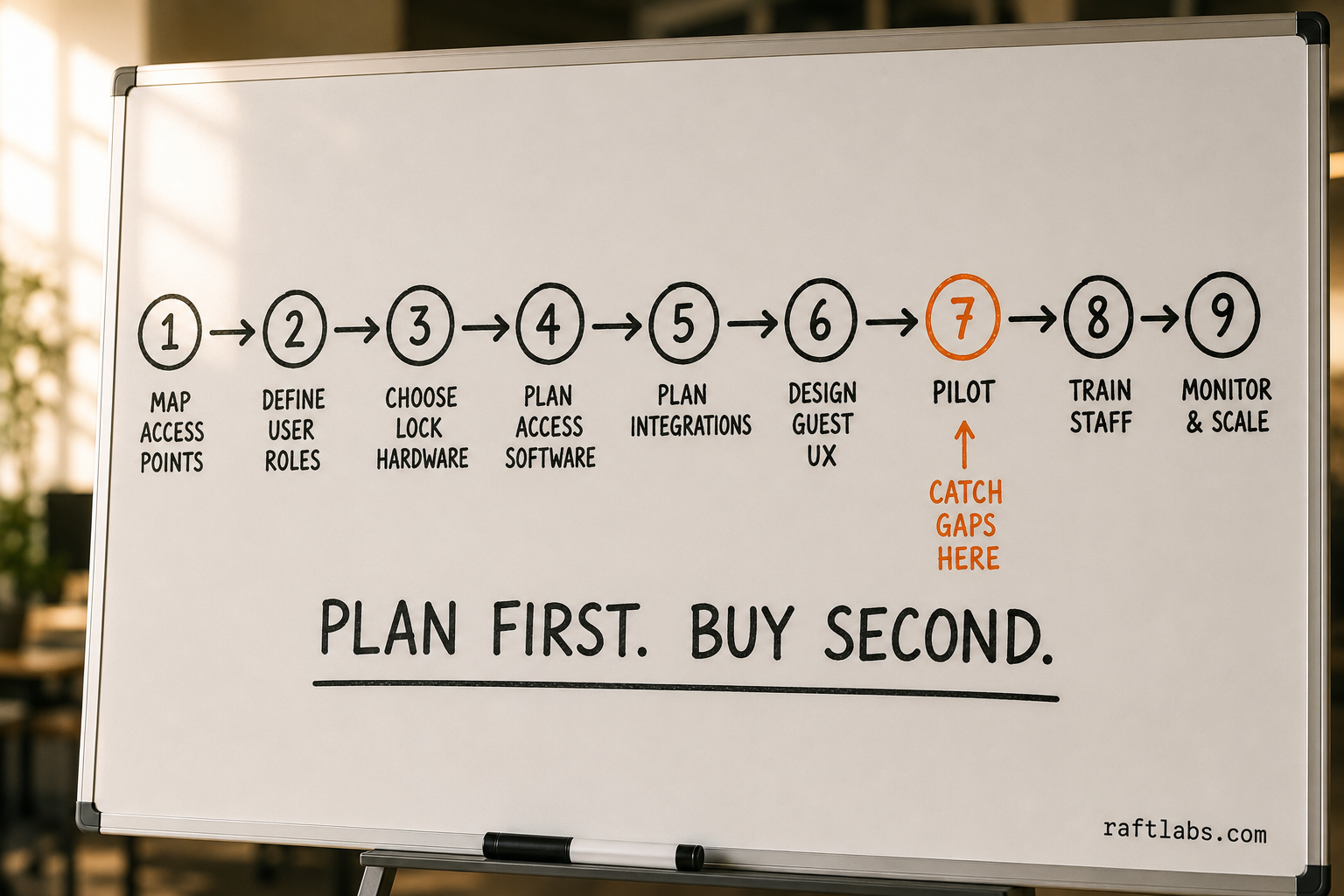
1. Review your property layout and access points
Start by mapping every door where access needs to be controlled. This includes apartment doors, main entrances, elevators, parking gates, storage rooms, and staff-only areas.
This step matters because keyless entry systems work on access points, not just rooms. If a door is missed during planning, it often ends up being managed manually later, which breaks automation and creates confusion for guests and staff.
2. Define who needs access and when
List every type of user who enters the property, such as guests, cleaners, maintenance staff, managers, and external vendors.
For each group, define when access should start, when it should end, and which doors they can open.
Clear access rules are the foundation of a reliable system. Without them, keyless entry becomes just another manual process.
3. Choose the right smart lock hardware
Choose locks that match your doors and support the access rules you defined. Some locks are better suited for guest rooms, while others are designed for main entrances or high-traffic areas.
This step is vital because not all smart locks support time-based access, offline operation, or frequent access changes. Choosing the wrong hardware can limit what your system can do later.
4. Choose and plan the access management software
After selecting the locks, decide which software will control access. Most lock manufacturers provide basic software, either free or as a paid SaaS, to create codes, issue mobile keys, and view access logs.
This works for simple setups but often requires manual work. Serviced apartment operators also have the option to use PMS-linked software or build custom access management software with a technology partner.
A custom setup gives more control over bookings, staff access, guest apps, and automation, and is better suited for growing operations.
5. Plan system integrations early
Decide how reservations will trigger access creation and removal. This usually involves integrating the keyless entry system with your booking platform development and PMS.
When this integration is planned properly, guest access is issued automatically at check-in and revoked at checkout. Without it, staff must manage access manually, which defeats the purpose of keyless entry.
6. Design the guest access experience
Decide whether guests will use a mobile app, a PIN code, or both. Define when instructions are sent and how simple they are to follow.
Remember that guests might experience keyless entry for the first time upon arrival. When instructions are not easy to follow, guests might lose confidence and contact support repeatedly.
7. Pilot the system before full rollout
Roll out the system in a few units before expanding it across the property. Test real scenarios such as late early arrivals, phone battery issues, and offline locks.
Piloting helps catch gaps that are easy to miss on paper but common in real life. Treating this pilot as an MVP for your access system reduces risk before full-scale deployment.
8. Train staff and prepare support processes
Train your operations team on how access works and what to do when something fails. Create clear steps for handling locked-out guests or hardware issues.
Keyless entry systems reduce daily work, but exceptions still happen. Staff should know how to respond quickly without escalating every issue.
9. Roll out gradually and monitor performance
Expand the system across all units once stable. Track access failures, support tickets, and guest feedback.
Continuous monitoring helps improve reliability over time.
Planning keyless check-in for your serviced apartments? From smart lock integrations to guest apps, we build software that makes self check-in simple and reliable. Talk to our team
Top smart-lock hardware options for contactless hospitality
Here are some of the most commonly used smart lock hardware options in the US market:
1. August Wi-Fi Smart Lock
A flexible smart lock that attaches to many existing deadbolts and supports app-based access, guest codes, and integrations with major smart home systems. Price is typically around $229 - $279 in the US retail market.
2. Google Nest x Yale Lock
A popular choice with strong customer feedback for reliability and ease of installation. It offers keypad access and smartphone control.
In the US market, it sells for roughly $250 - $280.
3. Yale Assure Lock SL with Wi-Fi/Bluetooth
From a long-established brand, this touchscreen deadbolt supports app control, PIN codes, and mobile keys.
Retail pricing for models with Wi-Fi and Bluetooth is in the range of $200 - $330.
4. SmartRent smart locks
These locks are specifically built for property management and apartment communities, with support for resident apps, PIN codes, and digital key sharing.
Exact pricing varies by installer and contract, but these systems are typically more expensive than consumer home locks, reflecting their commercial focus.
Cost of software for self check-in serviced apartments
The cost of serviced apartment software development depends on what you are building, how complex it is, and how tightly it needs to integrate with your operations.
Some operators only need a simple guest-facing app, while others need a full platform connected to PMS, smart locks, and booking channels.
Below is a high-level view of typical cost ranges:
| Project type | What it includes | Typical timeline | Estimated cost (USD) |
|---|---|---|---|
| Minimum Viable Product (MVP) | Basic guest-facing web or mobile app, limited features like property listings or a simple booking flow, clean and usable design | 6-8 weeks | 10,000 - 20,000 |
| Full-featured serviced apartment app | iOS, Android, and web apps, custom UI/UX, guest and staff features, integrations with PMS, booking systems, or smart locks | 12-14 weeks | 20,000 - 40,000 |
| Advanced hospitality tech product | Complex platforms with AI, IoT, or smart home integrations, custom workflows, advanced guest experiences, deep system integrations | Varies by scope | Custom pricing |
The biggest cost drivers are usually integrations and workflows. But another factor is long-term vision. Teams that plan for scalability and future features often invest more upfront to avoid rework later.
What matters most is building a system that works for operations today and continues to support guest experience as the business grows.
ROI of hardware and software investment in keyless entry for serviced apartments
When evaluating keyless entry, it is important to look beyond upfront costs and focus on long-term return. For serviced apartments, most of the value comes from software, not just from installing smart locks.
1. Hardware ROI is about reliability and coverage
Smart lock hardware is usually a one-time investment. Its main return comes from reliable access and fewer physical key issues.
For example, fewer lost keys mean fewer lock replacements and fewer emergency visits. Hardware ROI is mostly fixed and predictable once installed.
2. Software ROI compounds over time
Software delivers ongoing value by automating access and reducing manual work. Keyless check-in software can issue access automatically, revoke it at checkout, and handle changes without staff involvement.
So as the number of apartments increases, the same software continues to manage more bookings without increasing operational cost. This is where long-term ROI becomes visible.
3. ROI from self check-in apps and guest-facing software
Guest-facing apps and web-based self check-in flows directly affect efficiency and guest satisfaction. When guests can check in on their own, arrivals become smoother and more predictable.
For example, a guest can complete check-in, verify details, and unlock the apartment from their phone. This reduces front desk load and improves reviews, which supports repeat bookings.
Why software delivers higher ROI than hardware
Hardware enables keyless entry, but software determines how well it works. Operators who invest in flexible, well-integrated software usually see better returns than those who focus only on locks.

Over time, the highest ROI comes from systems that reduce guest friction, simplify staff operations, and scale smoothly as the serviced apartment business grows.
For most serviced apartment setups, software-led keyless entry systems typically recover their cost within 12 to 24 months through reduced staff time, fewer support calls, and smoother self check-in.
Choosing a Development Partner for Serviced Apartment Keyless Entry
Choosing the right software development partner plays a major role in how reliable and scalable your keyless entry system will be over time. Here are the top factors to check:
| Factor to evaluate | What to look for | Why it matters for serviced apartments |
|---|---|---|
| Hospitality domain experience | Prior work with hotels or serviced apartments | Ensures the software fits real check-in, housekeeping, and booking workflows |
| Smart lock integration expertise | Experience with major lock brands and APIs | Reduces risk of access failures and guest lockouts |
| PMS and booking system integration | Proven PMS and OTA integration work | Enables automatic access creation and removal |
| Guest experience design | Simple self check-in flows and clear instructions | Prevents support calls and poor arrival experiences |
| Mobile app capabilities | Ability to build or extend a guest app | Allows branded, familiar access instead of third-party apps |
| Scalability | Support for multiple properties and roles | Protects the system as your portfolio grows |
| Ownership and flexibility | Clear data and software ownership terms | Avoids vendor lock-in and future migration issues |
| Ongoing support | Long-term maintenance and improvements | Keeps the system reliable as needs change |
A strong software partner helps keyless entry work smoothly beyond the lock itself.
The right choice reduces operational effort, improves guest experience, and supports growth over time without constant rework.
Why Consider Us for Serviced Apartment Software Development
Building keyless entry for serviced apartments is not just a hardware or software task. It requires a clear understanding of hospitality operations, guest behavior, and system integrations. This is where working with the right technology partner makes a real difference.
We maintain a special focus on building practical, scalable software for serviced apartments and hospitality businesses.
1. Experience Building Hospitality Software
We work with hospitality and serviced apartment teams to build web and mobile software that supports bookings, guest journeys, and day-to-day operations. Our focus is on creating systems that fit real workflows and scale as the business grows.
2. Strong Understanding of Keyless Entry Systems
We don’t treat keyless entry as a standalone feature. We design it as part of a larger system that connects smart locks, PMS, booking platforms, and guest experiences. This helps avoid manual work and operational gaps.
3. Fully Custom Solutions, Not Templates
Every serviced apartment operates differently. We build custom web and mobile solutions that match your workflows, whether you need keyless check-in added to an existing app or a new guest app built from scratch.
4. Guest-focused Design and Self Check-In Flows
Our approach starts from the guest’s point of view. We design simple self check-in and access flows that reduce confusion, support late arrivals, and improve overall stay experience.
5. End-to-end Delivery with a Dedicated Team
You work with a focused, cross-functional team that includes developers, designers, QA, and AI engineers when needed. From planning and design to development and integrations, everything is handled in one place.
6. Transparent and Collaborative Communication
We work in short agile sprints with clear updates and open communication. You always know what is being built, what is coming next, and how your feedback is shaping the product.
7. Built to Scale with Your Business
Whether you manage one property or plan to grow across cities, we build systems that scale. New properties, new lock brands, and new features can be added without reworking the foundation.
If you are looking to build or improve keyless entry for serviced apartments with a long-term view, we help turn complex requirements into systems that actually work in day-to-day operations.
How We Delivered a Real-World Keyless Self Check-In Experience
We recently worked with a serviced apartment brand to rebuild their digital experience around self check-in and keyless access. The goal was to remove manual key handovers and give guests a smooth, fully digital check-in journey across multiple city locations.
We rebuilt the mobile app to support end-to-end digital check-in, including Bluetooth-based keyless entry using smart locks.
Alongside the app, we modernized the booking experience and tightly integrated it with the client’s existing RMS Cloud setup. This kept core operations connected while allowing the brand to deliver a more consistent and branded guest experience across booking and communication.
Here are the project results:
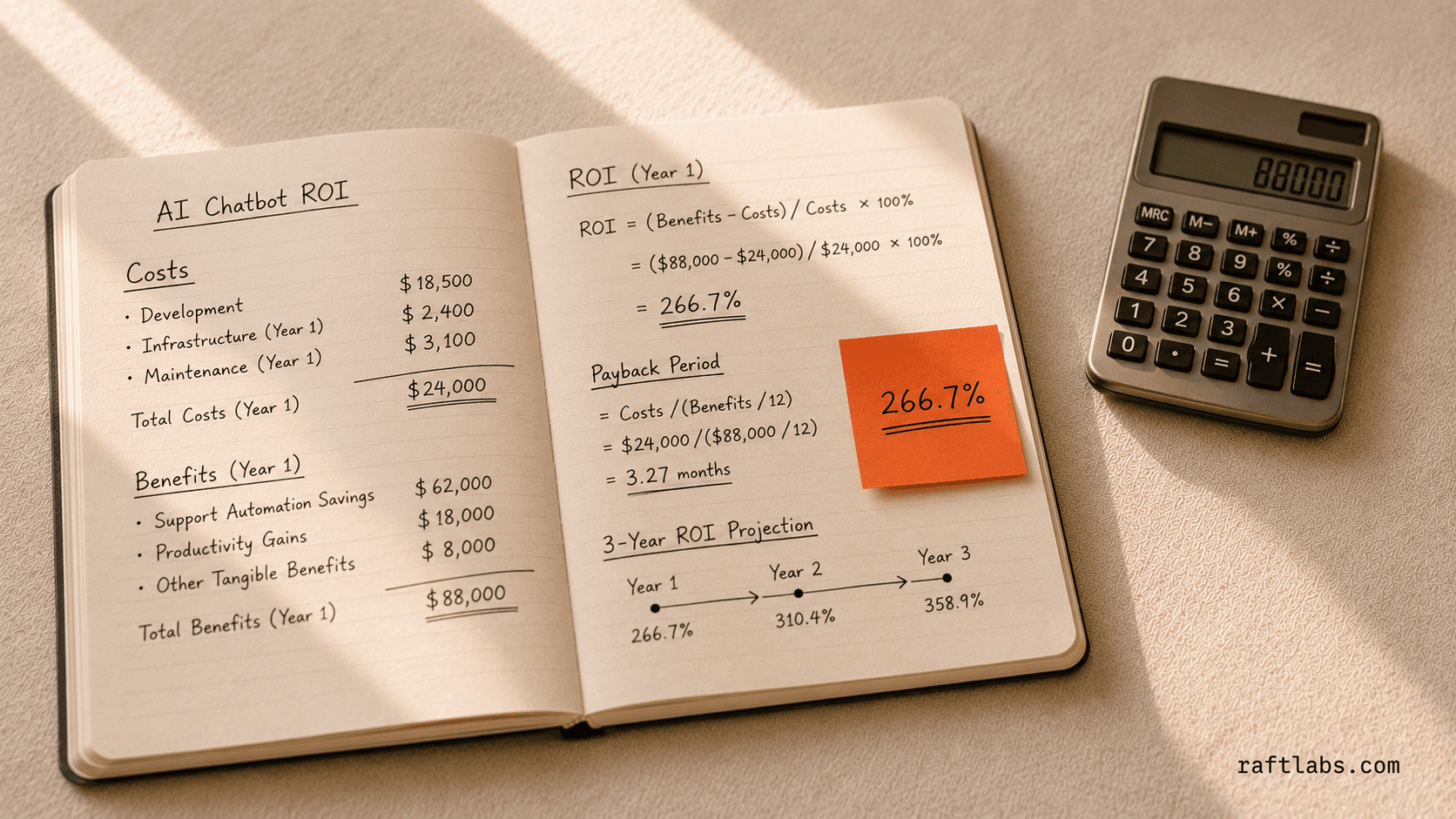
You can read more about the Irish serviced apartment project of keyless entry for citybreakapartments.
Conclusion: Making Keyless Entry Work for Your Serviced Apartments
Successful keyless entry is not just about choosing the right lock or app. It depends on how well hardware, software, integrations, and daily workflows work together in real operations.
Building this correctly requires both technical expertise and a clear understanding of how serviced apartments actually run.
Teams that understand bookings, PMS workflows, mobile experiences, and real-world operations are best positioned to deliver systems that actually work.
If you’re planning to specifically implement or improve keyless entry for your serviced apartments, we can help you build the right system.
From smart lock integrations to guest apps and backend platforms, talk to our team and discover how your ideas can be brought to life.
Ask an AI
Get an instant summary of this post from your preferred AI assistant.
Common questions
- Keyless entry for serviced apartments is a digital access control system that replaces physical keys with smart locks, access management software, and PMS integrations. Guests unlock doors using mobile apps, PIN codes, QR codes, or digital wallet keys. Access is automatically activated at check-in and revoked at checkout, eliminating manual key handovers.
- Key benefits include 24/7 self check-in without staff, reduced costs from lost keys, better security with automated access logs, improved guest experience with contactless entry, simplified housekeeping coordination through time-based access, and easy scalability across multiple properties. It also positions your brand as modern and tech-forward.
- Mobile app-based entry offers stronger security and better control since access can be instantly revoked and cannot be easily shared. PIN codes work well as backup for guests who prefer not to use apps. Most operators choose a hybrid system with mobile keys as primary and PIN codes as backup to ensure reliable access.
- Most operators might see ROI within 12-24 months through reduced staff time, fewer locksmith calls, lower lock replacement costs, and improved guest satisfaction. Software can deliver the highest ongoing ROI by automating access management without increasing operational costs as you scale to more properties and bookings.
- Smart lock manufacturers provide basic software for simple setups. However, custom or PMS-integrated solutions offer automatic access tied to bookings, branded guest experiences, multi-property management, and scalability. Custom software is recommended for operators managing multiple properties or planning to grow their portfolio.