Custom Software vs SaaS: The Real Impact on Boutique Hotel Profits
Discover how growing boutique hotels can escape shrinking profit margins by rethinking an expanding SaaS stack, custom software, and long-term technology ROI.

In this article
Short answer
Boutique hotel profit margins typically run 5-15%. Custom software improves that by consolidating SaaS tools, automating manual workflows, and giving multi-property operators a unified dashboard for costs and revenue. SaaS fits hotels at the start. Custom software makes more sense when managing 3+ properties, when software costs exceed $2,000/month, or when staff spend significant time on manual data reconciliation. RaftLabs builds hospitality software starting at $25K for focused modules, with full multi-property platforms at $80K-$150K, typically recovering cost within 2-3 years versus ongoing SaaS subscriptions that compound per room added.
Key takeaways
- Revenue and occupancy can grow while profit margins fall. Labor and SaaS subscription costs often rise faster than revenue, and the gap widens at 3+ properties.
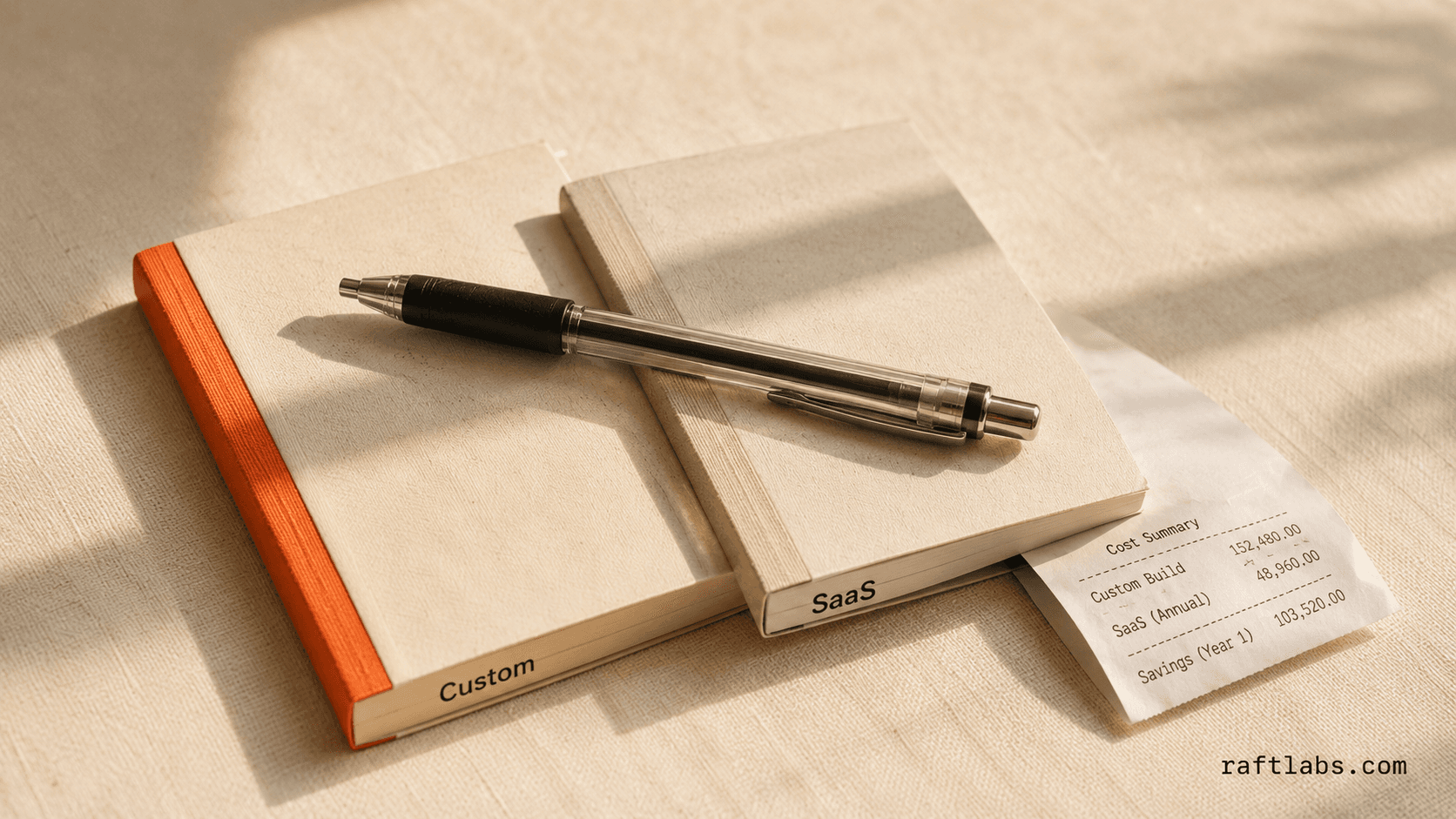
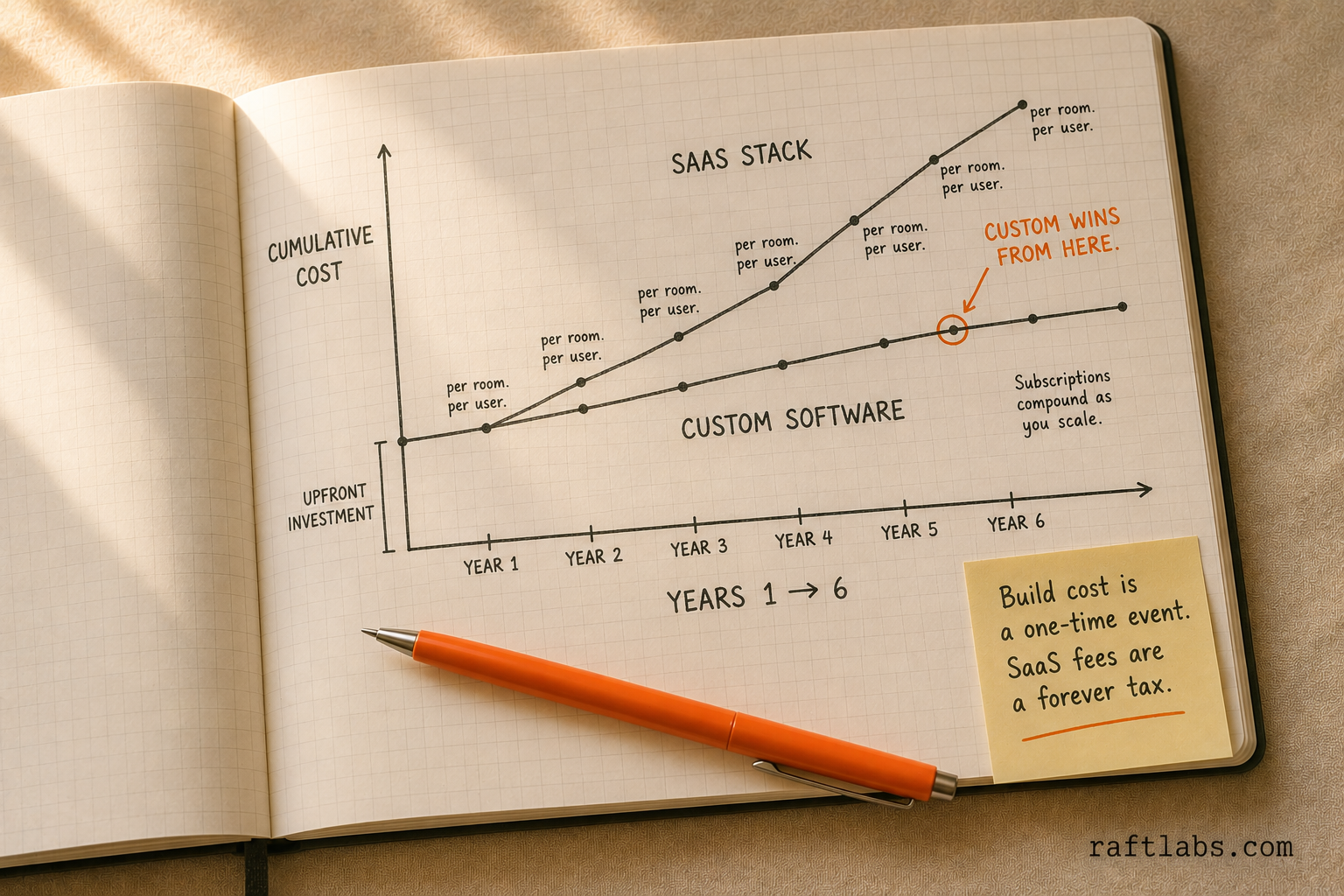
- SaaS tools charge per room or per user, so subscription costs compound as you scale. A hotel at 30 users on Microsoft Dynamics 365 pays $25,200/year in licensing alone, before implementation.
- Custom software acts as the connective layer between your PMS, channel manager, and accounting tools, replacing fragmented exports with automated data flows.
- Unified dashboards showing GOPPAR, labor percentage, and margin by property let owners catch cost pressure within the week rather than at month-end.
- The crossover point where custom software becomes cheaper than SaaS is typically 4-6 years, after which custom wins on total cost and grows without adding per-room fees.
If you run a boutique hotel in the 30-150 room range, you probably feel this already. Revenue is up, occupancy looks fine, but profit margin is not keeping pace. That gap between revenue performance and margin performance is where software choices start to matter.
Industry data shows something similar at a macro level. In the US, total hotel revenue per available room grew faster than gross operating profit because labor and other operating costs rose much faster.
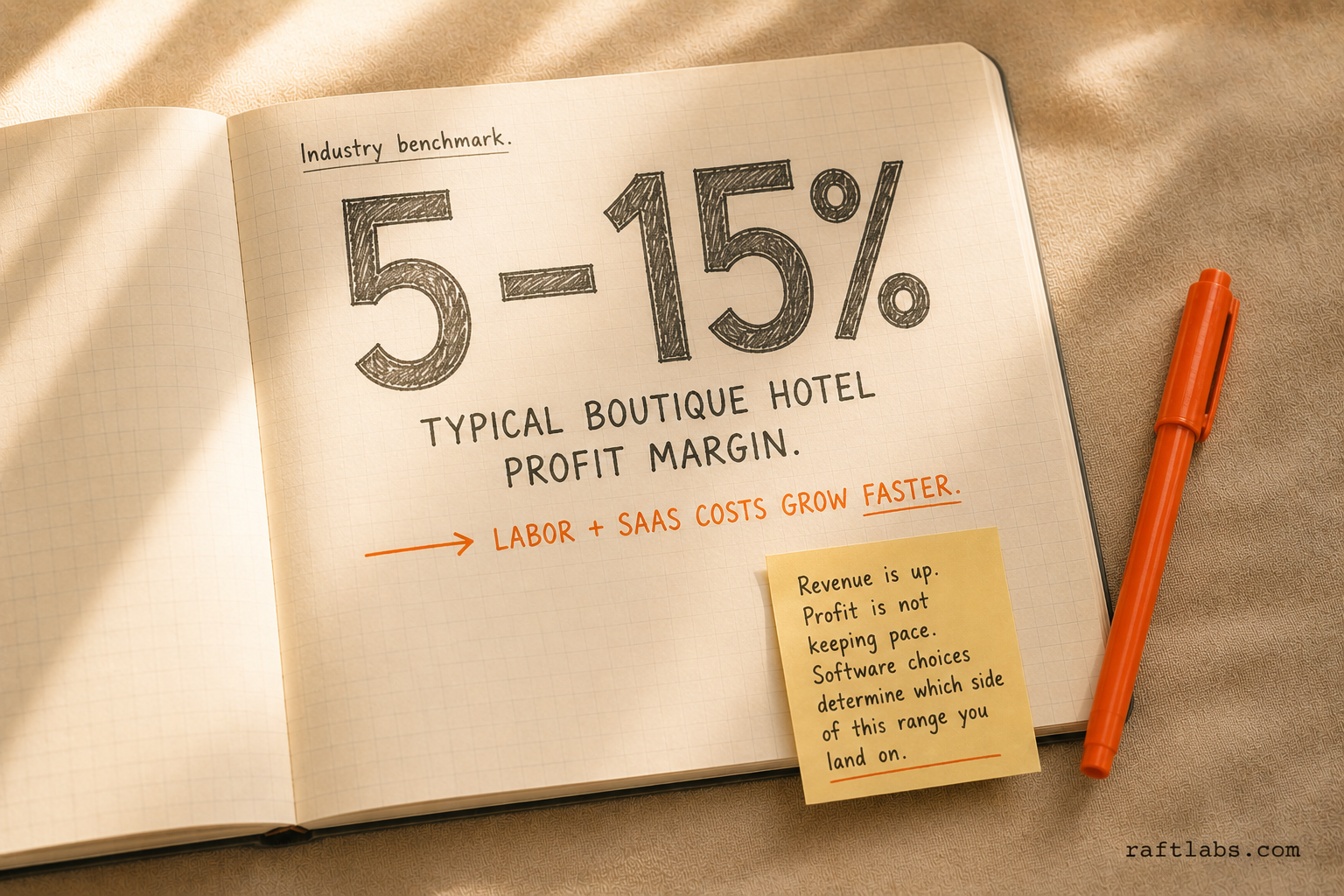
At the same time, many boutique hotels have the potential to earn much healthier profits than they do today. The space between what your business could be making and what your P&L actually shows is where the quality of your software choices starts to really matter.
This blog examines how custom software vs. SaaS hotel systems really affect hotel profitability for growth-stage boutique hotels. Not in abstract IT terms, but in terms of margin, overhead, and long-term hotel management profitability.
Who should read this
This guide is designed for hospitality professionals who are directly involved in running, scaling, or improving the financial performance of boutique hotels.
Boutique hotel owners and founders looking to grow their portfolio while improving profit margins and keeping overhead under control.
General managers and operations leaders managing daily operations and facing rising complexity, costs, and disconnected systems as the hotel scales.
Revenue and finance leaders focused on understanding hotel revenue vs. profit and improving margins through better cost visibility.
Multi-property operators and management companies running multiple boutique hotels and seeking unified systems without multiplying staff.
Hospitality decision-makers evaluating whether to continue with multiple SaaS tools or invest in custom software for long-term profitability.
If your hotel is growing but your profit margin is not keeping pace, this guide will help you rethink your technology choices.
What you’ll discover in this guide
This guide walks you through how software choices directly affect boutique hotel profit margins, especially as hotels grow and operations become more complex.
Where SaaS tools help and where they start to hurt profitability as your hotel scales
How custom software changes the balance between hotel revenue, costs, and profit
The real reasons margins drop when adding rooms or properties
Practical examples of how unified systems reduce overhead and manual work
When investing in custom software makes more financial sense than adding another SaaS tool
How to think about hotel software ROI over the long term, not just upfront cost
By the end, you will have a clearer framework to decide whether SaaS, custom software, or a mix of both is the right path for improving your boutique hotel's profit margin.
What Custom Software and SaaS Means for Boutique Hotels
Custom Software for Hotels
When people hear “custom software” they often imagine a huge, risky IT project. For boutique hotels, it usually looks much more focused.
Custom hospitality software for hotels is a system or set of tools designed specifically around your brand, your properties, and your workflows. It is built to sit on top of, or between, your existing systems via APIs
The custom software focused on reducing hotel operational costs, cutting manual work, and improving data visibility
You are not trying to rebuild a PMS from scratch. You are building the glue, the brain, and sometimes the missing internal tools that generic SaaS solutions do not give you.
Done well, custom software becomes your private operating layer. It makes it easier to manage hotel overhead costs as you scale, and it gives you better control over your hotel profit margin.
To better understand why custom software works the way it does, it helps to compare it with the tools most boutique hotels already use. That brings us to SaaS, the default choice for many hotels in their early stages.
SaaS Definition for Boutique Hotels
SaaS, or Software as a Service, refers to ready-made hotel software that you access through the internet by paying a monthly or yearly subscription. You do not own the software. You pay to use it, and the vendor handles hosting, updates, security, and support.
For boutique hotels, SaaS usually means tools that solve one specific operational problem using a standard setup. You sign up, configure some settings, train your team, and start using it right away.
This makes SaaS attractive in the early stages because it is quick to deploy and does not require technical work.
A common example: A housekeeping or guest messaging app that helps your staff update room status or send WhatsApp messages to guests. It works well on its own, but it lives separately from your PMS and accounting system.
SaaS works very well when your operations are straightforward, and you want a fast, low-effort setup. It lets you get started quickly without a large upfront investment.
However, as your hotel grows and your workflows become more complex, relying on multiple SaaS tools can create higher ongoing costs and disconnected data. At that stage, custom software often becomes a better replacement or can be used in combination with SaaS.
This shift from simple tools to layered systems is where software starts to influence financial outcomes. Once multiple tools are in play, how well they work together directly affects costs, efficiency, and ultimately profit margins.
Comparison of Custom Software vs SaaS Systems for Boutique Hotel
When comparing custom software vs SaaS hotel systems, the differences that matter most are not technical. They show up in your cost structure, how easily your team can operate, and how much control you have over your hotel profit margin as the business grows.
The table below outlines the most important differences from a boutique hotel profitability perspective.
| Area of comparison | Custom software for hotels | SaaS hotel software |
|---|---|---|
| Primary purpose | Built to support your specific properties, workflows, and reporting needs, with a direct focus on improving hotel profitability. | Built to serve a broad range of hotels using standardized workflows and features. |
| Customization level | Fully tailored to how your hotel operates, including roles, processes, and internal reporting. | Limited to configuration options provided by the vendor. |
| Cost structure | Higher upfront investment($25K-$150K one-time), but predictable and often lower ongoing costs as the hotel scales. | Lower initial cost, but recurring subscriptions ($100-$500 / month) that increase with rooms, users, and add-on features. |
| Control and ownership | Full control over features, data, and future changes, with no vendor lock-in. | Vendor controls roadmap, pricing changes, and long-term access to data. |
| Impact on hotel overhead costs | Designed to reduce overhead by consolidating tools and automating manual tasks. | Can increase overhead when multiple tools are required to cover different operational needs. |
| Integration with other systems | Built to integrate exactly with your PMS, channel manager, accounting, and other tools through custom APIs. | Uses standard integrations that may not fully match your data flow or reporting needs. |
| Data visibility and reporting | Provides unified, real-time views of hotel revenue vs profit, costs, and margins across properties. | Data is often spread across tools, requiring manual exports and reconciliation. |
| Scalability impact | Scales with your business without significantly increasing per-room or per-user costs. | Scales operationally, but costs rise steadily as subscriptions expand. |
This comparison highlights why the decision is less about replacing SaaS entirely and more about choosing where custom software can deliver a stronger hotel software ROI and support long-term hotel management profitability.
So it means, the SaaS wins for speed and simplicity, Custom software wins for long-term profitability at scale.
Ready to explore custom solutions? Check our hospitality software development services for hotels and resorts.
When Boutique Hotel Growth Starts Hurting Profit Margins
Many owners assume the path is simple. Add rooms, push RevPAR, profit climbs. In reality, a lot of boutique hotels hit a plateau or even a drop in hotel profit margin percentage when they move from, say, 30 rooms to 70 or from one property to three. Check your own RevPAR, ADR, and occupancy rate with the free RevPAR calculator before assuming rooms alone will fix the margin.
Common reasons:
1. Hotel overhead costs grow faster than revenue
As you add rooms or properties, you need more people to keep operations running smoothly. Extra front desk coverage, night audit shifts, maintenance support, and accounting work, all increase.
These costs rise almost immediately, while revenue takes longer to stabilize, which puts pressure on your hotel's profit margin.
2. Tool sprawl from SaaS
Most boutique hotels rely on many SaaS tools to manage daily operations. A PMS, channel manager, CRM, housekeeping app, and a separate reporting software are all common. Each tool charges monthly fees, often per room or per user.
Over time, these subscriptions add up and quietly increase your hotel management software cost.
Modern hotel booking app development consolidates these fragmented systems into unified platforms that integrate directly with your PMS, eliminating subscription sprawl."
3. More complexity than your original processes can handle
The systems and processes that worked when you had fewer rooms start to break down as the business grows. Spreadsheets, manual reports, and loosely connected tools struggle to handle higher volumes and more moving parts.
As a result, mistakes become more common, reports get delayed, and cost overruns go unnoticed until they impact profitability.
At the same time, the market is still healthy for boutique hotels. The segment has grown strongly in the US and is expected to keep expanding as guests look for unique, experience-driven stays.
But growth without better systems often compresses hotel operating margin instead of improving it.
To handle added rooms and complexity without hurting margins, boutique hotels need a different kind of software approach.
Custom guest apps provide the flexibility to build multi-property features that off-the-shelf solutions can't support: unified check-in flows, property-specific service menus, and cross-property loyalty programs.
When Custom Hospitality Software Makes More Sense Than SaaS
The global hotel and hospitality management software market is growing steadily and is expected to reach well above $6 billion by 2030. That tells you most operators are moving this way.
While standard tools can support early day-to-day needs, growing hotels quickly reach a point where those tools create friction instead of efficiency.
That is usually when custom hospitality software starts to make more sense, because it is built to handle complexity without increasing cost or operational strain.
Below are the situations where custom software often becomes the more practical and profitable choice.
1. Managing more than one property
Once you operate multiple boutique hotels, daily management becomes fragmented. Each property may have its own PMS instance, reports, and staff workflows. Owners and general managers often rely on manual spreadsheets to combine data and understand overall performance.
Investing in small hotel management software becomes essential to create a single internal view across properties making it easier to compare hotel profit margin, labor costs, and revenue mix without manual work.
2. Rising software costs without clear returns
As hotels grow, they tend to add more SaaS tools to solve small problems. Over time, this leads to a growing stack of subscriptions priced per room or per user. For example, a hotel might use one tool for housekeeping, another for upsells, another for reporting, and another for guest messaging.
Custom software can consolidate several of these functions into one internal platform, starting with MVP development allows you to test and validate the solution before full-scale implementation, reducing hotel management software cost and improving hotel software ROI.
3. Manual work increasing instead of decreasing
Many operators expect technology to reduce workload, but the opposite often happens. Staff export data from the PMS, copy it into reports, update tasks in multiple systems, and manually reconcile numbers at the month's end.
For instance, a revenue manager might pull data from three systems just to understand hotel revenue vs profit for the previous week.
Custom software automates these data flows and removes repetitive tasks, allowing teams to focus on decisions instead of administration.
4. Unique workflows or operating models
Boutique hotels often run on processes that do not fit standard software. This could include membership-based stays, long stay packages, flexible pricing rules, or mixed-use properties with coworking or events.
SaaS tools are built around common use cases, which means your team adapts its workflow to the tool. Custom software is built around your model, supporting how you actually operate instead of forcing compromises.
5. The need for better visibility into margins and costs
At a certain size, understanding overall performance is no longer enough. Operators need clear visibility into boutique hotel profit margin by property, by channel, and by segment.
SaaS tools usually focus on revenue or operations in isolation. Custom software brings these data points together, making it easier to track hotel operating margin and identify where costs or inefficiencies are eating into profitability.
In these situations, custom hospitality software might not replace SaaS entirely.
It works alongside existing tools, filling the gaps that directly affect hotel profitability and helping growing boutique hotels scale without losing control of their margins.
Get a free hotel booking engine review to see exactly what's holding your direct bookings back Submit details for free report
How custom hotel software improves profit margin
Custom hotel software improves hotel profit margin by fixing problems that directly affect costs, efficiency, and revenue capture. Instead of adding more tools, it improves how work gets done across existing systems and teams.
The biggest impact usually comes from a few core areas:
1. Lower labor costs without reducing service quality
Labor is one of the largest hotel overhead costs. In many boutique hotels, staff spend a lot of time on manual coordination. Room status checks, task assignments, report preparation, and follow-ups often happen across multiple tools or spreadsheets.
Custom software with AI-powered automation handles these flows. Suppose when a guest checks out, the system can automatically update room status, assign housekeeping, notify maintenance if there was an issue, and log the task for reporting.
2. Reduce revenue leakage that goes unnoticed
Small revenue leaks add up over time. Missed late checkout fees, uncharged add-ons, forgotten minibar items, or incorrect rate applications are common in growing boutique hotels. A custom software can flag these issues in real time.
For instance, if a guest stays past checkout or uses a paid service, the system can alert staff or automatically apply charges based on predefined rules. Implementing AI chatbot development can also proactively communicate with guests about late checkout fees and upsell opportunities. This improves hotel revenue vs profit by ensuring earned revenue actually shows up on the P and L.
3. Cut recurring software and admin costs
As hotels grow, they often stack SaaS tools to solve individual problems. Each tool looks affordable on its own, but together they increase hotel management software cost and training overhead. A custom software here can replace or consolidate several internal functions, such as task tracking, basic CRM views, and internal reporting.
4. Improve decision making with clearer data
Many SaaS tools focus on revenue or operations in isolation. Very few show the full picture of costs, margins, and performance together.
Custom hotel software brings these data points into one place.
Owners and managers can see the boutique hotel profit margin by property, by channel, or by segment without waiting for month end reports.
Faster visibility allows quicker adjustments to staffing or distribution, which directly supports hotel profitability.
In simple terms, a custom hotel software helps your team do less manual work, capture more of the revenue you already earn, and make better decisions as the business grows.
Understanding Hotel Software ROI Over the Long Term
When boutique hoteliers think about software ROI, they often focus on short-term savings. Choosing the right software development partner ensures you build systems that deliver compounding returns over time.
Custom software ROI shows up gradually, as operations scale and costs behave differently.
Here is how ROI typically plays out across different stages.
| Time horizon | What changes at this stage | How it impacts profitability |
|---|---|---|
| First year | Manual work and reporting are reduced. Data becomes easier to access. Fewer day-to-day operational errors occur. | Operations become more stable, with better control over costs, even if profit does not jump immediately. |
| Years two to three | Overlapping SaaS tools are retired. Labor planning improves with clearer demand and workload data. | Hotel overhead costs start to decline, improving hotel profit margin gradually. |
| Years three to five | Software scales without large increases in per-room or per-user costs. Maintenance becomes predictable. | Profit margins are protected as the business grows, supporting long-term hotel management profitability. |
| Long-term resilience | Managers can spot margin pressure early and adjust staffing, pricing, or channel mix faster. | Small issues are corrected before they impact profit, helping maintain stable and predictable profitability. |
Over time, the hotel software ROI compounds. It starts by making work easier, then steadily improves how much of your revenue turns into sustainable profit as the business grows.
Manage multiple boutique hotels without multiplying overhead See how unified systems help multi-property operators scale while keeping hotel overhead costs under control. Discuss your use case
Practical Ways Boutique Hotels Improve Margins with Custom Technology

Let us look at concrete patterns that work well for growth-stage boutique hotels.
1. Unified property dashboards
Pull data from PMS, POS, channel manager, and accounting
Show live or daily updated KPIs like GOPPAR, labor percentage, and hotel operating margin
Let owners compare properties side by side and drill down to line items (E.g., Utilities, laundry, and housekeeping supplies)
2. Custom API middleware
Connect SaaS tools so they behave more like one system through custom API integration that enables reliable, uninterrupted data flow
Automate common flows like:Booking created -> payment check -> invoice -> task assignment -> upsell message
Reduce manual retyping across platforms
3. Automated staff workflows
Auto-assign housekeeping tasks based on arrivals, departures, and stayovers
Notify maintenance when a room status, manual note, or sensor indicates an issue
Log completed tasks into your system for quality control and labor analysis
4. Internal tools instead of multiple subscriptions
Build a single internal portal that covers checklists, shift handovers, simple CRM views, and dashboards
Retire multiple overlapping tools used by the front office, housekeeping, and management
Cut recurring SaaS cost and training overhead
Each of these use cases has a direct and measurable link to hotel operational cost reduction and hotel cost optimization.
The result is a stronger boutique hotel profit margin without sacrificing guest experience.
Also Read : Keyless entry for serviced apartments implementation guide
Common SaaS Applications Used by Boutique and Independent Hotels
Many boutique and individual hotels today use a stack of SaaS tools. Typical examples include:
| SaaS Tool | What it is typically used for |
|---|---|
| Property Management System (PMS) | Manages core hotel operations such as reservations, check-ins and check-outs, room status, guest profiles, and billing. It acts as the central system for daily hotel operations. |
| Channel manager and CRS | Distributes room availability and rates across OTAs and direct channels. Helps prevent overbookings and keeps pricing consistent across platforms. |
| Booking engine and website tools | Enable direct bookings through the hotel website by handling availability display, pricing, payments, and booking confirmations. |
| Revenue management system | Uses demand and booking data to suggest or automate room pricing and restrictions. Focuses mainly on rate optimization, often without full visibility into costs. |
| Housekeeping and maintenance app | Helps manage room cleaning schedules, inspections, maintenance requests, and task assignments for operations staff. |
| CRM and guest engagement platform | Stores guest data and supports communication such as pre-arrival messages, upsells, and post-stay follow-ups. Mainly focused on guest experience and marketing. |
| Review and reputation management tool | Uses demand and booking data to suggest or automate room pricing and restrictions. Focuses mainly on rate optimization, often without full visibility into costs. |
| Accounting and reporting tools | Handles financial records, invoicing, expenses, and reports. Often requires manual reconciliation with data from other hotel systems. |
These systems are widely used across the hospitality industry and are designed to solve specific operational problems. The SaaS model makes it easier to adopt standard tools without building everything from scratch, which is why many boutique hotels start with these solutions.
However, their standardized nature also means they are built to work reasonably well for many hotels, rather than being optimized for the unique needs of a growing boutique operation.
Here are some common SaaS issues at the growth stage of hotels:
Every new SaaS adds another line item to the hotel management software cost
Many tools overlap in features, but you still pay the full subscription fee
Data lives in separate systems, so your team exports and reconciles manually
You adapt your processes to the software, instead of the software adapting to your property
The Direct Link Between Hotel Management Software and Profit Margins
Hotel management software has a direct effect on your profit margin because it shapes how work gets done every day. When systems are disconnected, teams spend more time switching tools, fixing mistakes, and pulling reports. Costs rise quietly, and problems are often spotted too late.
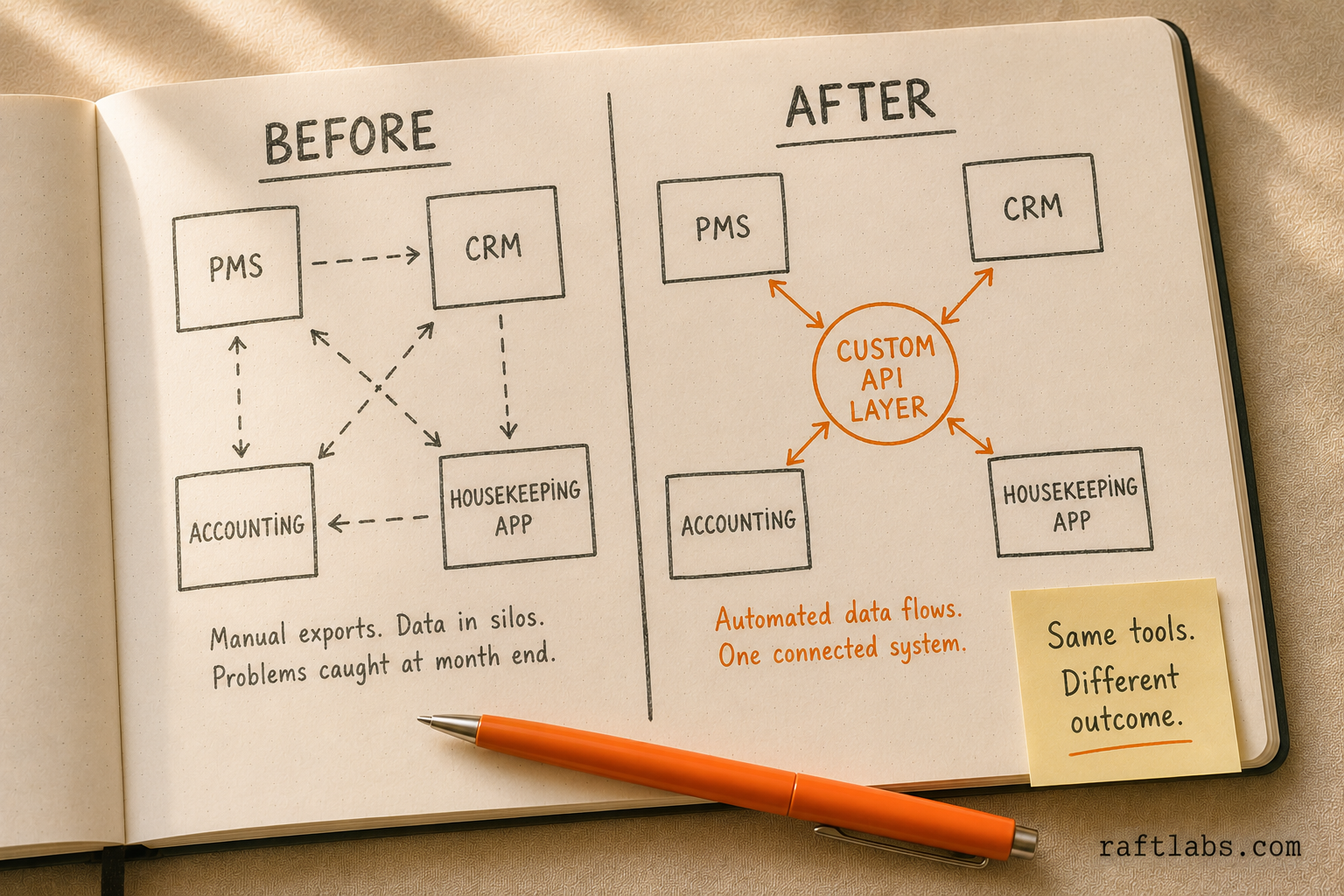
When the right systems work together, the picture changes. Data flows automatically, tasks are triggered without follow-ups, and managers can see how revenue and costs are tracking in near real time.
This makes it easier to control hotel overhead costs, catch issues early, and protect hotel profit margin as the business grows.
In simple terms, better software does not just support operations. It helps turn the same level of revenue into stronger and more predictable profitability.
Once you see how software directly shapes daily work and financial outcomes, the next step is to look at a few tools boutique hotels use today.
Turn complex hotel operations into a simpler system See how unified dashboards and automated workflows can replace fragmented SaaS tools. Talk to our experts
How to Choose the Right Custom Software Development Partner
Choosing a custom software development partner is a long-term decision, not a one-time project choice. The right partner does more than write code.
They help you translate hotel operations, cost structures, and growth plans into systems that actually improve profitability.
Here are the most important factors to look for when evaluating a partner for custom hospitality software.
1. Deep understanding of hotel operations
Your partner should understand how hotels actually run day to day. This includes front desk workflows, housekeeping cycles, maintenance coordination, and distribution through OTAs. Without this context, even well-built software can miss the mark and create friction for your team.
2. Ability to think in terms of profit, not just features
A strong partner talks comfortably about hotel profit margin, labor percentage, hotel overhead costs, and hotel revenue vs profit. They should ask questions about where money is being lost or time is being wasted, not just what screens or features you want built.
3. Experience integrating with existing hotel systems
Custom software rarely replaces core systems like a PMS or channel manager. Your partner should have hands-on experience working with APIs and hotel technology stacks, so new tools fit cleanly into your current setup.
4. Clear approach to scope and prioritization
Not every software idea needs to be built at once. A good partner helps you identify high-impact use cases first, through a structured product discovery phase, focusing on workflow automation or cost visibility that delivers immediate value. This reduces risk, controls budget, and improves hotel software ROI over time.
5. Focus on usability for hotel teams
Hotel staff are busy and often not technical. The partner should design simple, intuitive interfaces that fit into real shifts and workflows. Software that looks good but is hard to use will not deliver results.
6. Long term support and evolution mindset
Custom software is not static. As your hotel grows, processes change, and new needs emerge. Choose a partner that plans for ongoing improvement, maintenance, and scaling, not just initial delivery.
7. Transparency around cost and ownership
You should clearly understand what you are paying for, what you own, and how future changes will be handled. The right partner avoids hidden costs and helps you plan long-term operating expenses.
In practical terms, the right development partner acts as an extension of your management team, not just a technical vendor. They help you make smarter decisions about what to build, what to leave as SaaS, and how to evolve your systems as the business expands.
What a hotel software partner should understand
Our focus is on helping hospitality brands create software that fits their operations instead of forcing their operations to fit generic tools.
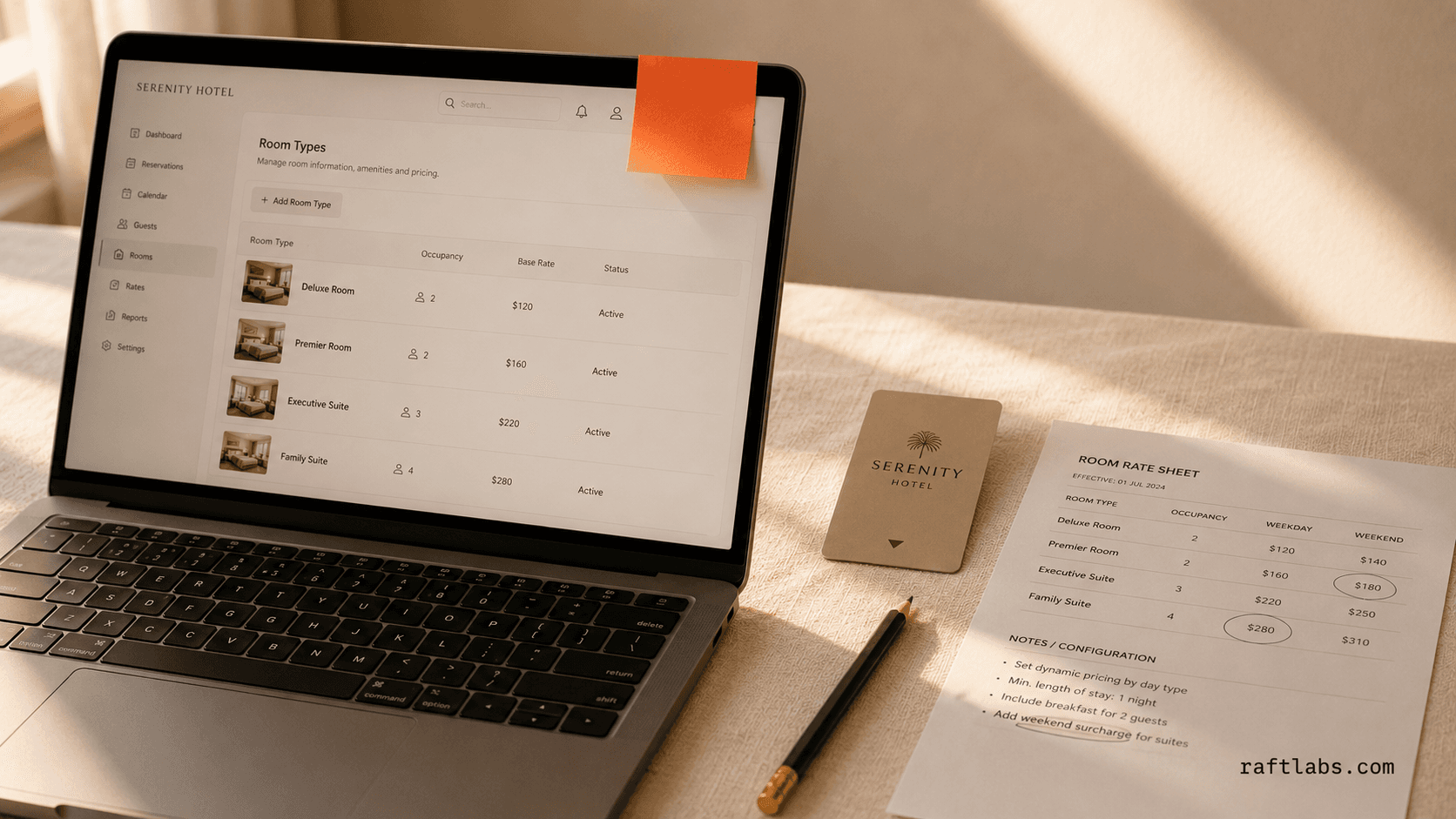
Here is what we clearly bring to the table:
1. Experience building software for travel and hospitality
We have a dedicated focus on travel and hospitality software development. This includes building systems for booking flows, internal operations, customer-facing applications, and backend platforms used by hospitality teams.
2. Web and mobile application development
We build modern web applications and mobile applications that are designed for real users. This includes internal dashboards, staff-facing tools, and customer-facing apps that are reliable, scalable, and easy to use across devices.
3. API driven and integration friendly systems
We emphasize building software that integrates with existing systems. In hospitality projects, this often means working alongside PMS, booking engines, payment systems, and third-party services rather than replacing them. The objective is to create connected systems that reduce manual work.
4. Use of AI where it adds practical value
We build AI-powered features where they make sense for the business. This can include AI agent development for automation, data processing, and smarter workflows, applied in a way that supports operations rather than adding complexity.
5. Custom solutions aligned to business needs
We focus on building custom software based on specific business requirements. Instead of offering one-size-fits-all products, solutions are scoped and designed around the client’s goals, workflows, and growth plans.
For boutique hotels thinking about custom software, this approach supports building practical systems that align with existing tools and evolve as the business grows, without adding unnecessary overhead or complexity.
Final Thoughts
As hotels grow, the systems that once felt “good enough” often become the reason margins stall or decline. More rooms, more staff, and more tools add complexity faster than revenue can absorb it.
SaaS platforms play an important role, especially for standard operational needs. But at the growth stage, relying only on off-the-shelf tools often leads to rising hotel overhead costs, fragmented data, and limited visibility into what is actually driving hotel profit margin.
This is where custom software changes the equation. If you are reaching the point where adding rooms or properties is no longer improving your hotel profit margin, it may be time to rethink your software stack.
We work with hospitality businesses to design and build custom web, mobile, and AI solutions that integrate with existing systems and support long-term growth. Let’s discuss what we can do for your business!
Ask an AI
Get an instant summary of this post from your preferred AI assistant.
Common questions
- Boutique hotel profit margin typically ranges between 5 to 15%, depending on location, operating efficiency, staffing, and software costs. Hotels with better cost control and well-connected systems tend to operate at the higher end of this range or even exceed it.
- SaaS software usually has low upfront cost, but recurring subscription fees, per-room pricing, and add-on charges can increase hotel overhead costs as the business scales. Over time, this can reduce hotel operating margins if not managed carefully.
- A boutique hotel should consider custom software when adding more rooms or properties starts increasing complexity faster than revenue. This often happens when multiple SaaS tools are needed, manual work increases, and software costs begin to affect profitability.
- Yes. Custom hotel software helps improve hotel profit margin by reducing manual work, consolidating tools, lowering software costs, and preventing revenue leakage. These improvements allow hotels to keep more profit from the same level of revenue.
- Custom software usually has a higher upfront cost, but ongoing maintenance is often predictable and lower than the combined cost of multiple SaaS subscriptions over time. This makes it more cost-effective for growth-stage boutique hotels in the long run.