Custom Med Spa Loyalty Program Software Development: Build vs Buy in 2026
Discover when generic loyalty apps quietly drain med spa profits. Learn how custom software can unlock six-figure retention gains in under a year.

In this article
Short answer
Custom med spa loyalty software costs $20,000-$60,000 to build. RaftLabs built Bella Skin Institute's custom app in 12 weeks. It makes financial sense for practices with 500+ active clients and $2,000+ average annual client value. Generic platforms like Mindbody charge $3,000+/month, so a custom system pays back within 8-12 months. Core features include treatment-cycle tiers, expiring points with countdown timers, and service-specific tracks for Botox and fillers.
Key takeaways
- Custom loyalty software starts to make strong financial sense at 500 or more active clients and over $2,000 average annual client value.
- Over 3 years, custom systems often cost less than generic SaaS while giving full control, data ownership, and no vendor lock in.
- Med spa specific features that drive retention include treatment cycle based tiers, service specific tracks, expiring points, and smart referrals.
- Real world builds like Bella Skin Institute show custom apps can launch in about 12 weeks and remove manual workarounds for staff.
- The key decision rule is to run the ROI math on retention, visit frequency, and referrals to see if custom will pay back within 8 to 12 months.
According to Grand View Research, the medical spa market is growing at 15.77% annually and is expected to reach $78.23 billion by 2033. That's explosive growth. But here's what most practice owners miss: acquiring a new client costs 5-25x more than keeping an existing one, yet the average med spa still loses 50-60% of clients annually.
Your Botox patients come back every 3-4 months. Filler clients every 6-12 months. These aren't weekly coffee shop visits. Between those appointments, most practices have zero digital touchpoint keeping clients engaged. That's where you're losing them.
Generic loyalty platforms like Mindbody or Square weren't built for treatment-cycle businesses. They're designed for frequent small purchases, not infrequent high-value appointments with 3-6 month gaps.
We've built loyalty software for premium practices since 2015, including Dr. Anna Guanche's Bella Skin Institute in Calabasas. We know what works when your business model doesn't match off-the-shelf software.
Who Should Read This
You're evaluating whether to build custom or buy off-the-shelf if you're:
A med spa owner with 500+ active clients trying to improve retention
A practice manager tired of working around platform limitations
A marketing director comparing recurring SaaS fees versus one-time custom development
A multi-location operator needing centralized data and control
Who Can Skip This
This isn't for you if:
You have fewer than 200 active clients (generic solutions work fine at that scale)
You're happy with physical punch cards and spreadsheets
You want the absolute cheapest option regardless of long-term costs
What You'll Learn
You'll get real build versus buy costs with 3-year projections. ROI timelines based on actual med spa retention economics. The decision framework for knowing when custom makes sense. Features that work for treatment-cycle businesses. Real costs from the Bella Skin Institute build. And the truth about when off-the-shelf is good enough.
"Acquiring a new customer costs five to 25 times more than retaining an existing one. For high-value service businesses like aesthetic clinics, where a single lost client represents thousands in lifetime revenue, that math makes retention technology the highest-return investment available."
Amy Gallo, contributing editor at Harvard Business Review, writing on the economics of customer retention (HBR, 2014, regularly cited in industry literature)
Where Generic Spa Loyalty Programs Fall Short for Med Spas
The economics of med spa client retention don't match retail or food service at all.
Treatment Cycles Don't Match Software Expectations
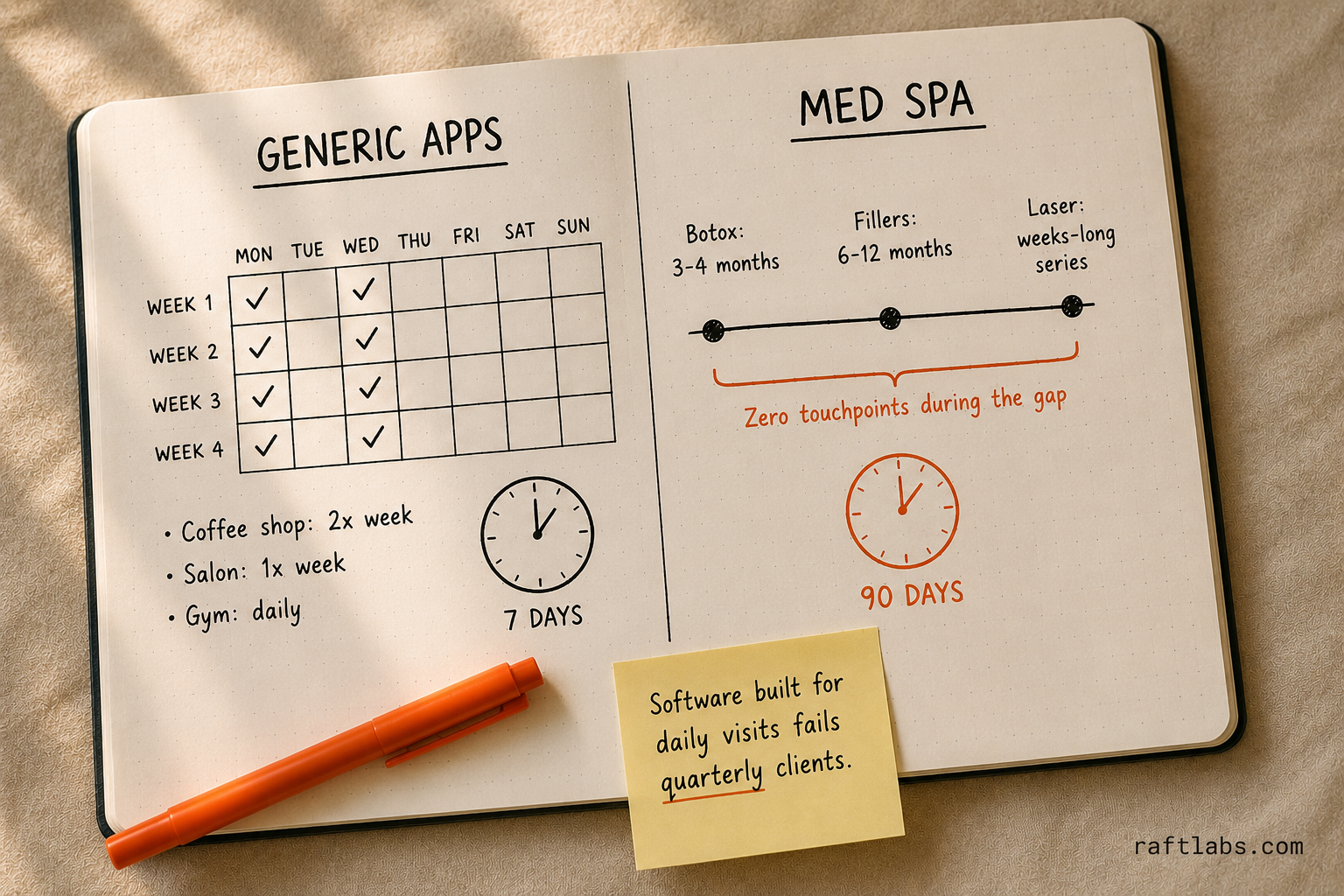
Your Botox patients return every 3-4 months. Filler clients every 6-12 months. Laser treatment series span weeks or months. These aren't weekly coffee visits or monthly haircuts.
Generic point systems reward visit frequency that cosmetic treatments physically can't match. The software expects customers weekly. Your best clients show up quarterly.
Most platforms assume engagement happens through frequent small purchases. Your business works opposite: infrequent high-value treatments with long gaps between appointments.
During those 3-6 month gaps, you have zero touchpoints unless your software creates them. Generic platforms don't do this.
Client Value Distribution Creates Problems
Industry data shows your top 20% of clients generate 70-80% of total revenue. One $10,000/year VIP client equals four $2,500/year regular clients in revenue impact.
Generic tier systems treat all clients identically or use simple spend thresholds. Bronze, Silver, Gold based purely on dollars spent.
But your $5,000/year client who comes quarterly for multiple treatments has completely different needs than your $5,000/year client who bought one expensive laser package and disappeared.
Treatment frequency matters more than total spend for retention. Generic systems can't distinguish between these client types.
The Urgency Mechanics Gap
Between appointments, clients forget about you. Three months is long enough to check out competitor offers, try another practice, or just let their treatment schedule slip.
Creating natural return urgency without aggressive discounting requires specific mechanics. You need expiring points, treatment-specific reminders, visual countdown timers showing benefits about to expire.
Generic platforms lack these features entirely. They're built for businesses where customers decide to visit this week versus next week. Not businesses where the decision is this quarter versus next quarter.
You need software that keeps clients engaged during the gaps. Most loyalty platforms don't even recognize gaps exist.
When Custom Med Spa Loyalty Software Makes Sense
The decision comes down to three numbers: client count, average client value, and competitive pressure.
The 500-Client Threshold
You hit custom software ROI in 12-18 months instead of 24+ months once you cross 500 active clients.
Here's the math: 500 clients at $2,500 average value equals $1.25M annual revenue. Improving retention 10% keeps 50 more clients. That's $125,000 additional revenue per year. Custom software that costs $35,000 pays for itself in 3.4 months.
Below 500 clients, the absolute revenue impact of 10% better retention doesn't justify $25K-40K custom development. Above 500, the math flips hard in your favor.
Multi-location practices need custom even sooner. Centralized data across locations, unified client profiles, consolidated reporting: these requirements break generic platforms or require expensive workarounds.
Treatment Value Matters
Average client value above $2,000/year changes the retention economics completely.
High-value treatments (laser, injectables, IV therapy) justify sophisticated loyalty tracking. When losing one client costs $2,000-10,000 in lifetime value, preventing churn through better engagement makes financial sense.
Lower-value services don't justify the investment. If your average client spends $500/year, you'd need 20% retention improvement just to break even on a $35,000 build. That's unrealistic.
Run this calculation: (Number of clients) × (Average annual value) × (Realistic retention improvement %) = Annual benefit
If annual benefit exceeds custom software cost by 3x or more, build makes sense.
Competitive Market Pressure
Three or more competing med spas within 5 miles means clients are comparison shopping everything including loyalty programs.
When competitors offer sophisticated apps with personalized rewards and treatment tracking, your Mindbody punch card looks dated.
Premium practices need premium digital experiences. Brand mismatch kills trust. Dr. Guanche spent 18 years building Bella Skin Institute's reputation. Then clients were supposed to use a loyalty app that looked identical to every other Mindbody practice?
The disconnect was obvious. Generic platforms work until your brand positioning requires differentiation.
Build vs Buy: The Real Cost Comparison
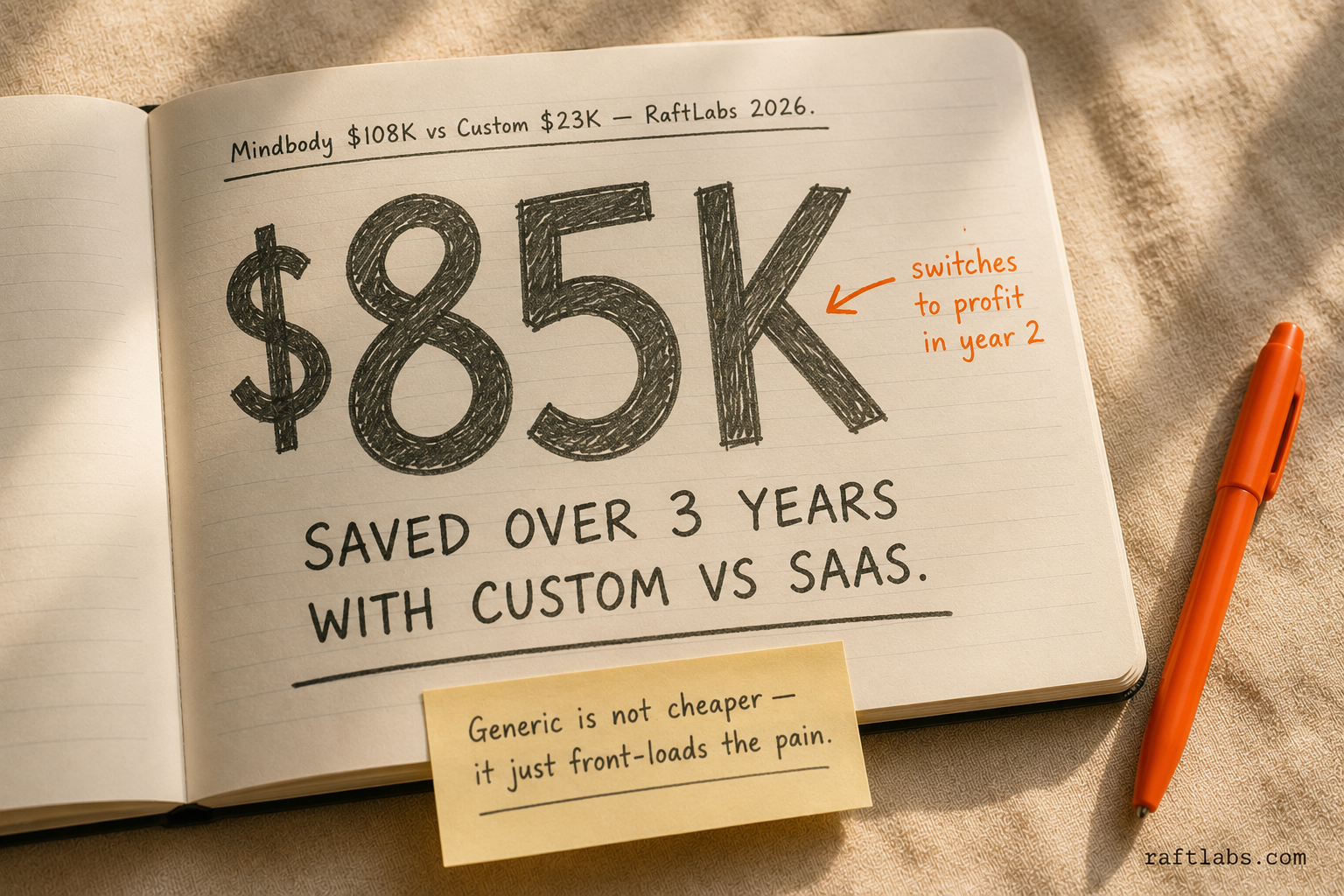
Here's what nobody publishes: the 3-year total cost of ownership for custom versus off-the-shelf platforms.
| Factor | Custom Development | Generic Loyalty Platforms |
|---|---|---|
| Upfront Cost | $20,000-$40,000 | $0-$2,000 setup |
| Monthly Cost | $200-$500 (hosting) | $1,500-$4,000/month |
| Year 1 Total | $22,400-$46,000 | $24,000-$50,000 |
| Year 3 Total | $27,200-$58,000 | $72,000-$146,000 |
| Customization | Unlimited | Limited |
| Data Ownership | 100% yours | Vendor-controlled |
| Feature Updates | Your choice, your cost | Forced updates, increasing fees |
| Vendor Lock-in | None | High |
Hidden Costs Most Practices Miss
Generic platforms charge per location. Two locations double the monthly fee. Three locations triple it.
Transaction fees on redemptions add 1-3% ongoing costs that compound over time.
Limited customization means your staff invents workarounds. Those workarounds cost time. Time costs money.
Your data stays locked in vendor platforms. You can't analyze retention patterns yourself or move to another system without losing history.
Price increases happen annually. You have zero control. Many practices start at $2,000/month and end at $4,000/month within 24 months.
Custom saves $20,000-$85,000 over three years while giving you complete control. You can read more about custom loyalty app development cost to build your product.
Med Spa Loyalty Program Ideas That Actually Work
Not generic coffee shop points. These are structures designed for treatment economics.
Treatment-Cycle Tiers Instead of Spend-Based
Most tier systems use spend thresholds. Bronze at $1,000 spend, Silver at $3,000, Gold at $5,000.
That's wrong for med spas. A client who spends $5,000 once and disappears isn't your Gold VIP. A client who returns consistently every quarter for $500 treatments is.
Here's what works better:
Bronze: 1-3 treatments per quarter
Silver: 4-6 treatments per quarter
Gold: 7+ treatments per quarter (true VIPs)
This rewards the behavior you actually want: regular return visits. Consistent treatment schedules mean better results for clients and predictable revenue for you.
The psychological difference matters. Spend-based tiers feel transactional. Frequency-based tiers feel relationship-focused.
Service-Specific Loyalty Tracks
Your Botox loyalty program should be separate from your filler program. Laser treatments separate from facials.
Different treatment cycles mean different economics and different client psychology.
Botox example: Buy 3 sessions, get 4th 50% off. The cycle matches the actual 3-4 month return pattern.
Filler example: Prepay for annual maintenance, get 15% discount plus priority booking. This locks in clients for the year.
Package pre-purchases with bonus treatments work because they guarantee future visits while giving clients immediate value.
Real implementation from Bella Skin Institute: 10% points earning on cash payments only (not insurance, not certain card types). Specific payment type restrictions require custom software. Generic platforms can't filter that granularly.
Expiring Points with Visual Urgency
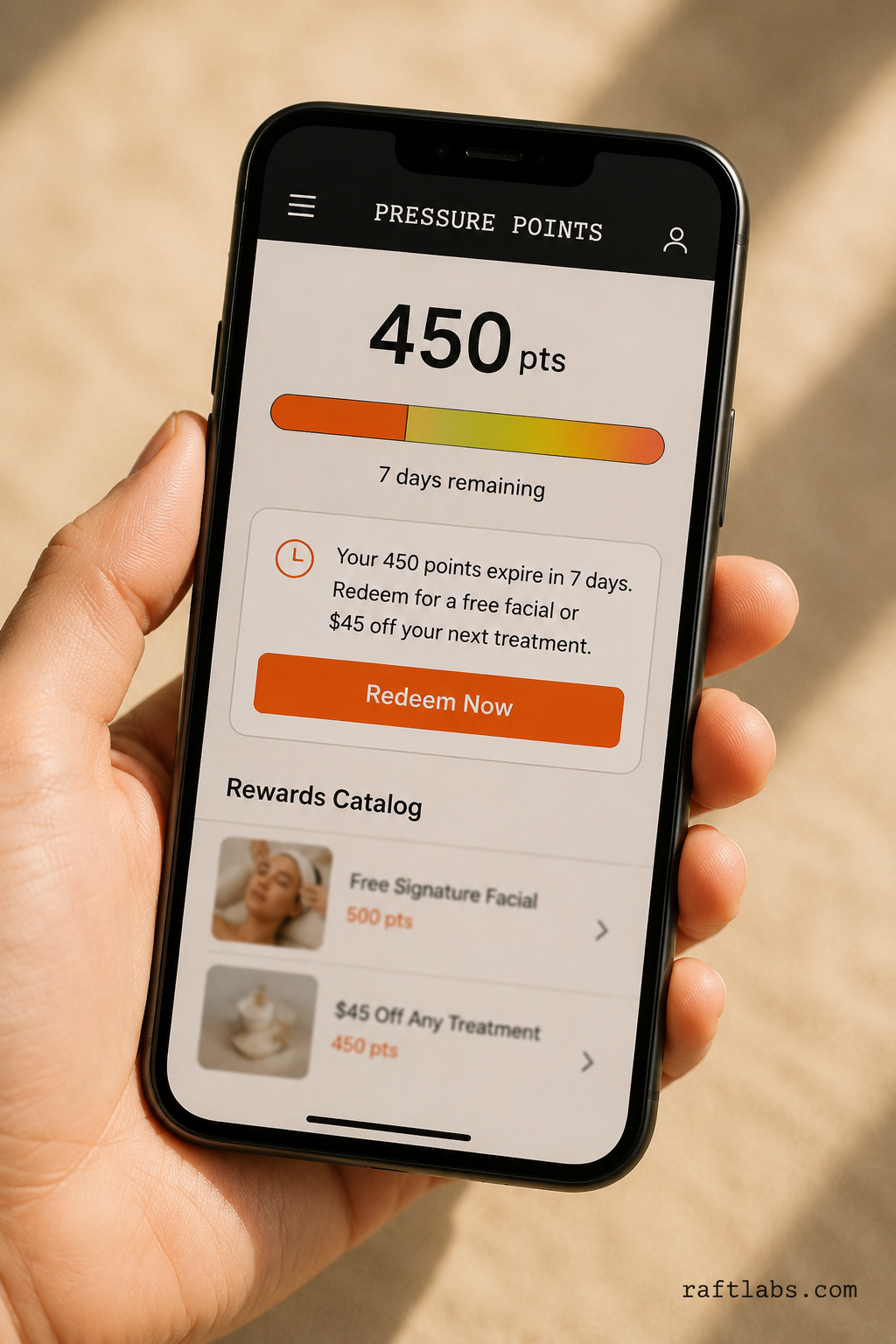
Bella Skin Institute calls these "Pressure Points."
Points expire in 30-90 days depending on treatment type. This creates natural urgency to return and redeem without aggressive discounting.
The visual psychology matters. Countdown timers showing "30 days remaining" then "14 days" then "7 days" in increasingly urgent colors (green → yellow → red).
Push notifications trigger at each milestone. Not annoying spam. Specific, valuable reminders: "You have 450 points expiring in 7 days. Redeem for a free facial or $45 off your next treatment."
Generic platforms either don't offer expiring points at all, or implement it so crudely clients miss notifications and lose points without warning. That creates frustration, not urgency.
Research shows properly implemented expiring points drive 15-25% increase in return visit frequency.
QR Code Earning at Checkout
Your patient presents their unique QR code from the mobile app. Your front desk staff scans it with an iPad or phone. Points credit instantly to the account.
Transaction time: under 15 seconds from scan to confirmation.
This is how Bella Skin Institute processes every loyalty transaction: no manual entry, no errors, no friction.
The technical requirement: dynamic QR codes tied to user accounts, validated server-side, with payment type filtering (cash-only in their case).
Generic platforms either don't offer QR earning or implement it poorly with frequent scanning errors.
Smart Referral Tracking
Med spa referrals are worth 10-15x retail referrals in lifetime value. But most platforms track referrals like retail: flat $10-25 reward per referral.
Smart referral tracking ties rewards to referee lifetime value:
Referral makes first visit: $50 credit
Referee spends $500 total: $100 credit
Referee spends $1,000 total: $200 credit
Automatic triggers when milestones hit
This aligns incentives. You're not paying for referrals who visit once and disappear. You're rewarding referrals who become valuable long-term clients.
The data requirement: track referee spend, link to referring client, automate milestone-based rewards. Generic platforms can't do this.
Treatment Results Gallery Integration
Before/after photos organized by procedure type help patients decide on their next treatment while browsing the loyalty app.
Psychological impact: seeing real results from procedures you're considering removes decision friction. "I was thinking about laser, and here's what it actually looks like on people similar to me."
Bella Skin Institute integrated a treatment gallery into their rewards app. Patients browse results, get inspired, and book consultations while checking their point balance.
This drives conversion on high-value treatments clients were considering but hadn't committed to yet.
Generic platforms don't offer treatment galleries at all. They're pure transactional: points in, rewards out.
What Custom Med Spa Loyalty Software Actually Costs
Real numbers based on our pricing and actual projects.
Development Investment by Complexity
Basic System ($20,000-$30,000):
What you get with a basic build:
Points earning and redemption
QR code checkout integration
Simple tier system (Bronze/Silver/Gold)
Mobile app (iOS + Android from single codebase)
Basic admin dashboard
Push notifications
Timeline: 6-8 weeks
Mid-Tier System ($30,000-$45,000):
Everything in Basic, plus:
Expiring points with countdown timers
Service-specific loyalty tracks
Treatment results gallery
Appointment request system (callback-based)
Advanced admin controls
Email automation integration
Timeline: 8-12 weeks
Advanced System ($45,000-$65,000):
Everything in Mid-Tier, plus:
AI-powered treatment recommendations
Predictive rebooking suggestions
Lifetime value referral tracking
Multi-location support with centralized data
Advanced analytics dashboard
Custom integrations with specialty systems
Timeline: 12-16 weeks
Integration Costs
Most integrations are included in base/mid-tier pricing: POS systems (Square, Clover, Lightspeed), push notifications (Firebase), and calendar sync (iOS, Google).
Additional integrations that cost extra:
Practice management systems (Boulevard, Zenoti, Aesthetic Record): +$5,000-$10,000
Email/SMS automation platforms: +$3,000-$5,000
Advanced analytics tools: +$3,000-$8,000
Ongoing Operational Costs
Hosting and infrastructure: $200-$500/month depending on user count and data storage
Maintenance and support: usually $200-$300/month or included in annual contract
Feature additions: $5,000-$15,000 per major feature added post-launch
Total 3-year ownership (mid-tier build): $35,000 upfront, 36 months hosting at $7,200-$18,000, maintenance at $7,200-$10,800, and one feature add at $8,000 comes to $57,400-$71,800 over 3 years. Compare that to Mindbody at $3,000/month ($108,000 over 3 years) with less flexibility and zero ownership.
Hidden Costs Generic Platforms Don't Advertise
The sticker price looks reasonable at first. But SaaS platforms bury costs that only show up months later when you're already locked in. Here's what actually hits your budget over time.
Per-location fees multiply fast. Mindbody charges per location. Open a second location and your monthly cost doubles. Add a third and it triples. What started at $2,000/month becomes $6,000/month across three practices.
Transaction fees on redemptions eat into margins. Most platforms charge 1-3% of every reward redeemed. If your clients redeem $500,000 worth of rewards annually, you're paying $5,000-$15,000 in fees just for giving out rewards you already paid for.
Staff workaround time costs more than you think. Generic platforms can't do what you need, so your staff invents workarounds. Manual spreadsheets. Duplicate tracking. End-of-month reconciliation. That time costs money, and it adds up to hours every week.
Forced platform updates break your workflows. Vendors change features without asking. Your carefully-built processes break. Now you're adapting workflows or paying for staff retraining because a vendor decided to redesign their interface.
Data export limitations block your analysis. You want to analyze retention patterns yourself or build custom reports. Most platforms charge extra for data exports or limit what you can access. Your data stays locked in their system.
Price increases happen every year. Vendors raise prices annually and you have zero control. You budget $3,000/month this year. Next year it's $3,600. Year after that it's $4,000. Over three years, that "affordable" platform just cost you an extra $25,000.
The real cost of "cheap" SaaS platforms appears in year 2-3, not year 1.
Also Read: Top Loyalty App development companies comparison to build your custom product.
The ROI Math: Retention Economics for Med Spas
Here's how custom loyalty software pays for itself through better client retention.
Client Retention Impact Calculation
According to Harvard Business Review, increasing customer retention by just 5% can boost profits by 25% to 95%, depending on margin structure and category. Industry baseline shows 40-50% annual client retention rate for med spas without loyalty programs.
Well-designed loyalty programs achieve 60-70% retention rate according to recent loyalty program research.
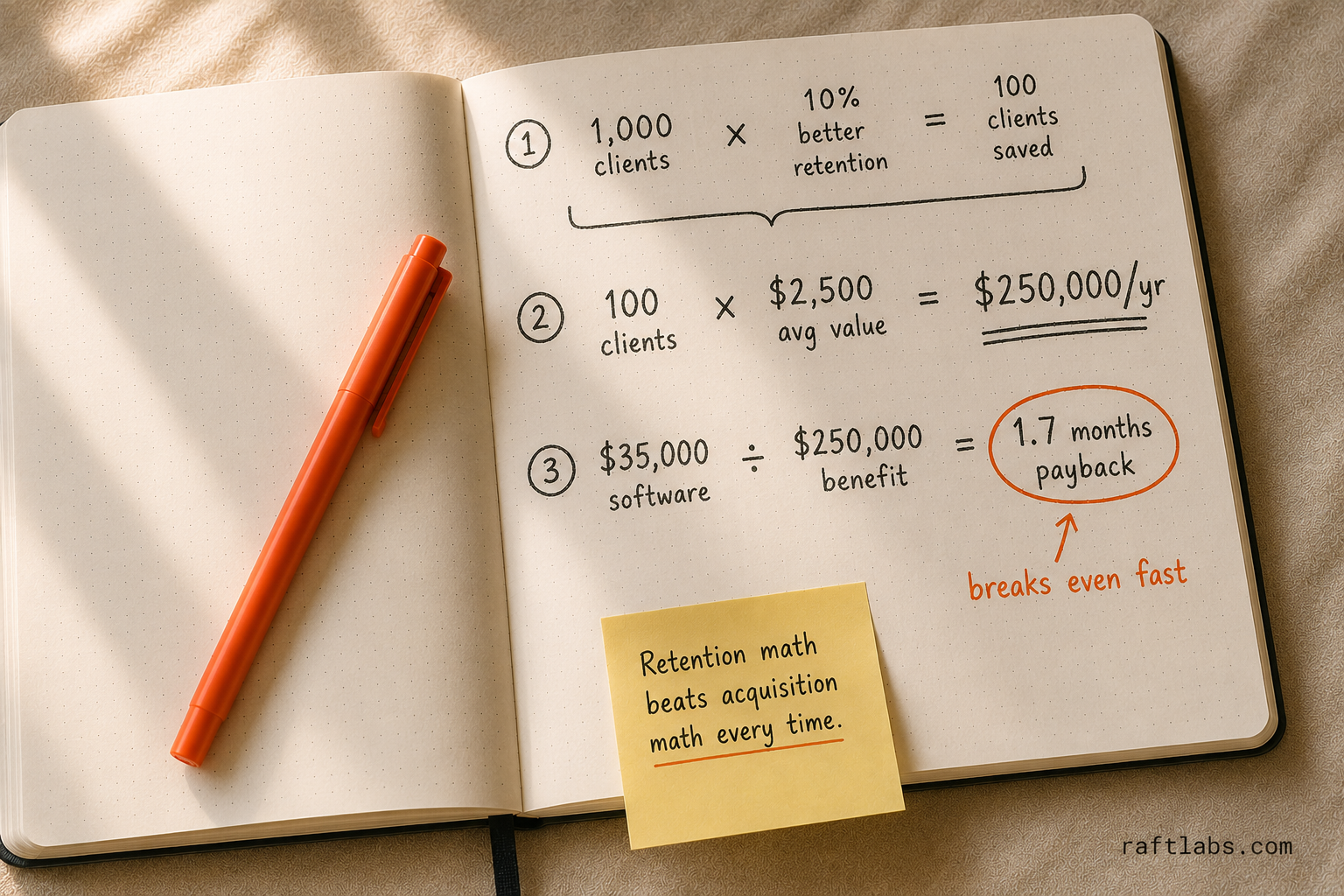
Example calculation with 1,000 active clients:
Current retention: 45% (450 clients return annually)
With loyalty program: 55% retention (550 clients return)
100 additional clients retained
At $2,500 average annual value
Revenue impact: $250,000 additional revenue per year
Your $35,000 software investment divided by $250,000 annual benefit equals 1.7 months to break even.
Most practices see retention improvement within 3-6 months of launching loyalty software.
Treatment Frequency Increase
Expiring points and smart reminders improve treatment frequency by 15-25% according to research on urgency mechanics in loyalty programs.
Example: A client on a 4-month cycle shifts to a 3.5-month cycle
3 visits per year → 3.4 visits per year
At $500 average per visit
$1,500 annual value → $1,700 annual value
Across 500 clients: $100,000 additional annual revenue
The compounding effect: higher frequency leads to better treatment results. Better results lead to higher satisfaction. Higher satisfaction improves retention further.
High-Value Client Churn Prevention
Your top 20% of clients generate 70-80% of med spa revenue. Losing one $10,000/year VIP client requires finding four new $2,500/year clients just to break even.
Custom loyalty software with VIP-specific features (priority booking, exclusive treatments, personalized service) reduces high-value client churn.
Example: Preventing loss of 5 high-value clients per year
5 clients at $8,000 average value
$40,000 revenue saved annually
$35,000 software cost recovers in 10.5 months
Identification and retention of high-value clients is where custom loyalty shows the biggest ROI difference versus generic platforms.
Calculate Your Loyalty ROI See exactly how much custom loyalty software would return for your practice in 8-12 months. Free ROI calculator based on your client count and average value. Calculate my ROI
Referral Program ROI
Med spa referrals convert at 40-60% (versus 10-20% for cold leads) and have 40% higher lifetime value according to industry research. Automated referral tracking increases that rate by 15-25% over manual tracking. With 500 existing clients: if 20% refer someone (100 referrals) and 50% convert (50 new clients) at $2,500 average annual value, that's $125,000 in new client revenue. Smart referral tracking (tiered rewards based on referee spend) ensures you're rewarding valuable referrals, not one-time visitors.
Break-Even Timeline Summary
Your $35,000-$45,000 custom investment breaks even in 8-12 months for practices with 500+ active clients, a $2,000+ average client value, 10-15% retention improvement, and 15-20% frequency increase.
Year 2-3 is pure profit versus ongoing SaaS fees that would cost $40,000-$100,000+ over the same period.
Technical Features for Med Spa Loyalty Platforms
Practical explanations without boring technical details.
QR Code Point Earning System
From your patient's perspective: they open the mobile app, unique QR code generates on their screen, your front desk staff scans with iPad or phone camera, points credit to account instantly with visual confirmation.
Transaction time: under 15 seconds from scan to point confirmation.
The technical implementation: dynamic QR codes contain encrypted user IDs, validated server-side when scanned to prevent fraud, tied to specific payment types (cash-only, specific processors, etc.), transaction logs for audit trail and dispute resolution.
This matters because no manual point entry means zero human error. Your staff can't forget to apply points. Patients can't claim points weren't credited.
Bella Skin Institute processes every checkout this way. 12 weeks into launch, zero point disputes.
Expiring Points Logic
Points get assigned expiration dates at the moment they're earned. Countdown timers show days remaining with color-coded urgency (green at 30+ days, yellow at 14 days, red at 7 days).
Push notification triggers: 30 days before expiry, 14 days, 7 days, 24 hours. Each notification is specific: "Your 450 points expire in 7 days. Redeem for a free consultation or $45 off any treatment."
You get admin control: adjust expiration windows per reward type. High-value rewards might have 90-day expiration. Standard rewards 60 days. Promotional points 30 days.
Technical requirement: scheduled jobs run daily checking expiration dates, triggering notifications, automatically moving expired points to "expired" status with option to reinstate if client books within grace period.
Generic platforms fail here. They either offer no expiring points at all, or implement it so crudely that clients miss notifications and lose points without warning. That creates frustration instead of urgency.
Tiered Rewards System
Automatic tier progression based on visit frequency and spend thresholds. Visual progress bars in app show "3 more visits to reach Gold tier" with benefits waiting at next level.
Different perks per tier work like this:
Bronze: standard point earning rate
Silver: 1.25x point multiplier, early booking access
Gold: 1.5x points, priority appointments, exclusive services
Your admin dashboard shows tier distribution (how many clients in each tier), tier movement trends (are people moving up or down), and tier-specific marketing opportunities.
Technical architecture: real-time tier calculation as transactions process, historical tier tracking for seasonal analysis, automated notification when clients reach new tiers or are at risk of dropping down.
Treatment Results Gallery
HIPAA-compliant photo storage with before/after comparisons. Photos organized by procedure type (Botox, fillers, laser treatments, facials). Admin moderation queue before photos go live.
This drives conversion: patients browse gallery while checking point balance or redeeming rewards. They see actual results from procedures they're considering. Removes "what will this actually look like?" friction from booking decision.
Bella Skin Institute integrated this into their rewards app. Anecdotal feedback: patients mention the gallery when booking consultations for new treatments.
Technical considerations: encrypted photo storage, consent tracking (which photos can be displayed publicly), tagging system for procedure types, responsive image loading for mobile performance.
Appointment Request System (Not Direct Booking)
This distinction matters for medical practices. Direct booking assumes any appointment can be instantly confirmed. Medical services require verification: is this treatment appropriate? Does this client need consultation first? What provider should handle this?
How it works: patient selects preferred dates and times, system creates request, your front desk staff receives notification, staff calls patient to confirm and finalize booking, confirmed appointments sync to patient's device calendar.
This maintains your practice control over medical treatment decisions while still giving patients easy booking interface.
Generic platforms push direct booking because it works for restaurants and salons. It doesn't work for medical services.
Must-Have Integrations
POS Systems: Square, Clover, Lightspeed integration means points credit automatically when transactions process. No duplicate systems. No manual reconciliation.
Practice Management Software: Boulevard, Zenoti, Aesthetic Record integration keeps patient records synchronized. Loyalty profile updates when treatment history updates.
Push Notifications: Firebase handles iOS and Android notifications. Delivery tracking shows which notifications were received, opened, clicked.
Email/SMS Automation: Triggered campaigns for expiring points, tier upgrades, personalized offers based on treatment history.
Analytics: Dashboard showing redemption rates, engagement metrics, tier distribution, ROI calculations based on actual retention data.
The integration requirement is another reason custom software makes sense at scale. Generic platforms limit which systems you can connect or charge extra for each integration.
Premium Cosmetic Dermatology Practice Launches a Fully Custom Loyalty App
A premium cosmetic dermatology practice in Calabasas, serving celebrities and high-value clients, had built a strong brand with media features, proprietary product lines, and trademarked procedures.
However, between 3 to 6 month Botox and filler appointments, there was zero digital engagement. Off-the-shelf loyalty platforms could not support their specific requirements: 10% cash-only point earning, expiring “Pressure Points” with urgency mechanics, QR-based checkout processing, and callback appointment requests instead of direct booking. Generic apps also diluted the premium brand experience.
We built a custom Flutter mobile app with QR code point earning that processes transactions in under 15 seconds, expiring points with visual countdown timers, a treatment results gallery, rewards catalog, and push notifications. A React.js and Next.js admin panel powers staff operations, supported by Hasura GraphQL, PostgreSQL, and Firebase.
Delivered in 12 weeks from concept to launch, the practice now owns its source code, data, and infrastructure with zero SaaS fees or vendor lock-in. Staff save hours weekly through automated tracking, while strategic notifications and expiring rewards drive repeat visits without discounting.
To know more, check out our detailed case study.
Implementation Timeline and Process
What building custom loyalty software actually involves.
Discovery Phase (2-3 weeks)
Client data analysis: We look at how many active clients you have, what your current retention rate is, what your average visit frequency is, what your client lifetime value distribution looks like.
This data determines your ROI projections and helps prioritize features.
Workflow mapping: We document how checkout actually works in your practice. Who scans loyalty codes? Where does staff access the system? What happens if a patient disputes points?
Understanding your real workflows prevents building software that looks good in demos but breaks in daily use.
Integration requirements: We identify what systems need to connect. POS for payments? Practice management for patient records? Email platform for campaigns? Calendar for appointments?
Integration complexity impacts timeline and cost.
Feature prioritization: What launches in version 1? What comes in phase 2? The Bella Skin Institute approach: core loyalty features first, treatment gallery and advanced analytics later.
Phased development reduces initial timeline and spreads costs.
Design Phase (2-3 weeks)
Brand-aligned UI/UX design: Your loyalty app should look like it belongs to your practice, not like a generic template.
We create wireframes showing structure, mockups showing visual design, clickable prototypes testing user flows before writing code.
Admin dashboard design: Staff tools matter as much as patient-facing features. Admin panels need to be fast and intuitive for front desk use during busy periods.
Approval and iteration: Design reviews with your practice team, adjustments based on feedback, final sign-off before development starts.
Getting design right before coding starts prevents expensive changes later.
Build Your Custom Loyalty Platform We'll build your med-spa-specific platform in 12-16 weeks with QR earning, expiring points, treatment tracking, and full admin control. Start your project
Development Phase (8-12 weeks)
Sprint-based development: Two-week sprints with demos at the end of each cycle. You see progress regularly, provide feedback continuously, adjust priorities as needed.
Core loyalty engine: Points earning rules, expiration logic, tier calculations, reward redemption, transaction history.
Mobile app development: iOS and Android apps built from single codebase using Flutter. Patient registration, QR code display, points balance, rewards catalog, notifications.
Admin panel: Web-based dashboard for your staff. Transaction processing, reward management, customer lookup, analytics.
Integration development: Connect to your POS, practice management, email platforms. Test data flow. Handle edge cases.
Quality assurance: Test on real devices (iOS and Android). Simulate heavy usage. Verify payment filtering. Check notification delivery.
Launch Phase (2-3 weeks)
Staff training: How to use admin panel. How to scan patient QR codes. How to handle common issues. Training documentation for reference.
Soft launch: Start with select patients. Test in real conditions with actual transactions. Monitor for problems. Adjust based on feedback.
Full rollout: Open to all patients. Monitor system performance. Support staff and patients through transition. Track early metrics (adoption rate, transaction volume, engagement).
Post-Launch Support
Our clients receive post-launch support to handle edge cases and real-world usage patterns that couldn't be predicted during testing.
Ongoing maintenance includes hosting, security updates, bug fixes, minor feature adjustments. Typically $200-$500/month depending on usage scale.
Total timeline: 12-16 weeks from first conversation to patients actively using the app.
Comparison: Generic platform setup takes 1-3 weeks. But that's just configuration, not custom feature development. You're constrained to what the platform offers. Custom takes longer upfront but delivers exactly what your business needs.
When NOT to Build Custom Med Spa Loyalty Software
Honest assessment of when off-the-shelf platforms make sense.
Your Client Base Is Too Small
Under 500 active clients makes custom development hard to justify financially.
The math: 400 clients at $2,000 average value equals $800,000 annual revenue. A 10% retention improvement keeps 40 more clients, generating $80,000 additional revenue. $35,000 software investment takes 5.3 months to recover.
That's not terrible ROI, but it's borderline. Under 300 clients, the timeline stretches to 12+ months.
Better approach: Start with simple solutions (Mindbody, Square), track retention and engagement metrics, upgrade to custom when your client base crosses 500 or when platform limitations clearly hurt revenue.
Your Services Don't Justify Complexity
If you're running a basic med spa offering standard facials and basic treatments with low client values ($500-$1,000 annually), sophisticated loyalty tracking probably isn't necessary.
Simple point accumulation might be enough. Generic platforms handle that fine.
Complex features like treatment-specific tracks, expiring points, and smart referral tracking make sense when average client value is high and treatment variety is significant.
High Churn Indicates Deeper Problems
If your annual retention is under 40%, loyalty software won't fix the core issues. That churn rate suggests problems with service quality, pricing, competition, or client expectations.
Fix the service first, then add loyalty. Software amplifies good experiences. It doesn't create them.
Loyalty programs work best when you already have satisfied clients who need a reason to return more often or stay engaged between visits. They don't fix fundamental business problems.
Budget Constraints Are Real
Can't invest $20,000-40,000 upfront? That's a real constraint.
Can't allocate $300-500/month for ongoing hosting and maintenance? That matters too.
Better to start simple than not start at all. Begin with an off-the-shelf platform, learn what matters to your clients, identify limitations as they become painful, then upgrade to custom when budget allows.
Many successful practices follow this path: Mindbody for year 1-2, custom build in year 3 when revenue and client base justify it.
Your Requirements Are Unclear
If you don't know what features you need, what client behaviors to track, or how loyalty fits into your overall practice strategy, building custom software is premature.
The discovery phase before development helps clarify requirements. But if you're truly starting from zero understanding of loyalty mechanics, experiment with a generic platform first.
Learn what clients respond to. Identify what's missing. Then build custom to address those specific gaps.
The Upgrade Path: Start Generic, Move to Custom
Most practices don't start with custom loyalty software. They start generic and upgrade later.
When Starting with Generic Makes Sense
Year 1 practice operations: You're learning your market, establishing client base, figuring out what treatments work, building team and processes.
Add simple loyalty (Mindbody or Square) to start tracking client behavior without major investment.
Under 300 active clients: Generic platforms work fine at small scale. Limitations don't hurt much yet. Monthly fees are manageable.
Testing loyalty concepts: Want to see if loyalty programs work for your practice at all? Start simple. Measure impact. Upgrade if results justify investment.
Warning Signs It's Time to Upgrade
Monthly SaaS fees exceeding $2,000: When recurring costs hit this level, the math flips. Custom software becomes cheaper in year 2-3.
Platform limitations costing revenue: Can't implement expiring points? Can't track service-specific loyalty? Can't filter by payment type? Each limitation costs potential revenue.
Calculate the revenue impact. If limitations cost $50,000+ annually, custom software pays for itself immediately.
Multi-location expansion: Adding second or third locations typically doubles or triples generic platform fees. Custom software scales without per-location costs.
Brand mismatch hurting premium positioning: When your loyalty app looks generic while competitors have custom apps, you're losing differentiation in client perception.
Data and flexibility needs growing: Want to analyze retention patterns yourself? Run custom reports? Integrate with specialty systems? Generic platforms block this.
The Migration Process
Most data migrates cleanly from generic platforms to custom systems:
Client information and contact details
Point balances and transaction history
Reward redemption records
Basic engagement metrics
Timeline: 2-4 weeks for data migration and system transition, plus staff training.
Risk: Minimal if planned properly. Maintain both systems in parallel for 2 weeks during transition to ensure no data loss.
Cost: Usually included in custom development if you're building with the same team. Add $3,000-5,000 if migrating to completely new system.
The decision in plain terms
Custom med spa loyalty software pays for itself in 8-12 months when you have 500+ active clients and average client value exceeding $2,000/year.
The build versus buy decision comes down to control versus convenience. Off-the-shelf platforms are faster to start but cost $60,000-$150,000 over three years with ongoing limitations. Custom costs $40,000-$65,000 over three years with complete control and ownership.
Bella Skin Institute chose custom because generic platforms couldn't handle their specific requirements: cash-only earning, expiring "Pressure Points," treatment-cycle engagement mechanics. They launched in 12 weeks and own the entire system.
Your next step: Calculate your current client retention rate and lifetime value. If 10% retention improvement would generate $200,000+ in additional annual revenue, custom software makes financial sense.
The decision framework:
500+ clients + $2,000+ average value = build custom
Under 300 clients or <$1,500 average value = start generic
Between 300-500 clients = run the ROI math carefully
At RaftLabs, we have been building loyalty software across multiple industries, including healthcare, wellness, retail, and service businesses since 2015. We understand complex customer lifecycles, high-value client economics, compliance requirements such as HIPAA where applicable, and the operational realities teams face on the ground.
If you need loyalty software that matches how med spas actually work (and not how coffee shops work), let's talk.
Ask an AI
Get an instant summary of this post from your preferred AI assistant.
Common questions
- Development costs range from $20,000-$40,000 depending on feature complexity. Basic systems (points, tiers, QR earning) start around $20,000. Advanced systems (expiring points, smart referrals, treatment galleries, AI recommendations) cost $40,000-$60,000+. Monthly hosting and maintenance adds $200-$500. Total 3-year ownership typically runs $40,000-$70,000 versus $60,000-$150,000 for generic SaaS platforms over the same period.
- Depends on three factors: client count (500+ favors custom), average client value ($2,000+ favors custom), and feature requirements (treatment-specific tracking, expiring points, payment filtering all require custom). If you need specific features generic platforms don't offer and those features would impact revenue by $50,000+ annually, custom makes sense. Under 300 clients with basic needs, generic platforms work fine.
- Yes, and many practices follow this path. Start with Mindbody or Square for year 1-2 while your client base grows. When monthly fees hit $2,000+ or platform limitations cost significant revenue, migrate to custom. Most data (client info, point balances, transaction history) transfers cleanly. Migration takes 2-4 weeks and costs $3,000-$5,000 if not included in custom development. This approach lets you prove loyalty ROI before bigger investment.
- The basics you simply cannot skip QR code point earning at checkout so patients earn rewards in seconds A fully branded mobile app for iOS and Android An easy admin dashboard so staff can manage everything without spreadsheets Push notifications to stay top of mind between treatments A clear, simple rewards catalog patients actually understand What really makes it work for a med spa Expiring points with a visible countdown timer that gently nudges patients to return Treatment-cycle tiers that reward consistency and frequency, not just how much someone spends Separate loyalty tracks for services like Botox and fillers so promotions stay targeted Smarter referral tracking with tiered rewards based on how valuable the referred patient becomes over time Appointment request with callback instead of direct booking, so the practice stays in control When loyalty is built around how med spas actually operate, it feels natural, premium, and effective rather than promotional or discount-driven.
- Yes, integration with Square, Clover, Boulevard, Zenoti, Aesthetic Record, and other common systems is standard. POS integration means points credit automatically when transactions process. Practice management integration keeps patient records synchronized with loyalty profiles. Integration costs typically $0-$10,000 depending on system complexity and API availability. Most common integrations (Square, Clover) are included in base development cost.