Updated August 2026
How Much Does it Cost to Hire a React JS Developer in 2026
Don't burn your React budget on guesswork. We break down global rates, hidden costs, and strategic hiring models to give you a clear roadmap for your next developer.

In this article
Short answer
ReactJS developers cost $25-$150/hour in 2026 depending on region. Senior North American developers run $100-$150/hour; Eastern European developers cost $40-$80/hour. RaftLabs provides dedicated React teams at $6,000-$6,500/month per developer, with no recruitment delay, overhead, or HR overhead. Staff augmentation beats in-house hiring on total cost for most businesses under $50M revenue.
Key takeaways
- ReactJS developer hourly rates range from $25/hour in South Asia to $150/hour in North America. The rate gap reflects regional cost of living, not skill level. Top talent exists at every price point.
- Senior React developers with TypeScript, state management, and performance optimization skills are in short supply globally. Demand far exceeds supply, keeping rates high in North America and Western Europe.
- Staff augmentation through an agency typically costs $6,000-$6,500/month per developer, comparable to in-house rates but without the overhead of recruitment, HR, benefits, and office space.
- For most businesses, outsourcing React development through a reliable agency beats in-house hiring on cost and speed. Building an in-house team only makes sense for deep IP work over a 5+ year horizon.
- The real cost of a bad React hire isn't the hourly rate. It's the 3-6 months of rework when architecture decisions are wrong. Prioritize engineers with production case studies over resumes.
Key Takeaways
Choosing the right ReactJS development partner directly impacts scalability, performance, and long-term product success.
Prioritize companies with proven expertise in React, Next.js, TypeScript, state management, and modern tooling.
The best React teams focus on outcomes, clean architecture, strong UX, accessibility, and maintainability.
Look for transparent delivery processes: agile sprints, regular demos, clear documentation, and predictable timelines.
Evaluate companies on real case studies, code quality, scalability practices, cloud experience, pricing clarity, and post-launch support.
Red flags include vague React claims, lack of portfolio depth, slow communication, over-promising, and absence of testing or DevOps maturity.
Experienced partners like RaftLabs bring 9+ years of engineering expertise, strong React + TypeScript proficiency, and a predictable shipping culture that supports long-term growth.
Let’s be honest for a second. If you are looking to build a modern web application, you’ve probably looked at React. It’s the standard these days. But the moment you start looking into the cost to hire a ReactJS developer, things get murky.
You see one rate on a freelance platform and a completely different number from an agency. It’s confusing, and if you aren't careful, it’s a quick way to burn through your budget without getting the results you need.
We are writing this because we have seen this confusion play out too many times. We’ve been in this game for decades, building 25+ apps, from POS and gaming to education platforms and AI assistants, designed for quick adoption, dependable scalability, and growth.
For example, our team recently engineered a scalable multi-carrier shipping software and delivered an online booking software for a major serviced apartment chain. We know that "cost" isn't just an hourly rate; it's about what you get for that money.
Who Is This Blog For?
We wrote this guide specifically for:
Startup Founders who need to balance a tight runway with high-quality code.
CTOs and Product Managers looking to scale their existing teams without wrecking their P&L.
Business Owners trying to understand if they should outsource or hire locally.
If you are responsible for the budget and the technical delivery of a project, this is for you.
What We Will Discuss
We aren't just going to throw random numbers at you. We are going to break down the ReactJS developer cost structure so you can actually plan.
We will cover the factors that drive prices up (or down), look at real hourly rates across the globe, compare hiring models, and even look at the hidden costs nobody talks about.
By the end of this, you’ll have a clear roadmap to budget for your next hire.
The most critical question facing any budget owner before looking at numbers: are we investing in the right technology?
As React continues to evolve, understanding its future trajectory is essential to justifying the investment in a developer's salary.
React’s future is secured: why it will dominate in 2026 and beyond
If you’re a CTO or Founder, you may hear whispers about "React Fatigue" or new competitors like Svelte or Solid. Cut through the noise: React is evolving strategically, making it more entrenched than ever for enterprise-grade applications.
The 2024 Stack Overflow Developer Survey ranked React as the most commonly used web framework for the third consecutive year, with 39.5% of professional developers using it. The next closest framework is Node.js at 40.8% (which is a runtime, not a framework), and Vue at 15.4%. React’s lead on pure frontend frameworks is not narrowing.
"React’s dominance is self-reinforcing. The larger the talent pool, the lower the hiring risk, and the lower the hiring risk, the more enterprises standardize on it. At this point, switching away from React at scale is a multi-year architectural bet that most companies won’t take."
Kent C. Dodds, React educator and software engineer, Epic Web (2024)
The question isn't whether React will survive; it will. The real cost to you will be hiring developers who aren't skilled in the new React paradigm.
Here is the analytical forecast for why React will remain the standard well into 2026:
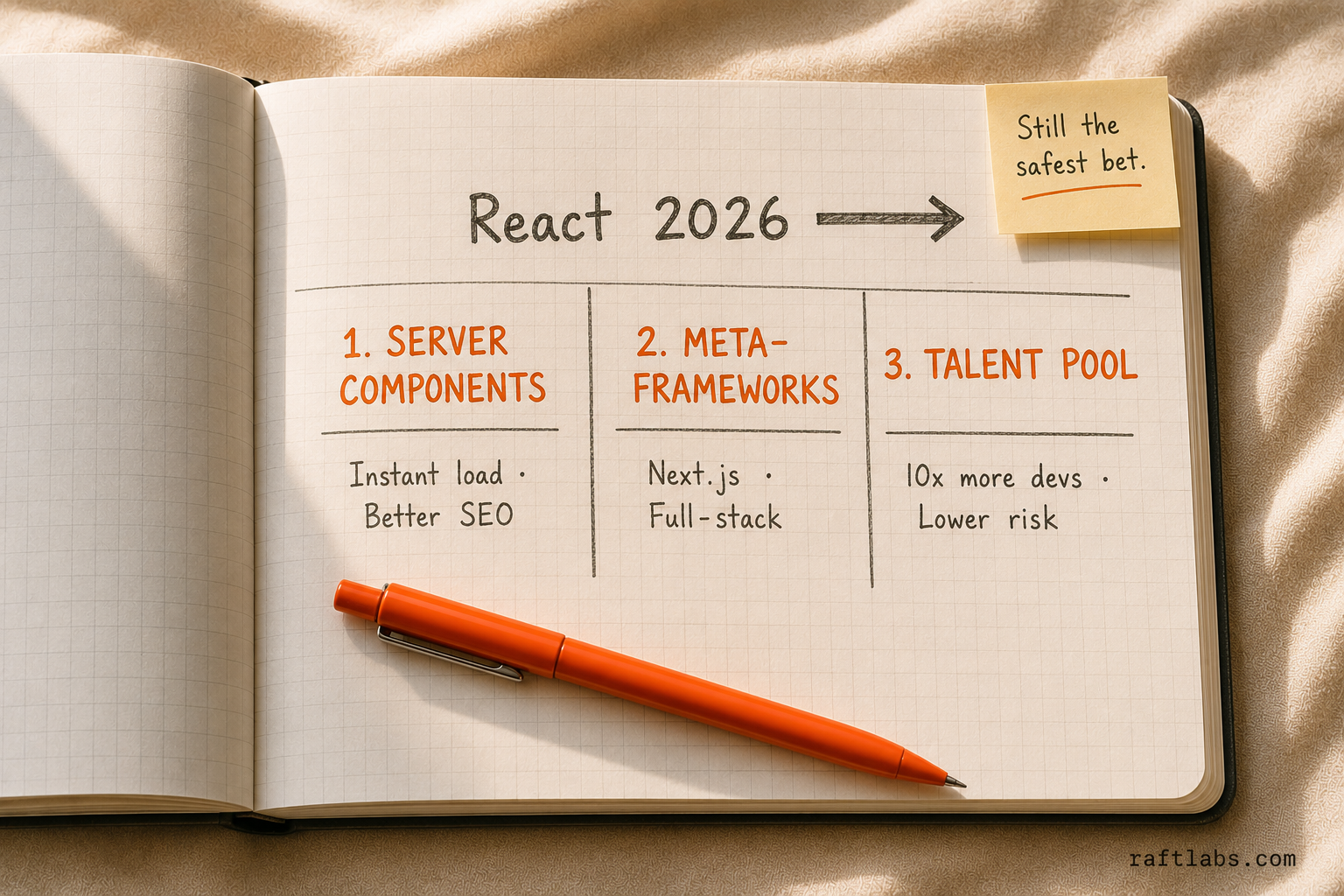
1. The React Server Component (RSC) shift
This is the biggest driver of React's future. With traditional React, the browser did all the heavy lifting (Client-Side Rendering). RSCs allow chunks of your application to run on the server, sending pure HTML and CSS to the client first.
| Impact | Old React (2023) | New React (Today) |
|---|---|---|
| Performance | Slow Time-to-Interactive (TII). | Near-instant First Contentful Paint. |
| Cost Saving | Required costly, manual optimization (memoization). | Automatic optimization by the framework. |
| SEO | Poor without complex Server-Side Rendering (SSR) setup. | Excellent, as the initial content is pure HTML. |
This move directly answers the performance and SEO critiques raised by competitors, securing React's place at the top.
2. Meta-Frameworks Make React the Full-Stack Standard
React is a UI library, but modern development is done using meta-frameworks that provide routing, data fetching, and build systems out of the box.
Next.js (Vercel) has become the definitive framework for commercial React applications. Its deep support for RSCs and global deployment via the edge network makes it an enterprise must-have.
This shift means the pool of "React developers" is narrowing to "Next.js/Remix developers." For a business, this is a massive advantage because you are hiring an architect, not just a coder.
3. The enterprise talent pool is unbeatable
Startups can experiment with small, fast frameworks like Svelte, but enterprises (like Netflix, Airbnb, and Meta, the original creator) rely on the mature tooling and talent pool.
Talent Availability: React still dominates global job listings. You can hire 10 vetted React developers faster and cheaper than you can hire two high-quality Svelte developers. This lowers the long-term risk and the cost of scaling.
TypeScript Standard: Over 80% of serious React projects now use TypeScript, which eliminates runtime bugs and drastically improves the maintainability of large, complex codebases (like the multi-carrier shipping software we mentioned). TypeScript is now a baseline skill, not an advanced one.
React is shedding its client-side-only reputation and transforming into a full-stack, performance-first platform. For businesses prioritizing scalability, low risk, and access to a massive talent market, React is the safest and most strategic bet through 2026.
Now that we have established that React is the technically sound choice for the next half-decade, the focus shifts entirely to your budget. The next layer of complexity is understanding why the cost of a developer varies so wildly.
Key Factors That Influence ReactJS Developer Cost
You can’t just ask "How much does a car cost?" without specifying if you want a used sedan or a new Ferrari. The same logic applies here. When you see a wide range in the cost of React app development, it’s usually because of these five specific variables.
1. Experience Level (Junior vs. Mid vs. Senior)
This is the biggest driver of cost. But be careful, years of experience don't always equal skill.
Junior Developers (0-2 years): They are affordable. They know the basics of React, HTML, and CSS. But, they need hand-holding. If you hire a junior to build a complex architecture from scratch, you will pay for it later in "technical debt."
Mid-Level Developers (3-5 years): These are your workhorses. They can write clean code, work independently, and solve standard problems without nagging you. For most companies, this is the sweet spot.
Senior Developers (5+ years): They cost a premium, and for good reason. They don't just code; they architect. They spot performance bottlenecks before they happen. You hire them when the stakes are high.
2. Developer Location
Geography is still king when it comes to pricing. A developer sitting in San Francisco has a higher cost of living than a developer in Bangalore or Warsaw. We’ll break down the specific rates in the next section, but just know that shifting your search radius can cut your costs by 50% or more without sacrificing quality.
3. Employment / Engagement Model
How you hire matters as much as who you hire.
Freelancers: usually have lower hourly rates because they have less overhead. But, reliability can be a toss-up.
In-house: You pay a salary, plus benefits, insurance, and taxes. It’s a long-term commitment.
Agency (Outsourcing): You usually pay a blended hourly rate. It might look higher than a freelancer on paper, but it covers the developer, the project management, and the guarantee of delivery.
4. Project Complexity & Scope
Are you building a simple brochure site with a few interactive elements? Or are you building a real-time data visualization dashboard?
Simple Projects: Lower React js developer cost because you can use junior or mid-level talent.
Complex Projects: Require knowledge of Redux, Next.js, server-side rendering, and API integrations. You need senior talent here, which raises the price.
5. Timeline & Urgency
If you need it done "yesterday," you are going to pay a rush fee. Tighter deadlines mean developers have to work overtime or weekends, and that comes at a premium. Planning ahead is the easiest way to save money.
Check out: Our ReactJS Development services to build web, mobile and AI applications
Average ReactJS developer hourly rates by region
Here is the data you probably came here for. We’ve aggregated this based on current market trends and what we see happening in the industry right now. Keep in mind, these are averages: you will always find outliers.
According to Glassdoor’s 2024 salary data, the median React developer salary in the United States is $127,000/year, equating to roughly $65/hour at standard employment costs. That’s before you factor in employer payroll taxes, benefits, and overhead, which typically add another 25-30% to the true cost.
We have categorized this by major tech hubs to give you a realistic view of the cost to hire a ReactJS developer globally.
| Region | Junior Dev ($/hr) | Mid-Level Dev ($/hr) | Senior Dev ($/hr) |
|---|---|---|---|
| North America (USA, Canada) | $60 - $90 | $90 - $140 | $150 - $250+ |
| Western Europe (UK, Germany) | $50 - $80 | $75 - $120 | $110 - $180 |
| Eastern Europe (Poland, Ukraine) | $30 - $50 | $50 - $80 | $70 - $110 |
| Asia-Pacific (India, Vietnam) | $18 - $30 | $30 - $50 | $50 - $80 |
| Middle East & Africa | $25 - $45 | $45 - $70 | $65 - $100 |
A Quick Breakdown
North America: You are paying for timezone alignment and cultural similarity, but it is the most expensive market.
Western Europe: Slightly cheaper than the US, but still high cost.
Eastern Europe: A very popular "nearshore" option. High-quality math and engineering education systems produce great devs here.
Asia-Pacific: The best value for budget. Vetting matters most here. A top-tier agency in this region delivers Senior US-level quality at Junior US-level prices.
Hiring ReactJS Developers vs In-house ReactJS Team
Now that we have looked at the hourly rates, you need to decide how you actually want to bring these people on board. This decision impacts your budget just as much as the hourly rate does.
There are generally two main paths our clients take.
1. In-House Route
Building an internal team is the traditional way. You have total control. The developers sit in your office (or your Slack channel) and work only for you.
Pros:
Deep Product Knowledge: They learn your business inside out.
Culture: They are part of your company's DNA.
Immediate Availability: You can tap them on the shoulder anytime.
Cons:
High Fixed Costs: You pay them even if there is no work to do.
Slow Scaling: It takes months to hire and onboard.
Retention Issues: Good React developers get poached easily.
2. The Outsourcing / Staff Augmentation Route
This is where you hire a individual React developers or dedicated team through an agency like Raflabs. You get the talent without the HR headaches.
Pros:
Flexibility: Scale up or down in weeks, not months.
Cost Efficiency: No overhead for office space, laptops, or insurance.
Access to Experts: Agencies usually have senior tech leads overseeing the juniors.
Cons:
Communication Gaps: If you don't manage it well, time zones can be tricky.
Less "Ownership": They are committed to the project, but they are not your employees.
If you are a startup or an SME, the cost to hire a Reactjs developer is almost always lower when you outsource because you are converting fixed costs into variable costs. You only pay for what you use.
Hidden & Additional Costs to Consider
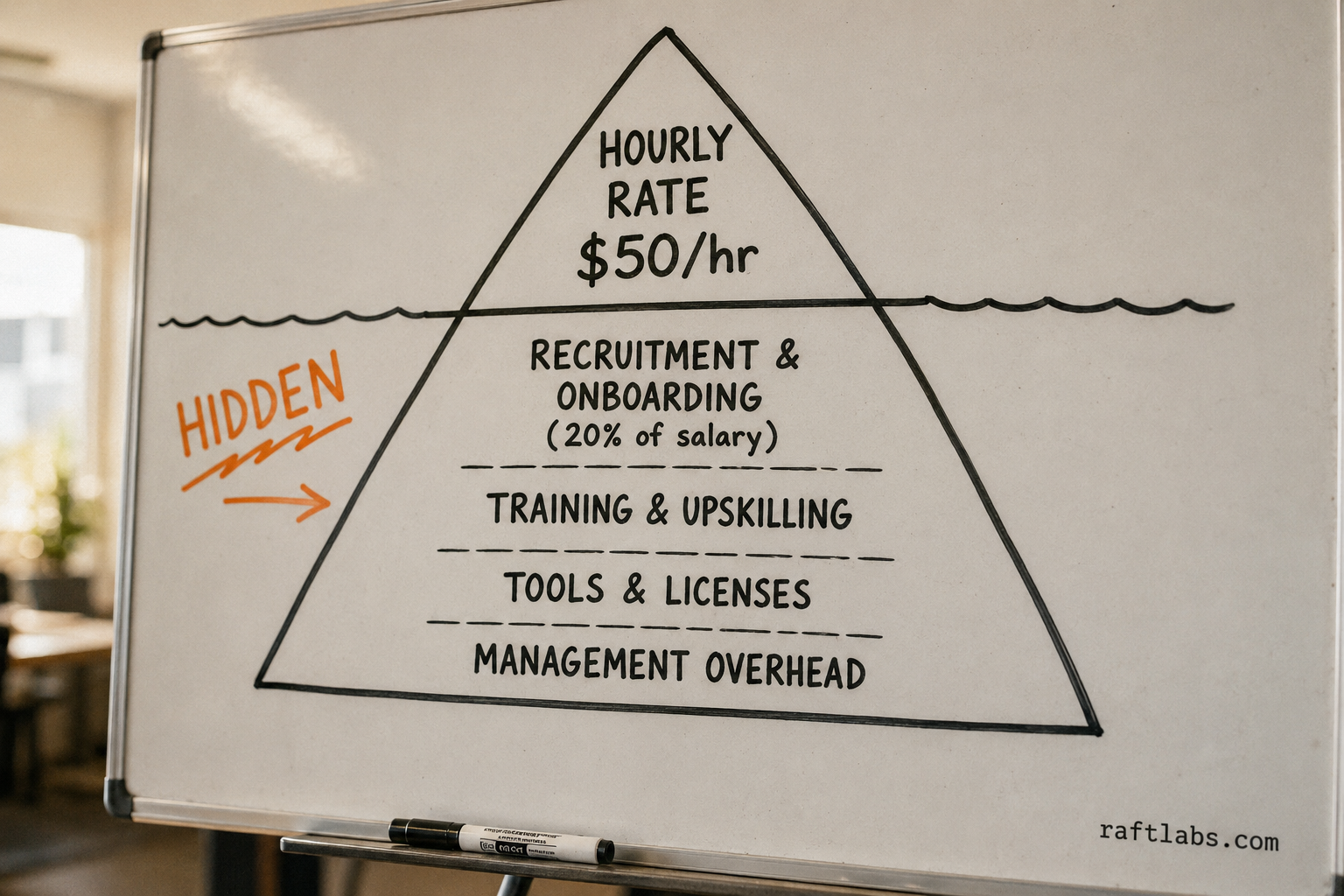
This is the section that saves you money. Most people look at a rate of $50/hour and think that is the final price. It is not. There is an "iceberg effect" in software development. The rate is just what you see above the water.
Here are the hidden costs that bloat the ReactJS developer cost if you aren't paying attention.
1. Recruitment & Onboarding
If you hire in-house, you are paying for job postings, recruiter fees (which can be 20% of the annual salary), and the time your CTO spends interviewing candidates instead of coding. That time is expensive. Even with freelancers, you spend hours vetting them.
Integrating an AI recruitment software can streamline the initial candidate screening process, significantly cutting down on the time and expensive administrative overhead spent by your internal team or HR department.
2. Training & Continuous Learning
React changes fast. New hooks, new state management libraries, new testing tools. If you have an in-house team, you need to pay for their courses and conference tickets. If you don't, their skills rot and your code suffers. When you hire an agency, this training cost is on us, not you.
3. Tools, Licenses, and Infrastructure
Every developer needs a good laptop. They need licenses for IDEs, Jira, Slack, and cloud server access. These small subscriptions add up to thousands of dollars a year per head.
4. Communication & Management Overhead
This is the silent budget killer. If you hire cheap freelancers who don't speak your language well or aren't proactive, you will spend 20 hours a week managing them. Your time has a dollar value. If you are spending half your week debugging their misunderstandings, the actual cost of React app development has just skyrocketed.
Need senior React expertise next week? Hire experienced React developers who can join immediately, improve your codebase, and deliver predictable results. Hire React devs
Best Practices for Hiring ReactJS Developers (Without Wasting Budget)
We have been doing this for over 20 years. We have seen clients burn their budget in two months on a project that should have taken six. Here is how you avoid that.
1. Define Requirements Clearly
Don't just say "I want a clone of Uber." Break it down.
What features are "must-haves" for the MVP?
What features can wait?
The clearer your scope, the more accurate the quote. Vague requirements lead to "scope creep," and scope creep destroys budgets.
2. Choose the Right Hiring Model for Your Stage
The way you hire should match your current needs for speed, cost, and control. For startups, the default answer is rarely a full-time, in-house salary commitment. The right model must align with your funding stage and project stability.
| Stage | Business Need | Recommended Model | Rationale |
|---|---|---|---|
| Pre-Seed / MVP | Maximum speed, minimum cost, high uncertainty. | Freelancer or Boutique Agency | Allows for rapid prototyping and access to a senior developer for a short, fixed scope. Avoids salary and benefits overhead. |
| Seed / Growth | Rapid scaling, building IP, fluctuating workload. | Staff Augmentation (Agency) | Ideal for managing the unpredictable growth phase. You get the flexibility to scale up or down in weeks and fill immediate skill gaps (like DevOps or senior architecture) without long-term risk. |
| Series A+ / Stability | Deep control, company culture integration, core product ownership. | Core In-House Team (with Augmentation) | Start hiring your first 1-3 full-time engineers (the core team) to own the IP, but use staff augmentation to handle the temporary bulk of development work. |
3. When to Use a Freelancer vs. An Agency vs. In-House
Each model has a purpose:
Use a Freelancer When...
The task is small and clearly defined: (e.g., "Implement a specific API endpoint," "Fix critical bugs on a legacy component," or "Design a new payment modal").
Budget is the absolute priority.: They have the lowest overhead and hourly rates for solo work.
The task is temporary: You only need someone for 40-80 hours to get over a hump.
Risk Alert: Freelancers offer no built-in quality control, project management, or backup. If they disappear, your project stops. Use them for non-critical, isolated tasks.
Use an Agency (Staff Augmentation) When...
You need to launch fast (MVP or new feature): Agencies provide pre-vetted, scalable teams that can start contributing in days, not months.
The project is complex or long-term (6+ months): Our model (like the 5-Hour Sync) includes project management, QA, and immediate developer replacement if needed. This eliminates the "freelancer risk."
You need specialized senior skills: Instead of hiring a full-time CTO-level architect, you augment your team with that expertise for the three months you need them.
Hire In-House When...
You need a founder/CTO: The core IP and architectural decisions must be owned internally, usually by a founding engineer or CTO.
Long-term commitment is paramount: The developer must be deeply integrated into the company culture and committed to supporting the product for years.
Data sensitivity is extreme: Legal and compliance requirements (e.g., highly regulated finance or healthcare apps) sometimes mandate local, full-time employment for IP security.
4. Assess Technical and Product Skills
Coding tests are fine, but they aren't enough. Ask them to explain a complex concept to you in simple English.
If they can't communicate clearly, they will be hard to work with.
Also, look for "product sense." You want a developer who asks "Why are we building this?" not just "How do I code this?"
5. Check Communication & Cultural Fit
This is more important than raw coding speed. A brilliant jerk will destroy your team's morale. A mid-level developer who communicates well, admits mistakes, and asks for help is worth their weight in gold. Make sure their working hours overlap with yours by at least 3 to 4 hours.
Also Read: Top 10 ReactJS Development companies in 2026
How to Optimize ReactJS Hiring Costs
We’ve seen what drives the React js developer cost up. Now, let’s talk about strategy.
How can you be smart about this and get senior-level output without paying top-tier US rates?
It’s completely possible, but it requires a change in mindset.
1. Look Beyond Your Local Market
This is the single biggest lever you have. If you’re based in London or New York, hiring locally means paying premium rates just for geographical proximity. By partnering with an established global agency, you instantly tap into talent pools in Eastern Europe, Asia, or Latin America.
Cost Savings: Rates can be 50-70% lower.
Talent Depth: You get access to a much wider, often highly specialized, pool of developers.
The Key: The quality control and vetting process must be handled by an experienced partner, like us.
2. Use Time Zone Overlap Strategically
Don't just hire someone ten time zones away and hope for the best. Plan for overlap. Even a few hours of synchronous communication (via video call or Slack) at the start or end of the day is enough for:
Daily stand-ups.
Feature clarification sessions.
Code review feedback.
The asynchronous work gets done while you sleep, which actually speeds up your overall project timeline. This efficiency reduces the total cost of React app development by cutting down on delays.
3. Plan for Long-Term Engagements
Short-term contracts, while flexible, often come with higher hourly rates to compensate the developer for the short-term risk. If you know you have 6-12 months of development ahead, locking in a commitment can yield better rates.
Agencies (like Raflabs) are more likely to offer volume discounts for extended contracts.
Developers appreciate stability and often integrate deeper into your company’s long-term vision.
4. Start with a Pilot Project
Don't commit to a multi-year engagement with a new partner. Mitigate risk.
Start with a clearly defined, small feature or an MVP.
Test their communication, code quality, and ability to hit deadlines.
If the pilot is successful, scale the team aggressively with the same partner. This proves their value before you invest large sums.
What to check before hiring React developers
We’ve laid out the map. You know the variables. You know the best practices. But why trust Raflabs to execute this vision for your business?
We are not just a staffing company. We are a software development agency built by veterans who understand that technology must serve the business goal. Here is what we bring to the table that impacts your overall cost to hire a ReactJS developer and delivers massive value.
Pre-vetted seniority: Our developers are already screened for both hard skills (clean code, architecture knowledge) and soft skills (communication, product thinking). You skip the costly and time-consuming internal recruitment process entirely.
Embedded process: We don't just hand you a coder. We provide the structure. Project management, daily reporting, automated testing, and QA are all part of our service. This eliminates your management overhead, which was one of those major hidden costs we talked about.
Scalability on demand: Your business doesn't grow linearly. You might need two developers next month and five the month after. We can scale our team up or down rapidly to match your product roadmap, ensuring you are never paying for idle resources.
Focus on maintainability: We build component-driven architectures that are easy to update, maintain, and scale. Our focus on clean, modular code reduces your future maintenance costs and technical debt, ensuring the actual lifetime React js developer cost of the application remains low.
If you are looking for dedicated ReactJS expertise, proven project delivery, and a transparent partnership, we should talk. We convert the confusion of hiring into a predictable, high-value process.
Conclusion
The cost to hire a ReactJS developer doesn't have to be a confusing, budget-killing gamble. By shifting your focus from the simple hourly rate to the Total Cost of Ownership (TCO), you gain the strategic clarity needed to make smart decisions.
React is undeniably the most future-proof technology for the next half-decade, but its success hinges on who you hire and how you hire them. The savvy founder or CTO understands that saving $10 per hour on a junior developer only to incur thousands in technical debt and management overhead is a false economy.
Your competitive advantage lies in accessing pre-vetted, high-caliber global talent without the enormous fixed costs and recruitment delays of the in-house route.
If you are ready to stop burning through budget on interviews and start building a scalable, performance-first application, the time to partner with an expert agency is now.
Don't just hire a developer; hire a dependable development process. We’ve successfully delivered 25+ apps, from POS and gaming platforms to education tools and AI assistants, all designed to scale reliably and support your business goals. If you’re ready to turn your ideas into reality, contact us today and let’s get started.
Ask an AI
Get an instant summary of this post from your preferred AI assistant.
Common questions
- The high cost to hire a Reactjs developer is mainly due to extreme demand and specialization. React is the dominant library for modern web interfaces. Demand for true senior-level talent, who can handle state management, performance optimization, and complex architecture, far outstrips supply, especially in high-cost regions like North America.
- For short, non-critical tasks, a freelancer might seem cheaper hourly. However, for anything complex or long-term, an agency is almost always more cost-effective. The agency cost includes project management, quality assurance, risk mitigation (if one developer leaves, the project continues), and guaranteed communication standards. A cheap freelancer often means you end up paying twice.
- The staff augmentation/dedicated team model is often the best balance. This is where you hire developers through an agency, but they work only for your project, integrating into your existing team. It gives you the cost savings and flexibility of outsourcing while maintaining the close collaboration and focus of an in-house team.
- Outsourcing is better for cost and speed. You eliminate the massive overhead of recruitment, HR, benefits, and office space. Building an in-house team is only recommended if you have deep, sensitive intellectual property that requires physical proximity, or if you plan to keep a stable core team for five-plus years. For most businesses, outsourcing through a reliable agency is the smarter strategic move.