Conversational AI in Hospitality: Use Cases, Benefits, ROI, and Examples
- Riya Thambiraj

- Travel and Hospitality
- Last updated on
Key Takeaways
Conversational AI in hospitality offers 24/7 guest support, improving operational efficiency and guest satisfaction.
AI addresses staffing shortages by acting as digital concierges, handling reservations, and answering questions.
Key benefits include cost savings, personalized interactions, and multilingual support.
Practical use cases span pre-arrival booking assistance to post-stay feedback and loyalty engagement.
Real-world success stories from Marriott, Hilton, and others highlight AI's transformative impact.
Measuring ROI involves tracking call deflection rates, cost per interaction savings, and customer satisfaction improvements.
Challenges include over-automation, data biases, and guest preferences for human interaction.
Implementation best practices focus on selecting the right platforms, designing conversational flows, and ensuring compliance.
AI enhances accessibility with voice commands, multilingual support, and real-time transcription.
Vendor evaluation should consider NLP accuracy, integration capability, and support.
Embracing conversational AI sets new standards for guest experience and competitive advantage.
Imagine a frustrated guest trying to get answers at 2 a.m., stuck on hold or navigating confusing phone menus.
How nice would it be to be able to just shoot a text or have a regular old conversation & instantly get some real help, 24/7 .
This is the promise of conversational AI in hospitality, transforming how companies across hotels, resorts, restaurants, and travel services engage with guests and streamline operations.
Conversational AI is a form of artificial intelligence that enables natural, human-like interactions between guests and hospitality companies, making communication faster and more intuitive.
With 87% of US hotels facing staffing shortages and 40% of calls unanswered, traditional hiring falls short. AI voice assistants serve as digital concierges that are available 24/7 to take care of reservations and answer questions.
In fact, according to Deloitte's Travel Industry Outlook, more than 70% of hotel executives are prioritizing AI investment.
Who this Article is for?
This guide serves as a resource for professionals responsible for the operational and technological direction of hospitality businesses.
It is written specifically for:
Hotel managers, resort operators, and hospitality executives looking to modernize guest services
Restaurant owners and travel service providers seeking to improve customer engagement
IT directors and operations managers responsible for evaluating and implementing AI solutions
Property management teams facing staff shortages or high operational costs
Anyone in the broader travel and hospitality industry interested in understanding how AI can transform guest experiences
You can skip reading this article if:
You operate an ultra-luxury boutique property (fewer than 20 rooms) that relies exclusively on highly personalized, white-glove human service
You're looking for basic chatbot information without implementation details or ROI analysis
Your property has no interest in automation or digital transformation
Why Conversational AI Matters in Hospitality: Key Benefits and Business Impact
Now that you understand who this guide is for and what we'll cover, let's start with the fundamental question: why should hospitality businesses invest in conversational AI?
The answer lies in understanding both the challenges facing the industry and the transformative capabilities this technology brings to the table.
Conversational AI technology, which includes AI chatbots, virtual assistants, and voice assistants, uses natural language processing and machine learning to provide real-time, context-aware support for guests. Unlike traditional automated systems that follow rigid scripts, modern AI understands intent, learns from interactions, and delivers increasingly personalized responses over time.
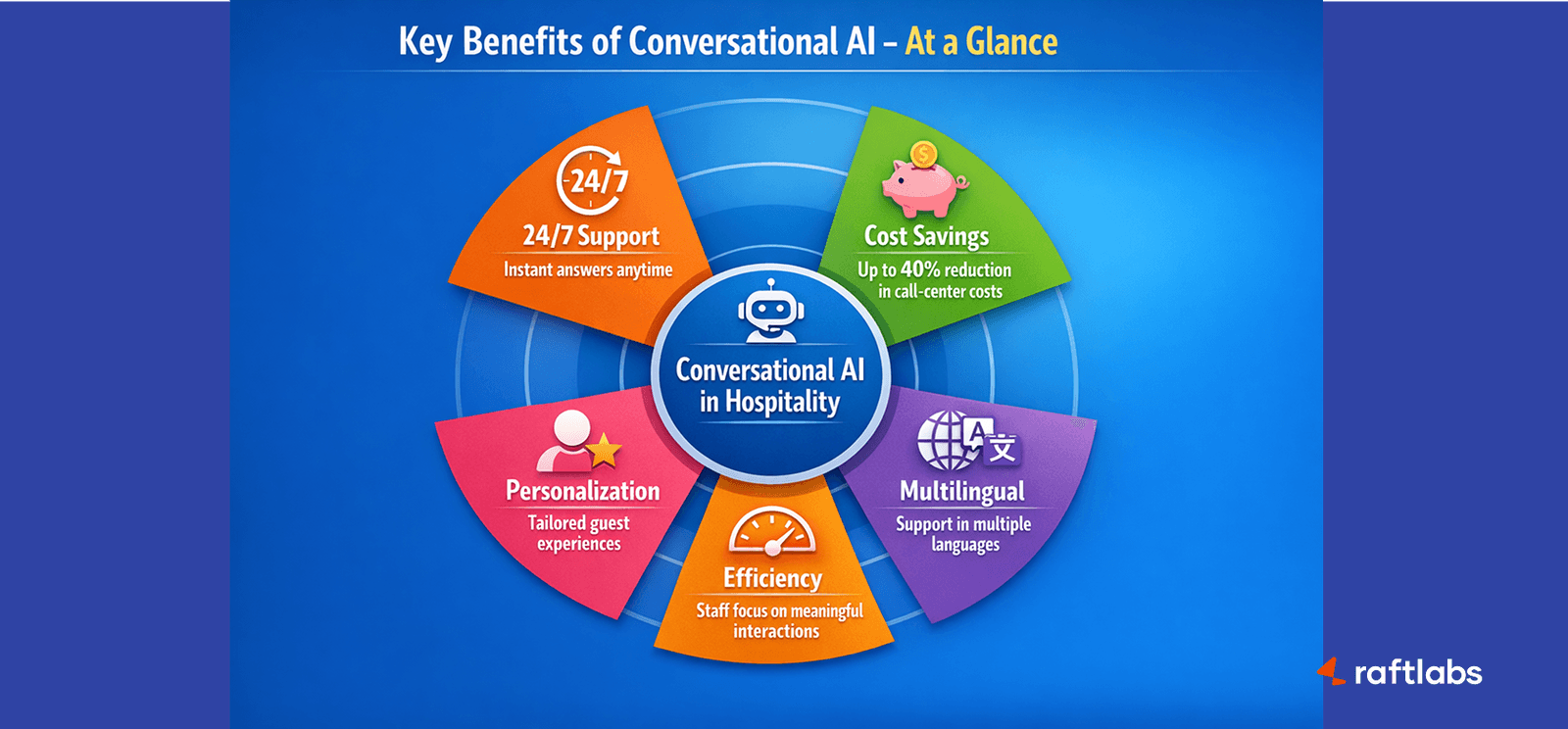
Let us first examine the core benefits that make conversational AI a game-changer for hospitality operations:
1. 24/7 Instant Support
Guests can get immediate answers to questions or requests at any time, creating a stress-free and convenient experience. Whether it's 2 a.m. or peak check-in hours, AI ensures no guest inquiry goes unanswered, eliminating the frustration of wait times and missed calls.
2. Operational Efficiency
By handling routine inquiries and service tasks, AI allows staff to focus on more meaningful interactions and memorable guest experiences. This shift enables your team to move from transactional work to relationship-building activities that truly differentiate your property.
3. Cost Savings
AI can manage a large portion of standard questions, helping hospitality companies reduce staffing and training costs while maintaining high-quality service. Properties typically see 40-80% reduction in cost per interaction when AI handles routine requests.
4. Personalized Guest Interactions
AI systems connect with property management and customer relationship platforms to offer tailored recommendations and experiences based on guest preferences and history. This level of personalization was previously possible only through dedicated concierge services.
5. Multilingual, Omnichannel Reach
Guests can communicate through web chat, messaging apps, or voice, in multiple languages, making it easy for everyone to feel understood and cared for. This removes language barriers and meets guests where they prefer to communicate.
These benefits aren't just theoretical advantages. Innovative AI solutions are transforming the hospitality industry by enhancing guest experiences, supporting staff, and delivering thoughtful, personalized service that makes every interaction feel effortless and meaningful. The question isn't whether conversational AI delivers value, but rather how to apply it strategically across your operations.
With these foundational benefits established, let us now explore where and how this technology creates impact throughout the guest journey.
Check out: Our travel & hospitality software development services to build you your tailored software product as per business needs.
How Conversational AI Is Transforming the Hospitality Guest Experience
Having explored why conversational AI matters, now let us see how these benefits translate into practical applications.
The guest journey consists of multiple touchpoints from booking to checkout, and conversational AI solutions address every phase, from pre-arrival to post-stay engagement. Understanding where AI creates the most value helps you prioritize implementation and maximize return on investment.
Conversational AI chatbots and AI agents assist guests at every stage of their journey by providing real-time support, answering questions, automating routine tasks like check-ins, and offering personalized suggestions, thereby enhancing operational efficiency and guest satisfaction.
Let us walk through each phase of the guest journey and examine the specific applications where AI delivers measurable impact:
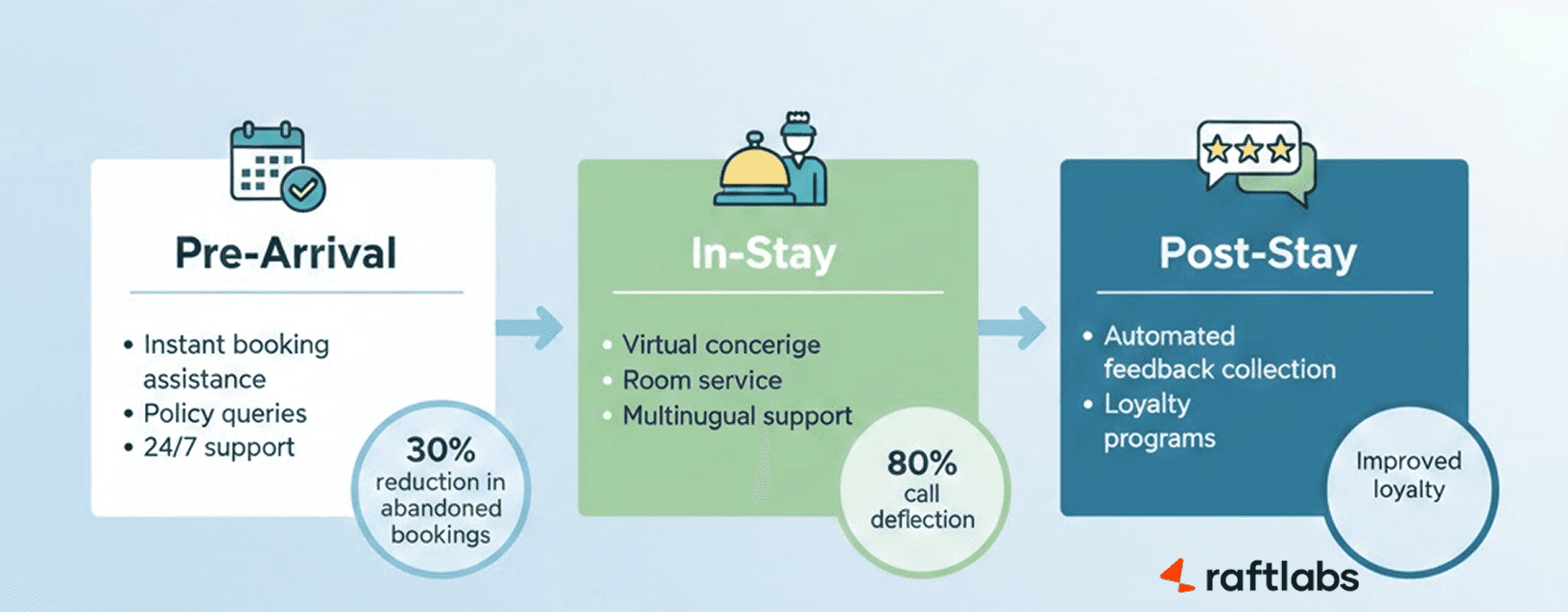
1. Pre-Arrival: Intelligent Search and Booking Assistance
Before guests even arrive at your property, conversational AI begins creating value. During this discovery and planning phase, potential guests have questions that often determine whether they book with you or a competitor.
Guests can inquire about parking, pet policies, and amenities at any hour, receiving instant, accurate responses. AI-powered digital booking agents streamline room reservations by guiding guests through natural-language booking processes, reducing abandoned bookings by up to 30%.
They handle modifications and sync directly with property management systems and existing hotel systems, eliminating manual errors. Digital booking agents can also personalize recommendations and planning for guests on a business trip, offering tailored suggestions and support to enhance their stay.
The key advantage here is speed and availability. When a potential guest asks about availability at 11 p.m., AI responds instantly rather than waiting for morning when they may have already booked elsewhere.
2. In-Stay: Virtual Concierge and Service Automation
Once guests arrive, conversational AI transitions into an always-available digital concierge role. This is where the technology creates its greatest operational impact by handling the high volume of routine requests that traditionally consume staff time.
Virtual concierges, also known as digital concierges, manage service requests such as extra towels, room maintenance, spa bookings, dining reservations, order room service, and room service requests. Multilingual AI chatbots support international guests by handling guest questions and service needs in multiple languages, ensuring seamless communication and a personalized experience.
Automated ticketing routes issues promptly to staff, cutting response times from minutes to seconds. Proactive messaging alerts guests about room readiness or facility updates, enhancing convenience without requiring guests to ask.
An AI solution streamlines front desk operations and supports hotel teams by automating routine tasks, allowing staff to focus on delivering more personalized guest services. The result is faster service delivery and staff who can focus on complex requests and memorable hospitality moments.
3. Post-Stay: Feedback and Loyalty Engagement
The guest relationship doesn't end at checkout. Post-stay engagement drives repeat bookings and builds long-term loyalty, and this is where AI excels at scale.
AI chatbots automate the process of collecting feedback from guests across various hospitality settings, including hotels, resorts, restaurants, and travel services. By engaging guests in personalized conversations tailored to their specific experiences and preferences, these chatbots gather valuable insights in real time.
This enables businesses to promptly identify and resolve issues before they escalate into negative reviews, enhancing service quality and guest satisfaction. Additionally, by continuously adapting to guest input, conversational AI helps build stronger loyalty and delivers a more personalized, seamless experience throughout the entire customer journey.
They also support loyalty programs by managing points, redemptions, and targeted win-back campaigns based on guest history, driving customer loyalty through personalized engagement and incentives.
Voice AI in Hospitality: The Channel Most Hotels Are Currently Ignoring
Most conversations about conversational AI in hospitality focus on text-based channels such as website chat, WhatsApp, and in-app messaging. Voice is the underutilized half of the equation, and for many hotel operations, it represents the higher-volume opportunity.
Hotel front desks still receive enormous numbers of inbound phone calls. Guests call to check availability, confirm booking details, request late checkouts, ask about parking, and report maintenance issues. Each call requires a staff member to answer, look up information, and respond, which are repetitive and time-consuming tasks that do not require human judgment. Voice AI changes this calculus entirely.
What hotel voice AI handles today:
Phone reservation handling is the most mature voice AI use case in hospitality. A voice AI system integrated with your booking engine and PMS can take a complete reservation by phone by gathering dates, room preferences, and guest details, checking real-time availability, confirming rates, and sending a booking confirmation without human involvement.
For hotels that still receive a significant portion of bookings by phone, this alone represents substantial front desk time savings.
In-room voice assistants extend the conversational interface into the guest room itself. Rather than calling the front desk for room service, extra towels, or a dinner reservation, a guest speaks a request to an in-room device. The voice AI routes the request to the appropriate department, logs it in your PMS or task management system, and confirms back to the guest, all within seconds.
Similarly, call center automation for hotel groups with centralized reservations operations is where voice AI delivers its largest efficiency gains. Processing the same reservation, modification, and cancellation workflows across hundreds of properties through a single voice AI layer significantly reduces per-call handling time and staffing requirements.
The multilingual advantage of voice AI: Text-based communication already benefits from multilingual support, but voice AI extends this to phone interactions, which have historically been one of the highest-friction touchpoints for international guests. A voice AI system that handles calls in the guest's language, without accent-matching difficulties or scripted hold music, creates a materially better experience for international travelers than traditional call center operations.
Implementation consideration: Voice AI for hospitality requires a different integration path than text-based conversational AI. It needs telephony system connectivity alongside your PMS, a text-to-speech layer that sounds natural rather than robotic, and a clearly defined human escalation path for calls that genuinely require judgment or empathy. The investment is usually higher than a standard chatbot deployment, but the operational return for front-desk-heavy properties is typically faster.
Enterprise Conversational AI in Hospitality: What Changes at Scale
The conversational AI challenges facing a 25-room boutique property and those facing a hotel group with 50 properties across three countries are fundamentally different. Enterprise deployments introduce complexity that requires architectural decisions not relevant at the single-property level.
Consistency with local customization
At scale, conversational AI in hospitality must maintain brand voice consistency while allowing each property to configure its own policies, rates, local recommendations, and amenity details. A guest interacting with the AI at your downtown city property and your coastal resort should experience the same brand quality, but the AI's operational knowledge needs to be entirely property-specific.
This requires a multi-tenant architecture where a shared AI layer sits above property-specific knowledge bases, which is a configuration that off-the-shelf chatbot platforms typically handle poorly.
Centralized data governance
Enterprise hotel groups cannot afford guest data scattered across per-property AI systems with no unified view. Conversational AI at the enterprise level needs to feed guest interaction data into a centralized CRM, maintain consistent guest profiles across properties, and enable the group-level analytics that inform revenue strategy and guest experience improvements. This requires robust API-level integration with your enterprise CRM and PMS, not just surface-level connections.
Integration with enterprise hotel tech stacks
Large hotel groups typically run complex technology environments: a central reservation system (CRS) for inventory management, property management systems that may differ by property, loyalty program infrastructure, and revenue management platforms. Enterprise conversational AI needs to connect to this full stack, not just the guest-facing PMS. Failing to integrate deeply means the AI is operating on incomplete information, and incomplete information produces wrong answers.
Human escalation at scale
Single-property conversational AI deployments escalate to the front desk. Enterprise deployments need intelligent routing: a guest complaint at Property A escalates to Property A's guest services team, not a shared inbox. A group booking inquiry routes to the sales team, not the front desk. Building these escalation paths correctly across 50 properties is a meaningful engineering challenge that separates enterprise implementations from basic deployments.
Pilot and rollout strategy
Enterprise conversational AI in hospitality is never a simultaneous rollout across all properties. The standard approach is a pilot at one or two high-volume properties, measurement of containment rates and guest satisfaction impact over 60–90 days, refinement of conversation flows based on real interaction data, and then a phased rollout with property-specific customization at each stage.
Organizations that skip the pilot and attempt enterprise-wide deployment simultaneously consistently report implementation failures not tied to the technology itself, but to inadequate training data and under-designed escalation logic.
Now that we've seen how conversational AI creates value across the guest journey, the natural next question becomes: how do you measure this value and demonstrate return on investment to stakeholders?
Conversational AI ROI in Hospitality: Metrics, Benchmarks, and Business Impact
Understanding the applications of conversational AI is important, but justifying the investment requires concrete metrics. Now let us examine how to measure success and what performance benchmarks indicate excellent versus adequate AI deployment.
Assessing conversational AI's impact requires tracking key performance indicators that align with your business objectives.
Understanding Performance Benchmarks
Beyond these core metrics, let us now examine what separates adequate AI performance from truly exceptional results. Understanding these benchmarks helps properties set appropriate targets and continuously improve.
The following table illustrates performance standards across three tiers:
| Metric | Adequate (Standard) | Good (High-Performance) | Great (Elite) |
|---|---|---|---|
| Call Deflection | 40–60% (Basic FAQs) | 60–75% (Routine tasks) | 75–85% (Complex logic) |
| First Contact Resolution | 60–70% | 70–85% | 85%+ |
| Response Time | 2–5 Minutes | 30s – 2 Minutes | < 30 Seconds |
| Cost Savings | 40–50% (Simple tasks) | 50–70% (Multi-turn) | 70–80% (Total automation) |
| Direct Booking Lift | 5–10% Increase | 10–18% Increase | 18–25%+ Increase |
| Upsell Conversion | 2–5% Take Rate | 5–10% Take Rate | 10–15%+ Take Rate |
| CSAT Score | 70–80% | 80–90% | 90%+ |
| NPS Improvement | +5 Points | +10–15 Points | +15–20 Points |
Strategic Note: Deflection rates above 85% can lead to guest frustration. The goal is "Smart Routing," ensuring guests get a human when they actually need one.
Let's start by understanding the essential metrics more clearly:
1. Call Deflection Rates (60–80%)
This metric measures the percentage of guest inquiries or calls that are successfully handled by the conversational AI system without needing to be transferred to human agents.
High call deflection rates indicate that the AI is effectively managing routine questions and requests, reducing the workload on hotel staff and contact centers. This leads to faster response times for guests and operational cost savings.
2. Cost Per Interaction Savings (up to 80%)
Conversational AI can handle many guest interactions at a fraction of the cost of human agents. This includes answering FAQs, managing bookings, and processing service requests.
The savings come from reduced staffing needs, lower training expenses, and the ability to handle multiple conversations simultaneously without additional costs.
3. Increases in Direct Bookings and Ancillary Revenue (10–25%)
By providing personalized recommendations and seamless booking assistance, conversational AI encourages guests to book directly through the hotel’s channels rather than third-party platforms.
This not only increases direct bookings but also boosts ancillary revenue through upselling services like spa treatments, dining, or room upgrades.
4. Customer Satisfaction Improvements (CSAT/NPS)
Customer satisfaction scores, such as CSAT (Customer Satisfaction Score) and NPS (Net Promoter Score), measure how guests perceive their experience.
Conversational AI enhances satisfaction by providing instant, accurate, and personalized responses, reducing wait times, and ensuring consistent service quality 24/7. Top-performing implementations achieve 90%+ CSAT scores for AI interactions.
Check out: Our Enterprise AI Chatbot Development Services to build tailored chatbot as per business needs.
Conversational AI Implementation Timeline and Expected ROI
Now that we understand the metrics, let's examine the typical timeline for seeing returns on your AI investment:
Months 1–3: Initial investment phase involving technology acquisition, integration with existing hotel systems (like property management systems and CRM), and pilot deployments to test the AI in real-world scenarios. During this period, focus on proper configuration and staff training.
Months 4–6: Breakeven point where cost savings from reduced staffing and improved booking conversions start offsetting the initial investment. You'll begin seeing measurable improvements in deflection rates and guest satisfaction.
Months 7+: Sustained returns become apparent through ongoing operational efficiencies, increased upsell revenue, and stronger guest loyalty driven by consistent, personalized service. This is when the compounding benefits of AI become clear.
Revenue Generation Beyond Cost Savings
Conversational AI doesn't just reduce costs—it actively drives revenue growth through intelligent upselling and personalization.
1. Contextual Upselling
AI identifies natural moments to suggest upgrades, add-ons, or premium services without feeling pushy. For example, when a guest books a spa appointment, the AI might suggest a complementary massage upgrade or extended session based on their preferences and past behavior.
Unlike human staff who may forget to mention upsells or feel uncomfortable pushing sales, AI consistently presents relevant offers at scale. The system learns which offers resonate with different guest types, continuously refining its approach to improve conversion rates.
2. Dynamic Pricing and Strategic Offer Management
Conversational AI can help hotels optimize pricing strategies by dynamically adjusting offers based on demand, seasonality, and guest segments. This data-driven approach ensures that hotels capture more value during peak periods while maintaining high guest satisfaction.
The system learns which offers resonate with different guest types, continuously refining its approach to improve conversion rates. For instance, leisure travelers might respond better to package deals, while business travelers value convenience upgrades like express checkout or lounge access.
3. Measurable Revenue Impact
Specific examples of how properties generate incremental revenue through AI:
Room Upgrades: AI identifies guests likely to upgrade based on past behavior and presents offers at optimal moments, typically generating 10-15% conversion rates
Spa and Dining: Proactive recommendations based on guest preferences and availability drive 5-10% increases in ancillary bookings
Late Checkout and Early Check-in: Dynamic pricing for timing flexibility can generate $20-50 per transaction with minimal operational cost
Ultimately, conversational AI empowers hotels to drive incremental revenue, foster guest loyalty, and stand out in a crowded marketplace. The best implementations see 15-25% increases in revenue per available room (RevPAR) directly attributable to AI-driven upselling.
Also Read: Cost of hotel booking app development guide
Real-World Examples of Conversational AI in Hospitality Industry
Theory and benchmarks are valuable, but nothing demonstrates the power of conversational AI quite like real-world success. Now let us examine how leading hospitality brands have successfully integrated AI solutions to enhance guest experiences and operational efficiency.
These examples span different property types and operational challenges, showing that conversational AI delivers results regardless of your specific context:
Marriott’s “MC” Chatbot
Marriott International deployed their AI chatbot "MC" across their portfolio to handle guest inquiries and service requests through multiple messaging platforms. The chatbot assists guests with reservations, check-in procedures, and service requests, reducing support queries by over 60% while simultaneously boosting satisfaction scores.
The key success factor was integration with Marriott's existing property management systems, allowing MC to access real-time room availability and guest preferences. This eliminated the common frustration of chatbots that can't actually complete actions, only provide information.
Hilton's "Connie" - Watson-Enabled Robot Concierge
Hilton took a different approach with Connie, an IBM Watson-powered robot concierge deployed at select properties. Connie uses natural language processing to assist guests with information about local attractions, hotel services, and amenities.
What makes Connie particularly effective is the learning capability, the system improves recommendations based on successful interactions and guest feedback.
Within six months of deployment, guest engagement rates increased by 40%, with particularly strong adoption among younger travelers who appreciate the technology-forward approach.
The Cosmopolitan of Las Vegas - "Rose" AI Chatbot
Rose represents AI with personality. This chatbot handles restaurant reservations, room service requests, and guest inquiries while maintaining the hotel's upscale, playful brand voice. The Cosmopolitan specifically designed Rose to feel like part of their team rather than a generic automated system.
The results speak for themselves: 70% deflection rate for routine inquiries, 85% guest satisfaction with AI interactions, and staff who can focus on creating memorable experiences rather than answering repetitive questions about pool hours and WiFi passwords.
Holiday Inn Express & Suites Orlando (SeaWorld)
This property demonstrates that you don't need to be a luxury brand to benefit from AI. By implementing a chatbot that tracks guest itineraries and delivers personalized recommendations for upgrades and amenities based on their travel plans, the property generates approximately $1,700 monthly through AI chatbot upsells.
The key lesson here is ROI at scale, even modest per-interaction revenue gains multiply across hundreds of monthly guests, creating significant incremental income with minimal operational overhead.
What These Success Stories Teach Us
These real-world examples highlight several critical success factors:
- Integration is essential - AI must connect with your existing systems to take actions, not just provide information
- Brand alignment matters - AI should reflect your property's personality and service standards
- Staff enablement is key - Successful implementations free staff for higher-value work rather than replacing them
- Continuous improvement drives results - The best systems learn and adapt based on actual guest interactions
These transformative implementations show that conversational AI hospitality solutions work across different types of properties and operational challenges. By automating routine tasks and providing instant, personalized guest support, these AI-powered tools not only enhance guest convenience but also drive measurable improvements in operational efficiency and customer satisfaction.
Ready to transform your guest experience? Schedule a free consultation with our hospitality AI experts to discuss your specific needs, explore integration options with your existing PMS, and get a customized implementation roadmap. Schedule now
With these success stories as inspiration, you're likely wondering how to begin your own AI journey. Let us now explore the practical roadmap for implementation.
Conversational AI Implementation Roadmap for Hotels: From Strategy to Launch
Seeing successful implementations from industry leaders is inspiring, but now let us translate that inspiration into action. This section provides your step-by-step roadmap for successfully implementing conversational AI at your property, from vendor selection through launch and beyond.
To successfully implement conversational AI in hospitality, you need a structured approach that addresses technology selection, integration, and organizational readiness. Let's walk through each critical phase:
Phase 1: Platform Selection and Vendor Evaluation
Before choosing a conversational AI platform, first understand your specific requirements and how different vendors meet them. Not all AI solutions are created equal, particularly for hospitality applications.
When choosing conversational AI hospitality solutions, evaluate vendors across these critical dimensions:
| Criterion | Description |
|---|---|
| NLP and Machine Learning | Accuracy with hospitality-specific language and intent |
| Multilingual Support | Number of languages and dialects supported |
| Integration Capability | Seamless connection with PMS, CRM, and communication tools |
| Security and Compliance | Certifications and adherence to privacy regulations; ensure compliance when sending marketing messages through AI-driven communication tools |
| Customization and Scalability | Ability to tailor to brand voice and scale across properties |
| Support and Training | Vendor assistance for onboarding and ongoing optimization |
Practical Tip: Request proof-of-concept deployments from your top 2-3 vendors using your actual guest interaction data. This reveals how well the system handles your specific use cases before committing to a full implementation.
Phase 2: Defining Objectives and Phased Rollout
With a vendor selected, now let us establish clear objectives and a realistic implementation timeline. Starting with high-impact use cases ensures early wins that build momentum and stakeholder support.
Begin by identifying your primary goals:
Cost reduction - Focus on high-volume, routine inquiries like hours, directions, amenities
Revenue growth - Prioritize booking assistance and upselling opportunities
Guest satisfaction - Target pain points like wait times and language barriers
Then structure your rollout in phases:
Phase 1 (Months 1-2): Deploy AI for single, high-volume use case (e.g., booking inquiries)
Phase 2 (Months 3-4): Expand to 2-3 additional use cases once initial deployment stabilizes
Phase 3 (Months 5-6): Full deployment across all planned touchpoints with continuous optimization
This phased approach allows your team to learn, adjust, and build confidence before scaling system-wide.
Phase 3: Designing Conversational Flows
The most sophisticated AI platform fails if the conversation design doesn't reflect your brand and meet guest needs. Now let us focus on creating natural, effective dialogue flows.
Design conversational flows that reflect your brand voice and culture. Your AI should sound like your team, not a generic robot. If your property is upscale and formal, the AI's tone should match. If you're boutique and playful, the AI can be more casual and friendly.
Key principles for effective conversation design:
Start with common paths - Map the 10-15 most frequent guest inquiries and perfect those flows first
Keep it concise - Guests want answers, not lengthy explanations. Aim for 1-2 sentence responses when possible
Provide clear options - When multiple paths exist, present 3-4 clear choices rather than open-ended questions
Design for failure - Plan what happens when AI doesn't understand, including seamless escalation to human agents
Phase 4: Integration and Testing
With conversation flows designed, now let us ensure the AI connects properly with your existing technology infrastructure.
Building the proper infrastructure and seeking expertise from specialized technology providers ensures smooth adoption and effective deployment. This phase focuses on technical integration with your property management system (PMS), customer relationship management (CRM), booking engines, and communication channels.
Key integration checkpoints:
Data sync verification - Confirm AI can access real-time room availability, guest profiles, and service status
Two-way communication - Ensure AI can both read information and take actions (create bookings, log requests)
Channel deployment - Test AI across all intended touchpoints (website chat, SMS, voice, messaging apps)
Escalation protocols - Establish robust escalation paths to human agents for complex issues
Conduct thorough testing with diverse scenarios including edge cases, multilingual requests, and situations requiring human intervention. Involve frontline staff in testing to identify issues before launch.
Phase 5: Staff Training and Launch
Technology alone doesn't create exceptional experiences. Now let us prepare your team to work effectively alongside AI and leverage its capabilities.
Comprehensive staff training programs should cover:
AI basics - How the system works, its capabilities and limitations
System navigation - How to access AI dashboards, review interactions, and update information
Escalation handling - When and how to take over from AI for complex guest needs
Performance monitoring - How to interpret AI metrics and identify improvement opportunities
Launch with a soft opening period where AI operates alongside existing processes, allowing staff to observe and adjust before full deployment. Gather feedback weekly from both staff and guests to identify issues quickly.
Phase 6: Ensuring Compliance
Throughout implementation, maintain focus on regulatory requirements. Now let us address the essential compliance considerations.
Ensure compliance with data privacy regulations including GDPR (European guests), CCPA (California residents), and the EU AI Act. This includes:
Transparent data collection - Clearly inform guests what data AI collects and how it's used
Consent mechanisms - Obtain explicit permission for data processing and marketing communications
Data retention policies - Define and enforce limits on how long guest data is stored
Audit trails - Maintain detailed logs of AI decisions and data access for compliance verification
Work with legal counsel to ensure your AI implementation meets all applicable regulations in the jurisdictions where you operate.
Phase 7: Continuous Monitoring and Optimization
Launch is just the beginning. It's actually the starting point for continuous improvement. Continuously monitor performance using the metrics we discussed earlier and optimize based on guest feedback and analytics.
Establish regular review cycles:
Weekly - Review escalation patterns and guest feedback to identify immediate issues
Monthly - Analyze performance metrics against benchmarks and implement optimizations
Quarterly - Conduct strategic reviews of overall AI effectiveness and plan enhancements
By following these implementation best practices, hospitality businesses can maximize the benefits of conversational AI, enhancing guest satisfaction and operational efficiency while minimizing risks. Thoughtful implementation paves the way for seamless integration that supports both guests and staff, ultimately driving long-term success in the competitive hospitality industry.
With your implementation roadmap established, let us now address a critical dimension that technology alone cannot solve: the human element.
Also Read: Generative AI for Hospitality Industry use cases and challenges
Balancing Conversational AI Automation with Human-Led Guest Service
Technology implementation is only half the equation. Now let us explore how conversational AI reshapes the human side of hospitality, from evolving staff roles to respecting guest preferences for authentic connection.
The introduction of conversational AI does not simply reduce headcount. It fundamentally reshapes hospitality roles, skill requirements, and the balance between efficiency and empathy. Understanding these changes is essential for successful implementation and maintaining the warmth that defines exceptional hospitality.
Let us first examine what happens to your team when AI handles routine interactions. The changes are more nuanced than simple job elimination.
1. Immediate Staffing Evolution
Properties typically see a 30 to 40 percent reduction in needs for purely transactional positions like overnight front desk agents or reservation call center staff as AI handles routine inquiries. However, this rarely leads to layoffs. Natural attrition and redeployment usually accommodate the shift.
Instead, existing roles evolve in meaningful ways. Front desk agents shift from answering repetitive questions to handling complex problem-solving, providing personalized recommendations, and managing escalations. The role becomes more consultative and relationship-focused and essentially more rewarding.
Concierge teams particularly benefit from this transformation. With AI handling basic directions and hours inquiries, human concierges can focus on creating truly memorable experiences, such as securing hard-to-get reservations, designing custom itineraries, and building genuine guest connections that drive loyalty.
2. Emerging Technical Roles
New positions emerge or expand to support AI operations:
AI System Managers who oversee conversational AI performance, update conversation flows, and analyze interaction data
Integration Specialists who maintain connections between AI platforms and property systems
Data Analysts who interpret AI-generated insights about guest preferences and operational trends
Quality Assurance Specialists dedicated to reviewing AI conversations, identifying training needs, and ensuring brand voice consistency
3. Essential New Skills
Staff at all levels need developing competencies in this AI-augmented environment:
Technical literacy - Understanding how AI systems work, their capabilities and limitations
Advanced emotional intelligence - As routine transactions move to AI, human interactions increasingly involve emotionally complex situations requiring empathy
Data interpretation skills - Reading AI-generated reports, understanding performance metrics, and translating insights into actionable service improvements
4. Change Management and Career Development
Forward-thinking hospitality companies invest in upskilling programs that help existing staff develop AI-related competencies, creating internal career advancement opportunities rather than external hiring. New career ladders emerge, such as "Guest Experience Analyst" or "Hospitality Technology Specialist," blending traditional hospitality expertise with technical skills.
However, retention risks exist. Without clear communication about how AI will enhance rather than replace jobs, properties risk losing talented staff to competitors. Transparency about role evolution is critical. Frame AI as eliminating tedious tasks, not eliminating jobs. Celebrate early wins where AI-human collaboration creates exceptional guest experiences, reinforcing the partnership model.
5. Scenarios Requiring Human Touch: When AI Falls Short
Despite AI's capabilities, certain situations demand human judgment and empathy. Let us identify when your team remains essential, regardless of technological advancement.
While conversational AI offers tremendous benefits, recognizing its limitations prevents guest frustration and maintains service quality:
Over-automation of Complex or Sensitive Interactions
AI may struggle with nuanced situations involving emotional sensitivity, complex problem-solving, or personalized care. Examples include guests dealing with personal emergencies, complicated billing disputes, or accessibility needs requiring creative solutions. Without proper escalation protocols, this can lead to guest frustration or dissatisfaction.
Unique Requests and Personalization
AI excels at patterns but struggles with truly unique situations. When a guest requests help planning a surprise proposal or needs assistance with an unusual dietary restriction, human creativity and emotional intelligence remain irreplaceable.
Cultural and Linguistic Nuances
Conversational AI systems that do not account for regional dialects, slang, or cultural context can cause miscommunication or appear impersonal. Humor, sarcasm, and indirect communication styles often confuse even sophisticated AI systems.
Crisis Situations
During emergencies, from medical issues to natural disasters, guests need the reassurance and judgment that only human staff can provide. AI can alert staff and provide initial information but should immediately escalate to appropriate personnel.
Property-Specific Considerations
Certain types of properties may find conversational AI less suitable or require more careful implementation. Ultra-luxury hotels that emphasize highly personalized, white-glove service often rely on human staff to deliver bespoke experiences that AI cannot replicate.
Similarly, very small boutique hotels with fewer than 20 rooms or properties with highly variable guest needs may not benefit from the scale or automation that conversational AI provides. In these cases, a hybrid model combining AI support with attentive human service is usually more effective.
Respecting Guest Communication Preferences in AI-Driven Hospitality
Not every guest wants to interact with automated systems. Now let us explore how to respect individual preferences while still gaining AI's benefits.
Transparent AI Disclosure:
Always make it clear when guests are interacting with AI rather than a human agent. Simple indicators like "AI Assistant" labels or opening messages ("Hi, I'm your virtual concierge") set appropriate expectations and allow guests to make informed choices about how they want to engage.
Easy Human Access:
Provide multiple, obvious pathways for guests to reach human staff:
Prominent "Speak to a person" buttons in chat interfaces
Voice commands like "I'd like to speak with someone" that immediately trigger transfers
Direct phone numbers displayed alongside digital channels
In-room materials explaining both AI and human contact options
Preference Memory:
Once a guest indicates they prefer human interaction, store this preference in the CRM system. Future visits should default to their preferred communication method, showing attentiveness to individual needs.
Hybrid Service Models:
Offer different service tiers that guests can choose from:
Full AI assistance for guests who prefer speed and self-service
AI-first with easy escalation as the default for most guests
Human-first service for loyalty program elite members or guests who have expressed this preference
Recognize that the same guest might prefer AI for simple requests (extra towels) but want human interaction for complex needs (planning a special anniversary dinner). Design systems that allow guests to switch between modes based on the specific situation.
Building Guest Trust: Data Privacy and Security in Conversational AI
Guest privacy concerns can undermine even the most sophisticated AI implementation. Now let us address how to build and maintain trust when deploying conversational systems.
While data protection regulations address legal compliance, guest perceptions and emotional concerns about AI handling their personal information require equally thoughtful attention.
1. Common Guest Privacy Concerns
Data Collection Anxiety: Many guests wonder what information AI systems are collecting, how it's being used, and who has access to it. Without clarity, this uncertainty can make guests hesitant to engage with AI services or share information needed for personalized service.
Conversation Recording: Guests may not realize their interactions with chatbots and voice assistants are being logged and analyzed. The lack of transparency around recording and retention policies can feel invasive.
Third-Party Sharing: Concerns about whether guest data from AI interactions might be shared with partners, vendors, or used for marketing without explicit consent are increasingly common.
Biometric Data: As voice assistants become more prevalent, guests may worry about voice recordings being stored or potentially misused.
2. Addressing Privacy Concerns Proactively
Display concise, jargon-free privacy notices before guests begin AI interactions
Allow guests to consent separately for different data uses (service delivery, personalization, marketing)
Design AI systems to collect only information necessary for the immediate request
Provide easy ways for guests to view, download, or delete their AI interaction history
Where possible, process guest data locally rather than sending it to cloud servers in other jurisdictions
By addressing privacy not just as a compliance checkbox but as a fundamental aspect of guest trust, hospitality businesses can differentiate themselves and make guests feel comfortable embracing AI-enhanced services.
3. Building Long-Term Trust
Privacy as a Competitive Advantage: Actively market your property's commitment to guest privacy. Highlight security certifications, privacy-first AI design, and transparent practices in booking communications and on-property materials.
Regular Privacy Audits: Conduct third-party privacy assessments of AI systems and share high-level results with guests, demonstrating ongoing commitment to data protection.
Incident Response Plan: Develop and communicate a clear protocol for how the property would respond if a data breach or privacy incident occurred, including immediate guest notification and remediation steps.
Staff Training on Privacy: Ensure all team members can answer basic guest questions about AI data practices confidently and know when to escalate more complex privacy inquiries.
By addressing privacy not just as a compliance checkbox but as a fundamental aspect of guest trust, hospitality businesses can differentiate themselves and make guests feel comfortable embracing AI-enhanced services.
Conversational AI Failure Recovery Strategies for Hospitality Businesses
Even sophisticated AI systems occasionally falter. Now let us examine how to turn these inevitable missteps into service wins.
Even the most sophisticated conversational AI systems will occasionally misunderstand requests, provide incorrect information, or fail to resolve a guest's issue. How hospitality businesses handle these moments can make the difference between a frustrated guest and a loyal advocate.
1. Immediate Escalation Triggers:
Configure AI systems to recognize when they're struggling, such as repeated clarification requests, negative sentiment detection, or explicit guest frustration and seamlessly transfer to human agents. The handoff should include full conversation context so guests don't need to repeat themselves.
2. Proactive Acknowledgment:
When AI realizes it has provided incorrect information, it should acknowledge the error immediately and offer to connect the guest with a staff member who can help. Transparency builds trust, even when technology falls short.
3. Service Recovery Protocols:
Establish clear guidelines for how staff should handle AI-related service failures. This might include offering compensation (room upgrades, dining credits) for significant inconveniences, similar to how properties handle other service disruptions.
Example Protocol:
A guest asks the AI chatbot about pool hours and receives incorrect information, arriving to find the pool closed. The front desk should:
(1) apologize for the system error
(2) explain what happened without making excuses
(3) offer alternative amenities or compensation, and
(4) ensure the AI is updated with correct information immediately.
The goal isn't to eliminate all AI errors (that's impossible) but to ensure that when failures happen, the human response is swift, empathetic, and turns a negative experience into a demonstration of exceptional service.
With the human element properly addressed, let us now turn our attention to the technical foundations that ensure your AI implementation remains secure, compliant, and effective over time.
Conversational AI Technical Foundations: Security, Compliance, and Maintenance
Having explored the human dimensions of AI implementation, now let us examine the technical infrastructure that keeps your system secure, compliant, and performing optimally. These behind-the-scenes elements are just as critical to success as guest-facing features.
As conversational AI becomes an integral part of the hospitality industry, ensuring the security and compliance of these AI systems is paramount. Hotels handle vast amounts of sensitive guest data, making robust data protection essential.
1. Security Standards and Data Protection
Implementing conversational AI in hospitality requires strict adherence to regulations such as the EU AI Act, GDPR, and CCPA, which set clear standards for data privacy and transparency. Let us first understand what these regulations require and how to meet them.
To maintain guest trust, conversational AI solutions must be designed with security at their core. This includes using advanced encryption methods for data in transit and at rest, secure data storage with access controls and monitoring, and regular security audits conducted by independent third parties to identify vulnerabilities.
Hotels should establish clear policies for data handling, ensuring that all guest data collected by AI systems is processed transparently and only for legitimate purposes. This means:
Data minimization - Collecting only what's necessary for the specific service
Purpose limitation - Using data exclusively for stated purposes
Storage limitation - Retaining data only as long as needed
Security safeguards - Implementing appropriate technical and organizational measures
Additionally, conversational AI platforms should provide audit trails and accountability features, allowing hotels to demonstrate compliance and quickly address any concerns. Every data access, modification, and deletion should be logged with timestamps and user identifiers.
2. Compliance Across Multiple Jurisdictions
Your AI system must comply with regulations in every jurisdiction where you operate or serve guests. Now let us explore the key requirements:
GDPR (General Data Protection Regulation) - Applies to all European Union guests, regardless of where your property is located. Requires explicit consent, right to access, right to deletion, and data portability. Penalties for non-compliance can reach 4% of annual global revenue.
CCPA (California Consumer Privacy Act) - Governs data from California residents. Requires disclosure of data collection practices, opt-out mechanisms for data sales, and equal service regardless of privacy choices. Penalties of up to $7,500 per intentional violation.
EU AI Act - New regulation specifically governing AI systems used in the EU. Classifies hospitality AI as "limited risk," requiring transparency about AI use and certain technical documentation. Full compliance required by 2026.
Work with legal counsel familiar with hospitality technology to ensure your AI implementation meets all applicable regulations. This investment in compliance prevents costly violations and maintains guest trust.
3. Ongoing Maintenance Requirements
Security and compliance aren't one-time achievements. Now let us examine the ongoing maintenance required to sustain AI performance over time.
Conversational AI systems require ongoing attention to remain effective, accurate, and aligned with evolving guest expectations and operational needs. Treating AI as "set it and forget it" technology leads to degraded performance and guest frustration.
Routine Maintenance Schedule:
Weekly Tasks - Review and update AI responses to reflect:
Seasonal changes (pool hours, restaurant schedules)
Special events or local happenings
New amenities, services, or policy changes
Temporary closures or construction notices
Assign a dedicated team member (often from guest services or operations) to own this process. Stale information erodes guest trust quickly.
Monthly Tasks - Analyze interaction transcripts to identify:
Common questions the AI struggles to answer
Frequent escalation patterns indicating training gaps
Unclear or awkward phrasing in AI responses
New guest inquiry patterns not previously anticipated
Refine conversation logic, add new intents, and improve response clarity based on these insights. Verify connections between AI platforms and property systems (PMS, CRM, booking engines) remain stable. Track KPIs against benchmarks, identifying trends that indicate emerging issues.
Curious about the ROI of Voice AI for your property? Use our Voice AI Calculator to estimate cost savings, call deflection rates, and potential revenue impact in under 2 minutes. Get personalized insights based on your property size and call volume. Calculate my ROI
Quarterly Enhancements - Implement significant improvements based on accumulated feedback:
Add new functionality (expanding from text to voice channels)
Introduce advanced features like proactive messaging
Refine natural language understanding for better intent recognition
Expand multilingual capabilities or regional dialect support
Annual Strategic Reviews - Reassess whether the AI platform still meets property needs:
Has guest volume or complexity changed?
Are new AI capabilities available that could drive better results?
Is the vendor providing adequate support and innovation?
Should additional use cases be added?
Many AI systems require periodic retraining on updated conversation data to maintain accuracy. Work with your vendor to understand their retraining schedule and process.
4. Resource Planning:
Budget 15-20% of initial AI implementation costs annually for ongoing maintenance, updates, and optimization. This includes platform subscription fees, integration support, staff time for content updates, and periodic enhancements.
Assign clear ownership for AI system health, whether a dedicated role or shared responsibility across IT, operations, and guest services. Without accountability, maintenance tasks fall through the cracks.
By prioritizing security and compliance when implementing conversational AI, hospitality businesses not only protect their guests but also strengthen their reputation as trustworthy, forward-thinking brands. This commitment to data privacy is a key differentiator in a competitive market and a critical factor in the successful adoption of conversational AI in hospitality.
With technical foundations established, let us now explore how AI enhances accessibility and creates inclusive experiences for all guests.
Designing for Everyone: Accessibility Features That Matter
Excellence in hospitality means serving all guests equally, regardless of their abilities or needs. Now let us examine how conversational AI enhances accessibility and creates more inclusive experiences across your property.
Conversational AI can significantly improve accessibility by enabling various interaction methods and support features that accommodate diverse guest needs. These features are essential elements of exceptional service that expand your addressable market while demonstrating genuine care for all guests.
1. Voice-Enabled Access for Mobility Challenges
Voice commands provide a crucial alternative for guests with mobility challenges or visual impairments. AI-powered voice assistants allow guests to:
Control room features (temperature, lighting, curtains) hands-free
Request services without needing to navigate physical phones or devices
Access information about facilities and amenities through simple voice queries
Navigate property services independently, increasing comfort and dignity
Properties implementing voice-first AI often see unexpected benefits—business travelers appreciate hands-free interaction while multitasking, and all guests value the convenience during activities like getting ready in the morning.
2. Multilingual Support for International Travelers
Language barriers create stress and limit guest experiences. Conversational AI breaks down these barriers by providing real-time multilingual support across all touchpoints. This goes beyond basic translation to include:
Cultural context awareness - Understanding regional communication styles and preferences
Dialect recognition - Accurately processing regional variations within languages
Native-quality responses - Generating natural-sounding replies in each language rather than awkward translations
24/7 availability - Providing language support even when multilingual staff aren't on duty
International guests consistently rate multilingual AI support as a top factor in their satisfaction and likelihood to return.
3. Support for Hearing and Visual Impairments
Conversational AI offers real-time transcription and captioning services for guests with hearing impairments, ensuring clear communication across all interactions. Video chat features with AI can provide text versions of spoken conversations, while voice interactions can be captured as readable transcripts.
For guests with visual impairments, AI-powered chatbots can be designed with:
Screen reader compatibility - Ensuring all information is accessible through assistive technologies
Adjustable text sizes and high-contrast modes - Allowing guests to customize the interface to their needs
Audio descriptions - Providing verbal versions of visual content like menus or facility maps
Simplified navigation - Creating streamlined paths to common information that work well with assistive devices
4. Neurodiversity and Communication Preferences
Conversational AI can adapt to different communication styles and preferences, making it easier for neurodiverse guests to engage comfortably. Some guests prefer:
Written communication over phone calls due to processing preferences
Structured, predictable interactions rather than open-ended conversations
The ability to review and edit requests before sending
Non-judgmental, patient responses when requests need clarification
AI excels at providing these consistent, adaptable interaction styles without fatigue or frustration, something that benefits many guests beyond those with specific neurodiversity considerations.
Implementation Considerations
When designing accessible AI experiences, involve users with disabilities in testing and feedback. Their lived experience reveals issues that developers might miss and ensures your implementation truly meets needs rather than assumptions.
Clearly communicate accessibility features in marketing materials and during booking so guests know what support is available. Many travelers make property decisions based on accessibility offerings.
By prioritizing accessibility and inclusivity, hospitality businesses not only comply with legal standards but also demonstrate a commitment to exceptional guest service for everyone. These features create competitive advantages while fulfilling the fundamental hospitality principle of making every guest feel welcome and cared for.
Your Next Steps: Embracing AI-Powered Hospitality
We've covered substantial ground together, from understanding the fundamental value of conversational AI through practical implementation strategies, real-world success stories, and the crucial human and technical considerations that determine success. Now let us bring it all together and chart your path forward.
Conversational AI is reshaping the hospitality industry by delivering faster, more personalized, and cost-effective guest service. When thoughtfully implemented, it enhances guest satisfaction, boosts operational efficiency, and drives revenue growth. As technology continues to evolve, hotels that strategically leverage conversational AI will set new standards for guest experience and competitive advantage.
Key Points to Remember
Looking back at everything we've explored, several essential truths emerge:
Strategic Value: Conversational AI delivers measurable returns across multiple dimensions, 60-80% call deflection, up to 80% cost savings per interaction, 10-25% increases in direct bookings, and consistent improvements in guest satisfaction scores. These aren't theoretical benefits but proven results from properties already leveraging this technology.
Comprehensive Applications: AI creates value throughout the guest journey, from pre-arrival booking assistance through in-stay concierge services to post-stay feedback and loyalty engagement. The most successful implementations take a holistic approach rather than focusing on isolated touchpoints.
Human-AI Partnership: The goal isn't replacing staff but elevating their roles. AI handles routine transactions, freeing team members for the meaningful interactions and creative problem-solving that guests truly value. Properties that frame AI as a staff enabler rather than replacement see better adoption and results.
Technical Excellence Matters: Security, compliance, and ongoing maintenance aren't afterthoughts—they're fundamental requirements. Properties that invest in robust technical foundations and continuous improvement sustain AI performance while those that neglect maintenance see declining effectiveness over time.
Accessibility and Inclusion: AI creates opportunities to serve all guests better through multilingual support, voice interaction options, and adaptable communication styles. These features expand your market while demonstrating genuine commitment to inclusive hospitality.
Determining Your Readiness
Consider these questions to assess whether now is the right time for your property to implement conversational AI:
Are you currently facing staffing challenges or high operational costs?
Do you receive high volumes of routine guest inquiries that consume staff time?
Are you looking to increase direct bookings and reduce OTA commissions?
Do you serve international guests who would benefit from multilingual support?
Is your property management system cloud-based with modern integration capabilities?
Does your leadership support digital transformation initiatives?
If you answered yes to three or more of these questions, you're likely ready to benefit from conversational AI implementation.
Getting Started
Ready to transform your hospitality business? Here's how to begin:
Immediate Actions (This Week):
Audit your current guest interaction volume and patterns to identify highest-impact use cases
Survey your staff about the most time-consuming routine inquiries
Review your existing technology stack to understand integration requirements
Calculate your baseline metrics (call volume, cost per interaction, booking conversion rates)
Short-Term Planning (Next Month):
Request demonstrations from 2-3 conversational AI vendors specializing in hospitality
Conduct proof-of-concept testing with your actual guest interaction data
Develop a preliminary ROI model based on your specific metrics and vendor pricing
Build internal stakeholder support through case studies from comparable properties
Implementation Timeline (3-6 Months):
Select vendor and finalize contract terms
Phase 1: Deploy for single high-impact use case
Phase 2: Expand to additional touchpoints
Phase 3: Full deployment with continuous optimization
Partner with Experts
Implementation success often depends on working with experienced technology partners who understand hospitality operations. Consider partnering with firms that specialize in designing and deploying conversational AI solutions tailored to hospitality needs.
We've helped numerous businesses successfully implement AI-powered services. From initial strategy through deployment and optimization, we provide the specialized expertise needed to ensure your AI investment delivers measurable results.
Conclusion: The Future is Here
The hospitality industry stands at a pivotal moment. Conversational AI has matured from experimental technology to proven solution, with clear ROI and well-established best practices. Properties implementing AI today gain immediate operational benefits while positioning themselves as innovation leaders in an increasingly competitive market.
Guest expectations continue evolving toward instant, personalized, always-available service. The question isn't whether to adopt conversational AI, but when and how to implement it most effectively for your specific property and guests.
The journey we've explored together, from understanding benefits through implementation roadmaps to human considerations and technical foundations provides the knowledge you need to move forward confidently. Now it's time to take action.
Ready to transform your guest experience? Schedule a free consultation with our hospitality AI experts to discuss your specific needs, explore integration options with your existing PMS, and get a customized implementation roadmap.
The future of hospitality is conversational, intelligent, and always available. Start your AI journey today.
Frequently Asked Questions
- Basic FAQ bots can be deployed within 4–6 weeks, while fully integrated systems with booking and voice capabilities typically require 3–6 months.
- Well-designed systems include fallback mechanisms to escalate conversations to human agents promptly, ensuring guest issues are resolved satisfactorily.
- Preferences vary; many appreciate instant AI responses for routine queries but expect seamless access to human agents for complex or sensitive matters.
- AI supports VIP guests by handling routine requests efficiently, freeing staff to focus on personalized, high-touch service.
- Yes, cloud-based solutions scale down for small properties, offering cost-effective support without requiring large IT investments.